
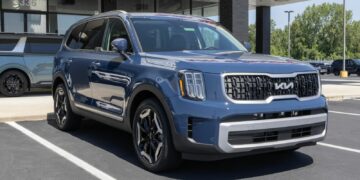





















Toyota is giving its largest Highlander a more adventurous personality for 2027. The new Grand Highlander Hybrid Woodland Edition is coming to Canada with all-terrain tires, a slightly taller ride height, blacked-out exterior details and a surprisingly practical feature between its second-row seats: a removable console that doubles as a cooler.
The changes do not turn the three-row family crossover into a dedicated off-roader. Instead, Toyota has added just enough capability and utility to make gravel roads, campsites, cottage weekends and winter travel a little more approachable. The Canadian Woodland also keeps the regular Grand Highlander hybrid powertrain, standard all-wheel drive and the model’s family-focused interior. Pricing has not yet been announced, but Toyota expects 2027 Grand Highlanders to begin reaching Canadian dealers before the end of 2026.
Woodland Gives the Grand Highlander a More Adventurous Role
Toyota’s Woodland treatment is designed to move the Grand Highlander slightly beyond the conventional family-crossover formula. The Canadian version receives matte-black 18-inch alloy wheels wrapped in all-terrain tires, additional ground clearance, black exterior detailing and roof rails with crossbars. Those changes give the SUV a noticeably tougher appearance without abandoning the three-row layout that made the Grand Highlander attractive to larger families in the first place.
It is important to keep the upgrade in perspective. Toyota has not added the kind of specialized low-range hardware normally associated with serious trail vehicles. Instead, the Woodland is best understood as a more outdoor-oriented Grand Highlander for drivers who occasionally encounter rough cottage roads, gravel parking areas, snowy access roads or campsites. The combination makes sense for a vehicle that can still carry seven people while offering hybrid efficiency, and it gives Toyota another answer to the growing number of mainstream SUVs receiving adventure-themed packages.
The Extra Ground Clearance Is Modest but Useful
The most meaningful mechanical change is underneath the vehicle. Toyota says the Woodland gains an additional 12 millimetres of ground clearance compared with other Grand Highlander models. That works out to roughly half an inch, with the increase coming from the combination of taller springs and the all-terrain tires. It is not an enormous lift, but ground clearance is often a matter of small margins when a vehicle encounters deep snow, uneven gravel or a badly rutted access road.
Toyota has paired the taller setup with 18-inch wheels rather than the larger 20-inch wheels available on upscale Grand Highlanders. The additional tire sidewall that generally accompanies an 18-inch wheel can also suit the Woodland’s mission, particularly on imperfect surfaces. Canadian automotive coverage has appropriately described the model as “mild-rugged” rather than a hardcore off-roader. That distinction matters: the Woodland adds useful capability for everyday adventures without pretending that a large three-row crossover has suddenly become a substitute for Toyota’s more specialized trail vehicles.
The Woodland Is Hybrid-Only in Canada
Canadian buyers will not have to choose between several Woodland powertrains. Toyota is pairing the trim exclusively with its 2.5-litre hybrid system, producing 245 total system horsepower. Electronic On-Demand All-Wheel Drive is standard. That places the Woodland alongside the Hybrid XLE and Hybrid Limited rather than Toyota’s substantially more powerful Hybrid MAX configuration, which remains reserved for the Platinum grade for 2027.
The decision gives the Woodland a clear identity. Rather than chasing maximum acceleration, Toyota is emphasizing efficiency and everyday usability in a vehicle likely to spend much of its time commuting, carrying children or covering long highway distances before reaching the occasional gravel road. Elsewhere in the Canadian lineup, the conventional 2.4-litre turbo gasoline engine produces 265 horsepower, while the Hybrid MAX develops 362 horsepower. The Woodland’s 245-horsepower figure therefore makes it the efficiency-focused adventure option, not the performance leader of the Grand Highlander range.
Fuel Economy Remains a Major Part of the Package
Adding all-terrain tires and a taller stance has not resulted in a dramatic advertised fuel-economy penalty. Toyota estimates combined consumption of 7.0 L/100 km for the 2027 Hybrid XLE, Woodland and Hybrid Limited models. That is a notable figure for a large three-row crossover capable of carrying seven or eight people depending on trim, especially compared with the gasoline Grand Highlander, which Toyota estimates at 10.0 L/100 km for the XLE and 10.7 L/100 km for the Limited.
There is a trade-off for choosing the regular hybrid system instead of the Hybrid MAX. Toyota rates its conventional hybrid Grand Highlanders to tow up to 3,500 pounds, or approximately 1,588 kilograms. Gasoline models and the 362-horsepower Hybrid MAX Platinum can tow as much as 5,000 pounds. For families hauling smaller utility trailers, recreational equipment or lightweight camping gear, the Woodland’s rating may still be sufficient. Buyers planning to pull heavier trailers, however, will find considerably more towing capacity elsewhere in the Grand Highlander range.
The Cooler Is More Practical Than the Headline Suggests
One of the Woodland’s most unusual features is located between its second-row captain’s chairs. Toyota replaces the conventional removable console with a Woodland-branded console that functions as a cooler and can itself be removed from the vehicle. Toyota says there is room inside for as many as six 12-ounce, or roughly 355-millilitre, cans. That is enough for a small collection of drinks on a road trip without sacrificing cargo space for a full-size cooler.
There is an important distinction: Toyota describes it as a removable cooler/console, not an electrically refrigerated compartment. Its appeal is therefore simplicity rather than technology. Drinks and snacks can be packed before leaving home, placed within reach of second-row passengers and then carried out of the vehicle after arriving at a campsite, beach or picnic area. In a family vehicle, that kind of small convenience can prove more useful during everyday ownership than an elaborate feature that is rarely used.
Seven Seats and a Genuine Adult-Sized Third Row Remain
The Woodland is configured for seven occupants, using second-row captain’s chairs rather than an eight-passenger bench. That arrangement provides a natural location for the removable cooler while also leaving a passage between the second-row seats. The Grand Highlander was designed from the beginning to offer more meaningful third-row room than many three-row crossovers, with Toyota listing 851 millimetres of third-row legroom and 945 millimetres of headroom.
Cargo capacity remains another important part of the formula. Toyota says the Grand Highlander can provide as much as 2,761 litres of cargo room with the rear seats folded flat. More significantly for a family actually using every seating row, the company says seven carry-on suitcases can fit behind the occupied third row. That combination helps explain why the Woodland treatment makes sense on this particular Toyota. A camping-oriented trim is considerably more useful when passengers do not have to choose between bringing friends, children or the luggage needed for the trip.
Toyota Added Power and Cargo Details for Outdoor Trips
The Woodland upgrades extend beyond tires and appearance. A 120-volt, 1,500-watt power outlet is fitted behind the centre console, giving occupants access to substantially more electrical power than a typical USB charging port. That could be useful for compatible small appliances, equipment or electronics at a campsite or during a long road trip, although owners will still need to stay within the outlet and vehicle’s specified operating limits.
The cargo area also receives enhanced lighting and a Woodland-branded tray equipped with pop-up dividers. Those dividers are a small detail, but they can prevent groceries, muddy boots or smaller pieces of outdoor equipment from sliding across the luggage compartment. Woodland-branded all-weather floor mats are standard as well. Taken together, the additions show that Toyota has concentrated as much on organization and daily usefulness as on the SUV’s appearance. The result is a package aimed at families who may spend more time loading gear than tackling genuinely difficult terrain.
The Technology Package Stays Familiar and Well Equipped
The new trim does not require buyers to give up the technology expected in a modern family crossover. Every 2027 Grand Highlander receives a standard 12.3-inch central touchscreen running Toyota Multimedia, along with wireless Apple CarPlay and Android Auto. Toyota also specifies seven USB-C ports across the cabin, an important number when a vehicle may be carrying passengers in all three rows with phones, tablets and other devices competing for charging access.
The Woodland uses a seven-inch colour multi-information display between its main gauges rather than the 12.3-inch digital instrument cluster fitted to Limited and Platinum models. It also supports Toyota’s Digital Key capability, which can allow a compatible smartphone to perform key functions when the necessary Remote Connect service is active. Toyota says its 2027 Grand Highlander includes five-year trials for Safety Connect, Service Connect and Remote Connect, while Drive Connect receives a three-month trial. Subscription and network requirements apply to certain connected functions.
Toyota Safety Sense 3.0 Is Standard
The Woodland’s adventure-oriented styling does not change the Grand Highlander’s standard driver-assistance package. Every 2027 model sold in Canada receives Toyota Safety Sense 3.0. The suite includes a Pre-Collision System with Pedestrian Detection, Full-Speed Range Dynamic Radar Cruise Control, Lane Departure Alert with Steering Assist, Lane Tracing Assist, Road Sign Assist, Automatic High Beams and Proactive Driving Assist.
Toyota also lists Blind Spot Monitor with Rear Cross-Traffic Alert and Safe Exit Alert as standard equipment. These technologies are particularly relevant in a large three-row vehicle, where visibility around the body and awareness of approaching traffic can become important during parking or passenger drop-offs. Buyers should still view these systems as assistance rather than replacements for an attentive driver. Some higher-end functions remain grade-specific: for example, Traffic Jam Assist is associated with the Platinum model and requires an active Drive Connect trial or subscription as well as compatible 4G network service.
Canadian Pricing Is the Big Detail Toyota Has Not Revealed
Toyota says the 2027 Grand Highlander will begin arriving at Canadian dealerships later in 2026, but Canadian pricing for the new model year has not yet been released. Independent Canadian coverage places the Woodland between the Hybrid XLE and Hybrid Limited in the range, which fits Toyota’s published grade structure of XLE, Woodland, Limited and Platinum. Until official 2027 prices arrive, however, any specific Woodland price would be speculation.
The outgoing 2026 lineup provides context, but not a forecast. Toyota Canada listed the 2026 Hybrid XLE at a starting MSRP of C$54,935, the Hybrid Limited at C$62,270 and the Hybrid MAX Platinum at C$66,530. The timing also comes as Toyota’s electrified sales are running strongly in Canada: the company reported 15,077 electrified Toyota and Lexus vehicles sold in September 2026, up 49.8% year over year, while year-to-date electrified sales reached a record 130,369 units after only nine months. Against that backdrop, a hybrid-only Grand Highlander Woodland arrives in a part of Toyota’s Canadian business that is already expanding rapidly.