
























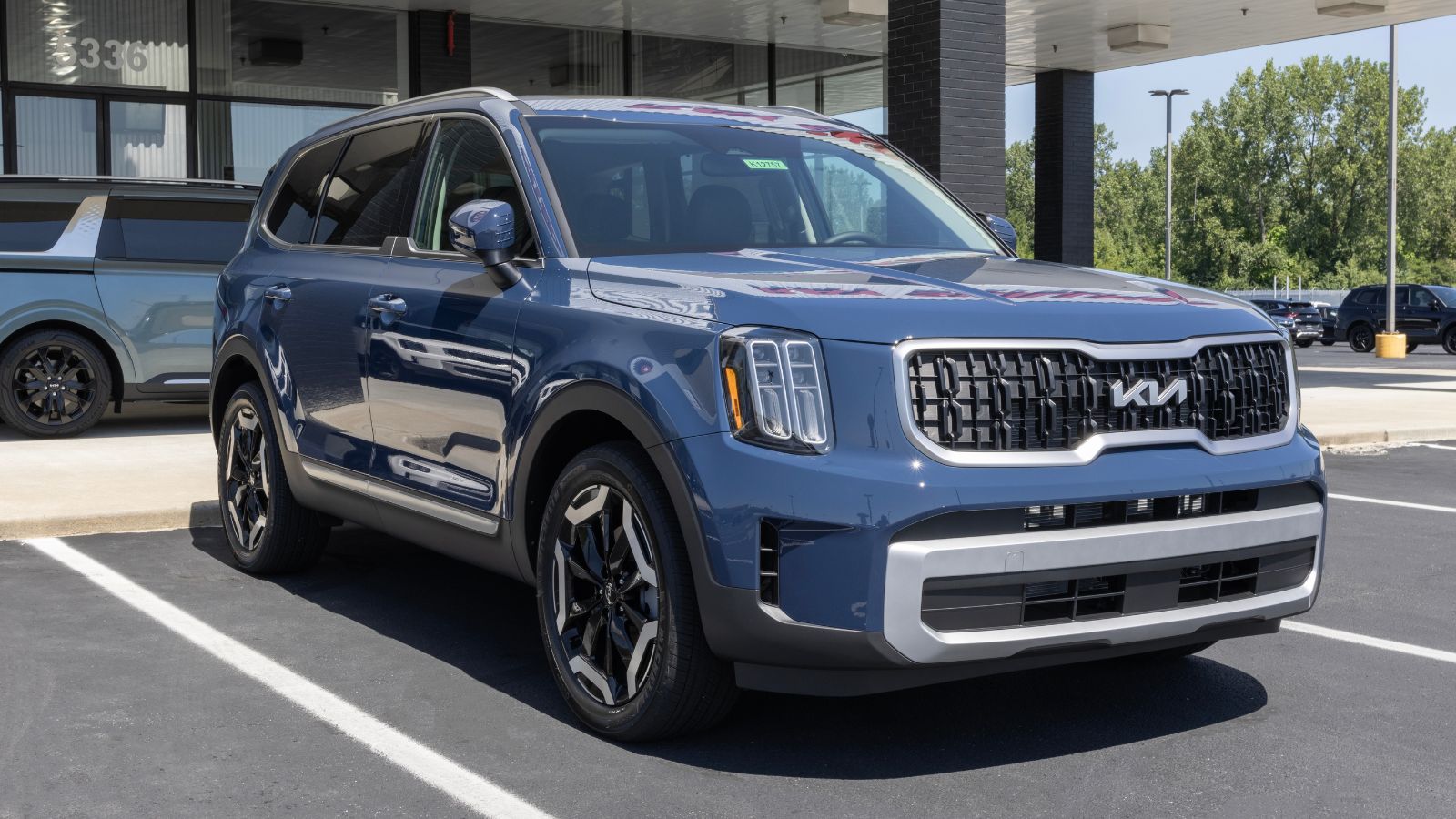
For Canadian families planning their next three-row SUV, the hardest feature to secure on the redesigned Kia Telluride may be an arrival date. Kia Canada now hopes to launch the vehicle later in 2027, after stronger-than-expected American demand disrupted its plans, according to Auto123’s October 3, 2026 reporting.
The uncertainty leaves a practical dilemma: wait for the new model or replace an ageing vehicle with something available sooner. A household facing a lease expiry has a different decision from one merely considering an upgrade. Understanding what the demand figures actually represent—and what the redesigned SUV changes—is essential before turning anticipation into a purchase decision.
The 80,000 Figure Is a Production Target, Not an Order Count
The striking number is not a published count of deposits or signed customer orders. Auto123 reported that U.S. demand exceeded Kia’s initial 80,000-unit production target, prompting a revised annual target of 180,000. The account attributes those figures to Elias El-Achhab, Kia Canada’s chief operating officer and vice-president. That represents a substantial planning revision, but the report does not identify those numbers as customer deposits or an audited order backlog.
The arithmetic shows how large the change is: the new target is 100,000 vehicles higher, or 2.25 times the original figure. A target, however, describes intended output rather than completed deliveries. It does not establish how quickly the factory will reach that pace or how many vehicles Canada will receive. For someone considering a deposit, those distinctions matter. A manufacturer can be confident about a model’s commercial appeal while still being unable to promise a particular dealership a particular vehicle in a particular month.
Canada’s Wait Is Longer Than the Model-Year Badge Suggests
The redesigned Telluride was introduced in November 2025 and has already been sold in the United States for months, as The Car Guide noted in its Canadian launch update. There was no 2026 Telluride model. That unusual sequence helps explain the disconnect: a vehicle carrying a 2027 badge can be familiar to American shoppers while Canadian families are still waiting for their first opportunity to buy it.
The Car Guide’s September 30, 2026 update also relayed Kia’s explanation that sustained U.S. demand was forcing priority for that market. These are separate national launches, not a single North American rollout with identical timing. A Canadian buyer should therefore distinguish an announcement, the opening of orders, the arrival of dealer demonstrators and delivery of a chosen configuration. None is interchangeable with the others. For a household with a fixed lease-end date, even a broad launch window leaves an important planning gap: whether the exact replacement will arrive before the current vehicle must go back.
One Georgia Factory Sits at the Centre of the Problem
Kia’s West Point plant in Georgia is the only factory worldwide that builds the Telluride, according to the company’s February 24, 2026 production announcement. That event also marked the plant’s five-millionth vehicle and Kia’s first U.S.-assembled hybrid. The same release listed annual capacity of 350,000 vehicles across a portfolio including the Telluride, Sorento, Sportage, EV6 and EV9—not 350,000 Tellurides alone.
That distinction puts the supply challenge in perspective. An established, high-volume factory is not necessarily a factory with unlimited room for one increasingly popular model. Nor does its total capacity reveal how much production is reserved for Canadian customers. The public figures support a straightforward conclusion: Telluride supply depends on a shared manufacturing operation, rather than an alternative plant ready to serve Canada independently. They do not, by themselves, prove a labour shortage, a missing component or a quality-control problem. For Canadian shoppers, the milestone worth watching is therefore not another factory celebration but confirmation of vehicles allocated to their market.
Tariffs Matter, but Kia Says They Are Not the Main Cause
El-Achhab told Auto123 that Canadian countertariffs remained a concern but would not themselves prevent the Telluride’s Canadian launch. That separates two questions: whether enough vehicles are available and what importing them will cost. Treating those questions as interchangeable can lead to the wrong conclusion about why customers are waiting.
The Canada Border Services Agency’s motor-vehicle notice describes a 25% surtax on covered U.S.-origin vehicles, with the taxable base depending on tariff treatment and eligible Canadian or Mexican content. That is not the same as an automatic 25% increase in a showroom sticker price. Import duties, manufacturer pricing decisions and the final customer transaction are different calculations. It would therefore be premature to attach a specific tariff-driven price increase to the future Canadian Telluride. Families need an actual Canadian price list and itemized dealer quote, rather than a U.S. price converted into Canadian dollars and multiplied by a headline tariff rate. Until those figures exist, affordability remains a separate question from availability.
The Familiar V6 Gives Way to a Turbocharged Four-Cylinder
The new Telluride changes more than styling. Kia’s U.S. specifications list a 2.5-litre turbocharged four-cylinder making 274 horsepower and 311 lb-ft of torque, paired with an eight-speed automatic. The previous V6 produced 291 horsepower and 262 lb-ft. In other words, the gasoline model loses 17 horsepower on paper but gains 49 lb-ft of torque. It is a different approach to power delivery, not simply the old engine in a new body.
For a family moving from the original Telluride, this makes a test drive particularly important. Peak horsepower alone cannot explain how confidently an SUV merges with passengers aboard, how smoothly the transmission responds or how intrusive the engine sounds under load. Those impressions require driving the actual vehicle. The new figures also should not be stretched into claims about superior long-term reliability or guaranteed fuel savings. They establish the redesigned engine’s output; they do not settle every ownership question associated with an entirely revised family vehicle.
The First Hybrid Gives Families a New Reason to Wait
The most consequential addition may be the Telluride’s first hybrid powertrain. Kia pairs a turbocharged 2.5-litre engine with electric motors and a 1.65-kWh lithium-ion battery, producing a combined 329 horsepower and 339 lb-ft of torque. A six-speed automatic handles the power. Compared with the new gasoline-only version, that means 55 additional horsepower and 28 lb-ft more torque, making the hybrid the higher-output choice as well as the efficiency-focused alternative.
It is a conventional hybrid rather than a plug-in hybrid, so ownership does not depend on installing a home charger. That could make it attractive to a family seeking lower fuel consumption without reorganizing parking or charging arrangements. The financial case, however, still needs Canadian numbers. Any purchase-price premium, annual distance travelled and the difference in fuel consumption all affect whether a hybrid premium is worthwhile. The useful question is not simply whether the hybrid is desirable. It is whether its particular combination of power, running costs and eventual availability fits the household better than the alternatives.
The Fuel-Economy Headline Does Not Apply to Every Version
The hybrid’s strongest fuel-economy figure needs a trim designation attached. Kia lists an EPA-estimated 35 mpg combined for the EX with front-wheel drive, compared with 31 mpg combined for the all-wheel-drive hybrids. Those figures translate mathematically to approximately 6.7 and 7.6 litres per 100 kilometres, respectively. They are conversions of U.S. ratings, not Canadian certification results, and should not be presented as a promise about consumption on a particular commute.
For an all-wheel-drive shopper, the distinction matters more than a headline advertising the most efficient configuration. The version actually purchased must be the version used in a household’s fuel budget. Even a modest consumption difference can add up: over 20,000 kilometres, a saving of one litre per 100 kilometres would mean buying 200 fewer litres of fuel. That is an illustrative calculation, not a forecast for the Telluride. It shows why Canadian specifications, annual driving distance and the eventual price difference deserve more attention than one impressive marketing number.
Extra Space Matters Most With Every Seat in Use
Kia increased the Telluride’s length by 2.3 inches and its wheelbase by 2.7 inches. Its current U.S. gasoline-model specifications list seating for seven or eight and 22.3 cubic feet of cargo room behind the third row. The hybrid is advertised with seating for up to seven. Those differences make the seating layout part of the powertrain decision, rather than a detail to settle after choosing an engine.
For a family carrying children, grandparents and weekend luggage, the useful measurement is often the space left when everyone is aboard—not the maximum cargo figure with seats folded flat. A stroller, a grocery run and a set of sports bags are a more revealing test than an empty showroom cabin. The larger dimensions offer a reason to investigate, but the decisive comparison should involve the family’s actual equipment. An extra passenger position may matter more to one household than the hybrid system; another may value easier movement between second-row captain’s chairs.
More Hybrid Power Does Not Mean More Towing
Despite its higher horsepower and torque, the Telluride Hybrid has a lower maximum towing rating than the gasoline model. Kia lists up to 4,500 pounds for the properly equipped hybrid, against 5,000 pounds for the gasoline version. That 500-pound difference could influence the decision for a household that already owns a trailer. Choosing the stronger engine on paper does not automatically produce the more suitable tow vehicle.
There is another distinction for buyers drawn to the rugged-looking models. Kia’s U.S. X-Pro specification includes 9.1 inches of ground clearance and 18-inch wheels with all-terrain tires. These are specific equipment choices, not features automatically included with every Telluride. A family comparing vehicles for camping trips should work backward from the trailer and the roads it expects to use, then examine the exact configuration. Towing limits should be checked against the owner’s manual and the vehicle’s other load limits. A brochure’s maximum figure is not permission to ignore passengers, luggage or the weight added to a trailer before departure.
The Safety Award Has an Important Build-Date Condition
The redesigned Telluride has earned an Insurance Institute for Highway Safety Top Safety Pick+ award, but the listing applies only to vehicles built after June 2026. IIHS records Good results in its small-overlap, updated moderate-overlap and updated side crashworthiness evaluations. Its headlight ratings also distinguish between production periods: Good for the later vehicles and Marginal for those built before July. The award is therefore more specific than a blanket endorsement of every vehicle carrying the Telluride name.
That detail matters when families compare reviews, advertisements and individual vehicles. The model year, build date and equipment should match the assessment being quoted. IIHS also gives the redesigned model a Good+ rating for the ease of using its child-seat anchors, a particularly relevant consideration for parents installing restraints regularly. These findings provide useful evidence about crash protection and practical safety features. They should sit alongside an inspection of the eventual Canadian vehicle and its seating arrangements, rather than replace the checks that make a family vehicle suitable for its passengers.
The Decision Still Comes Down to a Canadian Price and Delivery Date
Kia’s current U.S. starting prices are US$39,190 for the gasoline Telluride LX and US$46,490 for the Telluride Hybrid EX, before destination charges, taxes and other applicable fees. Those are different trim levels, so their price gap is not a like-for-like measure of the hybrid premium. Nor does converting either amount into Canadian dollars produce a dependable Canadian purchase price. Local equipment, pricing and the final transaction must be considered on their own terms.
Waiting could make sense for a household whose current vehicle remains dependable and whose preferred replacement is the new hybrid. It becomes harder to justify when a lease deadline or an increasingly troublesome vehicle makes certainty more valuable than a particular badge. Before committing money, buyers should seek written details about the proposed configuration, deposit conditions and the basis for any delivery estimate. The redesigned Telluride has compelling changes, but Canadians cannot drive a production target. The next meaningful milestone is a confirmed local offering with a credible path from the factory to the driveway.