





















A white RX-7, a yellow RX-7 and a mountain road are enough to make the connection. Mazda is bringing the Takahashi brothers’ cars from Initial D into its official merchandise range, announcing its first collaboration of that kind with Shuichi Shigeno’s manga on October 2, 2026. The release pairs Ryosuke’s FC3S with Keisuke’s FD3S as 1:64-scale models—not new road cars.
The small-scale reunion has a bigger historical purpose. It arrives ahead of the Cosmo Sport’s 60th anniversary in May 2027, connecting two of the story’s distinctive cars with Mazda’s rotary heritage. Its appeal lies in that overlap: the RX-7s as engineering achievements and as memorable parts of a street-racing drama.
Ryosuke Takahashi’s White FC3S RX-7
Ryosuke Takahashi’s white FC3S Savanna RX-7 gives the pairing its calculating side. Known as the “White Comet,” Ryosuke studies Takumi Fujiwara’s driving before preparing his Mazda for a showdown with Takumi’s Trueno Eight-Six. Their contest is not simply about who has more power. It pits an analytical driver with a carefully developed plan against an instinctive young rival whose ability grew through regular tofu deliveries. That tension gives the white RX-7 a role beyond being another fast car on the page.
Ryosuke later becomes the architect of Project D, the team that takes Takumi’s racing beyond his familiar roads. His position as its founder and commander reinforces his importance as the operation’s strategist. Seen in that context, the FC model is as much a character portrait as a vehicle replica. Its emotional appeal comes from remembering the watchful assessment and the moment when a theory must prove itself on the road. The white paint identifies the car; Ryosuke’s approach to driving gives it a personality.
The FC’s Real-World Story Began in 1985
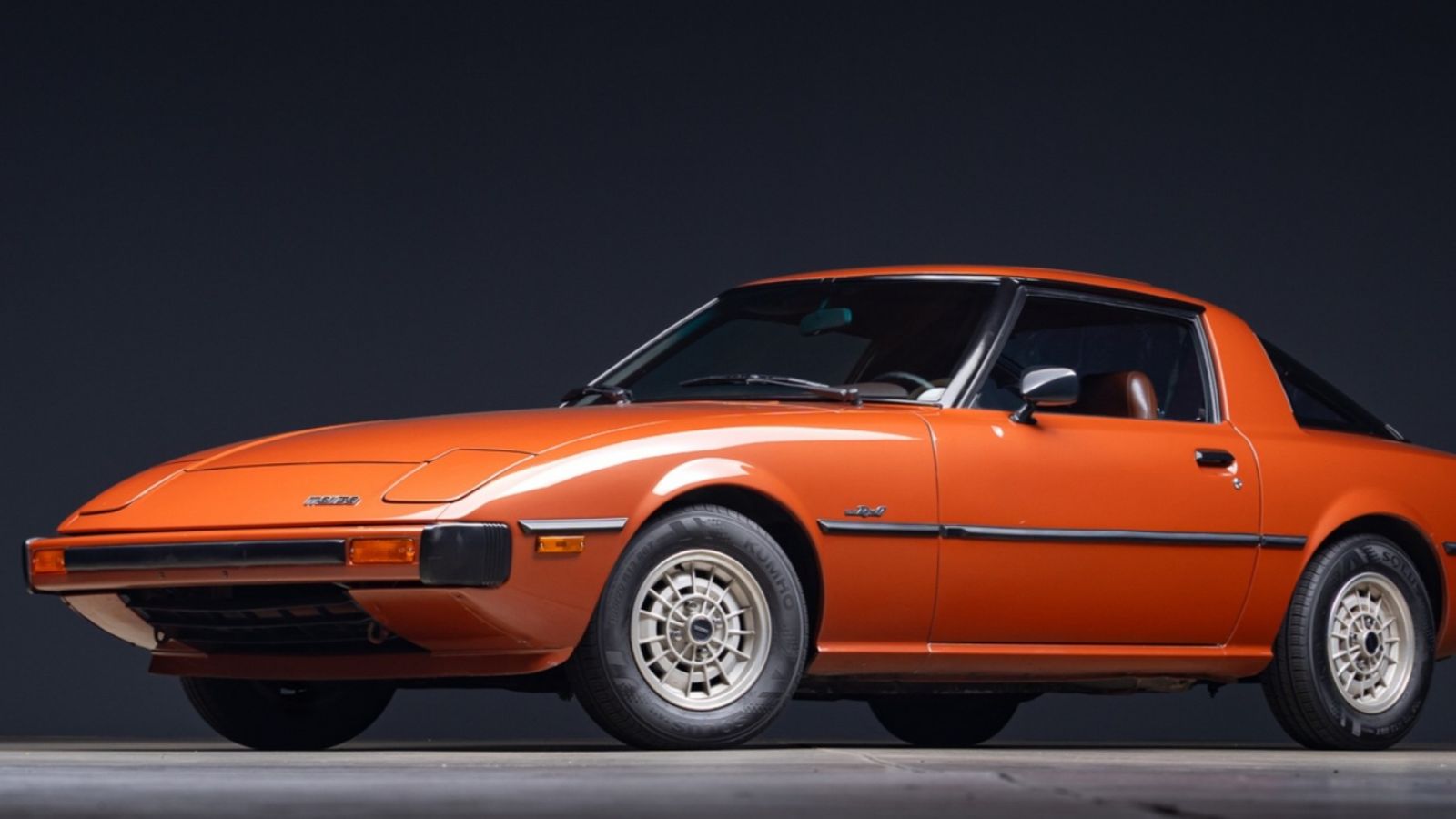
The second-generation Savanna RX-7 arrived in October 1985, years before this collaboration. Mazda’s historical archive describes its development goal as balancing sports-car dynamics with comfort, rather than treating everyday usability as an afterthought. At 4,310 millimetres long and 1,690 millimetres wide, the FC was compact. Its 13B rotary engine used a front-midship layout, positioning it well back in the front of the car. Those details place Ryosuke’s Mazda within a real engineering programme, independent of its fictional mountain-pass battles.
Another milestone came that December, when cumulative RX-7 production reached 500,000 vehicles. That total covered the nameplate as a whole, not half a million examples of the newly introduced FC. The second generation was building on an established sports-car line, not starting from scratch. Mazda subsequently added a two-seat RX-7 convertible in August 1987, illustrating the broader ambitions of that generation. The white coupe in the model set represents one recognizable part of that history, with its manga identity layered over an already substantial real-world background.
The Anniversary Starts With the Cosmo
The 60-year milestone belongs to Mazda’s production rotary heritage. The Cosmo Sport launched in May 1967 as the company’s first rotary-powered vehicle; the RX-7 nameplate arrived in March 1978. Mazda’s chronology also records technical cooperation with NSU/Wankel in July 1961, well before the Cosmo went on sale. The coming celebration therefore marks Mazda’s production-car breakthrough, rather than the RX-7’s 60th birthday or the rotary engine’s original invention. The distinction places both collectible cars within a much longer story.
The first RX-7 carried that lineage into a different sports-car package, using a two-rotor 12A engine and a front-midship layout. Its distinctive pop-up headlights gave it another recognizable feature. By selecting the later FC and FD for this tribute, Mazda approaches that history through cars associated with a story rather than through the original Cosmo alone. A fan who recognizes the Takahashi brothers can start with their RX-7s and trace the connection backwards—a more personal introduction to the anniversary than a date printed on a commemorative badge.
The Employee Behind Ryosuke’s Words
A Mazda employee who discovered an interest in cars through Initial D later joined the company and helped select the dialogue for this release. The same person helped plan the manga’s original-art and vehicle display at Mazda Fan Festa 2026. Mazda does not name the employee, but the connection gives the project a human starting point: a fictional story helped shape a real career, eventually bringing that enthusiasm into an official collaboration.
The chosen passage comes from volume five of the original manga. In paraphrase, Ryosuke admires the rotary engine’s independent spirit precisely because it belongs to a minority tradition. It is an apt choice for a company celebrating an unconventional engine, and more personal than a generic performance slogan. Shigeno’s signature also appears on the packaging, although Mazda does not describe the boxes as individually hand-autographed. Together, the author’s mark and Ryosuke’s words make the packaging part of the tribute rather than merely a container for two miniatures.
Keisuke Takahashi’s Yellow FD3S RX-7
Keisuke Takahashi’s yellow FD3S Efini RX-7 brings the pairing’s more combative personality. An early encounter helps establish the story’s central surprise: Takumi, a tofu delivery driver with little awareness of his own ability, overtakes Keisuke’s car. That meeting draws attention to Takumi and brings him into the local racing scene. Keisuke’s Mazda is therefore much more than background scenery. It helps demonstrate how an apparently ordinary delivery routine has produced an unexpectedly capable driver.
Keisuke’s story does not end with being an early opponent. He becomes Project D’s hillclimb specialist, while Takumi takes the downhill role. His competitive spirit and sharp instincts develop into the abilities of a formidable driver, giving the yellow FD an association with improvement as well as rivalry. That progression matters to the model’s appeal: it represents a character learning to become better, not simply an impressive car. Alongside Ryosuke’s FC, it captures two approaches to competition—careful assessment on one side and a fierce competitive urge that matures into discipline on the other.
A Different RX-7 for the 1990s
Mazda introduced the third-generation FD RX-7 in December 1991. Its Japanese-launch specification combined a two-rotor 13B engine with sequential twin-turbocharging and an output of 255 PS, or metric horsepower. The chassis received just as much attention. Mazda records a 50:50 front-to-rear weight distribution, a front-midship engine layout and aluminium double-wishbone suspension at all four wheels. Those specifications explain why the FD belongs in a discussion of purposeful sports-car engineering as well as pop-culture memories.
The 255 PS figure describes the production car at launch, not a definitive output for Keisuke’s modified fictional RX-7. Mazda also lists a weight-to-power ratio of 4.9 kilograms per PS, illustrating the importance of controlling mass alongside increasing output. The FD earned the inaugural RJC New Car of the Year award in Japan, with its styling and handling highlighted in Mazda’s historical account. Beside the FC miniature, it makes the generational change visible: one nameplate, two periods of development and a common rotary identity, rather than matching cars separated only by colour.
A Mountain-Road Scene in Miniature
The pair is reproduced in 1:64 scale using die-cast material, but the presentation is not simply two cars parked on a plain base. Their staggered positions and different angles suggest movement against a mountain-road backdrop at dawn. The grey Mazda × Initial D packaging frames the scene. Product photographs show RedSuns lettering on both cars and raised pop-up headlights on the FC, details that help connect the miniatures to their fictional identities without needing the drivers standing beside them.
The box measures 17 centimetres wide, 7.5 centimetres deep and 6.2 centimetres high, making this a modest shelf display rather than a space-hungry showpiece. Visually, the contrast does much of the work: the white FC beside the yellow FD, with their different body shapes immediately apparent. The scene cannot reproduce an engine note or the pace of a race. Instead, it works like a small frozen moment, inviting attention to the relationship between the cars as well as to the individual models.
The ¥11,000 Set Starts With Japan
Mazda announced a tax-inclusive price of ¥11,000 for the two-car set. Sales were scheduled to begin at 9 a.m. Japan time on October 3, 2026, through Mazda’s online shop and at Fuji Speedway’s Fan Festa, with Japanese dealership orders available from October 8. The announcement does not give a Canadian or U.S. release date, nor does it specify a numbered production limit. The price covers both cars, rather than requiring separate purchases to complete the pairing.
“First” also needs the correct scope. Mazda identifies this as its first Initial D collaboration within its own official merchandise range, not the first time a model manufacturer has recreated these RX-7s. Aoshima, for example, lists an April 2021 release for its 1:24-scale Ryosuke FC3S Hakone-battle kit. These cars already have a history in model form. What distinguishes Mazda’s release is the automaker presenting the brothers together as a tribute to its rotary heritage, giving the collaboration a specific purpose beyond adding another replica to the market.
Where Manga Meets Mazda’s Racing History
The launch coincides with Mazda Fan Festa 2026 at Fuji Speedway on October 3 and 4. The event programme includes approximately 20 original Initial D artworks and an RX-7 recreation display, extending the connection beyond a retail box. Original drawings let visitors examine the artwork that gives a car movement on the page, while a full-size recreation brings that drawn world back into three dimensions. It is a fitting setting for models whose appeal depends on recognizing both the real cars and their fictional lives.
There is another anniversary at Fuji: 35 years since the Mazda 787B’s overall victory at the 1991 Le Mans 24 Hours. The programme also advertises historic racing-car demonstration runs, linking the weekend to actual circuit achievements as well as imagined mountain passes. The FC and FD collectibles connect those worlds. Their attraction is not a promise that the RX-7 is returning to production, but something more personal: two familiar cars that connect engineering history with the stories that made people care about it.