























The Ford Mustang Mach-E arrives with a difficult assignment in Canada. It has to look like something more exciting than a sensible EV crossover, yet still cope with salt, slush, deep cold, and the stop-and-go routine that defines winter driving in much of the country. That tension is what makes it interesting. It is stylish and quick, but also judged by a harsher standard than many vehicles ever face.
This review breaks the experience into 12 areas that matter most in a Canadian winter, from cold-weather range and charging to cabin comfort, traction, tech, practicality, and overall value. The result is a balanced picture: the Mach-E gets a lot right, but it also reveals a few weaknesses once temperatures drop well below freezing.
1. It Still Looks Special in a Sea of Generic EVs
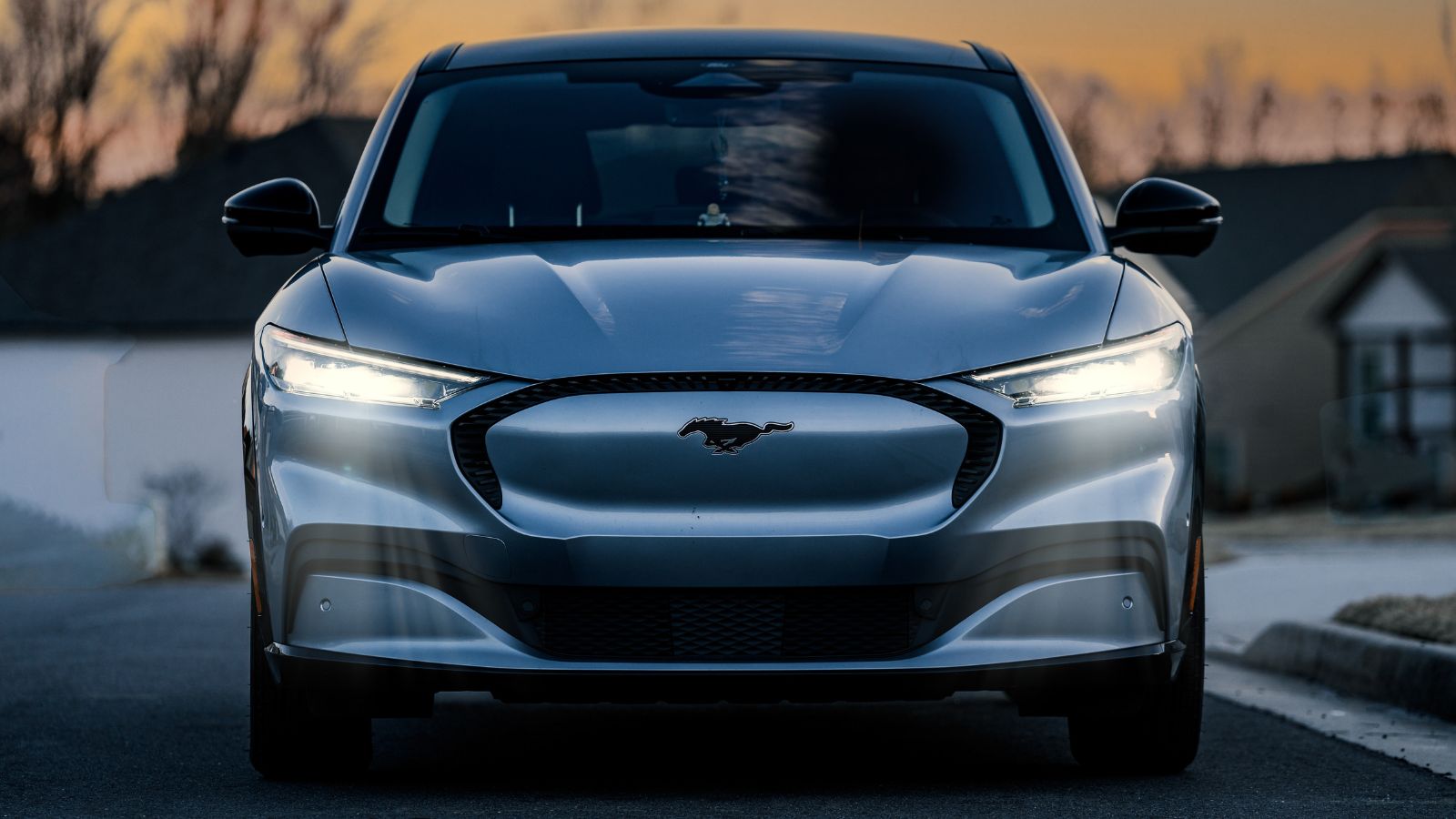
The first thing the Mach-E gets right is presence. Even parked under road grime and winter salt spray, it does not disappear into crossover anonymity. The long wheelbase, short overhangs, and familiar tri-bar lighting give it a shape that feels more deliberate than many battery-powered rivals. Ford’s Canadian specs also show it is not a tiny runabout pretending to be practical. The wheelbase stretches to 2,984 mm, and the cabin seats five, so it carries family-car proportions without looking bulky. That matters in a segment where many vehicles are competent but forgettable.
In winter, the styling also serves a psychological purpose. A vehicle that looks engaging tends to feel more rewarding on dark mornings and grey commutes, and the Mach-E benefits from that effect. It has the kind of design that still earns a second glance in a grocery store parking lot. That may sound superficial, but it matters in ownership. People forgive small compromises more easily when a car feels desirable. The Mach-E does, and that helps it feel like a purchase made with enthusiasm rather than obligation.
2. Winter Grip Depends More on Tires Than the Badge
The Mach-E’s standard electric all-wheel drive available on much of the lineup gives it an obvious advantage when roads turn slick, but the real winter story starts lower down, where the tires meet the pavement. Ford’s own 2025 Canadian listing shows all-season tires on at least some trims, and that is the kind of detail that matters more in January than horsepower figures do. Transport Canada notes that all-season tires begin to lose elasticity below 7°C, while proper winter tires maintain grip at much lower temperatures. In other words, a dual-motor EV on mediocre rubber can still feel less secure than a slower vehicle on the right tires.
That reality shapes the Mach-E’s winter character. With a proper winter setup, it should feel planted, progressive, and easier to trust when accelerating away from snowy intersections. The official drive-mode programming helps too. Ford says Whisper mode is best for slippery conditions, and all models include one-pedal driving for stronger regenerative deceleration. Still, winter drivers should not confuse software with physics. On a Canadian commute full of black ice, packed snow, and rutted slush, the smartest money is spent on four winter tires before spending extra on cosmetic options. The Mach-E can be a confident winter vehicle, but only when it is equipped like one.
3. Cold-Weather Comfort Is One of Its Best Tricks
A Canadian winter EV needs to prove itself within the first five minutes of a drive, not after an hour on the highway. That means seat heat, steering-wheel heat, windshield clearing, and cabin warm-up all matter immediately. The Mach-E performs well on that front. Ford offers heated front seats and a heated steering wheel broadly across the lineup through its Comfort Package, while the Premium adds ventilated front seats as well. On paper that may sound ordinary, but in an EV it becomes more important because targeted heat lets the driver stay comfortable without leaning as heavily on energy-hungry cabin heating.
Ford’s addition of a vapor-injection heat pump is one of the more meaningful cold-weather upgrades tied to the newer Mach-E. Ford has said the heat pump can reduce the energy draw required for cabin heating, which is especially valuable in colder climates. Broader EV research supports that logic, with Recurrent citing a roughly 10% winter range benefit from heat-pump technology at 32°F. In practice, that means the Mach-E feels better adapted to real Canadian weather than earlier EVs that treated winter as an afterthought. The cabin experience is not just tolerable. It is genuinely easy to live with, which is exactly what a family-focused EV needs.
4. Winter Range Is Good, but It Is Not Immune to Reality
This is the part of EV ownership where marketing language meets January. Ford’s Canadian numbers for the 2026 Mach-E show a wide spread, from 380 km for a standard-range eAWD model to as much as 515 km for an extended-range rear-wheel-drive version. Those are useful figures, but they are not winter guarantees. In Canada’s first major real-world winter EV test, CAA drove 14 EVs in temperatures ranging from -7°C to -15°C. The Ford Mustang Mach-E in that test managed 334 km against an official 483 km rating, a 31% drop. That is not a failure. It is simply the kind of honesty buyers need.
The bigger takeaway is that the Mach-E lands in the believable middle of the winter EV conversation. CAA found all tested EVs lost between 14% and 39% of their official range in the cold, so the Mach-E was neither a hero nor a disaster. That makes it workable for commuters and suburban families, especially when most daily travel remains far below 100 km. But it also means buyers should not shop the Mach-E as though winter changes nothing. Cabin heat, highway speed, snow-covered roads, and battery temperature all take their share. In a Canadian winter, the Mach-E feels competent rather than miraculous, and that is the honest answer.
5. Home Charging Is What Makes the Mach-E Make Sense
The strongest argument for the Mach-E in Canada is not actually performance. It is routine. Ford says a standard-range Mach-E can recharge from 0 to 100% in about 7.7 to 7.8 hours on a 48-amp Level 2 setup, while certain extended-range all-wheel-drive versions need about 9.9 hours. That means an overnight top-up is realistic for most owners. Once that rhythm is in place, winter ownership gets much easier. Preconditioning the cabin while plugged in, leaving each morning with a warm interior, and starting the day near a full charge are the kinds of advantages that matter more than spec-sheet bragging rights.
Canadian EV data backs that up. CAA says more than 80% of charging is done at home, and 66% of battery-electric owners primarily use Level 2 charging at home. That is why the Mach-E feels most convincing as a driveway EV rather than an apartment-lot experiment. For households with a garage or dedicated parking, the vehicle fits naturally into daily life. For renters or condo owners without reliable access to charging, the story gets less comfortable. The vehicle itself is not the whole ownership equation. The home setup is part of the product, whether automakers want to admit it or not, and the Mach-E benefits enormously when that setup is already in place.
6. Public Fast Charging Is Usable, but Winter Exposes Its Limits
On paper, the Mach-E is well connected for public charging. Ford’s BlueOval Charge Network gives access to thousands of stations, and Ford says its drivers can now use Tesla Superchargers across Canada and the U.S. through the company’s charging ecosystem. That is a meaningful advantage because access matters almost as much as charging speed. Ford’s 2024 announcement said the BlueOval network had grown to more than 126,000 chargers, including more than 28,000 fast chargers, after Tesla access was added. For Canadian road-trippers, that extra redundancy lowers stress in a way brochure range figures never can.
The tougher question is how the Mach-E performs once plugged in during real winter conditions. In CAA’s cold-weather charging test, the Mustang Mach-E added 71 km of displayed range in 15 minutes, averaged 85 kW, and took 46 minutes to go from 10% to 80%. That is perfectly usable, but it is not class-leading. It means winter road trips are possible, though they still require some patience and planning. This is where expectations matter. The Mach-E is easy enough to live with if it is mostly charged at home and asked to do occasional intercity travel. If it must function like a high-mileage winter highway machine every week, its charging performance feels adequate rather than exceptional.
7. The Tech Experience Is Modern, Mostly in a Good Way
Ford has avoided the trap of making the Mach-E’s cabin feel futuristic but irritating. The core setup is easy to understand: a 10.2-inch driver display, a 15.5-inch centre screen, wireless Apple CarPlay and Android Auto, and phone-as-a-key functionality across the experience. Ford also includes connected navigation with intelligent range planning, charge-station routing, and en-route battery preconditioning. Those details matter more in winter because EV owners are not just navigating roads. They are managing battery temperature, charger availability, and the difference between theoretical and real-world range.
The honest review angle is that the Mach-E’s tech is strong, but not effortless every second of the day. Large touchscreens always ask drivers to trade some simplicity for visual drama, and that trade becomes more noticeable when hands are cold or gloves are on. Still, Ford’s interface is easier to live with than some rivals because the most important functions do not feel buried behind five layers of design theater. Broader testing from Edmunds also gives the Mach-E credit for strong navigation and smartphone integration. For most owners, the system should feel current rather than gimmicky, and that is the right outcome for a vehicle meant to bridge enthusiast appeal and family practicality.
8. It Is Quick Enough to Feel Like It Earned the Mustang Name
There will always be people who object to the word “Mustang” appearing on a five-door EV, but the Mach-E at least has the acceleration to defend itself. Ford’s Canadian figures show the lineup spans from 264 horsepower in standard-range rear-wheel-drive form to 480 horsepower in the GT, with torque climbing as high as 700 lb-ft in GT models equipped with the Performance Upgrade. Ford also claims a 0-100 km/h time of 3.5 seconds at the sharp end of the range. Those are serious numbers, especially in winter traffic where effortless merging and clean passing matter as much as theatrics do.
What is more important is that even the less extreme versions feel immediately responsive, which suits Canadian driving well. EV torque helps the Mach-E feel alert when darting through short highway openings or climbing slushy on-ramps. Edmunds found the rear-drive version quick at 6.5 seconds to 60 mph and the all-wheel-drive version stronger at 5.2 seconds, though it also noted some body lean and a firmer ride over broken pavement. That reads as fair. The Mach-E is not pretending to be a track toy in everyday trims, but it has enough punch and character to avoid feeling appliance-like. In a world full of heavy, numb EV crossovers, that still counts for a lot.
9. It Is More Practical Than the Roofline Suggests
Sleek EV crossovers often ask owners to sacrifice usefulness for style. The Mach-E does not escape that trade entirely, but it handles it better than expected. Ford lists 840 litres of cargo space behind the second row and as much as 1,674 to 1,690 litres with the rear seats folded, depending on how the figure is presented across model pages. It also offers a drainable front trunk of about 73 litres. That frunk is more than a novelty in winter. It is a smart place for wet boots, charging cables, or grimy gear that drivers would rather not throw into the main cabin.
The cabin itself also feels more family-ready than the coupe-like profile suggests. Ford rates the vehicle for five passengers, and outside testing has found the rear seat reasonably accommodating for adults. That matters because many Canadian EV buyers are not replacing sports sedans. They are replacing compact or midsize utility vehicles. The Mach-E understands that assignment better than its name might suggest. It can carry groceries, hockey bags, backpacks, and the random clutter of daily family life without constantly reminding everyone that style came first. In that sense, it succeeds as a winter household vehicle, not just as an aspirational EV with a familiar badge.
10. Safety and Driver Aids Add Real Everyday Confidence
Canadian winter driving rewards visibility, predictability, and low-speed awareness more than dramatic handling ever will. The Mach-E scores well here. IIHS has given the 2025 Mustang Mach-E a Top Safety Pick+ award, and the 2025-26 model remains on the organization’s Top Safety Pick+ list. That matters because a lot of EV shoppers are moving into this segment with family use in mind. Ford’s own safety suite also looks strong on paper, with available BlueCruise, Co-Pilot360 Active 2.0, a 360-degree camera, front parking sensors, reverse brake assist, blind-spot monitoring with cross-traffic alert, and pre-collision assist with automatic emergency braking.
The useful part is how these features map onto ordinary winter problems. A 360-degree camera that works under 9 km/h is handy when backing around snowbanks. Blind-spot alerts help when side windows are dirty and roads are lined with spray. Automatic emergency braking and cross-traffic monitoring add a margin of confidence in parking lots full of slush piles and poor sightlines. None of that changes the need for careful driving, especially because bad weather can challenge sensor-based systems. But it does make the Mach-E feel like a thoughtfully equipped winter commuter. The vehicle’s safety story is not only about crash scores. It is also about reducing everyday friction when conditions are messy and visibility is mediocre.
11. The Ownership Trade-Offs Are Real, Not Deal-Breaking
The Mach-E’s starting price in Canada begins at $45,690, which puts it into serious-purchase territory even before options and taxes enter the picture. That means the vehicle has to justify itself beyond style and acceleration. Ford helps its case with an eight-year or 160,000-kilometre high-voltage battery warranty, which should ease the biggest long-term fear many buyers still carry into EV ownership. But that reassurance does not erase every practical concern. CAA says 67% of EV drivers have experienced lower battery range in extreme cold, and only 31% were completely satisfied with the availability of public DC fast charging locations.
There are smaller ownership realities too. CAA’s EV owner research notes that a third of EV drivers feel their gas vehicle needs cheaper and less frequent tire replacements. That aligns with what many buyers already suspect: EVs can be inexpensive in some ways and quietly costly in others. The Mach-E fits that pattern. It has the potential to feel impressively easy and economical when driven mostly on home charging with predictable routines. It feels less convincing when public fast charging, winter highway travel, and replacement-tire costs become central parts of the ownership story. The vehicle is not a flawless value play. It is a strong package with a few conditions attached.
12. The Honest Verdict: A Strong Canadian EV, but Not a Perfect One
The Ford Mustang Mach-E works in a Canadian winter because it gets the fundamentals mostly right. It looks distinctive, offers real straight-line punch, stays comfortable in the cold, provides useful cargo flexibility, and makes daily life feel surprisingly normal when home charging is available. Ford’s winter-friendly features, including preconditioning tools, intelligent route planning, heated touchpoints, and newer heat-pump hardware, all point in the right direction. It is also backed by solid safety credentials and a battery warranty that should matter to cautious buyers. Put simply, this is not an EV that falls apart once temperatures drop.
At the same time, the honest review cannot ignore what winter exposes. Real-world cold-weather range drops are significant, public fast charging still feels less seamless than refueling, and the Mach-E’s winter charging performance is more acceptable than outstanding. The ride can also feel firmer than some rivals on broken urban pavement. That leaves the final impression clear. The Mach-E is one of the better EVs for Canadian buyers who can charge at home and want something that feels more alive than a typical electric crossover. It is easy to recommend with the right setup. It is harder to recommend as a leap of faith.