

























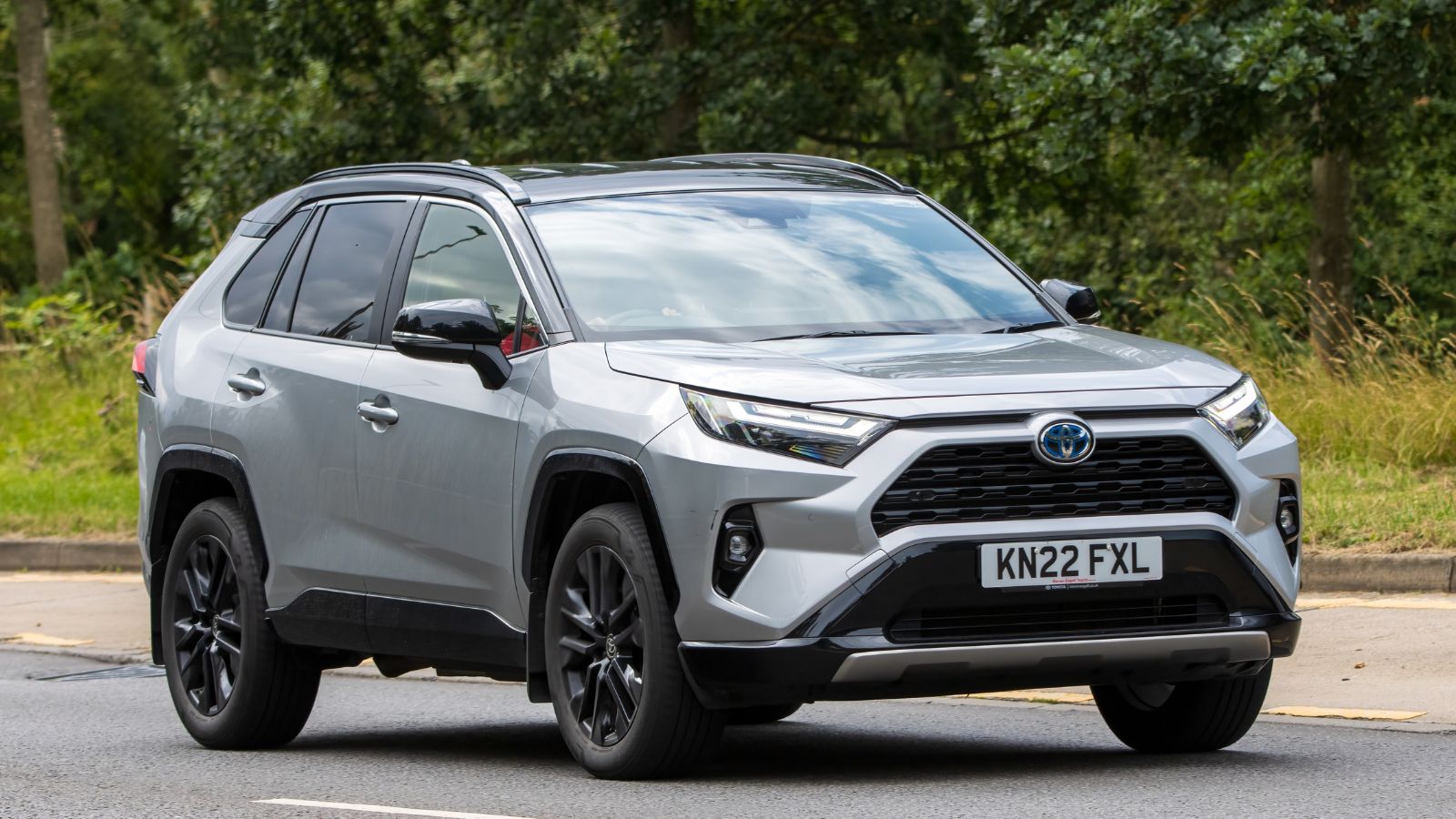
Toyota Canada’s latest sales numbers put one of the country’s most familiar SUVs at the centre of a much bigger shift in the auto market. The Canadian-built RAV4 Hybrid finished September with another record month, its fifth consecutive monthly record, while year-to-date sales were up 189.63%. At the same time, electrified Toyota and Lexus models accounted for 67.1% of Toyota Canada’s September sales.
Those figures arrive as hybrids move deeper into the Canadian mainstream. Toyota’s redesigned RAV4 is now built around electrification rather than treating it as a specialty option, while the company’s broader mix of hybrids, plug-in hybrids and battery-electric vehicles continues to grow. The result is a sales story that connects Canadian manufacturing, changing consumer demand and Toyota’s increasingly electrified product lineup.
The 190% Figure Is a Year-to-Date Surge
The biggest number deserves an important qualification. Toyota Canada reported that sales of the Canadian-built RAV4 Hybrid were up 189.63% on a year-to-date basis through September 2026. In other words, the roughly 190% increase is not a comparison between September 2026 and September 2025 alone. Toyota also said September marked the model’s fifth consecutive record month, extending a run that began earlier in the year as the redesigned sixth-generation RAV4 reached customers.
The distinction matters because percentages this large can easily create the impression that demand suddenly tripled in a single month. What Toyota’s data actually show is sustained momentum across several months combined with a rapidly changing sales base. September was also a record quarter for the RAV4 Hybrid, while the plug-in RAV4 posted a record quarter of its own. That makes the story broader than one unusually strong monthly comparison: Toyota is selling substantially more electrified RAV4s as the new generation becomes established in Canadian showrooms.
RAV4 Hybrid Momentum Has Been Building for Months
The September result did not appear out of nowhere. Toyota reported a best-ever month for the redesigned Canadian-assembled RAV4 Hybrid in April, when sales were up 24.6% year over year. May produced another record, with the hybrid up 113.3% from a year earlier. By July, Toyota reported 4,550 Canadian-built RAV4 Hybrid sales, an extraordinary 1,026.2% increase from the comparable month of 2025. August then became the model’s fourth consecutive record month.
Those comparisons also illustrate why individual percentage gains require context. A redesigned vehicle entering higher-volume production can produce enormous year-over-year increases when the comparable period had unusually low volume. Sales figures alone cannot separate how much of the increase came from underlying consumer demand, model-change timing, inventory availability or production patterns. What is clear is the consistency of the records. By September, Toyota was no longer describing a single breakout month but a five-month streak, making the RAV4 Hybrid one of the most visible contributors to the company’s accelerating electrified sales.
Ontario Manufacturing Sits at the Centre of the Story
The RAV4 Hybrid’s sales performance carries additional weight because the vehicle is produced in Ontario. Toyota Motor Manufacturing Canada began Canadian production of the sixth-generation RAV4 in January 2026 for the North American market. Toyota says all 2026 RAV4 hybrid models sold in Canada are assembled at TMMC, whose operations include plants in Cambridge and Woodstock. RAV4 production originally began in Woodstock in 2009, with hybrid production added later as Toyota expanded its Canadian electrified manufacturing footprint.
The scale is substantial. TMMC said in January that it employed more than 8,500 people, had produced more than four million RAV4s since 2009 and assembled more than 535,000 vehicles during 2025. Toyota also said it invested more than $1.1 billion in the new-generation RAV4 program, bringing its cumulative Canadian investment above $12 billion. For workers and suppliers tied to Ontario’s auto corridor, the significance therefore extends beyond dealership sales. Higher RAV4 Hybrid volumes connect one of Canada’s highest-volume consumer vehicles directly to domestic assembly, manufacturing employment and Toyota’s long-term production strategy.
Toyota’s 67% Electrified Mix Does Not Mean 67% Battery-Electric
Toyota Canada sold 15,077 electrified Toyota and Lexus vehicles in September, a 49.8% increase from the same month of 2025. Those vehicles represented 67.1% of the company’s 22,477 total September sales. During the full third quarter, Toyota Canada sold 40,019 electrified vehicles, equivalent to 65.7% of its overall volume. Looking only at the Toyota brand, electrified vehicles represented exactly 67.0% of third-quarter sales and 67.1% in September.
There is an important terminology distinction behind those numbers. Toyota uses “electrified” as a broad category encompassing conventional hybrids as well as plug-in hybrids, battery-electric vehicles and, where applicable, fuel-cell technology. Toyota reported 10,114 battery-electric and plug-in-hybrid vehicles within its 40,019 electrified Q3 sales. That works out to roughly one-quarter of the electrified total, meaning conventional hybrids remained the dominant part of the company’s electrified volume. The 67% figure therefore reflects Toyota’s hybrid-heavy strategy, rather than suggesting two-thirds of its Canadian customers suddenly bought fully electric vehicles.
Electrification Is Helping Lift Toyota’s Overall Sales
Toyota’s electrified growth is occurring alongside higher overall sales rather than simply replacing volume elsewhere in its lineup. Toyota Canada sold 22,477 vehicles in September, up 13.6% from September 2025 and a monthly record. Third-quarter volume reached 70,008 vehicles, an increase of 8.3% year over year. Toyota said both totals represented records, with Q3 2026 becoming its strongest third quarter since 2021.
The individual brands participated differently. Toyota Division sold 60,881 vehicles during the quarter, up 6.9%, while September Toyota-brand volume rose 10.4% to 19,136. Lexus delivered 9,127 vehicles in Q3, an increase of 18.5%, and September Lexus volume jumped 36.1% to a record 3,341 units. The records also spread across multiple products. Toyota cited quarterly or monthly highs for models including the Corolla Cross, bZ, Crown Signia, Sienna and RAV4 Hybrid, while Lexus recorded strong results from the NX, RX and their plug-in variants. The RAV4 is therefore important, but it is part of a wider product-mix change rather than Toyota Canada’s only source of growth.
Toyota Has Already Passed Its Full-Year Electrified Record
Perhaps the clearest measure of the pace of change is Toyota Canada’s year-to-date total. Through only nine months of 2026, the company had sold 130,369 electrified vehicles. That was already more than 6,400 units above the full-year electrified total Toyota reported for 2025. The company therefore broke its previous annual record before the fourth quarter had even started, with three months of the calendar year still remaining.
The change becomes even more striking when compared with Toyota’s 2025 sales mix. Toyota reported that electrified vehicles represented 49.7% of its Canadian Toyota-and-Lexus sales last year. By September 2026, the monthly share had reached 67.1%. The progression has not been perfectly linear—monthly percentages move with inventories, launches and the mix of vehicles delivered—but electrification has repeatedly accounted for roughly two-thirds of Toyota Canada’s sales during recent months. June came in at 67.9%, July at 65.8%, August at 64.3% and September at 67.1%, showing that the latest figure is part of a sustained pattern.
The New RAV4 Makes Hybrid Power the Starting Point
The redesigned RAV4 helps explain why Toyota’s sales mix can change so quickly. For the sixth generation, the conventional gasoline-only RAV4 disappeared from the Canadian lineup. The standard RAV4 is now hybrid-powered, while customers wanting greater electric capability can move to the RAV4 Plug-in Hybrid. That means one of Canada’s highest-volume passenger vehicles automatically pushes Toyota’s electrified share higher whenever a standard RAV4 Hybrid leaves a dealership.
The Canadian-market RAV4 Hybrid combines a 2.5-litre four-cylinder engine with Toyota’s fifth-generation hybrid system and produces 236 net system horsepower, up from 219 horsepower in the outgoing version. All-wheel drive is standard in Canada. Toyota’s manufacturer estimates put combined fuel consumption between 5.5 and 6.2 L/100 km depending on trim, and the hybrid lineup launched with a starting MSRP of $37,500. Those details help make the broader sales story understandable: Toyota is not relying only on consumers deliberately seeking a niche electrified model. Hybrid technology has effectively become the default powertrain in its most important Canadian SUV.
Canada’s Wider Market Is Moving Toward Hybrids Too
Toyota’s performance is happening alongside a wider change in Canadian vehicle registrations. Statistics Canada reported that new hybrid-electric vehicle registrations increased 39.5% year over year in the second quarter of 2026, the strongest increase among the fuel types it tracked. Battery-electric registrations increased 37.4% and plug-in hybrids rose 8.0%, while gasoline registrations declined 7.3%. Overall, Canadians registered 547,673 new vehicles during the quarter, the highest Q2 total since 2019.
That broader data also reinforces why Toyota’s 67% figure should be interpreted carefully. Statistics Canada classifies battery-electric and plug-in hybrid models as zero-emission vehicles but excludes conventional hybrids from that category. ZEVs represented 10.7% of all new Canadian registrations in Q2, far below Toyota’s electrified share because the two measurements describe different things. Toyota’s strength is heavily tied to conventional hybrids such as the RAV4. With one of Canada’s best-known SUVs now hybrid by default and Canadian production supporting that transition, the latest numbers show how quickly electrification can expand even when battery-electric vehicles are only one part of the market.