

























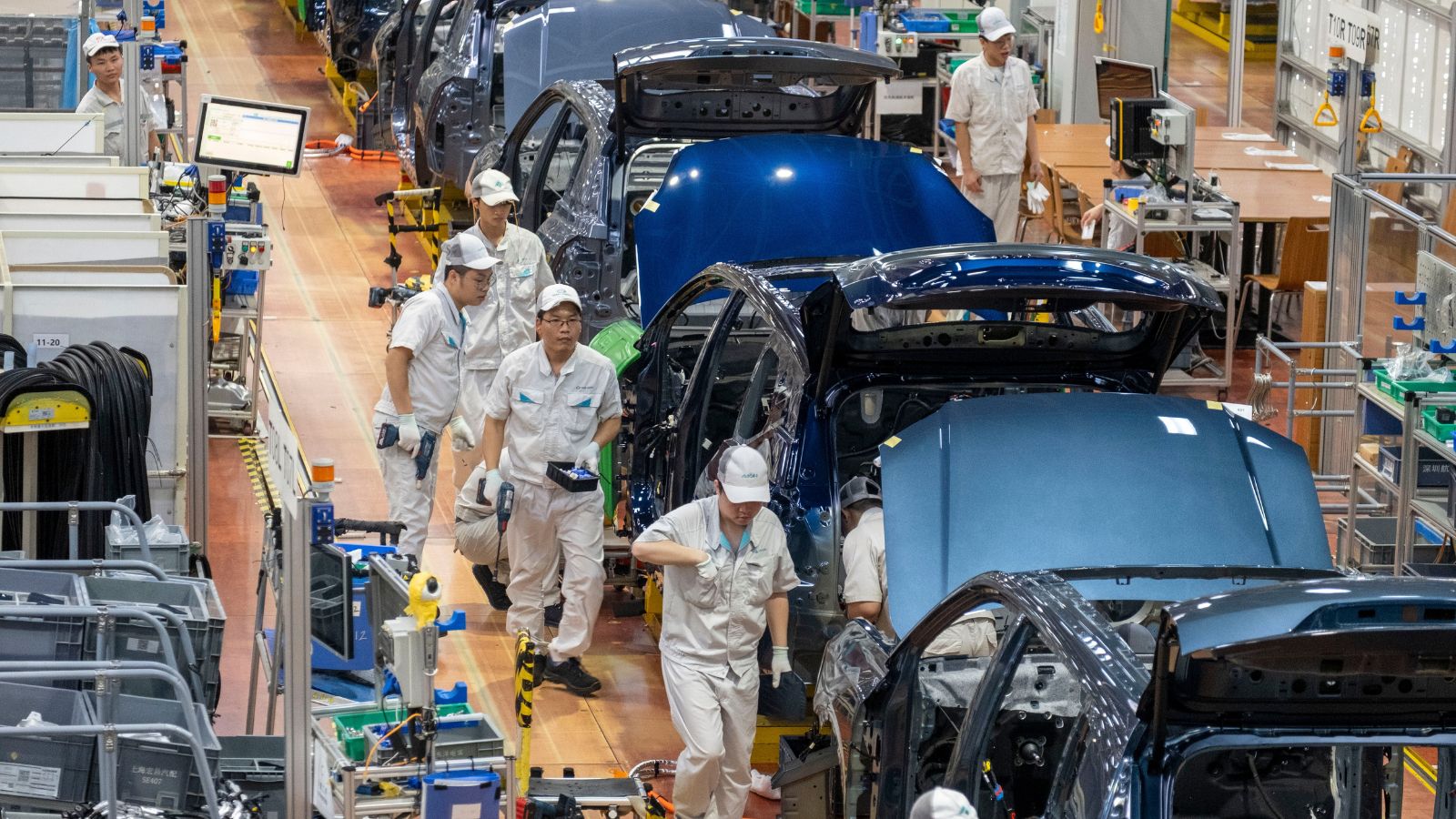
Ontario is signalling that it is prepared to do more to keep vehicle production alive at Stellantis’ idled Brampton Assembly Plant, raising the stakes in a dispute that now reaches well beyond one factory. Economic Development Minister Vic Fedeli said on September 18 that the province is willing to discuss additional assistance, including training or other targeted measures that could remove barriers to assigning another vehicle to Brampton. The position comes as Stellantis explores a potential sale of the plant to Canadian armoured-vehicle manufacturer Roshel and as governments and Unifor push the automaker to reconsider. For roughly 2,200 laid-off workers, the debate is no longer about when an already-promised vehicle will arrive. It is about whether large-scale automotive assembly will return to the plant at all.
Ontario Is Making Its Preferred Outcome Clear
The latest provincial position leaves relatively little ambiguity about what Queen’s Park wants from Stellantis. Fedeli said Ontario remains focused on getting another vehicle assigned to Brampton and is prepared to discuss whether the company requires different forms of assistance to make the economics work. Potential measures could include worker training or help addressing specific obstacles identified by the automaker. No new dollar figure or finalized incentive package was announced, meaning the offer is better understood as an opening for negotiations rather than a new subsidy agreement.
That distinction matters because Ontario is trying to preserve automotive production rather than simply keep the enormous industrial site occupied. Premier Doug Ford made the same point on September 16 while discussing the proposed Roshel transaction, saying the province wanted to work with Stellantis while supporting the push for a new model at Brampton. Federal Industry Minister Mélanie Joly has taken a similar position, saying Ottawa wants Stellantis to assign another model to the facility. The two governments therefore appear aligned on the basic objective even though their financial agreements with Stellantis and their available policy tools are different.
Brampton Was Supposed to Be Part of Ontario’s EV Manufacturing Future
The current uncertainty is particularly striking because only a few years ago Brampton was being positioned as an important part of Stellantis’ Canadian electrification strategy. In May 2022, the company announced a $3.6-billion investment covering its Windsor and Brampton operations as well as research and development work. Ontario committed up to $513 million toward the broader package, including up to $132 million specifically to modernize Brampton with a flexible assembly line capable of producing gasoline, hybrid and battery-electric vehicles. Ottawa separately announced federal support of up to $529 million for the Brampton and Windsor transformation.
Production at Brampton stopped in late 2023 as the facility entered its planned retooling period. The intention was eventually to launch a new generation of Jeep Compass production there. That plan unravelled in stages. Stellantis paused Brampton retooling work in 2025 and, in October of that year, announced that future Compass production would instead go to its Belvidere, Illinois, facility. Federal records confirm the Compass had originally been planned for Brampton beginning in 2026. What had been presented as a transition between generations of vehicle production instead became an extended shutdown with approximately 2,200 Unifor members ultimately left on indefinite layoff.
The Roshel Deal Has Changed the Nature of the Debate
Stellantis added another layer of uncertainty in September when it confirmed that it had signed a memorandum of understanding with Roshel concerning a potential sale of the Brampton plant. Stellantis Canada has said it examined multiple alternatives for the facility and views Roshel as a possible route to restoring sustainable manufacturing operations. Roshel, which produces armoured vehicles, has said it wants to establish a defence-manufacturing centre at the property. The MOU represents a path toward a possible transaction; it is not the same as a completed sale.
Roshel has also said it would give laid-off Unifor workers first consideration and has discussed bringing workers back as early as 2026. Chief executive Roman Shimonov has publicly outlined ambitions for more than 2,000 jobs at the site, tied to defence and automotive opportunities, but those numbers remain company plans rather than completed hiring commitments. For Ontario and Unifor, that is an important distinction. A busy industrial facility could still generate significant employment, yet their stated objective is to preserve the site as a major automotive assembly operation. That is why the proposed sale has not ended the search for another Stellantis vehicle mandate.
Public Money Gives Governments Additional Leverage
The Brampton dispute also involves significant public commitments, although the difference between money promised and money actually disbursed is important. Ontario’s 2022 announcement included up to $132 million for Brampton. Ford said on September 16 that the province had not given Stellantis money for the Brampton facility, indicating the conditions required for that provincial support had not resulted in a Brampton payout. That means Ontario’s new willingness to consider further assistance should not be confused with simply adding money on top of $132 million already paid to the plant.
Ottawa’s position is different. Federal records show that, as of March 31, 2025, approximately $222.4 million had been disbursed under the federal contribution agreement covering the Brampton and Windsor facilities. After Stellantis announced the relocation of Compass production to Illinois, the federal government paused further payments and launched a dispute-resolution process. Federal officials have said the agreement contains compliance mechanisms that can ultimately lead to recovery of funds if requirements cannot be resolved. Joly has more recently warned Stellantis that Ottawa is prepared to seek repayment if the company does not meet its commitments.
Labour Negotiations Are Now Tied Directly to Brampton’s Future
The timing is especially sensitive because Stellantis and Unifor are simultaneously negotiating a new collective agreement covering more than 9,000 workers in Canada. Talks reached an impasse in September, with Unifor identifying Brampton as the central unresolved issue. The union says approximately 2,200 Local 1285 members connected to the plant remain on indefinite layoff and has argued that a settlement cannot ignore what happens to those workers. The existing collective agreement is scheduled to expire at 11:59 p.m. on September 20.
Expiry of the agreement does not, however, mean workers automatically enter a legal strike position at that moment. Unifor clarified on September 16 that the parties remain in Ontario’s conciliation process, which must be completed before a legal strike or lockout can occur. The union has nevertheless described strike action as a real possibility if the dispute remains unresolved. Stellantis, meanwhile, has said market and trade conditions changed the original business case for Brampton and that it evaluated potential new product allocations, interim production concepts and arrangements with other companies before pursuing discussions with Roshel. Those competing positions make Brampton both an industrial-policy question and a central bargaining issue.
U.S. Trade Pressure Has Made Canadian Auto Investment Harder to Secure
The uncertainty surrounding Brampton is unfolding during a much broader restructuring of North American automotive production. Since April 2025, Canadian-made vehicles have faced a U.S. tariff of 25 per cent on their non-U.S. content, while U.S. content in CUSMA-compliant vehicles is exempt. Canada’s federal auto strategy notes that more than 90 per cent of Canadian-made vehicles and roughly 60 per cent of Canadian-made auto parts are exported to the United States, making changes in U.S. trade policy unusually important for Canadian assembly operations.
Stellantis has linked the deterioration of Brampton’s original business case to changing market and trade conditions, while Unifor has explicitly connected the loss of the Compass program to the tariff environment. That does not mean tariffs are the only factor behind every Stellantis product decision; vehicle demand, regulatory requirements, investment costs and the company’s broader North American production strategy also matter. Still, the cross-border exposure helps explain why Ontario is willing to consider new forms of support. Governments are competing not only against the cost of leaving Brampton idle, but against alternative production locations inside a North American market where policy incentives and tariffs can quickly change the economics of an assembly mandate.
Why Ontario Is Fighting to Preserve Assembly Capacity
The scale of the surrounding auto economy helps explain the province’s determination. Ontario’s 2026 budget says the provincial automotive industry employed nearly 100,000 people in 2025. Nationally, federal industry data show the sector directly employed more than 125,000 people in 2024 and supported roughly 427,000 additional jobs. Statistics Canada has also estimated that 68.3 per cent of employment in Canadian automotive manufacturing industries depended on U.S. demand for Canadian exports in early 2025, illustrating both the size of the industry and its exposure to cross-border disruptions.
Brampton itself has already acted to try to preserve that industrial capacity. In February 2026, city council unanimously approved a motion directing planning changes intended to explicitly designate the Stellantis property for automotive assembly and related manufacturing. That municipal decision cannot force Stellantis to assign a vehicle, but it demonstrates how strongly local officials view the land as an automotive asset. Ontario’s latest offer of additional support adds another layer of pressure. The question now is whether a combination of incentives, labour negotiations, federal leverage and political pressure can produce a vehicle program with a sustainable business case—or whether Stellantis ultimately concludes that another manufacturer represents the future of the Brampton site.