


























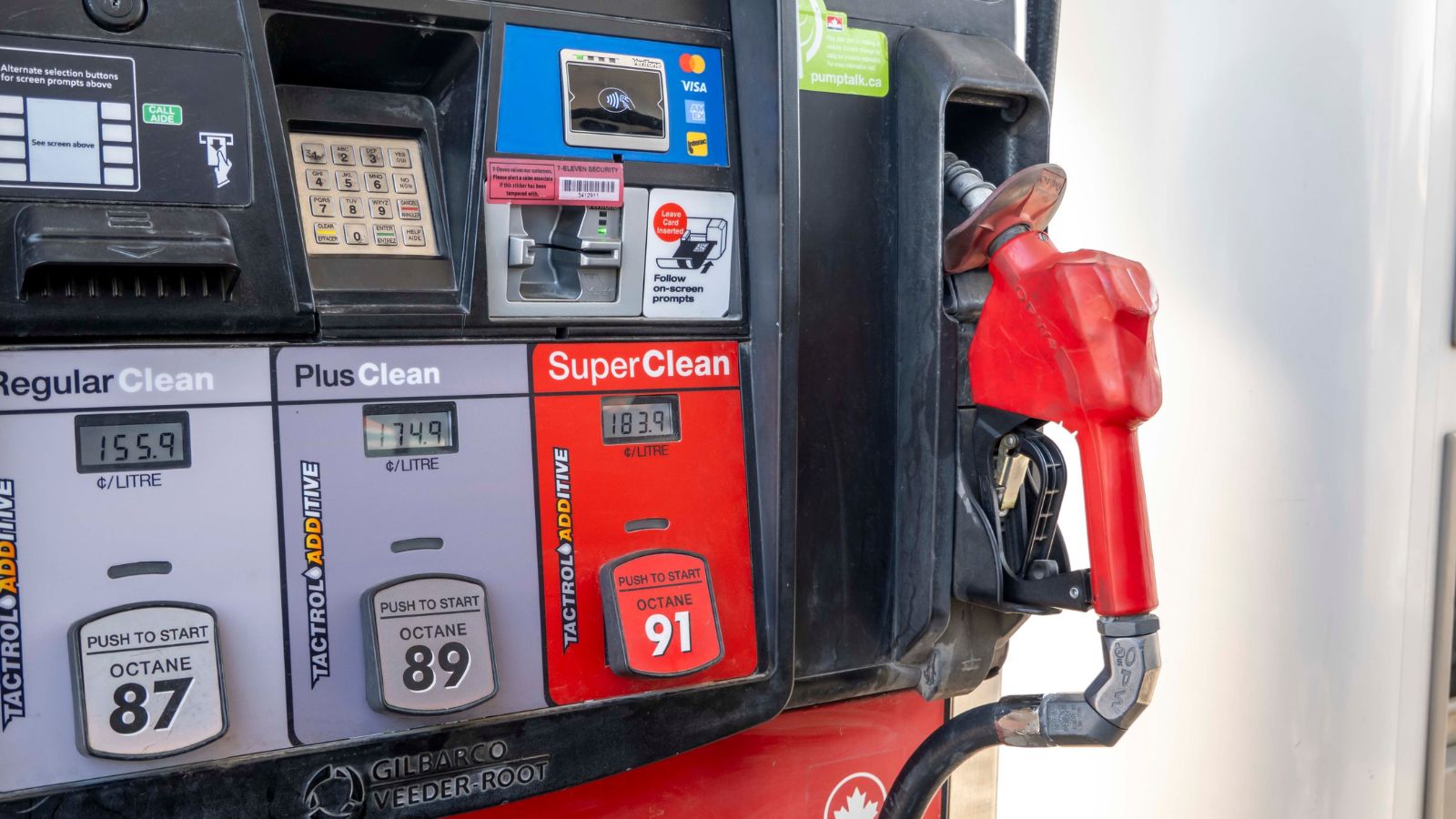
A fill-up in Vancouver and a fill-up in Regina are beginning to look like purchases made in two different fuel markets. Gas Wizard’s September 7 forecast puts regular gasoline at 211.9 cents per litre in Vancouver and 144.9 cents in Regina, a striking 67-cent difference between two western Canadian cities.
The contrast is more than a curiosity at the pump. Vancouver is exposed to a combination of higher regional fuel taxes, a more complicated supply chain and West Coast pricing pressures, while Regina sits beside one of Western Canada’s largest refineries in a province that produces more refined petroleum products than it consumes. Global oil disruptions are pushing prices higher across Canada, but geography determines how severely that pressure reaches individual drivers.
A 67-Cent Gap That Quickly Becomes Real Money
Gas Wizard’s September 7 figures place Vancouver at the top of the cities it tracks, with regular gasoline forecast at 211.9 cents a litre. Regina is at the opposite end at 144.9 cents. That makes Vancouver gasoline 67 cents per litre more expensive using the same forecast source. The difference is especially striking because both cities are in Western Canada and ultimately draw heavily on western Canadian energy production.
The impact becomes clearer at the fuel tank. At those prices, a 50-litre fill would cost about $105.95 in Vancouver versus $72.45 in Regina, a difference of $33.50. A household making four comparable fills could face roughly $134 more in fuel costs before considering differences in driving distance or vehicle efficiency. Gas Wizard’s numbers are forecasts rather than guaranteed station prices, but they capture the extraordinary regional divide facing motorists at the start of September.
Vancouver’s Fuel Taxes Begin With a Built-In Disadvantage
Part of the divide is visible before wholesale gasoline or retailer margins are considered. British Columbia imposes a 27-cent-per-litre motor fuel tax in the Vancouver area. That includes 18.5 cents dedicated to TransLink, 6.75 cents for the B.C. Transportation Financing Authority and 1.75 cents in general provincial revenue. Saskatchewan’s gasoline fuel tax is 15 cents per litre.
That creates a 12-cent difference in fixed provincial and regional fuel taxation alone. However, it does not explain anything close to the entire 67-cent gap. Another important detail is that B.C.’s consumer carbon tax was eliminated effective April 1, 2025, meaning the old explanation that Vancouver’s high pump prices simply reflect a provincial carbon tax is no longer accurate. Taxes still matter substantially, but the much larger difference points toward wholesale fuel economics, refinery access, transportation and regional supply conditions as equally important pieces of the puzzle.
Regina Has a Refinery Advantage Few Canadian Cities Can Match
Regina sits beside a major piece of Western Canada’s fuel infrastructure. Federated Co-operatives Limited’s Co-op Refinery Complex can process up to 130,000 barrels of crude oil per day and produces gasoline, diesel and several other petroleum products. The facility distributes as much as 17 million litres of petroleum products daily to communities across Western Canada.
The broader Saskatchewan market is also unusually well positioned. The Canada Energy Regulator says Saskatchewan’s two refineries have combined capacity of roughly 152,000 barrels per day and that the province produces a net surplus of refined petroleum products. Some of that surplus moves into Alberta and Manitoba or is exported. That does not guarantee Regina will always have Canada’s cheapest gasoline, but being located beside substantial refining capacity reduces some of the logistical disadvantages faced by markets dependent on distant supply. Saskatchewan also remains a major crude-producing province, adding another layer to the region’s energy infrastructure.
Vancouver Depends on a More Complicated Supply Network
Metro Vancouver’s fuel system has more moving parts. The Canada Energy Regulator says most gasoline consumed in British Columbia comes from Alberta, primarily through the Trans Mountain system. B.C. also receives gasoline from its own refineries and can import finished fuel by ship or barge from the U.S. Pacific Northwest. Each source connects Vancouver to a different wholesale market and transportation route.
The Burnaby refinery is an important local supplier, but its crude-processing capacity is roughly 55,000 barrels per day, far smaller than Regina’s 130,000-barrel-per-day Co-op complex. Historical CER analysis has shown that the Trans Mountain system serves Vancouver in two ways: delivering refined products from Alberta and supplying crude to the Burnaby refinery. That interconnected system normally provides flexibility, but it also means West Coast prices can react strongly when regional refinery availability, imported-product costs or transportation conditions tighten. Vancouver therefore remains unusually exposed to changes beyond B.C.’s borders.
Global Oil Prices Are Making an Expensive Market Even Harder
The regional divide is unfolding during another turbulent period for global oil. Reuters reported that Brent crude ended September 4 at US$96.28 a barrel, up 7.6 per cent during the week, while West Texas Intermediate climbed nearly 10 per cent to US$91.48. Renewed U.S.-Iran hostilities, uncertainty surrounding Middle Eastern energy flows and attacks affecting Russian refinery capacity have all contributed to supply concerns.
Those pressures affect every Canadian city because crude oil and wholesale refined-product markets are interconnected internationally. They do not, however, hit every city equally. A region with abundant nearby refining capacity and surplus fuel can react differently from a coastal market that supplements domestic supplies with imported gasoline. CAA notes that crude costs are only one component of pump prices; regional competition, transportation, taxes, retail margins and local supply also matter. Vancouver entered the latest global price shock with structural disadvantages that can amplify an international increase.
The Rest of Canada Shows Just How Extreme Vancouver Has Become
Gas Wizard’s September 7 city list illustrates the scale of the divergence. Vancouver’s 211.9-cent forecast is the highest among the Canadian cities it reports, while nearby Victoria is at 210.9. Montreal is forecast at 209.9 cents. At the cheaper end, Regina is at 144.9, Winnipeg at 155.9 and Saskatoon at 158.9 cents per litre.
Those figures create a broad geographic spread even though Canadians are buying essentially the same commodity. Gas Wizard places its 48-city regular-gasoline figure at 186.4 cents per litre for September 7. CAA, using a different national-average methodology, reported 174.9 cents on September 6, up sharply from 153.3 cents a month earlier and 142.3 cents one year earlier. The precise national benchmark therefore varies by data provider, but both sets of numbers tell the same broader story: gasoline has become markedly more expensive, while regional differences remain unusually large.
Taxes Explain Some of the Gap — But Not Most of It
It is tempting to look at Vancouver’s pump price and blame taxation alone. The numbers make that explanation incomplete. Vancouver’s 27-cent regional motor fuel tax exceeds Saskatchewan’s 15-cent gasoline tax by 12 cents per litre. Yet the forecast difference between Vancouver and Regina is 67 cents. Fixed provincial and regional gasoline taxes therefore account for only a fraction of the headline spread.
Other costs appear before motorists ever see a service-station sign. Gasoline must be refined, transported to terminals, stored, blended to meet regulatory requirements, moved to retail stations and sold at a margin. B.C. also operates a Low Carbon Fuel Standard requiring fuel suppliers to reduce the carbon intensity of their gasoline and diesel pools. For 2026, the gasoline and diesel reduction requirement is 20.6 per cent from the provincial baseline, while gasoline retains a five-per-cent renewable-fuel requirement. Those rules are separate from the abolished consumer carbon tax.
Ottawa’s Gas-Tax Break Is No Longer About to Disappear
One major nationwide tax increase that had been looming after Labour Day has been pushed back. Ottawa originally suspended the federal gasoline excise tax of 10 cents per litre from April 20 through September 7, 2026, as fuel costs surged during Middle East disruptions. On September 2, the federal government announced plans to extend the full suspension through January 31, 2027.
Draft federal legislation provides for the tax to return at half its regular rate from February through March 2027 before the full rate resumes April 1. Because that federal relief applies nationwide, it does little to explain why Vancouver and Regina are currently so far apart. It does, however, matter to both cities’ near-term outlook. Without the extension, motorists had been facing another significant pump-price pressure immediately after Labour Day. The policy effectively removes one scheduled nationwide increase while leaving regional differences in taxes, supply and wholesale costs intact.
A Forecast Is Not the Same Thing as Every Station’s Pump Price
The 211.9-cent and 144.9-cent figures should be understood for what they are: regional price forecasts, not mandatory prices every retailer must post. Gas Wizard itself notes that individual stations can experience local volatility, rapid inventory changes and competitive “gas wars.” CAA similarly says pump prices vary according to station location, sales volume, local competition, taxes and retail margins.
That distinction matters in a city as large as Metro Vancouver. A driver may encounter prices noticeably above or below the forecast depending on neighbourhood and time of day. The same applies in Regina. Gas Wizard reported Regina’s observed average at roughly 142.9 cents on September 5, close to but not identical to its later 144.9-cent forecast. The headline comparison is therefore best treated as a snapshot of expected regional pricing. Shopping among nearby stations can save several cents, but it cannot erase a regional difference measured in dozens of cents.
What Would Have to Change for the Gap to Narrow
A lasting narrowing of the Vancouver-Regina spread would likely require more than a drop in crude oil prices. Lower global crude and wholesale gasoline costs would help both cities, but Vancouver would remain subject to its higher local fuel tax and its dependence on a mixture of Alberta supply, B.C. refinery production and Pacific Northwest imports. Stronger West Coast refinery availability or cheaper imported gasoline could reduce some of that pressure.
Regina’s advantage could also change. Refineries periodically undergo maintenance, unexpected outages can tighten local supply, and agricultural or transportation demand can affect Prairie fuel markets. The Co-op Refinery itself undertakes major planned maintenance projects to keep its large facility operating reliably. CAA’s broader explanation of pump pricing is useful here: there is no single lever controlling gasoline prices. For Vancouver motorists staring at a figure above $2.10 a litre, the current 67-cent divide is the result of several forces converging at once.