






















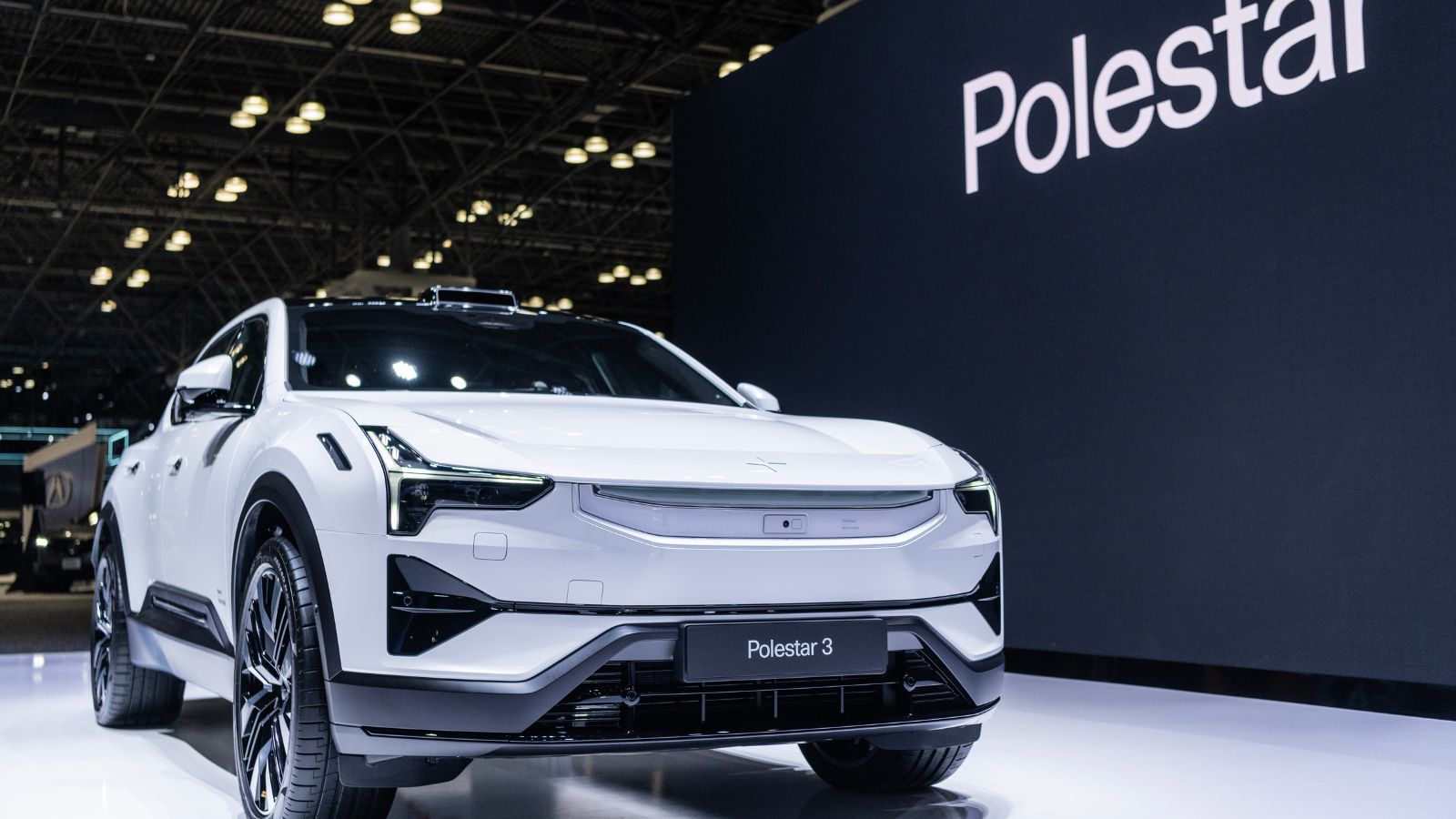
Polestar has taken one of the electric-car industry’s more unconventional designs and made it considerably easier to live with. The new Polestar 4 SUV keeps the performance, battery technology and Scandinavian character of the existing Polestar 4, but adds a straighter roof, more cargo room and something the original famously rejected: a rear window.
For Canada, the timing is notable. Polestar has identified the country as a market where it intends to keep investing even as its American business effectively closes to new vehicles from the 2027 model year. At the top of the new SUV range sits a 544-horsepower, dual-motor version capable of accelerating from zero to 100 km/h in 3.9 seconds. Production is already underway in South Korea, with initial deliveries planned for the fourth quarter of 2026.
Polestar Gives the 4 a More Conventional SUV Shape
The original Polestar 4 blurred the distinction between a fastback, crossover and SUV coupe. The new Polestar 4 SUV moves deliberately in the other direction. Its roof remains relatively low and sleek, but it runs straighter toward a more upright tailgate, creating a shape that resembles a sporty electric wagon as much as a conventional utility vehicle. Polestar says the new model is aimed at the compact executive SUV segment and is intended to broaden the appeal of what has become its most successful model.
The dimensions remain closely related to the existing 4. The SUV measures 4,840 mm long and rides on the same 2,999-mm wheelbase, but the body has been reorganized around practicality. Full-length roof rails are standard, with a rated dynamic roof load of 100 kg and a static load of 300 kg. That makes roof boxes, bicycles and camping equipment far more natural additions than they were on the coupe-styled version. Polestar has effectively preserved the 4’s visual identity while giving families and outdoor-oriented buyers fewer reasons to dismiss it.
The Dual-Motor Version Still Packs 544 Horsepower
Extra practicality has not turned the Polestar 4 into a slow family hauler. The flagship dual-motor model combines two electric motors for 400 kW, equivalent to 544 horsepower, and 686 Nm of torque. Power goes to all four wheels, and Polestar lists a zero-to-100-km/h time of 3.9 seconds. That is only marginally slower than the current Canadian Polestar 4 coupe, which is rated at 3.8 seconds despite sharing the same headline power output.
There is also a more efficiency-focused rear-wheel-drive model. Its single motor produces 200 kW, or 272 horsepower, along with 343 Nm of torque, taking the SUV to 100 km/h in 7.3 seconds. Both versions have a 200-km/h top speed. Buyers wanting something more aggressive can add the Performance pack to the dual-motor model. It brings recalibrated active dampers from ZF, larger Brembo brakes, Swedish-gold detailing and 22-inch forged wheels wearing Pirelli P Zero tires. The result is a vehicle designed to retain Polestar’s performance identity despite its more practical proportions.
A 100-kWh Battery Underpins Both Versions
Every Polestar 4 SUV uses a 100-kWh lithium-ion battery and a 400-volt electrical architecture. The rear-motor version carries a preliminary WLTP range target of as much as 630 km, while the more powerful dual-motor model is rated at up to 600 km under the European test cycle. Those figures should not be treated as Canadian range estimates. WLTP testing is generally more generous than North American procedures, and Polestar has not yet published a certified Canadian range figure for this newly revealed body style.
Fast charging peaks at 200 kW, with Polestar estimating a 10-to-80-per-cent DC charging session at approximately 30 minutes under suitable conditions. AC capability reaches 22 kW in some markets, but Polestar specifically lists an 11-kW maximum for Canada. That difference matters for owners charging at higher-powered commercial AC stations, although overnight home charging should still cover typical daily use. For perspective, the existing Canadian Polestar 4 coupe is rated at up to 499 km of EPA-estimated range in single-motor form and 451 km with dual motors.
Cargo Space Becomes a Much Bigger Part of the Sales Pitch
The clearest reason for creating the new variant appears behind the rear seats. Polestar lists 530 litres of luggage capacity when cargo is measured to the top of the seatbacks and 655 litres when the area is filled to the roof. Fold the 60/40-split rear seats and available luggage volume rises to 1,665 litres. Including the vehicle’s front and rear storage compartments, Polestar calculates as much as 1,680 litres of total storage.
That fundamentally changes how the Polestar 4 can be used. The coupe version made a visual statement, but buyers carrying strollers, suitcases, skis, large dogs or camping equipment often prioritize vertical cargo space over a dramatic roofline. Rear passengers benefit as well. The redesigned roof provides an additional 2.5 cm of second-row headroom. A new panoramic glass roof stretches almost to the tailgate, and an optional electrochromic version allows sections to be electronically darkened. These are modest changes individually, but together they turn the 4 into a considerably more conventional family vehicle without requiring an entirely new platform.
Polestar Has Brought the Rear Window Back
Few modern production vehicles have attracted as much discussion over a missing piece of glass as the original Polestar 4. Its designers eliminated the conventional rear window and replaced the interior mirror with a screen receiving video from an exterior camera. The approach allowed the roof structure to extend farther behind rear passengers and gave the vehicle its unusual profile, but it also asked drivers to abandon one of the most familiar sightlines in motoring.
The SUV effectively gives buyers a choice. A conventional rear window, rear wiper and optical rear-view mirror are standard, making the new variant feel immediately familiar. Polestar has not completely abandoned its digital idea, however. A camera-based rear-view mirror remains optional and can provide an unobstructed view when cargo is stacked high enough to block the glass. That compromise may prove important commercially. Instead of insisting that every Polestar 4 customer adapt to the same design philosophy, the company now offers one visually radical version and another that places traditional utility first.
V2L and Camping Mode Push the SUV Beyond Transportation
Polestar is also adding functions designed around how an electric SUV might be used while parked. Vehicle-to-Load capability will allow the high-voltage battery to provide electricity to external equipment through a separately sold adapter. Polestar rates output at up to 3.3 kW, enough for many portable appliances, power tools, electronics and camping accessories. Owners will be able to select a minimum battery level so the vehicle stops supplying external power before its driving reserve falls too far.
A dedicated Camping mode builds on that capability. It allows climate control, lighting, entertainment and other cabin systems to remain accessible when the vehicle is stationary, creating a climate-controlled space for overnight use. Polestar says both V2L and Camping mode will eventually reach other Polestar 4 models through software updates. Google Gemini is also being integrated into the vehicle’s Google-based infotainment system, expanding voice interaction beyond rigid commands toward contextual conversations, trip planning and translation. The additions reflect a wider EV trend: automakers increasingly treat the traction battery as both transportation energy and a large mobile power source.
Canadian Pricing Is Still the Major Missing Number
Polestar has disclosed European pricing, beginning at €57,900 for the rear-motor SUV and €65,900 for the dual-motor model, but it had not announced Canadian pricing at the time of the September 2 launch. That distinction is important because simply converting European prices into Canadian dollars would ignore differences in taxes, equipment, logistics and market positioning. The existing 2026 Polestar 4 coupe currently starts at $64,900 in Canada for the single-motor version and $69,900 for the dual-motor model before options and applicable charges.
The Canadian backdrop is also more difficult than it was during the EV boom of 2024. Statistics Canada reported that zero-emission vehicles accounted for 9.5% of new registrations in 2025, down from 14.6% a year earlier. Sales nevertheless began recovering late in the year, and first-quarter 2026 registrations showed more than 43,000 ZEVs entering Canadian roads. For Polestar, expanding its SUV choices could therefore matter more than simply offering additional performance. Canadian consumers overwhelmingly favour utility-style vehicles, which represented the vast majority of new-vehicle sales in 2025.
U.S. Buyers Are Being Locked Out by Regulation, Not Product Strategy
The absence of the Polestar 4 SUV from American showrooms is driven by a much larger regulatory problem. In June, the U.S. Department of Commerce’s Bureau of Industry and Security declined to grant Polestar authorization under the Connected Vehicle Rule. Under the rule, restrictions covering connected-vehicle manufacturers with sufficient links to China or Russia take effect with the 2027 model year. Polestar is majority-owned by China’s Geely group, placing the company directly in the regulatory fight.
Polestar consequently says it cannot sell new model-year 2027 vehicles in the United States under the current authorization framework. Existing inventories of 2026 Polestar 3 and Polestar 4 models can continue to be sold, and the company says American owners will retain access to servicing and customer support. That makes the new 4 SUV a striking example of the increasingly regional nature of the global auto industry. A vehicle manufactured in Busan, designed by a Swedish brand and offered to Canadian consumers will be unavailable just across the border because of U.S. connected-vehicle security rules.
Canada Becomes More Important as Polestar Rebuilds Its Global Strategy
The geographic split matters because Polestar is trying to grow while simultaneously restructuring its business. The company delivered an estimated 30,423 vehicles in the first half of 2026, its highest first-half total, although second-quarter volume of 17,296 vehicles was slightly below the same period of 2025. Polestar has expanded its worldwide retail network to 235 sales points, up 39% year over year, and the 4 has become central to its product and profitability strategy.
The United States was already a relatively small part of that picture before the regulatory decision. Polestar said 94% of its first-quarter 2026 sales occurred outside the U.S., with Europe accounting for close to 80% of retail volumes. The company has specifically identified Canada, Latin America, Southeast Asia and parts of Eastern Europe as markets where growth remains possible. Against that backdrop, the Polestar 4 SUV is more than a derivative body style. It represents the kind of globally adaptable product the company needs as political borders increasingly determine which cars can be sold where.