






















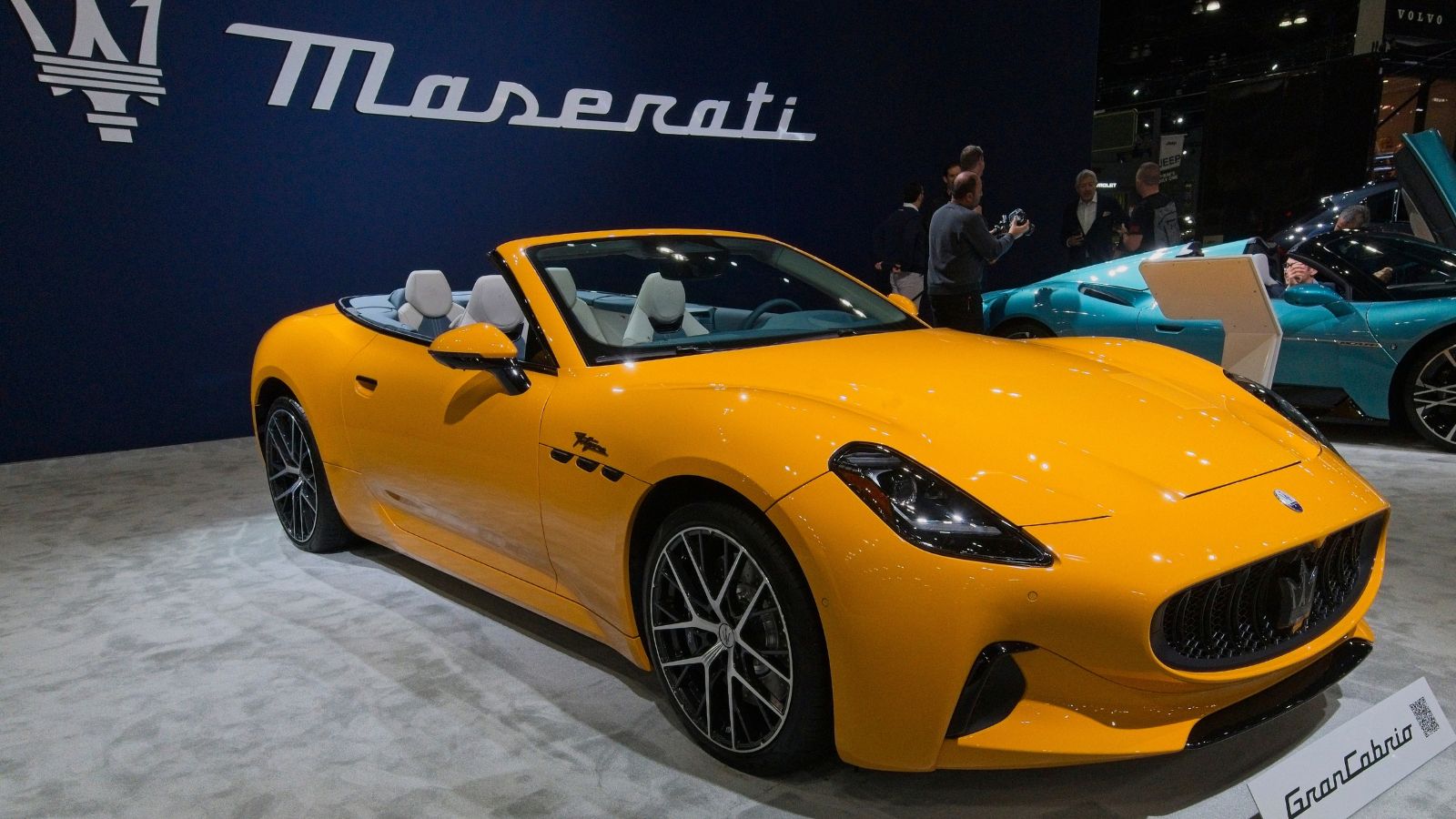
Maserati’s next chapter could look very different from its last. The century-old Italian luxury brand is reportedly preparing two new electric vehicles with help from Huawei and Chinese automaker JAC, potentially combining Chinese technology and manufacturing with Maserati design, tuning and final assembly in Italy.
The reported plan arrives at a difficult moment. Maserati’s volumes have fallen sharply from their late-2010s peak, its revenue has contracted, and Stellantis is under pressure to give the brand a clearer product and investment strategy. A partnership with Huawei and JAC could provide faster access to competitive EV technology without forcing Maserati to develop every expensive component alone. It would also create an unusual luxury-car formula: Chinese engineering beneath a vehicle finished, calibrated and sold internationally as a Maserati.
A Two-Model Comeback Plan Is Reportedly Taking Shape
The latest reports point to something considerably more ambitious than Maserati simply purchasing technology from an outside supplier. The proposed program reportedly includes two battery-electric vehicles: a large electric grand tourer and a mid-to-large electric SUV. People familiar with the plans have indicated that the GT is currently favoured to reach the market first. That choice would make sense from a brand perspective, since grand touring has been central to Maserati’s identity for generations, even if SUVs typically offer greater volume potential.
The SUV would reportedly sit alongside or expand upon the territory occupied by the Grecale Folgore, while the GT would complement Maserati’s existing GranTurismo Folgore. There is also an interesting connection with Stellantis’ official planning. In May 2026, the parent company said Maserati would receive two new E-segment vehicles under its FaSTLAne 2030 strategy. Stellantis has not publicly said that those vehicles are the same Huawei-JAC projects, however. Specific launch dates also remain unconfirmed, and no definitive commercial agreement between the companies has been publicly announced.
Huawei Could Give Maserati a Shortcut to Modern EV Technology
Huawei’s potential contribution reaches far beyond supplying an infotainment screen. Earlier reports describing the proposed arrangement said the Chinese technology company could lead product definition and provide key vehicle technologies, following the model it already uses with automakers participating in its Harmony Intelligent Mobility ecosystem. Huawei’s automotive portfolio spans assisted-driving systems, digital cockpits, vehicle controls, connectivity and other software-heavy systems that increasingly define how premium EVs feel in daily use.
That expertise matters because luxury cars now compete on more than leather quality, acceleration and badge prestige. Buyers in China in particular have grown accustomed to rapid software updates, sophisticated cabin technology and increasingly capable driver-assistance systems. Building those capabilities internally requires enormous spending and years of development. Huawei says its intelligent automotive operation has thousands of research-and-development engineers and has shipped millions of intelligent vehicle components. For Maserati, using an established technology ecosystem could shorten development times while allowing the Italian brand to concentrate more resources on the characteristics customers traditionally associate with the Trident: styling, materials, chassis behaviour and exclusivity.
JAC Would Provide the Manufacturing Backbone
JAC would reportedly occupy a different but equally important position. Under the proposed division of labour, the Hefei-based automaker would be responsible for vehicle engineering and manufacturing, drawing on facilities already used for its high-end cooperation with Huawei. JAC and Huawei have worked together for several years, progressing from business-process and digital-manufacturing projects to jointly developing premium electric vehicles. Their Maextro manufacturing operation provides a ready-made industrial base rather than requiring Maserati to construct an entirely new EV ecosystem.
That could be especially valuable for a brand producing fewer than 10,000 consolidated shipments annually. Low-volume luxury vehicles can be extraordinarily expensive to develop because engineering, tooling, battery integration and software costs must be recovered across comparatively few cars. JAC, by contrast, can spread expertise and infrastructure across a wider Chinese automotive operation. Its Maextro factory also uses highly digitized production processes and automated quality-control systems. For workers and suppliers around Maserati’s Italian plants, the attraction is straightforward: sharing the costly underlying industrial work could make it easier to justify new products that still require meaningful assembly, finishing and calibration in Italy.
China-Built Bodies and Italian Finishing Would Create an Unusual Production Model
Perhaps the most striking element of the reported proposal is how the vehicles could be built. Industry reports say Maserati is considering a semi-knocked-down, or SKD, arrangement for international versions. The body-in-white structures would reportedly be manufactured at JAC’s facility in Hefei and then shipped to Italy, where luxury interiors, calibration and other finishing work would be completed. Stellantis’ Cassino and Modena operations have been identified as potential beneficiaries of the program.
Such a structure would try to solve two problems at once. Producing major vehicle structures in China could lower development and industrial costs by using JAC’s existing supply base and manufacturing capacity, while performing important finishing work in Italy would preserve a direct connection to Maserati’s home market and existing workforce. It is also a delicate balancing act. Maserati has spent decades selling Italian craftsmanship and engineering as part of the product itself. A customer considering a six-figure GT is buying more than transportation. The challenge would therefore be ensuring that a shared Chinese industrial foundation does not make the finished vehicle feel interchangeable with other premium EVs using related technology.
Maserati’s Financial Numbers Explain the Urgency
The business case for trying something unconventional becomes clearer when Maserati’s recent performance is examined. Stellantis reported that Maserati’s consolidated shipments fell to roughly 7,900 vehicles in 2025 from about 11,300 in 2024, a decline of roughly 30%. Net revenue dropped from €1.04 billion to €726 million over the same period. Maserati still recorded an adjusted operating loss of €198 million, with an adjusted operating margin of negative 27.3%. Although that loss improved in absolute terms from €260 million in 2024, the brand remained deeply unprofitable.
There is an important distinction between shipments and retail sales. Stellantis separately reported approximately 11,127 Maserati sales worldwide during 2025, compared with 14,725 in 2024 and 26,689 in 2023. Either measure shows how far the operation has contracted. The contrast with Maserati’s high point is even sharper: the company delivered 51,500 vehicles globally in 2017, when the Levante helped push the brand to record volume. For dealers, suppliers and factory workers, the decline is more than a statistic. Fewer cars moving through the network means less revenue to fund the next generation of expensive luxury products.
China Has Become Too Important — and Too Fast-Moving — to Ignore
Maserati’s difficulties in China illustrate why Huawei and JAC could be strategically significant. Stellantis reported 1,431 Maserati sales in China during 2025, an improvement from 1,209 in 2024 but still dramatically below the 4,367 vehicles sold there in 2023. The company itself cited reduced appetite for Western luxury vehicles in China as one factor affecting Maserati’s 2025 performance. That is a particularly difficult problem because China was once Maserati’s largest individual market during the brand’s 2017 peak.
Meanwhile, the broader Chinese market has become increasingly electrified. China sold 16.49 million new-energy vehicles in 2025, according to the China Association of Automobile Manufacturers. By August 2026, new-energy vehicles accounted for roughly 65% of Chinese passenger-vehicle retail sales according to China Passenger Car Association data. The competitive implications are enormous. Domestic automakers can introduce digitally sophisticated EVs quickly, update them frequently and compete aggressively on price and technology. Partnering with companies already operating inside that ecosystem could give Maserati access to development speeds and electronic capabilities that would be difficult to replicate independently.
Maextro Gives Huawei and JAC a Real Luxury Proof Point
Huawei and JAC are not approaching Maserati with only a presentation deck and an unfinished platform. Their Maextro operation already has a production flagship in the S800, a large luxury sedan launched in China in May 2025. The S800 was introduced with prices ranging from 708,000 to 1.018 million yuan, putting it directly into territory traditionally occupied by established European luxury cars. JAC says the model integrates Huawei’s ADS assisted-driving technology, a highly digitalized chassis platform and an array of 36 sensors.
More importantly, buyers actually appeared. JAC reported more than 6,500 firm S800 orders during its first month, while Huawei’s HIMA operation said cumulative deliveries had reached 15,000 units by March 2026. By June, reported deliveries had moved beyond 19,000. Industry sales tracking also showed the S800 leading China’s market for sedans priced above 700,000 yuan during several periods, competing directly with products such as the Mercedes-Maybach S-Class and Porsche Panamera. That does not guarantee success for a future Maserati, but it demonstrates that Huawei and JAC already know how to package Chinese technology for customers spending genuine luxury-car money.
This Would Be a Reset of Maserati’s EV Strategy, Not a Simple All-Electric Bet
Maserati already sells electric vehicles, so the reported Huawei-JAC program should not be interpreted as the brand’s first attempt at electrification. The GranTurismo Folgore uses an 800-volt architecture and a three-motor electric drivetrain, while the Grecale Folgore gives Maserati a battery-electric luxury SUV. For 2026 and 2027 model updates, Maserati has continued improving Folgore efficiency and driving range rather than abandoning those cars. The company is therefore bringing genuine in-house EV experience to any future partnership.
At the same time, Maserati has learned that electrification cannot simply be imposed on every part of its customer base. In 2025, the company cancelled the planned electric MC20 Folgore after determining that expected demand for a battery-powered super sports car was too weak. Maserati said customers in that segment continued to favour high-performance combustion engines. Its refreshed 2026 range reflects that reality: electric Folgore models remain available, but Maserati is also investing in its Nettuno V6. The Huawei-JAC vehicles therefore look less like an abandonment of traditional Maserati and more like a targeted attempt to make electric luxury economically viable.
December Could Reveal Whether This Becomes Maserati’s New Business Model
The biggest unanswered question is how much of the reported program will survive into a signed agreement. Reuters reported in early September that Stellantis was in talks with Huawei and JAC over long-term industrial cooperation involving Maserati. Stellantis acknowledged that it regularly holds discussions with companies across the industry but did not announce a deal, while Huawei and JAC did not publicly confirm the negotiations. Subsequent Chinese reporting added considerably more detail, including the two proposed models and the split-production strategy, but definitive contracts and specifications remain unannounced.
A clearer answer should come soon. Stellantis has already committed to presenting a detailed Maserati roadmap in Modena in December 2026. The parent company’s €60-billion FaSTLAne 2030 strategy explicitly places greater emphasis on partnerships that can reduce capital requirements, accelerate product development and improve factory utilization. Maserati may become one of the clearest tests of that philosophy. If the Huawei-JAC arrangement proceeds, the Trident’s revival will depend on whether Italian design and dynamic character can successfully coexist with Chinese software, engineering and industrial scale without weakening the exclusivity that made the badge valuable in the first place.