


























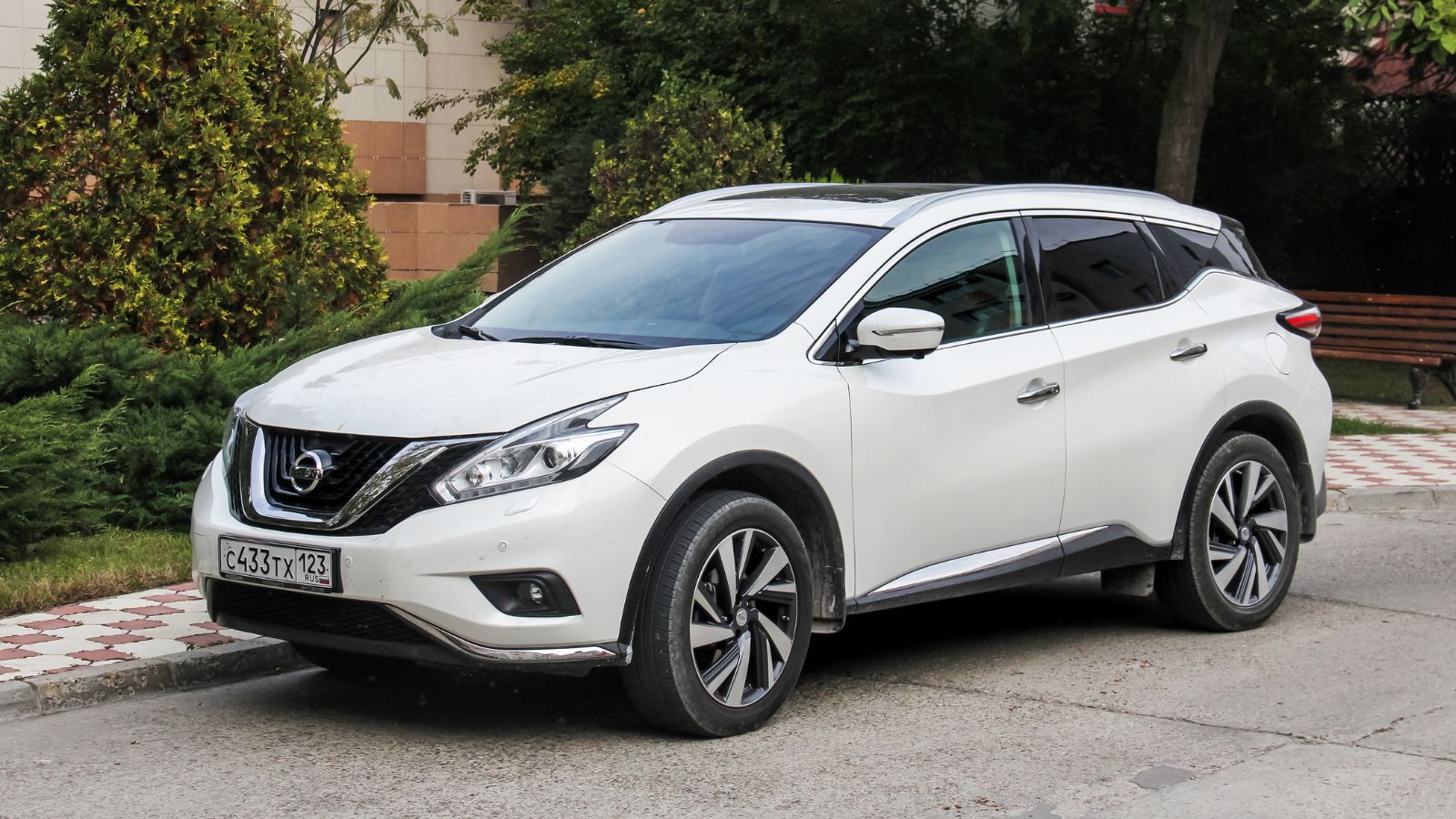
The Nissan Murano is moving further away from its old role as an attainable midsize crossover. In the United States, Nissan has eliminated the entry-level SV for 2027, lifting the model’s effective starting price even as it cuts the price and equipment of the SL that replaces it at the bottom of the range. The contrast is sharper in Canada, where the 2026 Murano is currently offered only as a fully loaded Platinum with a C$58,498 MSRP.
That does not mean Canadians will be limited to the Platinum forever: Nissan has announced a new Dark Armor grade for 2027. Even so, the latest changes show how dramatically the Murano’s pricing ladder has narrowed on both sides of the border, leaving budget-minded buyers with fewer ways into Nissan’s redesigned two-row SUV.
U.S. Buyers Lose the Murano SV for 2027
For 2027, Nissan has removed the Murano SV from the U.S. lineup and made the SL the least expensive version. Nissan’s own pricing lists the 2027 SL at US$43,990 before the US$1,545 destination charge, producing a delivered starting figure of US$45,535. The outgoing 2026 SV carried a US$41,670 MSRP before destination, or US$43,215 including that same charge. In practical terms, the cheapest new Murano has therefore become US$2,320 more expensive from one model year to the next, even though buyers are stepping into a trim name that previously sat above the base model. The lineup now consists of SL, the new Dark Armor, and Platinum, all positioned as comparatively upscale versions of a two-row crossover Nissan already describes as a premium offering.
That move is notable because the Murano had only just been redesigned for 2025, when Nissan gave it a much more modern cabin and exterior. Automakers often use a redesign to expand pricing power, but eliminating the least expensive grade is a stronger signal than a routine annual increase. It changes the shopping conversation before options are added: a customer who simply wants the Murano’s basic design and powertrain can no longer choose the lowest-content SV in the United States. The 2027 Dark Armor sits higher still at US$46,990 before destination, while Platinum is US$49,790. Rather than stretching from a relatively accessible base model to a luxury-leaning flagship, the range is now concentrated within three higher-priced grades that emphasize equipment, styling, and a more premium identity.
The Cheaper SL Also Gives Up Some Equipment
The new U.S. base price needs one important qualification: Nissan did not simply rename the old SL and charge less for the same equipment. The 2027 SL is priced below the 2026 SL, but some previously standard features have been removed. Car and Driver reports that the panoramic moonroof, 10-speaker Bose audio system, and in-dash navigation are no longer included on the SL. Nissan’s 2027 brochure shows those features moving into the Dark Armor package, which also adds 21-inch gloss-black wheels, black exterior accents, special badging, perforated Prima-Tex upholstery, a heated steering wheel, and customizable ambient lighting. The result is a less expensive SL than last year’s SL, but one that has been deliberately stripped back so it can function as the new entry point after the SV disappears.
This kind of reshuffling can make year-over-year pricing look better or worse depending on which comparison is used. Including destination charges consistently, the 2027 SL starts at US$45,535 compared with US$48,305 for the 2026 SL, a US$2,770 reduction. Yet the overall Murano entry point still rises by US$2,320 because the cheaper SV is gone. For shoppers, that distinction matters more than the headline price cut on the SL. A lower price on one trim does not necessarily mean the model has become more affordable when the least expensive version has vanished. It also means equipment that was once bundled into the middle grade may now require stepping up to Dark Armor, which starts US$3,000 above the SL before destination and leans heavily on appearance and comfort upgrades.
Canada’s 2026 Murano Lineup Is Even More Restricted
Canada is already living with an even more compressed version of that strategy. Nissan Canada’s current 2026 Murano page lists a single grade: Platinum AWD at a C$58,498 MSRP. There is no 2026 Canadian SV or SL to serve buyers who like the Murano but do not want the most heavily equipped version. The Platinum includes 21-inch alloy wheels, a 12.6-inch head-up display, quilted semi-aniline leather-appointed seating, and ventilated and massaging front seats. That makes the Canadian Murano richly equipped, but it also pushes every new-order customer toward the top end of the range. Nissan’s pricing page further notes that freight, levies, dealer charges, taxes, registration, and optional products can sit on top of the advertised MSRP, so the real transaction starting point is higher still.
The change is especially striking when compared with the 2025 Canadian lineup. That model year offered three grades, with the SV at C$46,848, SL at C$50,498, and Platinum at C$54,498. Moving to the 2026 single-trim strategy therefore removed two lower-priced entry points and raised the Platinum MSRP by C$4,000. Someone who might have considered a 2025 SV faced an advertised gap of C$11,650 to the 2026 Platinum before fees and taxes. That does not mean every Canadian buyer actually pays that difference, because leftover inventory, incentives, trade-ins, and dealer discounts can change transaction prices. It does show, however, how much the factory lineup narrowed in a single model year and why the C$58,498 figure feels unusually consequential in Canada.
Tariffs Help Explain Canada’s Unusual Trim Situation
The Canadian trim squeeze did not happen in isolation. The current Murano is assembled at Nissan’s Smyrna, Tennessee plant, and Canada has maintained automotive counter-tariffs on U.S.-built vehicles since April 2025. Under the federal framework, Canada imposes a 25% tariff on non-CUSMA-compliant U.S.-made vehicles and on the non-Canadian and non-Mexican content of qualifying U.S.-made vehicles, subject to remission programs. Nissan later acknowledged in financial discussions that it halted shipments from the United States to Canada as part of its response to tariff exposure. Reuters separately reported that Canada-bound production of the Murano and Pathfinder in Tennessee, along with the Frontier in Mississippi, had been suspended after reciprocal auto tariffs disrupted cross-border flows.
That does not prove tariffs alone dictated every Canadian trim decision, but the timing and Nissan’s own statements make them an important part of the explanation. The Automobile Protection Association explicitly notes that the U.S.-built Murano is subject to import tariffs and that Nissan is selling only the Platinum in Canada for 2026. In a tariff-heavy environment, concentrating limited imports in a high-margin, high-content grade can be more workable than maintaining a broad ladder of cheaper versions, although Nissan has not publicly framed the trim strategy in those exact terms. The larger point is that Canadian Murano availability has been shaped by more than normal product planning. Trade policy disrupted the flow of vehicles from Nissan’s U.S. factories, and consumers saw that disruption reflected in fewer configurations at dealerships.
Canada Gets a Cheaper Dark Armor Grade for 2027
There is some relief coming for Canadians in 2027, which is why the C$58,498 headline needs a model-year distinction. Nissan Canada has announced a new Dark Armor grade that will sit below Platinum. Canadian reporting based on Nissan’s release places its MSRP at C$55,898, while the Platinum remains at C$58,498. Dark Armor lowers the factory entry price by C$2,600 compared with the 2026 Platinum, but it does not restore the value end of the old lineup. The 2025 SV started at C$46,848, meaning the new 2027 entry grade is still C$9,050 higher before fees and taxes. The name may suggest a special appearance package, but in Canada it will also serve a more basic commercial purpose: reopening a second rung on a ladder that had been reduced to one.
The equipment mix reinforces that premium positioning. Dark Armor brings gloss-black 21-inch wheels, black Nissan badging, darker exterior trim, unique door badging, sportier bumper details, and Graphite upholstery. Both Canadian 2027 grades use all-wheel drive, while the Platinum remains the richer choice. Mechanically, the Canadian Murano continues with Nissan’s 2.0-litre variable-compression turbocharged four-cylinder, rated at 241 horsepower and 260 lb-ft of torque, paired with a nine-speed automatic. Nissan Canada lists a 1,500-pound towing capacity and estimated fuel consumption of 10.6 L/100 km city, 8.6 highway, and 9.7 combined for the 2026 model. In other words, the 2027 expansion is primarily about price position, styling, and equipment rather than a fundamentally different powertrain.
Stronger Sales Give Nissan Room to Push Murano Upmarket
Nissan is making these pricing moves from a stronger Murano sales position than it had before the redesign. Company data show U.S. Murano sales jumped from 19,316 units in 2024 to 42,747 in 2025, an increase of 121.3%. The momentum did not immediately disappear in 2026: through June, Nissan reported 19,661 U.S. Murano sales, up 7.9% from 18,228 in the same period of 2025. That rebound gives the company a reason to protect the model’s more premium image rather than chase volume with a deeply discounted base grade. It also suggests the redesigned Murano has found a larger audience despite moving away from the V6-and-CVT formula used by its predecessor and adopting the smaller turbocharged engine with a conventional nine-speed automatic.
For buyers, the bigger story is therefore not one isolated price increase but a broader narrowing of choice. In the United States, the SV disappears and the SL becomes the floor, with some equipment removed to keep its price below the old SL. In Canada, the 2026 floor and ceiling are currently the same vehicle: Platinum at C$58,498. The 2027 Dark Armor will improve that situation, but its C$55,898 MSRP remains far above the 2025 SV’s starting point. Nissan can point to stronger Murano sales, a richer cabin, standard all-wheel drive in Canada, and extensive technology to justify the move upmarket. Shoppers, however, are left with a simpler calculation: the Murano may be better equipped than before, but there are fewer inexpensive ways to buy one.