

























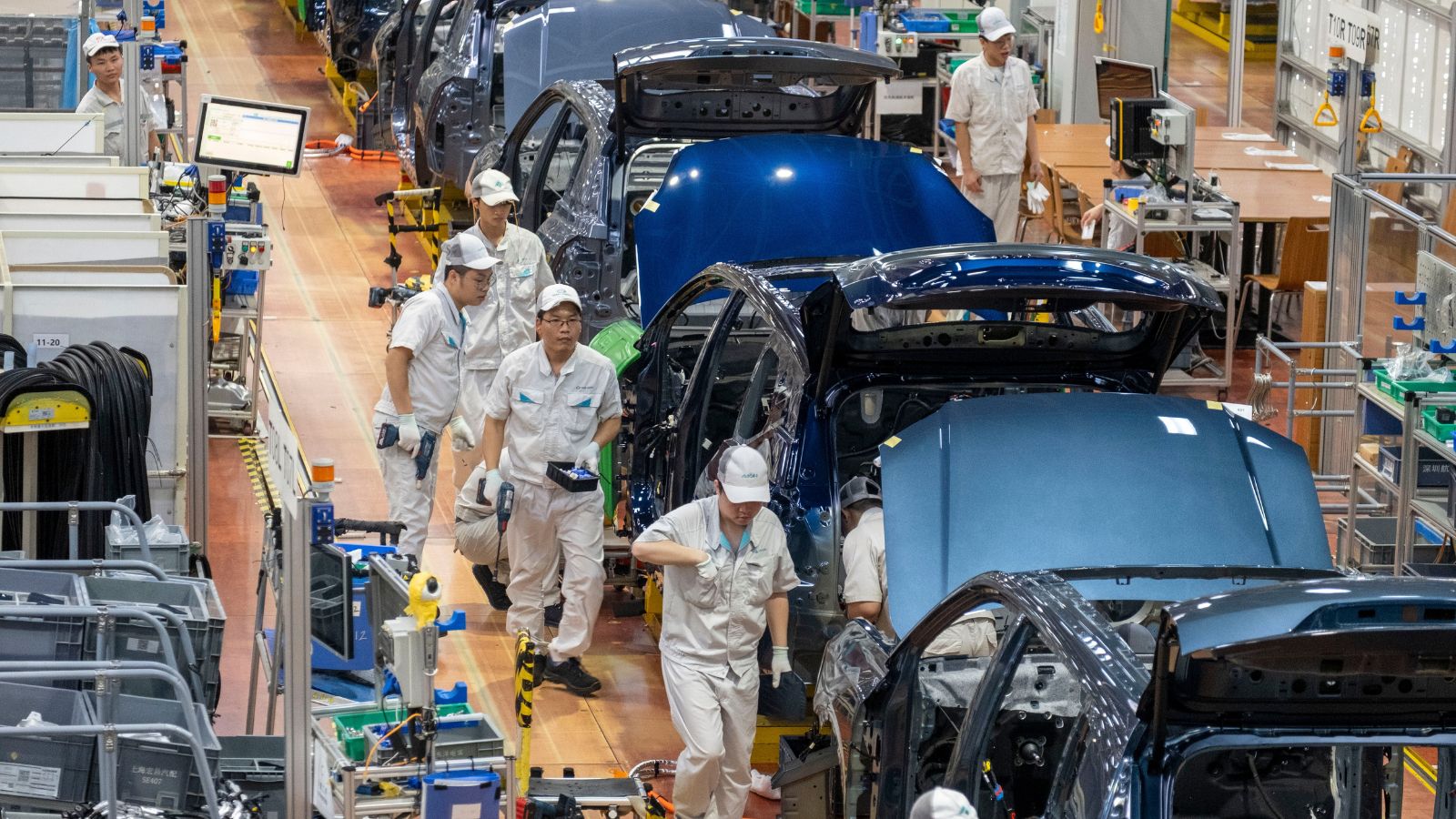
Algoma Steel is heading into the final months of 2026 with one of the most important phases of its industrial transformation still unfolding. The Sault Ste. Marie steelmaker expects third-quarter shipments of approximately 145,000 tons and adjusted EBITDA between negative $10 million and negative $20 million for the three months ended September 30. All financial figures are in Canadian dollars unless otherwise noted.
Those numbers reflect more than a weak shipment quarter. An unexpected outage at Algoma’s Lake Superior Power facility temporarily constrained electric-arc-furnace production just as the company was attempting to ramp its new steelmaking platform. Full power has since been restored, maintenance work has been accelerated, and the second electric arc furnace is moving toward production. That leaves the third-quarter guidance looking backward at a difficult disruption while investors increasingly focus on what happens next.
Q3 Guidance Shows the Scale of the Volume Hit
The headline numbers are stark. Algoma expects approximately 145,000 tons of total steel shipments for its third quarter and adjusted EBITDA between a $10 million and $20 million loss. The company also disclosed that the EBITDA estimate already includes an expected capacity-utilization adjustment of roughly $50 million to $55 million. That adjustment is important because it means the headline EBITDA figure does not tell the entire story about the costs Algoma is carrying during its transition.
Shipment volume puts the disruption into clearer perspective. Algoma shipped 181,473 tons during the quarter ended June 30, 2026, and 419,173 tons in the third quarter of 2025. The new guidance therefore represents another sequential step down from Q2 and a much larger decline compared with the same period last year. The comparison is not entirely like-for-like because Algoma has fundamentally changed its operating model, shutting down its legacy blast-furnace route and increasingly concentrating on EAF-produced steel and Canadian plate. Even with that qualification, 145,000 tons illustrates how much the power interruption complicated an already delicate production ramp.
The Power Outage Became the Quarter’s Defining Operational Event
Algoma’s third quarter was disrupted on August 17 when one turbine at its Lake Superior Power generating facility detected an abnormal condition and automatically went offline. Because Lake Superior Power supplies electricity to the steelmaking operation, Algoma temporarily suspended production at its electric arc furnace. Downstream finishing and shipping were able to continue, meaning the mill did not simply stop functioning, but its ability to replenish steel inventory was constrained at an especially sensitive time.
The interruption proved significant but was not permanent. Algoma worked with Ontario’s Independent Electricity System Operator on interim arrangements that allowed EAF production to resume on August 29 while the affected turbine remained unavailable. By October 1, the company said a replacement turbine had been successfully installed and Lake Superior Power was again operating at full power. Management also used the interruption to bring forward planned maintenance and continue work on the second EAF. That does not erase the lost production, but it potentially moves some future downtime into a quarter that was already disrupted, giving the company an opportunity to enter the next phase with fewer scheduled interruptions hanging over operations.
The Capacity-Utilization Adjustment Makes EBITDA More Complicated
Algoma’s projected adjusted EBITDA loss deserves particular attention because the company expects the figure to include a $50 million to $55 million capacity-utilization adjustment. In previous financial disclosures, Algoma has described this adjustment as primarily representing excess fixed costs associated with operating during the transition from its former production configuration to the EAF system. Those expenses have included labour, fixed utilities, equipment leases, rentals and maintenance connected with assets or staffing levels beyond what was required for the steel volumes being produced.
The adjustment is useful for understanding management’s view of transitional operating performance, but adjusted EBITDA is a non-IFRS measure and should not be treated as the same thing as cash generated by the business. Algoma specifically cautions that adjusted EBITDA does not represent operating cash flow or discretionary cash available for investment or debt reduction. For Q3, that distinction matters. A $10 million to $20 million adjusted EBITDA loss may initially appear modest relative to the shipment decline, but the measure already excludes tens of millions of dollars of costs through the capacity-utilization adjustment. Full quarterly financial statements will therefore provide a considerably more complete picture of the economic impact of the outage and reduced production.
Q2 Provides a Useful Baseline—but Not a Clean Comparison
Algoma reported adjusted EBITDA of $13.8 million in the second quarter of 2026, so the new guidance points to a return to negative adjusted EBITDA. Yet the Q2 figure contained substantial items that make a straightforward quarter-to-quarter comparison misleading. Second-quarter adjusted EBITDA included a $45 million final insurance settlement related to a January 2024 utility-corridor incident, along with a $54.7 million capacity-utilization adjustment. Revenue for the quarter was $267.5 million, while Algoma recorded a net loss of $96 million.
There were encouraging operating developments beneath those figures. Average net sales realization reached $1,361 per ton in Q2, up from $1,132 a year earlier, as Algoma emphasized higher-value plate products. The company also described the period as its second consecutive quarter of record plate sales. At the same time, the cost of steel products sold was $1,411 per ton, reflecting poor fixed-cost absorption while production volumes remained low during the EAF ramp. The Q3 guidance suggests that this basic challenge—getting enough volume through the new operation to spread fixed costs efficiently—remained unresolved when the power outage arrived.
EAF Unit Two Has Become the Most Important Near-Term Milestone
The second electric arc furnace now sits at the centre of Algoma’s operational outlook. On October 1, CEO Rajat Marwah said all electrical equipment on EAF Unit Two had been tested and that the company expected its first heat in the coming days. Production and customer shipments from the second furnace are expected during the fourth quarter. If that timetable holds, Algoma will finally move closer to operating the two-furnace configuration around which its multiyear transformation was designed.
The scale of that project helps explain why the next few months matter so much. Algoma has said the completed EAF system is expected to provide approximately 3.7 million tons of annual raw-steel capacity while reducing annual carbon emissions by roughly 70% compared with pre-EAF levels. The plant uses two large electric arc furnaces instead of the traditional blast-furnace and basic-oxygen route that historically defined steelmaking in Sault Ste. Marie. Unit One has already been operating around the clock and producing multiple plate and hot-rolled-coil grades. Unit Two is intended to add the capacity needed to improve throughput, fixed-cost absorption and operating flexibility across the rebuilt steelmaking system.
Algoma Is Building a Different Business Than It Had a Year Ago
The severe shipment decline compared with 2025 cannot be separated from Algoma’s strategic transformation. The company permanently halted its legacy blast-furnace operations in January 2026 and has been producing liquid steel entirely through EAF technology. At the same time, its commercial focus has shifted away from the historical model of sending large volumes of steel into the United States. Management is instead concentrating more heavily on Canadian customers and, in particular, discrete steel plate.
That strategy produced tangible signs of progress before the Q3 disruption. Algoma reported record plate sales in consecutive quarters and said demand remained healthy across infrastructure, construction and defence applications. The company describes itself as Canada’s only domestic producer of discrete plate, giving it a position that differs from the more crowded coil market. The transition, however, has also meant accepting substantially lower overall shipment volumes while the new furnaces ramp. For a steel operation with significant fixed costs, the difference between producing premium plate successfully and producing enough total steel to absorb those costs is critical. Q3 shows that Algoma is still working through that balance.
U.S. Steel Tariffs Remain Central to the Strategy
Trade policy continues to sit in the background of nearly every major change Algoma has made. The United States raised Section 232 tariffs on covered steel articles to 50% in 2026, and Algoma has repeatedly said those tariffs severely restricted its traditional access to American customers. During Q2, the company incurred $18.7 million in direct tariff costs. U.S.-bound shipments accounted for 23% of total shipments, down from 54% in the same quarter a year earlier and below Algoma’s historical range of roughly 45% to 55%.
The reduced U.S. exposure is intentional rather than temporary positioning. Algoma has said the tariff environment fundamentally altered the economics of its cross-border business and accelerated its shift toward a Canada-centric, plate-first model. There is another challenge inside Canada: steel coil that might otherwise have moved south can remain in the domestic market, increasing supply and putting pressure on pricing. Algoma’s response has been to concentrate on discrete plate, where management says pricing and its competitive position are stronger. The effectiveness of that strategy will become increasingly visible once both EAFs are capable of producing consistently.
Liquidity Gives Algoma Room to Finish the Transition
Algoma entered the second half of 2026 with approximately $437 million of available liquidity. At June 30, that consisted of $62.6 million in cash, $206.7 million of unused availability under its revolving credit facility and $168 million still available through government-backed Large Enterprise Tariff Loan facilities. During Q2 alone, the company received $124.5 million in governmental loan advances to help support operations and complete the EAF transition.
Those facilities stem from a $500 million financing package completed in late 2025, including $400 million from the federal government and $100 million from Ontario. The financing was designed to provide additional liquidity as Algoma adapted to the changed trade environment and completed its industrial transformation. Capital spending is also falling from peak construction levels. Algoma spent $29 million on capital expenditures in Q2 2026, compared with $97.4 million during the same period a year earlier. Lower construction spending and available liquidity provide breathing room, but neither guarantees profitability. The company still needs the new furnaces to translate completed construction into greater steel output, better fixed-cost absorption and stronger operating cash generation.
Q4 Now Has to Demonstrate That the Disruption Was Temporary
The fourth quarter is shaping up as an unusually important test. The immediate power problem appears to have been resolved: Lake Superior Power is operating at full capacity again, planned maintenance was accelerated during the outage and Algoma says the electrical systems on EAF Unit Two have been tested. Management has also pointed to improving steel prices. The next challenge is converting those favourable developments into actual production and shipment growth without another major interruption.
Several indicators should make the direction clearer. Investors will be watching when Unit Two produces its first steel, how quickly it progresses to commercial shipments, whether overall volumes recover from the roughly 145,000-ton Q3 level and whether the capacity-utilization adjustment declines as previously anticipated. Product mix will matter as well, particularly the proportion of higher-value plate compared with coil. Algoma has spent years and significant capital changing both the technology it uses and the markets it serves. The third-quarter guidance captures many of the costs and complications of that transition. The fourth quarter will begin showing whether the new operating model can deliver the production stability and financial improvement the investment was designed to create.