

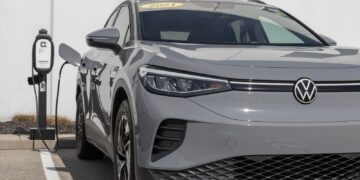




















For thousands of Canadian Volkswagen ID.4 owners, the next charging session comes with a safety precaution: stop at 80%. A federal recall warns that the electric SUV’s high-voltage battery could overheat and cause a fire, even when the vehicle is parked and switched off.
Transport Canada lists 5,633 affected vehicles from the 2023–2025 model years. As of October 20, 2026, its notice says a repair is still under development and advises owners to maintain the charging limit until recall work is completed. Reports of an automatic restriction in the United States do not establish that Canadian vehicles will receive the same change. For affected households, the immediate challenge is adjusting daily routines while waiting for a lasting fix.
Canadian Recall Covers 5,633 ID.4 SUVs
Transport Canada’s recall database identifies 5,633 vehicles under campaign 2026-469, which Volkswagen calls 93EX. The recall is dated September 30, 2026, and the Canadian notice was last updated October 9. It covers certain ID.4 SUVs from three model years: 2023, 2024 and 2025. The notice does not cover every ID.4. The official campaign number gives owners something specific to reference when contacting a dealership about their own SUV and determining which safety instructions apply.
The corresponding American filing lists 22,524 vehicles and includes model years 2023 through 2026. That is a U.S. total, not a Canadian one, and the different year ranges should not be combined into a single eligibility rule. Volkswagen Canada explains that recalls can depend on production periods and particular equipment. Two seemingly identical vehicles can therefore have different recall status. For a household with a recently purchased or second-hand ID.4, checking the vehicle identification number is more useful than relying on its age, appearance or trim badge.
The Fire Warning Applies Even When the SUV Is Parked
Transport Canada explicitly warns that an overheating battery can create a fire risk while an affected ID.4 is parked and turned off. Simply switching off the vehicle is therefore not a reason to dismiss the recall. Volkswagen’s American defect report provides additional context: certain charging patterns, combined with a battery charge above 80%, may trigger heat spreading within the battery pack. The company said the root cause remained unknown in its October 1 filing, making it premature to present a single manufacturing fault as the established explanation.
The same document records 22 U.S. claims identified between January 18, 2024, and August 7, 2026. It does not describe those claims as 22 confirmed fires, and they should not be presented as Canadian incidents. Volkswagen’s investigation included a field study ordered in June 2026 before its safety committee decided on a U.S. recall in September. For owners, the distinction is important: a recall identifies a risk requiring action, not a prediction that every affected vehicle will catch fire. Conversely, normal operation does not make the precaution unnecessary.
The 80% Limit Is a Safety Precaution, Not a Battery Health Score
An 80% charging ceiling does not mean an affected battery has permanently lost one-fifth of its storage capacity. It limits how much charge owners should put into the battery while the safety issue is addressed. Volkswagen’s general Canadian charging advice already recommends an 80% target for everyday use. Normally, that guidance allows charging to 100% before longer journeys. The recall changes that calculation: affected owners are advised to stay at 80% until repairs are completed, rather than making an exception for a weekend trip.
That difference can be easy to overlook when the same percentage appears in both routine battery-care advice and a safety warning. A driver who already charges to 80% may notice little immediate change in commuting habits, but the recall still requires attention. Someone accustomed to starting longer drives with a full battery will need to rethink charging stops. The vehicle’s owner’s manual and dealership can explain the applicable charge settings. The important question is whether the maximum charge target is actually set correctly, not simply whether the car is plugged in for fewer hours.
The U.S. Automatic Charging Cap Is Not a Confirmed Canadian Rollout
Renewed attention to the recall involves Volkswagen’s plan to apply an automatic charging restriction to affected vehicles in the United States. Drive Tesla reports that the company intends to introduce the temporary setting around October 27, 2026. Eligible American owners have until October 21 to decline the automatic change through the myVW app. Crucially, declining that setting does not remove the safety advice: those owners are still expected to keep charging at or below 80% manually until the recall repair is completed.
Canada’s published instructions are different. Transport Canada advises owners to set their maximum charge level themselves and says Volkswagen will provide notification by mail. As of October 20, the Canadian notice does not announce an automatic rollout or the American opt-out deadline. Canadian owners should therefore not wait for a remote update before taking the prescribed precaution. Likewise, a vehicle that still allows a higher target is not necessarily outside the recall. Eligibility and the current charging setting are separate questions, both of which deserve checking before the next charging session.
An Earlier Battery Recall Has Additional Parking and Charging Warnings
Not every ID.4 battery recall carries identical instructions. Transport Canada’s separate campaign 2025-669 covers certain 2023 and 2024 vehicles whose battery cells may have been manufactured improperly. Its notice, updated January 22, 2026, advises three precautions until repairs are completed: limit charging to 80%, avoid Level 3 quick charging, and park outdoors away from other vehicles or structures. That campaign identifies replacement of the affected high-voltage battery modules as the corrective action. These additional requirements could significantly affect a household that normally charges inside an attached garage.
The newer 2026-469 notice does not list those same fast-charging and outdoor-parking restrictions. That difference should not be used to disregard instructions attached to an older, unresolved recall on the same vehicle. Owners need to establish which campaigns apply to their particular SUV and follow all applicable precautions. A dealership can clarify conflicting or incomplete information before a driver makes assumptions about charging or overnight parking. Completing previous battery work also should not be treated as proof that the latest campaign is already resolved; the dealer must verify the vehicle’s current status.
Less Charge Can Mean an Earlier Stop on Longer Trips
The range trade-off is easier to picture with a concrete example. Volkswagen lists an estimated full-charge range of 468 kilometres for the 2024 ID.4 Pro rear-wheel-drive version under Natural Resources Canada’s approved testing methods. A simple 80% calculation produces roughly 374 kilometres, about 94 kilometres less. That is an illustration, not a newly certified range rating or a prediction for every recalled ID.4. Volkswagen cautions that actual distance depends on factors including weather, driving habits, terrain, accessories and vehicle condition.
An additional reserve makes the planning difference more apparent. A driver leaving at 80% and aiming to reach the next charger at 20% has a 60-percentage-point charging window, not the entire battery available for that leg. For someone making short local trips, the adjustment may be manageable. A family travelling to a distant appointment or weekend destination may need an earlier stop. Households relying on shared or public chargers could also need to rethink when they plug in. Planning around the available charge is preferable to treating a longer journey as permission to exceed the recall limit.
Winter Adds Another Variable to the Range Calculation
Canadian winter conditions make a reduced starting charge particularly relevant. In February 2025, the Canadian Automobile Association published results from a cold-weather EV test in which vehicles travelled 14% to 39% less than their official range estimates. The route ran from Ottawa toward Mont-Tremblant in sub-zero temperatures. The ID.4 tested covered 338 kilometres against its published 423-kilometre rating, a shortfall of approximately 20%. That result belongs to the specific test vehicle and conditions; it is not a revised rating for every version of the SUV.
Those findings should not be added mechanically to the recall’s 20-percentage-point reduction in maximum charge. The CAA exercise was not a test of this recall restriction, and it cannot establish a precise winter range for an affected ID.4. Temperature-related performance and the charging ceiling are separate considerations. A parent planning an evening return from a hockey tournament, for example, would need to account for actual conditions and a charging reserve rather than relying solely on a brochure figure. The useful lesson is to plan conservatively, not to claim that every recalled SUV will lose the same amount of winter range.
Checking the VIN Is More Useful Than Waiting for a Letter
Owners can check their vehicle without waiting for a recall letter to arrive. Volkswagen Canada provides an online recall lookup using the vehicle identification number, the 17-character code commonly visible through the lower windshield on the driver’s side. A dealer can also use that number to confirm outstanding campaigns. Keeping a copy of the result and the campaign number can make later conversations easier, particularly when different battery recalls or older repair records are involved. The aim is to establish what applies to the individual vehicle.
Mailing information deserves attention as well. Transport Canada recommends notifying the manufacturer after a change of address and registering a used vehicle with the manufacturer. These steps help ensure notices reach the right household. A missing letter is not reliable evidence that a vehicle is unaffected. The federal department also accepts reports of suspected safety defects and analyzes complaints to determine whether investigation is needed. Reporting an unusual problem can help regulators, but it does not replace contacting Volkswagen about an existing recall.
A Final Repair Is Still Being Developed
The most consequential unanswered question is how long affected Canadian owners will need to live with the restriction. Transport Canada’s latest notice says corrective action for campaign 2026-469 remains under development. It does not provide a firm repair date or promise that every vehicle will receive a replacement battery. A charging cap is an interim measure, not evidence that the underlying problem has been corrected. Owners should distinguish an acknowledgement that their vehicle is recalled from confirmation that the dealership can perform the final repair.
Volkswagen Canada says safety recall repairs are free when completed at its dealerships and do not expire. However, alternative transportation depends on the campaign and vehicle availability at the dealer; a complimentary loaner should not be assumed. For a single-vehicle household, asking about transport arrangements and expected workshop time can be as important as securing an appointment. Keeping dated correspondence and service records can help track what has been promised and completed.
Owners Should Act on the Precaution Before the Next Charge
Affected owners have practical steps available now: confirm all outstanding recalls, set the required maximum charge, and make sure anyone else using the SUV understands the restriction. Volkswagen Canada’s customer-care number is 1-800-822-8987. Suspected safety defects can also be reported to Transport Canada at 1-800-333-0510. Neither a normal-looking charge screen nor the absence of a mailed notice should substitute for checking the vehicle. Owners whose battery is already above the advised level, or who encounter warning messages, should seek vehicle-specific guidance rather than improvising a solution.
Smoke or fire requires a different response altogether. The U.S. Fire Administration advises drivers to stop safely, switch off the vehicle, get everyone out, move away and call 911. It warns against returning to a burning vehicle or trying to fight the fire personally. Protecting passengers takes priority over retrieving belongings or adjusting charging equipment. For everyone else affected by the recall, the task is less dramatic but still important: maintain the precaution, stay in contact with Volkswagen, and arrange the approved repair when it becomes available.