


























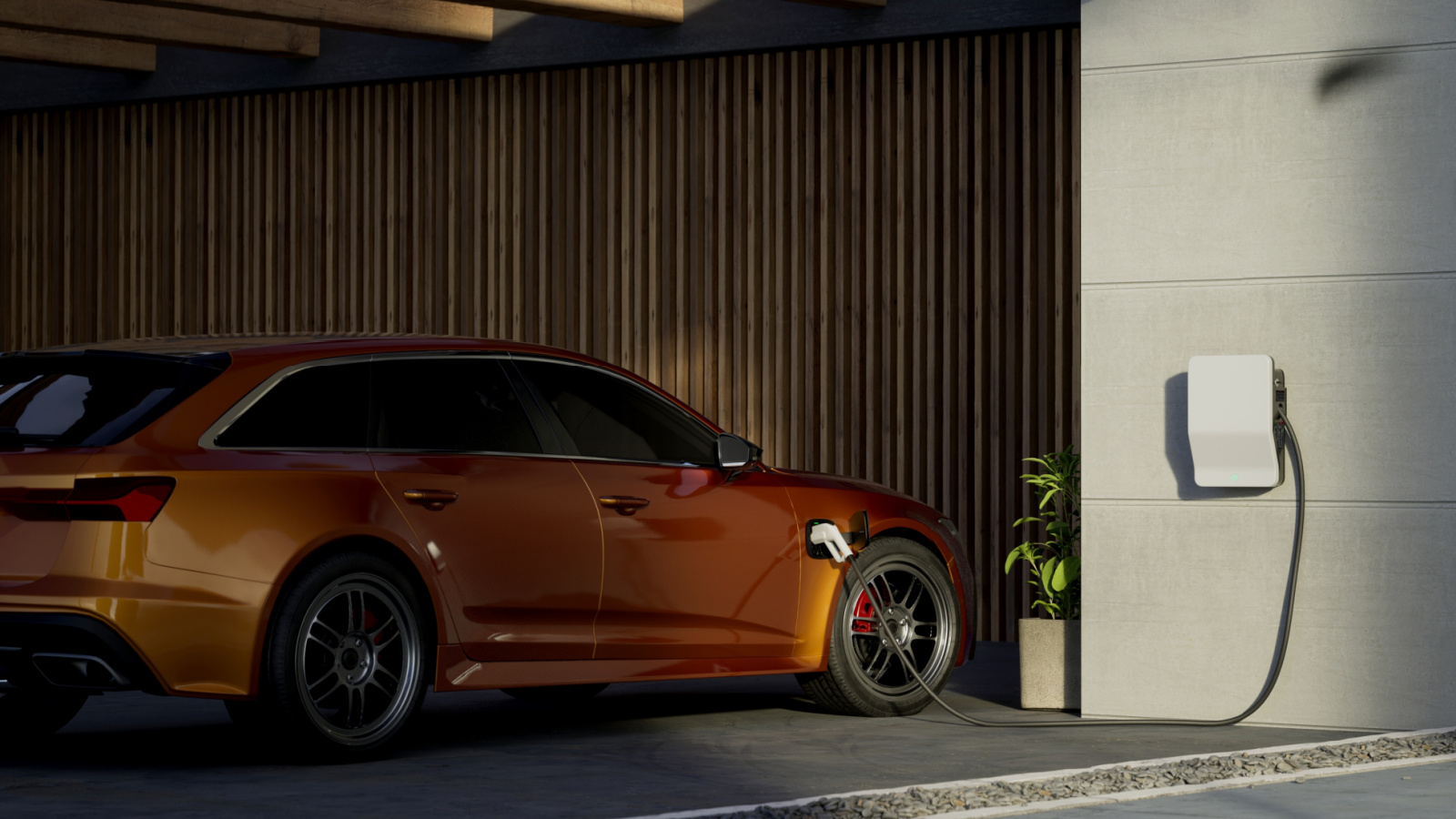
Installing a fast home EV charger can turn into a much larger electrical project than expected, particularly in older Canadian houses where the existing service is already carrying electric heating, appliances and other heavy loads. Schneider Electric is trying to remove some of that friction with Schneider Charge, a new Level 2 residential charger launched in Canada on August 25, 2026.
The hardwired unit can deliver up to 11.5 kW at 48 amps, but its more notable feature is SmartAmp, a built-in system that watches household electricity use and adjusts vehicle charging accordingly. That means many homeowners may be able to install higher-powered Level 2 charging without replacing the main electrical panel or upgrading the home’s electrical service. It is an increasingly relevant problem as more Canadian households add EVs to electrical systems that were never designed with vehicle charging in mind.
The Bigger Story Is the Electrical Panel, Not Just the Charger
Schneider Charge arrives in a market crowded with Level 2 chargers capable of supplying considerably more power than a normal household outlet. What separates the new Canadian offering is the way Schneider Electric has designed the charger around the limits of the house itself. Instead of assuming that 48 amps of additional continuous load are always available, the system monitors how much electrical capacity the household is actually using. Charging can then rise or fall within those limits. For a homeowner with an otherwise adequate panel that simply cannot accommodate another large load at peak times, that distinction can change the scope of the installation dramatically.
The wording is important: SmartAmp can help avoid a panel or service upgrade; it does not make electrical capacity unlimited. A licensed electrician still needs to evaluate the house, determine what wiring and protection are required and commission the installation. Natural Resources Canada notes that Level 2 charging operates at 208 or 240 volts and that electrical capacity is one of the factors that determines home-installation cost. The new charger essentially gives installers another way to manage that capacity instead of automatically increasing it.
SmartAmp Watches the House and Throttles the Car
The SmartAmp system uses current transformers installed at the electrical panel to monitor household demand in real time. When major appliances and other loads leave sufficient capacity available, the EV can charge at a higher rate. If demand rises toward the panel’s limit, the charger automatically reduces its output. Once household demand drops again, charging can increase. Schneider says the monitoring hardware is integrated into compatible hardwired models rather than requiring a separate third-party energy-management gateway.
That approach addresses a familiar residential electrification problem. An EV charger might normally compete for capacity with an electric range, clothes dryer, heat pump, water heater or other large equipment. Most of those appliances do not operate at maximum load all night, while vehicles are often parked for many hours. Dynamic management takes advantage of those changing conditions. It is therefore less about magically creating electricity and more about deciding when the car can safely use the capacity that already exists. Schneider also says the load-monitoring function continues without an active Wi-Fi connection, an important distinction because the core safety function does not depend entirely on a home’s internet service.
Up to 11.5 kW Is Serious Residential Charging Power
At maximum output, Schneider Charge is rated at 48 amps and 11.5 kW. That places it toward the upper end of commonly installed residential Level 2 equipment. Natural Resources Canada says Level 2 charging generally provides substantially faster replenishment than a 120-volt Level 1 connection, although real charging speed varies significantly according to the vehicle, battery, charger and conditions. Schneider and retailers promote the new unit as capable of adding a substantial amount of driving range during each hour connected to a compatible vehicle.
There is an important catch behind that 11.5-kW number. It is a maximum, not a promise that every charging session will remain at that output. The vehicle’s onboard AC charger must be capable of accepting it, and SmartAmp may deliberately reduce power when the rest of the home is using more electricity. That trade-off is central to the product’s design. A household may prefer several hours of variable-rate overnight charging to the expense and disruption of increasing the electrical service simply so the vehicle can draw maximum power continuously. For everyday commuters who park overnight, maximum charging speed is not always the same thing as useful charging speed.
Schneider Built It With Canadian Winters in Mind
Residential charging equipment in Canada frequently lives outside, sometimes mounted to the side of a house rather than protected inside a heated garage. Schneider Charge is rated for indoor and outdoor installation and has an operating-temperature range extending down to -30°C and up to 50°C. The charger also uses a Type 4-rated enclosure, while Canadian retail listings describe the hardwired model as built for outdoor exposure. Those specifications matter in markets where an EV cable may be handled during freezing rain, blowing snow and prolonged periods of sub-zero weather.
Compatibility is another practical part of the launch. Schneider is offering versions with the familiar J1772 connection and with the newer J3400 connector, commonly called NACS. That gives buyers options as the North American vehicle market transitions toward NACS while millions of existing EVs and plug-in hybrids still use J1772. The charger includes a 25-foot cable, giving homeowners some flexibility over where the car needs to sit relative to the installation point. It is also ENERGY STAR certified and carries a three-year warranty, according to Schneider’s Canadian launch materials.
Avoiding an Upgrade Could Change the Installation Economics
The charger itself is only one part of the cost of home charging. Schneider says electrical panel or service upgrades can reach $9,000 or more in some Canadian installations, depending on location and the amount of work involved. That is a manufacturer estimate rather than a universal price, and actual quotes can vary enormously. Natural Resources Canada similarly identifies the home’s electrical capacity, permits, charger price and labour as major variables in installation cost. A straightforward charger installation and a project involving a new service entrance are fundamentally different jobs.
At launch, Home Depot Canada listed a Schneider Charge NACS hardwired model at $899. For some households, that equipment price could therefore be much smaller than the cost of modifying the electrical service around it. This is where load management has its strongest appeal. A family shopping for an EV may have budgeted for a charger and electrician, only to discover that the electrical work could cost several times more. If SmartAmp allows an installer to stay within an existing service where regulations and the specific installation permit it, the financial equation becomes considerably easier. It will not eliminate upgrades in every home, but it can reduce the number of homes that require one.
Installation Still Belongs in the Hands of an Electrician
Smart load management does not turn a 48-amp charger into a do-it-yourself appliance. Schneider Charge is initially being sold as a hardwired unit, and Schneider says SmartAmp is configured during professional installation. Current transformers have to be positioned to measure the relevant electrical load, while the charger’s circuit, conductors and protection still have to satisfy applicable electrical requirements. Natural Resources Canada recommends licensed electricians for Level 2 installations and notes that they can evaluate a home’s available capacity and handle required permits.
Schneider has also tried to simplify the contractor side of the process. Its eSetup application is designed to help installers commission the charger, while Canadian customers can be connected with installation services through Schneider’s relationship with Qmerit. After installation, drivers can use the Schneider Charge app to monitor sessions and set charging schedules. That can be particularly useful in provinces with time-of-use electricity rates, where delaying a charging session until lower-cost hours can reduce operating expenses. The smartest part of the system may therefore happen quietly: the car charges when the home has room, while the owner mostly notices that it is ready in the morning.
Home Charging Is Becoming Part of Canada’s Electrical-Infrastructure Question
The potential audience for equipment like this is already substantial. Transport Canada’s EV dashboard counted 726,126 light-duty battery-electric vehicles and 304,823 light-duty plug-in hybrids operating in Canada as of October 1, 2025. Meanwhile, Natural Resources Canada says more than 80% of EV owners charge at home. Even after new zero-emission vehicle registrations weakened in 2025, Statistics Canada recorded 43,113 new ZEV registrations in the first quarter of 2026. Every additional plug-in vehicle eventually raises the same practical question somewhere: where will it charge?
That makes residential electrical capacity a broader EV-adoption issue rather than a niche concern for electricians. Building more public fast chargers remains important, but most routine vehicle energy is still likely to be delivered where cars spend the night. Schneider Charge represents one response to the challenge: rather than treating every new EV as a reason to build a larger household electrical system, it attempts to use the existing one more intelligently. For Canadian homeowners with limited spare panel capacity, that may prove more valuable than the charger’s headline 11.5-kW rating.