

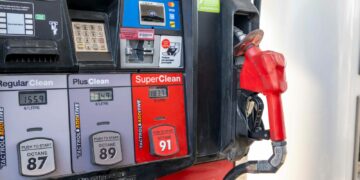

























Canada’s fuel-price squeeze is producing two striking numbers at opposite ends of the country. Montreal diesel is forecast at 299.9 cents per litre for September 21 and 22, putting the fuel effectively at the $3-a-litre threshold, while regular gasoline in Vancouver is expected to remain at 206.9 cents per litre.
The numbers arrive as global refined-fuel supplies remain unusually tight and Canadian households are already dealing with gasoline prices well above year-ago levels. Diesel has become the bigger concern because its price is being driven not only by expensive crude oil, but also by refinery disruptions and shrinking inventories. For truckers, contractors and businesses that cannot simply reduce fuel use, the impact can extend far beyond the service-station sign.
Montreal Diesel Is Effectively at the $3 Mark
The Montreal forecast puts diesel at 299.9 cents per litre for both September 21 and September 22, while regular gasoline is forecast at 203.9 cents. That nearly one-dollar spread between diesel and regular gasoline is unusually painful for anyone operating a diesel pickup, delivery vehicle or commercial truck. It also underscores how differently the two fuels are behaving in the current energy market. Diesel is no longer simply moving up and down alongside gasoline.
Retail information collected from Quebec’s regulated price-reporting system supports the direction of that forecast. Montreal diesel averaged about 297.6 cents per litre in the latest September 20 data, compared with roughly 257 cents in late August. In Mont-Royal on September 21, individual reported prices ranged from 295.9 to 298.9 cents. In other words, the forecast is not describing a distant possibility. Diesel prices near $3 per litre are already appearing around the Montreal market, transforming what was already an expensive fill-up into a significant operating expense.
The Diesel Increase Has Been Remarkably Fast
The speed of the increase may be as important as the headline price. Montreal diesel was around 257 cents per litre in late August before moving through the 270s, 280s and 290s during September. Quebec-wide data show a similar trajectory, with average diesel prices rising from roughly 256.5 cents on August 25 to almost 296 cents by September 20.
Such a rapid increase is difficult for businesses to absorb. A trucking company can attempt to pass fuel costs through a surcharge, but contracts and competitive pressure can delay that adjustment. A contractor running several diesel work trucks may have little choice but to keep filling them. Farmers, construction operators and delivery businesses face similar problems because fuel is tied directly to the amount of work they can perform. The latest Montreal numbers therefore matter beyond motorists who happen to own diesel vehicles. They are part of a broader increase in the cost of moving equipment, goods and people.
A Global Diesel Shortage Is Driving the Market
Diesel has become one of the tightest parts of the global energy market. International supplies have been disrupted by the continuing conflicts involving Iran and Ukraine, affecting refinery production and exports from the Middle East and Russia. Reuters reported on September 21 that global diesel inventories have fallen to historically low levels and that industry participants do not expect the shortage to disappear quickly.
The strain is visible far beyond Canada. U.S. diesel prices moved above US$6 per gallon for the first time during the current crisis, while inventories remain unusually low. Middle Eastern diesel shipments between March and August were roughly half their year-earlier level, according to current market reporting. Russian refinery disruptions have added another problem to a market already short of refined products. Because diesel is traded internationally, Canadian wholesale prices are exposed to those pressures even when Canada itself has crude-oil production. Having crude available is not the same as having enough finished diesel in the right market at the right time.
Refining Has Become Almost as Important as Crude Oil
Fuel prices are often explained by what happens to crude oil, but the present diesel spike shows why that is only part of the story. A barrel of crude still has to be processed into gasoline, diesel, jet fuel and other products. When refining capacity is restricted or diesel production falls, the wholesale value of the finished fuel can climb much faster than the underlying crude price.
The U.S. Energy Information Administration describes the difference between crude costs and wholesale diesel prices as a diesel “crack spread,” commonly used as a measure of refinery margins. Those spreads have surged in 2026 as distillate supplies tightened. Global refineries have been operating at high utilization rates, leaving relatively little spare capacity to make up for major outages elsewhere. U.S. distillate inventories also remained well below normal seasonal levels in September. That helps explain why a decline in crude prices does not necessarily produce an equally rapid decline at a diesel pump. The bottleneck can exist farther downstream in the refining system.
Vancouver Gasoline Is Still Holding Above $2
Diesel is generating the most dramatic increases, but gasoline motorists are hardly escaping. Vancouver regular gasoline is forecast at 206.9 cents per litre for September 21 and 22 after rising three cents on September 20. Premium is forecast at 236.9 cents, while Vancouver diesel is considerably higher at 289.9 cents per litre.
Vancouver routinely carries one of Canada’s higher gasoline price structures, and the current market adds global energy pressure on top of regional costs. The Vancouver-area motor-fuel tax on regular gasoline is 27 cents per litre, including the 18.5-cent TransLink levy and other provincial and transportation charges. British Columbia eliminated its consumer carbon tax in April 2025, so that levy is no longer part of the current pump price. Even so, Vancouver’s forecast remains far above markets such as Edmonton, where regular gasoline is forecast at 176.9 cents. For commuters and households with multiple vehicles, another prolonged period above $2 can quickly become a noticeable monthly expense.
Taxes Matter, but They Do Not Explain the Entire Spike
Taxes remain an important part of Canadian pump prices, although the latest diesel surge cannot be attributed to taxation alone. Quebec’s regular provincial fuel-tax rate is 19.2 cents per litre for gasoline and 20.2 cents for non-coloured fuel oil and diesel. Federal excise taxes also returned on September 8 after a temporary national suspension ended, restoring 10 cents per litre on gasoline and four cents on diesel.
That restoration added some upward pressure, but Montreal diesel has moved by far more than four cents since late August. The Quebec energy regulator explains that pump prices also incorporate the wholesale rack price, transportation costs, taxes and retail margins. The wholesale component itself reflects crude prices and refining margins and is linked to broader North American petroleum markets. This distinction becomes important when prices move dramatically: changing taxes can alter the baseline, but a diesel market approaching $3 per litre requires looking at the much larger international supply and refining pressures now affecting wholesale fuel.
Canadians Were Already Paying Much More for Gasoline
The latest price spike is arriving after months of energy-driven inflation. Statistics Canada reported that gasoline prices were 22.8% higher in August 2026 than a year earlier. That was slightly slower than July’s 25.7% annual increase, but it still left gasoline as one of the more visible sources of pressure on household budgets.
Transportation prices overall were up 7.5% year over year in August, while Canada’s headline Consumer Price Index increased 3.0%. Excluding gasoline, inflation was considerably lower at 2.4%. Those figures demonstrate why fuel attracts so much attention even when other parts of the inflation basket are calmer. A price displayed on a roadside sign is encountered repeatedly, and households that commute long distances have limited ability to avoid it. The September increases are also too recent to be fully captured in the August CPI data, meaning the most recent movement in Montreal diesel and Vancouver gasoline belongs to the next stage of the inflation picture rather than the statistics already released.
Diesel Costs Can Travel Through the Supply Chain
High gasoline prices are primarily visible to households, but diesel prices can spread more quietly through the economy. Heavy trucks, delivery fleets, agricultural equipment and numerous industrial machines depend heavily on diesel. When their fuel becomes more expensive, businesses can absorb the cost temporarily, reduce other spending or eventually attempt to pass some of it along through higher prices.
Statistics Canada was already finding significant transportation pressure before diesel approached $3 per litre in Montreal. Prices for truck-transportation services increased 9.5% year over year in the second quarter of 2026 and 5.3% from the previous quarter. Earlier business data showed that 65.8% of transportation and warehousing businesses expecting input-cost obstacles identified energy as a concern. Canada also had more than 155,000 business locations in the truck-transportation subsector as of June. That makes diesel more than a niche automotive expense. Higher fuel bills can eventually appear in freight charges, construction estimates, agricultural costs and the price of getting products onto store shelves.
A Forecast Is Not the Price at Every Station
The 299.9-cent Montreal diesel number and Vancouver’s 206.9-cent gasoline figure should be read as regional price forecasts rather than guarantees for every station. Fuel markets can vary significantly within the same metropolitan area because retailers have different inventories, margins, competitive conditions and timing for wholesale deliveries. A station can therefore be several cents above or below the regional prediction.
Current Montreal-area data illustrate that distinction. Mont-Royal stations reporting diesel prices on September 21 ranged from 295.9 to 298.9 cents per litre, close to but not identical to the 299.9-cent forecast. Montreal regular gasoline data also show meaningful differences between individual stations. Forecast services use wholesale fuel-market movements, crude prices, exchange rates, supply conditions and other variables to estimate where regional prices are headed. They are useful for identifying direction and scale, particularly during periods of rapid change, but a motorist driving across a city can still encounter substantially different signs within minutes.
Relief May Depend More on Refineries Than on Oil Alone
There are potential paths to lower prices, but the latest market outlook suggests diesel may remain vulnerable. Additional exports from large refining centres, repaired facilities in Russia and the Middle East, stronger refinery production elsewhere and rebuilding inventories could all reduce the pressure. Lower crude prices would help as well, particularly for gasoline. The difficulty is that several of those conditions have to improve at the same time for diesel markets to normalize rapidly.
The U.S. Energy Information Administration expects American distillate inventories to fall below 100 million barrels in September and remain below the recent five-year low through much of 2027. It also expects disrupted Russian refinery activity to affect global markets into the first half of next year. That does not mean Montreal diesel will remain at $3 per litre throughout that period; retail prices can move sharply in either direction. It does mean the underlying market remains fragile. For Canadian motorists and businesses, the next meaningful signal may come from refinery output and diesel inventories as much as from the daily price of crude oil.