
























A federal rebate program designed to make electric vehicles more attainable is quickly revealing which models fit Canada’s new definition of “affordable.” Since the Electric Vehicle Affordability Program began in February 2026, more than 44,700 incentive requests have been submitted and nearly $195 million has been committed. Yet Tesla, once the most visible name in Canada’s electric transition, accounts for only 1,009 of those applications.
That contrast is striking, but it does not tell a simple story of Canadians abandoning Tesla. The program’s price ceiling, trade rules and limited list of qualifying Tesla vehicles have reshaped the competition. Toyota, Chevrolet and other manufacturers are benefiting from broader lineups that include lower-priced battery-electric vehicles and plug-in hybrids. The early results show how quickly government policy can redirect consumer demand—and how a rebate designed around affordability can rearrange the EV leaderboard.
A Strong Start Has Begun to Level Off
The program’s first months produced a burst of activity. April alone generated 21,662 incentive requests, followed by 10,364 in May and 10,116 in June. Combined, May and June still delivered 20,480 applications, but that was about 37% below the same two-month period under the former federal program in 2024. The slowdown matters because it suggests the initial wave included shoppers who had delayed purchases while federal support was unavailable.
Even so, more than 44,700 applications in less than five months is substantial. At an average committed amount of roughly $4,360 per request, the program is supporting a mix of full battery-electric vehicles and lower-rebate plug-in hybrids. For a family comparing a gasoline crossover with an electric model, a point-of-sale discount can change the monthly payment immediately. The numbers therefore reflect more than enthusiasm for new technology; they capture households timing major purchases around a federal incentive that can remove several thousand dollars from the upfront cost.
Tesla’s Share Is Only About 2.3%
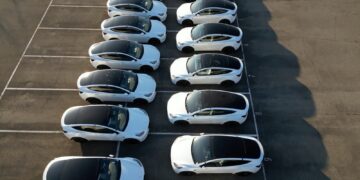
Tesla’s 1,009 applications represent roughly 2.3% of all requests submitted so far. That is a surprisingly small position for a company whose Model 3 and Model Y were Canada’s two leading electric models in 2023. The latest rebate table instead places Tesla far behind manufacturers offering several eligible vehicles across different body styles and powertrains.
The main constraint is product eligibility. Transport Canada’s current list includes the 2026 Model Y RWD-B for the full $5,000 incentive, while Tesla advertises the qualifying rear-wheel-drive version at a $49,990 transaction price. Other Tesla trims exceed the program’s threshold, and the lower-priced Model 3 imported from China does not satisfy the program’s free-trade-country requirement. A shopper may therefore prefer a Tesla and still receive no federal support for the exact version wanted. The 1,009 total is best understood as the result of a narrow doorway: Tesla can enter the program, but only through one qualifying configuration.
Toyota and Chevrolet Are Winning the Model Race
The early leaders are vehicles positioned close to the centre of the Canadian market. The Toyota bZ has generated 6,013 applications, the Toyota Prius Plug-in Hybrid has 4,842, and the Chevrolet Equinox EV has 4,402. Together, those three nameplates account for more than 15,000 requests—about 34% of the program total.
Their success shows the advantage of variety. Toyota can reach buyers who want a fully electric crossover as well as drivers who are more comfortable with a plug-in hybrid. Chevrolet’s Equinox EV, meanwhile, competes in the familiar compact-SUV segment that many households already shop. The vehicles do not need to dominate every specification comparison; they need to fit the price rules, arrive in practical configurations and feel recognizable to mainstream buyers. At a dealership, that can mean the difference between discussing an EV as a risky lifestyle change and treating it as the next family vehicle. Tesla’s single eligible option cannot cover as many budgets, preferences or charging situations.
The $50,000 Rule Changes the Shopping Process
EVAP is not a simple rebate attached to every electric vehicle below a published base price. Most eligible transactions must finish at $50,000 or less, although Canadian-made EVs are exempt from that cap. The vehicle must also be manufactured in Canada or in a country that has a free-trade agreement with Canada. In 2026, qualifying battery-electric and hydrogen fuel-cell vehicles can receive up to $5,000, while plug-in hybrids can receive up to $2,500.
That final-transaction test makes options, accessories and dealer negotiations unusually important. A model may appear on Transport Canada’s information list, yet a particular deal can lose eligibility if the final value crosses the threshold. Conversely, manufacturer discounts can bring a vehicle back under the line. Buyers are effectively shopping for both a vehicle and a compliant transaction. The structure favours automakers able to price several trims near the cutoff, while premium packages create added risk. It also explains why a brand’s broader Canadian sales do not automatically translate into a large share of rebate applications.
Tesla’s Current Position Is a Sharp Historical Reversal
Tesla’s modest EVAP count looks even more dramatic against its earlier role in Canada. Transport Canada reported that the Model Y and Model 3 were the country’s best-selling zero-emission models in 2023, with the Model Y moving into first place. Under the former iZEV program, Tesla repeatedly gained or lost eligibility as prices changed, showing how strongly federal thresholds could influence its position.
The company also entered 2026 carrying controversy from the previous program. In March 2025, Ottawa froze approximately $43 million in pending Tesla rebate payments while claims were reviewed, after an unusual end-of-program surge that included nearly 4,000 claimed sales from one Quebec City location over a single weekend. The current 1,009 applications are separate from those older claims, but the contrast is hard to miss. Tesla has moved from being a rebate-program powerhouse to a limited participant. Policy design, manufacturing origin and transaction price now matter as much as brand recognition.
Quebec Still Shapes the National Picture
EV adoption remains highly concentrated by province. Through May, Quebec accounted for 17,269 EVAP applications, more than twice Ontario’s 7,135 and ahead of British Columbia’s 6,757. Alberta recorded 1,351. Those differences reflect years of uneven provincial incentives, charging investment, vehicle availability and consumer familiarity with electrified transportation.
Broader registration data reinforces Quebec’s importance, although the national market is becoming more balanced. Statistics Canada recorded 43,113 new zero-emission vehicles in the first quarter of 2026, equal to 10.8% of all new registrations and 15.8% more than a year earlier. Battery-electric registrations rose 12.9%, while plug-in hybrids increased 22.9%. For automakers, the provincial map matters almost as much as the national total. A model that qualifies for both federal and provincial support may look far more attractive in one province than another. It also means national rebate rankings can be heavily influenced by what Quebec buyers choose, especially when a popular plug-in hybrid or affordable crossover becomes widely available.
Rebates Still Have a Measurable Effect on Demand
The softer application pace after April should not be mistaken for evidence that incentives no longer matter. Canadian research examining provincial programs found that each additional $1,000 in purchase support was associated with a 5% to 8% increase in electric-vehicle sales, with roughly 35% of sales in rebating provinces attributed to the incentives during the study period. International research has also found that direct rebates tend to produce stronger adoption effects than delayed tax credits.
Canada’s recent market swings point in the same direction. Zero-emission vehicles reached 15.4% of new light-duty registrations in 2024, then demand weakened in 2025 as federal and some provincial incentives paused or disappeared. After EVAP launched on February 16, 2026, first-quarter ZEV registrations rose year over year despite a difficult broader vehicle market. A rebate cannot solve every barrier, but it can move a purchase forward, steer a buyer toward a qualifying trim or make an electric model competitive with a discounted gasoline vehicle. The 44,700 applications are evidence of that leverage.
Affordability Extends Beyond the Purchase Price
The rebate focuses attention on the showroom price, but households ultimately pay for a vehicle over many years. The federal government notes that charging an EV can cost substantially less than buying gasoline for the same distance, while the Canadian Automobile Association estimates electric vehicles can reduce maintenance costs by roughly 40% to 50%. Those savings are meaningful, particularly for drivers with predictable commutes and access to home charging.
Still, the lowest long-term cost is not always the easiest purchase. Research and federal consumer studies have repeatedly identified upfront price, charger access and uncertainty about ownership as barriers. A renter without a dedicated parking outlet may value a $5,000 rebate but still face inconvenient public charging. A rural household may worry about winter range or long distances between fast chargers. EVAP addresses one major obstacle without eliminating the rest. The most successful qualifying models will therefore combine a manageable transaction price with useful range, practical cargo space, dependable charging and a dealer network capable of explaining the transition clearly.
Most of the Five-Year Budget Remains Available
Nearly $195 million has been committed, but the program began with $2.275 billion over five years. As of July 1, about $2.08 billion remained—more than 91% of the original funding. The current figures therefore do not point to an immediate repeat of the former program’s abrupt funding exhaustion. They instead provide Ottawa with an early test of whether the tighter rules are directing money toward affordable vehicles without burning through the budget too quickly.
The next question is whether application volumes stabilize, rise with new model launches or weaken after the first wave of delayed buyers clears. Tesla could improve its position by adding eligible configurations or changing where Canadian vehicles are sourced, while rivals may keep adjusting discounts to land below the $50,000 ceiling. For now, the clearest lesson is that the rebate has created its own competitive market. More than 44,700 Canadians have used it, but the winners are not simply the most famous EV brands. They are the manufacturers best able to build, source and price vehicles around the program’s rules.