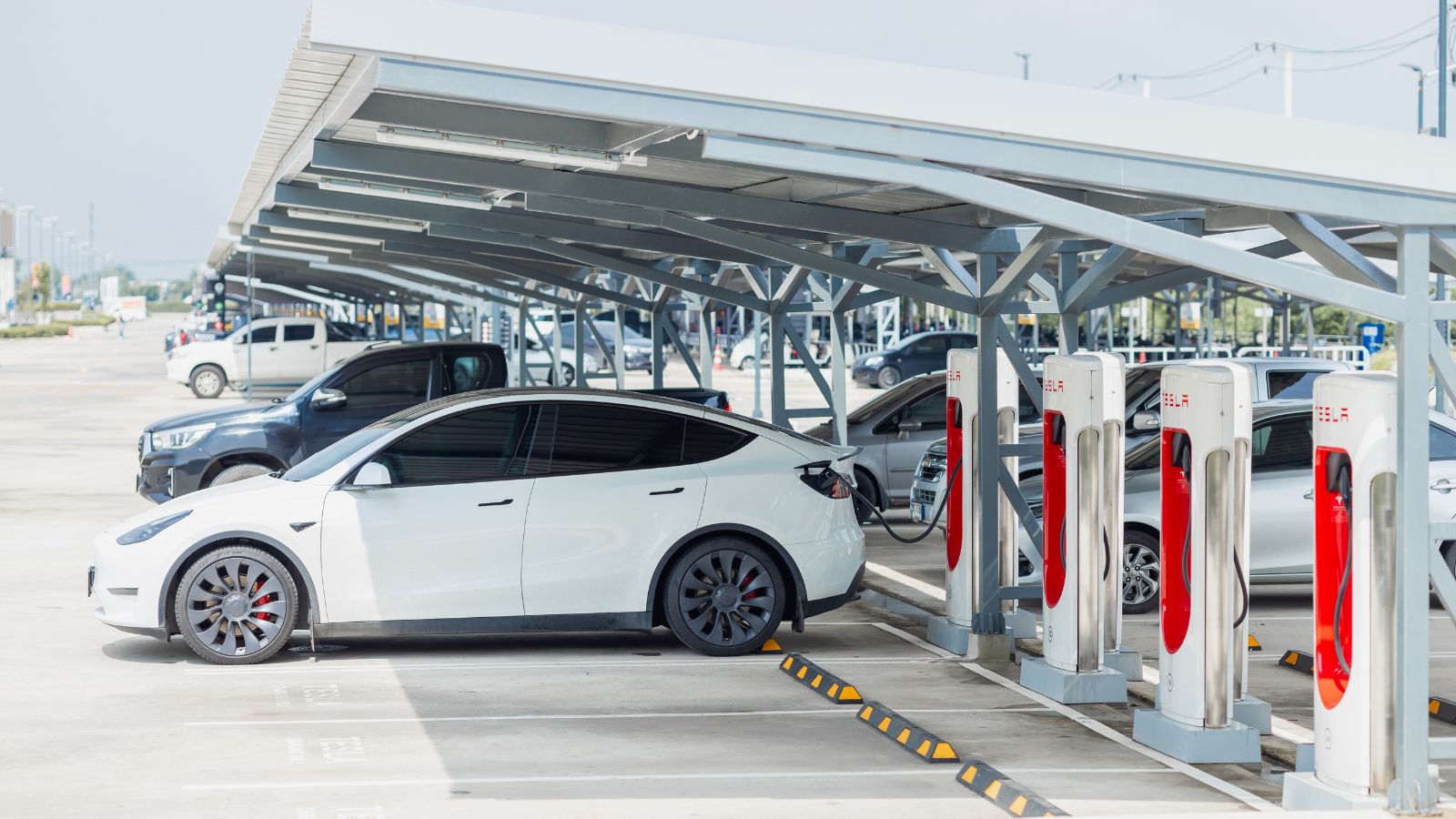
A major highway junction in British Columbia is preparing for another substantial expansion of electric vehicle charging infrastructure. Tesla is developing a new Supercharger location near Merritt, where recent construction photographs suggest at least 32 charging stalls are taking shape. If completed with that number, the project would bring the community’s combined Tesla Supercharger capacity to 72 stalls across five locations, an 80% increase over its existing network. The development comes as British Columbia expands fast-charging infrastructure along major travel corridors and more drivers depend on electric vehicles for journeys beyond major cities. For motorists crossing the Coquihalla Highway, travelling toward the Okanagan, or towing recreational trailers through the Interior, the project could make an important difference in charging convenience, availability, and confidence during long-distance travel.
A Fifth Tesla Supercharger Is Taking Shape Near Merritt
Tesla’s newest charging development is located near Hamilton Hill Road, close to the junction of Highway 5 and Highway 5A outside Merritt. The project appeared on Tesla’s Supercharger development map in July 2026 before its status was subsequently changed to under construction. On October 12, Drive Tesla reported that photographs submitted by a reader named Glenn showed substantial progress at the location. Based on the visible layout, the station appears to include at least 32 charging stalls, several of which are configured for vehicles towing trailers.
The location occupies part of the former Merritt Visitor Centre area, a familiar stopping point for travellers entering British Columbia’s Interior. Although construction is visibly progressing, Tesla has not publicly confirmed the final stall count, maximum charging output, or an opening date for the new station. That distinction matters because installation work does not necessarily mean a site is ready for customers. Electrical commissioning, safety checks, and network activation can still affect when chargers become operational. For now, the project represents a substantial addition under development rather than 32 additional charging stalls that motorists can already use. Its eventual opening would give Tesla drivers another option at one of the province’s important highway connections.
Merritt’s Existing 40 Charging Stalls Could Increase to 72
Merritt already has four Tesla Supercharger stations offering a combined 40 charging stalls. Tesla’s existing listings include eight stalls at the original Best Western Plus location on Crawford Avenue, eight at Wagon West Travel Plaza on Airport Road, and another eight beside Mary Brown’s Chicken on De Wolf Way. A newer 16-stall station on Crawford Avenue completes the current total. The two Crawford Avenue installations are listed separately by Tesla despite sharing the same street address. Their maximum advertised charging outputs also vary, ranging from 150 kilowatts at the older installation to 325 kilowatts at the newer one.
Adding an estimated 32 stalls would increase Merritt’s total to 72, representing an 80% expansion in available Tesla charging positions. Importantly, the figure would describe charging capacity distributed across five stations rather than a single 72-stall facility. For drivers, additional locations and stalls can be valuable during busy travel periods when multiple vehicles arrive within minutes of one another. More charging positions could reduce the likelihood of queues and provide alternatives if another location is occupied. However, stall counts alone do not establish charging speed or network reliability. The actual improvement will depend on available electrical capacity, charger performance, and how many vehicles use the stations simultaneously.
The Highway Junction Explains Why Merritt Needs So Many Chargers
Merritt’s importance to electric vehicle travel has considerably more to do with geography than population. The city occupies a strategic position along the Coquihalla Highway, connecting the Lower Mainland with communities farther into British Columbia. The nearby Okanagan Connector, Highway 97C, provides another major route toward Kelowna and the southern Interior, while Highway 5 continues north toward Kamloops. The City of Merritt has estimated that approximately 20,000 vehicles pass the Gateway 286 area daily, highlighting the importance of the interchange for regional transportation and roadside businesses.
This concentration of highway traffic makes Merritt a practical place for drivers to recharge before continuing through mountainous terrain. Long journeys can involve significant changes in elevation, temperature, and weather conditions, all of which influence an electric vehicle’s energy consumption. Tesla’s own driving guidance identifies uphill travel, cold weather, high speeds, and added cargo as factors that can reduce available range. A driver approaching the Coquihalla after several hours on the road may therefore value charging access more than someone travelling a short distance within a city. By concentrating additional fast chargers near established travel routes, Tesla could make Merritt a more dependable stopping point during busy weekends and seasonal travel periods.
Pull-Through Charging Stalls Could Make Trailer Travel Much Easier
One particularly useful feature visible in the new Merritt development is the apparent inclusion of pull-through charging stalls. Unlike conventional charging spaces, which often require vehicles to reverse into a parking position, pull-through stalls allow drivers to enter and leave while keeping a trailer attached. This can make a meaningful difference for electric pickup owners, families towing recreational trailers, and travellers carrying larger loads. A driver arriving after hours on the highway may otherwise have to disconnect a trailer before reaching the charging cable.
Merritt already has experience with this approach. When Tesla developed its 16-stall Crawford Avenue station in 2024, construction photographs showed five planned pull-through charging positions. The newer project appears to incorporate similar provisions, although the exact number has not been confirmed. Trailer accessibility matters because towing presents two separate challenges for EV drivers: higher energy consumption and the physical difficulty of accessing some charging spaces. Tesla’s driving guidance acknowledges that trailers and external accessories can significantly reduce vehicle efficiency, particularly at highway speeds. Charging stations designed around these conditions could help make electric towing more practical, rather than treating it as an unusual activity.
The Former Visitor Centre Is Becoming a Larger Commercial Gateway
The setting of Tesla’s newest development has a history that extends beyond electric vehicles. The former Merritt Visitor Centre site is being redeveloped as Gateway 286, a commercial project intended to create a modern stopping point for highway travellers. The City of Merritt has described plans for a 47,000-square-foot commercial centre containing restaurants, convenience shopping, fuel services, EV charging, and public gathering spaces. The approximately $40-million development involves Troika Developments, PR Petroleum, and Spayum Holdings LP, which represents five Nicola Valley First Nations.
For the surrounding community, the project carries economic and cultural significance. The land is part of the traditional territories of the Nlaka’pamux and Syilx peoples, and its redevelopment follows decades of efforts to establish Indigenous participation in local economic opportunities. The former visitor centre, recognizable for its log-building design, was itself a familiar landmark for generations of travellers. City planning materials describe efforts to preserve and reuse some of its original logs. The broader project aims to create employment, commercial activity, and services at a previously underused highway property. The Tesla construction fits the area’s planned transition toward modern transportation services, although detailed commercial arrangements between Tesla and the development partners have not been publicly confirmed.
BC Hydro Is Also Expanding Fast Charging Along the Coquihalla
Tesla’s Merritt expansion is taking place alongside another important infrastructure improvement on the same highway corridor. On June 29, 2026, BC Hydro announced the expansion of its fast-charging location at the Britton Creek Rest Area near the Coquihalla Summit, between Hope and Merritt. The upgraded site includes two 400-kilowatt chargers and two 350-kilowatt chargers. Through power-sharing technology, the four charging units can accommodate up to eight electric vehicles simultaneously, with the available output distributed between connected vehicles when necessary.
The upgraded facility also incorporates different charging connector configurations, including CCS, NACS, and CHAdeMO, increasing compatibility with a wider range of electric vehicles. BC Hydro described the location as one of the most heavily used sites in its network, illustrating why highway charging capacity is becoming a major infrastructure priority. By July 21, the utility’s provincial public charging network had reached 917 charging ports across 190 locations. The combination of privately operated Tesla Superchargers and publicly supported charging infrastructure offers drivers more options along demanding routes. The distinction is important: Tesla’s planned 32 stalls in Merritt and BC Hydro’s installations at Britton Creek are separate projects, each serving different parts of the highway charging network.
More Charging Stalls May Also Benefit Drivers Outside the Tesla Brand
An important development in Canada’s charging landscape is Tesla’s gradual decision to open selected Supercharger locations to electric vehicles manufactured by other companies. The automaker now supports charging access for numerous brands through the North American Charging Standard, also known as NACS or SAE J3400. In Merritt, Tesla’s official listings identify the 16-stall Crawford Avenue station and the eight-stall Airport Road station as locations accessible to eligible non-Tesla vehicles. The older Best Western installation and the De Wolf Way location, however, do not currently display the same non-Tesla access information.
That distinction means not all 40 existing stalls should be assumed available to every electric vehicle owner. Drivers of compatible Ford, General Motors, Hyundai, Kia, Rivian, and other supported models may be able to use eligible Tesla stations, sometimes requiring a manufacturer-approved NACS DC adapter. Tesla also advises drivers to check individual station compatibility through its app or interactive charging map before travelling. The new 32-stall Merritt facility could provide additional opportunities for drivers of other brands, but Tesla has not confirmed which vehicles it will support. Charging accessibility will depend on the final hardware, Tesla’s network arrangements, and vehicle compatibility when the station becomes operational.
British Columbia’s Growing EV Fleet Is Putting Greater Demands on Charging Infrastructure
British Columbia already has a substantial electric vehicle population, making continued investment in public charging increasingly important. Provincial figures released in July 2026 showed more than 238,000 light-duty zero-emission vehicles registered as of April 1. At that time, British Columbia also had more than 8,900 public charging ports, representing an 87% increase from 2023. The province’s figures distinguish between slower Level 2 chargers and fast-charging ports, which are particularly important for longer journeys where drivers cannot leave their vehicles connected for several hours.
The expansion is continuing through both public and private investment. In July, BC Hydro announced a $700-million program to significantly increase its public charging network, targeting 3,500 charging ports by 2035. The utility plans to develop larger charging hubs, improve reliability, and introduce faster equipment, including 400-kilowatt chargers at selected high-demand locations. These investments reflect a broader shift in how charging infrastructure is being designed. Early networks often focused on ensuring that a charger existed somewhere along a route. As the number of electric vehicles grows, the next challenge is ensuring enough working chargers are available when several drivers need them at once. Merritt’s proposed expansion illustrates that transition from basic route coverage toward greater capacity.
Tesla Is Expanding Charging Infrastructure Across Several B.C. Communities
Merritt is not the only British Columbia community experiencing a new wave of Tesla charging development. Construction has also been reported at Highgate Village Shopping Centre in Burnaby, where approximately 12 V4 charging stalls are planned. Two additional Supercharger locations are being developed in Surrey, while work continues on a long-awaited station in Keremeos. In early October 2026, Tesla also began construction on a new Supercharger in Squamish near the Sea to Sky Hotel. These projects indicate that the company is expanding charging availability across both densely populated urban areas and important regional travel corridors.
Other communities have already seen new stations begin operating. In late August, Tesla opened an eight-stall Supercharger in Sicamous. September brought additional openings in northern British Columbia, including four stalls in Vanderhoof, eight in Terrace, and four in Prince Rupert. Together, the three northern stations added 16 charging stalls along Highway 16, although significant distances between available stations remain. This broader expansion helps explain why Merritt’s proposed 32-stall installation stands out. Rather than merely introducing charging to a previously unserved community, Tesla is substantially increasing capacity at an established highway location. The strategy reflects the growing importance of providing enough chargers at popular stops while continuing to extend coverage into underserved regions.
Opening Dates, Charging Speeds, and Final Capacity Still Need Confirmation
Despite the visible progress at Merritt’s newest Supercharger development, several important details remain unresolved. Tesla has not announced a confirmed opening date, final equipment specifications, maximum charging output, or public charging prices for the proposed station. The estimated 32-stall layout comes from construction photographs rather than a detailed public specification issued by the company. The broader Gateway 286 project has also experienced scheduling difficulties. In September 2025, developer Troika explained that securing sufficient electricity for its planned charging facilities had contributed to delays in the commercial redevelopment. That history illustrates the infrastructure requirements behind large charging hubs, although it does not establish that Tesla’s current installation faces a new delay.
For drivers, the most meaningful milestone will come when the chargers are officially activated and listed as operational. Tesla’s charging guidance recommends checking the app or vehicle navigation system for station availability, compatible equipment, and applicable prices. Actual charging speeds also depend on vehicle capabilities, battery temperature, state of charge, and operating conditions. Until the new site opens, Merritt’s existing 40 Tesla stalls remain the confirmed operating capacity. If the additional 32 stalls are completed and activated as expected, the community would reach 72 across its Supercharger network. The project would represent more than another roadside construction achievement: it could make a strategically important stretch of British Columbia’s highway system easier to navigate for an increasingly diverse population of electric vehicle drivers.