























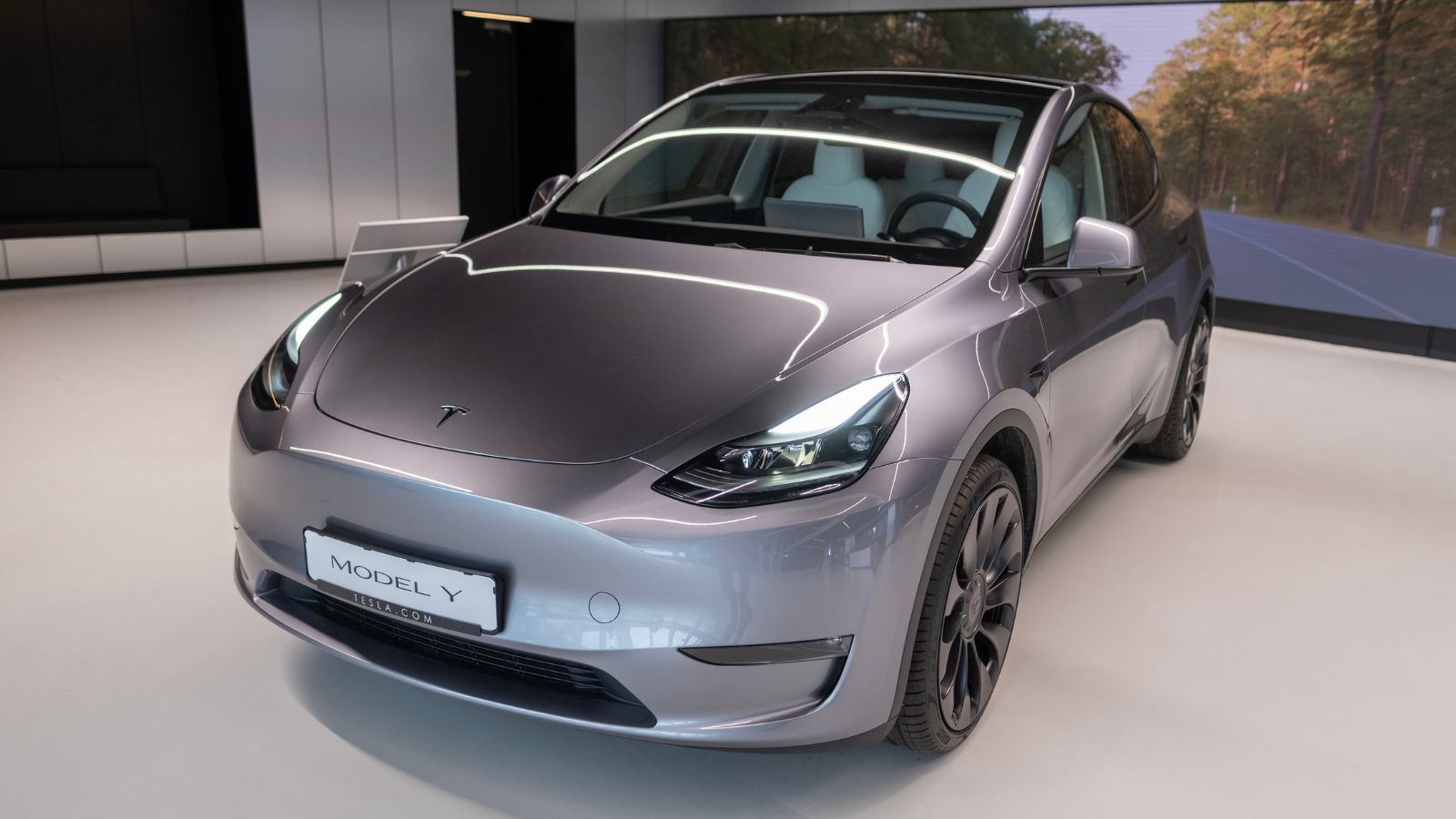
Canada’s electric vehicle market is revealing a surprising divide between what Ontario drivers are choosing and what is proving most popular across the country. New federal rebate data for October 2026 shows the Tesla Model Y dominating incentive requests in Ontario, while the Chevrolet Bolt secured the top position nationally.
The figures, released by Transport Canada on November 16, provide a fresh look at how Canadians are responding to federal EV incentives, vehicle pricing, and expanding electric vehicle choices.
With federal rebates scheduled to decrease in January 2027, the results offer important insight into which models are attracting buyers, how regional preferences differ, and why the competition between established manufacturers and Tesla is becoming increasingly interesting.
Tesla Model Y Dominates Ontario’s EV Rebate Requests
Ontario emerged as a particularly strong market for the Tesla Model Y in October 2026, with Transport Canada recording 1,194 federal rebate requests associated with Ontario recipients. That represented approximately 31% of the province’s 3,860 requests under the Electric Vehicle Affordability Program (EVAP). The Chevrolet Bolt followed with 537 requests, while the Toyota bZ recorded 239 and the Chevrolet Equinox EV accounted for 233. Tesla’s lead was substantial, with the Model Y attracting more than twice as many requests as its closest competitor.
The figures are especially significant because Ontario currently offers no separate provincial electric vehicle purchase rebate. Eligible buyers therefore rely on the federal incentive to reduce their purchase or lease costs. For someone comparing an electric SUV with conventional gasoline alternatives, an incentive worth up to $5,000 can make a meaningful difference to the overall purchase decision. Although the statistics do not establish why individual buyers selected Tesla, they demonstrate the Model Y’s strong position among Ontario consumers seeking federally eligible electric vehicles.
Chevrolet Bolt Takes First Place Across Canada
The national results tell a different story. Across Canada, the Chevrolet Bolt generated 2,420 federal EV rebate requests during October, securing first place ahead of the Tesla Model Y’s 1,834. The Chevrolet Equinox EV ranked third with 1,321 requests, followed by the Ford Mustang Mach-E with 1,034 and the Kia Niro EV with 942. In total, Transport Canada recorded 14,878 incentive requests during the month, including 12,664 for fully electric vehicles and 2,214 for plug-in hybrids.
The Bolt’s national advantage over Tesla amounted to 586 requests, illustrating how different the rankings become when Canada’s provincial markets are combined. While the Model Y commanded a particularly large share of Ontario’s eligible requests, Chevrolet attracted enough interest elsewhere to finish comfortably ahead. The results also illustrate that the competition is not simply between Tesla and one traditional automaker. Chevrolet placed two models among the country’s three most-requested vehicles, suggesting that its electric lineup is reaching customers across different vehicle categories and price points.
Ontario and Quebec Reveal Different EV Buying Patterns
Ontario accounted for 1,194 of the Model Y’s 1,834 rebate requests nationwide in October, representing approximately 65% of Tesla’s national total for that model. Quebec contributed another 303 requests, while British Columbia accounted for 201. The distribution helps explain how Tesla could dominate one of Canada’s largest vehicle markets without securing the national lead. By comparison, only 537 of the Chevrolet Bolt’s 2,420 requests were associated with Ontario recipients, meaning most of the Bolt’s activity originated elsewhere in the country.
Provincial incentive programs provide additional context. Quebec’s Roulez vert program offers up to $2,000 toward eligible new electric vehicles registered in 2026, potentially supplementing the federal incentive. Ontario currently has no comparable provincial EV purchase rebate. Quebec also accounted for approximately 52.5% of national EVAP requests during the third quarter of 2026, demonstrating its considerable influence on Canadian rankings. While these financial differences may shape purchasing decisions, the available statistics cannot determine whether rebates, vehicle pricing, dealership availability, or other considerations were responsible for the contrasting provincial results.
Vehicle Pricing Helps Explain the Bolt’s Appeal
Affordability is central to Canada’s federal EV incentive structure, and the Chevrolet Bolt enters that conversation with a significant pricing advantage over the Tesla Model Y. Chevrolet lists the 2027 Bolt LT with a starting manufacturer’s suggested retail price of $39,999, compared with Tesla’s listed $49,990 MSRP for the Model Y rear-wheel-drive variant. The Bolt also offers up to 422 kilometres of manufacturer-estimated electric range, positioning it as an option for drivers seeking practical daily transportation without entering a higher vehicle price category.
Federal eligibility rules make this comparison particularly important. Under EVAP, qualifying vehicles generally must have a final transaction value of $50,000 or less, although Canadian-made vehicles are exempt from that price ceiling. Transport Canada’s eligible vehicle list includes specific Model Y rear-wheel-drive versions, along with the Chevrolet Bolt LT and RS. The more expensive Model Y all-wheel-drive configuration is not included among the eligible versions. While purchase prices can change with options, dealer charges, and available discounts, the Bolt’s lower starting MSRP offers a plausible reason for its appeal among cost-conscious buyers. However, rebate statistics alone cannot establish that pricing determined the national outcome.
Rebate Requests Are Not the Same as Confirmed Vehicle Sales
One important distinction is that federal rebate requests do not necessarily represent completed vehicle sales or deliveries. Transport Canada’s EVAP statistics track incentive requests submitted by participating dealerships and authorized sellers. Under the program, eligible customers generally receive the incentive directly on their purchase or lease agreement, while the seller handles the paperwork required for federal reimbursement. The published figures therefore provide useful information about rebate activity but should not be treated as a complete ranking of Canada’s best-selling electric vehicles.
The October records offer additional insight into Tesla’s activity. Of the 1,834 Model Y requests submitted nationally, 1,790 were classified as purchases and 44 as leases. Almost every request—1,830 in total—listed the maximum $5,000 incentive. The records also included 976 vehicles identified as 2026 models and 858 identified as 2027 models. These details show that buyers were seeking rebates across two model years and overwhelmingly pursuing transactions eligible for the full incentive. However, the information does not establish exactly how many vehicles were delivered or whether every request ultimately resulted in an approved payment.
Tesla’s October Requests Declined From September
Despite its strong Ontario performance, the Tesla Model Y recorded fewer national rebate requests in October than in the previous month. According to Transport Canada’s updated October dataset, Model Y requests declined from 2,376 in September to 1,834 in October, a decrease of approximately 23%. That represented 542 fewer requests over the month. Interestingly, total EVAP requests across all eligible models moved in the opposite direction, rising from a revised 14,151 in September to 14,878 in October, an increase of approximately 5%.
The monthly pattern deserves attention because Tesla’s rebate activity has not followed a consistently upward trajectory. The October records also show substantial variation within the month itself, including 678 Model Y requests dated October 1 through October 4 and another 858 during the final seven days. Transport Canada does not identify the reasons behind those concentrations. Its statistics are also subject to revision as claims are processed, meaning historical figures can change between releases. Consequently, October’s decline should not automatically be interpreted as a comparable drop in actual retail demand. It does, however, show that Tesla’s position within the eligible EV market remains competitive and subject to monthly fluctuations.
Canada’s Broader EV Market Is Continuing to Expand
The competition between Tesla and Chevrolet is unfolding during a period of substantial growth in Canadian electric vehicle sales. Statistics Canada reported on November 16 that 28,490 new zero-emission vehicles were sold nationwide in September 2026, an increase of 66.6% compared with the same month in 2025. These vehicles represented 15.8% of all 180,457 new vehicles sold during September, up from 10.1% a year earlier. The figures include both fully electric vehicles and plug-in hybrids, demonstrating the expanding presence of electrified transportation within Canada’s automotive market.
However, the broader sales statistics and federal rebate figures measure different things. Statistics Canada’s numbers include new zero-emission vehicles regardless of whether they qualified for federal incentives, while Transport Canada’s EVAP statistics cover requests involving eligible transactions. The reporting periods also differ, with September’s sales data being compared against October’s rebate activity. As a result, the Bolt’s leading position in federal rebates does not establish that it was Canada’s overall best-selling electric vehicle. Similarly, Tesla’s dominance in Ontario rebate requests cannot be interpreted as dominance of every EV sale in the province. Both datasets provide valuable but distinct perspectives on changing Canadian vehicle preferences.
The Upcoming Federal Rebate Reduction Adds Urgency
The timing of Canada’s electric vehicle incentive program could become increasingly important as 2026 approaches its end. Transport Canada has confirmed that the maximum federal rebate for eligible fully electric vehicles will decline from $5,000 to $4,000 on January 1, 2027. Plug-in hybrid incentives will also decrease, from a maximum of $2,500 to $2,000. Importantly, the applicable rebate amount is determined by when a participating dealership submits the customer’s eligibility assessment, rather than when the vehicle is delivered. An approved eligibility assessment remains valid for 90 days.
Ottawa originally allocated $2.275 billion to the five-year EVAP program, with approximately $1.87 billion remaining as of November 1, 2026. The program is scheduled to operate until March 31, 2031, although it could end earlier if available funding is exhausted. For households considering an EV purchase, the approaching reduction creates another factor to consider alongside pricing, driving range, and availability. The October results suggest that both Tesla and Chevrolet have established considerable interest among rebate-eligible customers, but their contrasting provincial performances also demonstrate that Canada’s electric vehicle transition is unlikely to favour a single manufacturer or model across every market.