


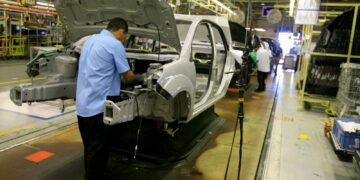





















Canada’s automotive industry is facing a critical test as President Donald Trump’s trade proposals raise concerns about the future of Canadian manufacturing jobs. Former Canadian ambassador to the United States David MacNaughton has warned that Washington’s demands could threaten employment across the sector, arguing that Ottawa must seriously consider alternative partnerships if negotiations fail to protect Canadian workers.
His warning comes as Prime Minister Mark Carney explores opportunities beyond the United States, including potential partnerships with Chinese automakers. With more than 120,000 direct automotive manufacturing jobs and hundreds of thousands of related positions connected to the industry, the stakes extend far beyond individual assembly plants. The growing uncertainty is forcing Canada to confront a difficult question: how much of its automotive future can remain dependent on decisions made in Washington?
Former Ambassador Raises Alarm Over Trump’s Automotive Demands
David MacNaughton, who served as Canada’s ambassador to Washington from 2016 to 2019, delivered a warning on November 16, 2026, about the potential consequences of President Trump’s automotive trade proposals. Speaking with iPolitics, MacNaughton argued that the measures being discussed by the American administration could eliminate a substantial number of Canadian jobs. Having represented Canada during Trump’s first presidency and the negotiations that produced the Canada-United States-Mexico Agreement (CUSMA), he brings firsthand experience dealing with difficult trade negotiations.
MacNaughton said exploring alternatives to the current relationship was sensible, particularly if Washington continues pursuing policies that undermine Canadian manufacturing. However, he did not advocate abandoning the American market. He emphasized the importance of preserving the ability to export Canadian-made vehicles to the United States while finding ways to reduce the country’s vulnerability. His position reflects a growing dilemma for Ottawa: Canada needs a functioning North American automotive industry, but it cannot assume the American administration will always prioritize maintaining that integration.
Proposed U.S. Content Rules Could Reshape North American Manufacturing
One of the biggest concerns involves proposed changes to automotive rules of origin under CUSMA. Under the existing agreement, passenger vehicles and light trucks generally need 75% North American content to qualify for preferential treatment. Reuters reported in May that American negotiators were seeking to increase that requirement to 82%, with at least 50% of a vehicle’s value produced specifically in the United States. Such a change could fundamentally alter how automakers allocate production across the continent.
The distinction matters because existing rules recognize qualifying manufacturing activity across Canada, Mexico and the United States. A separate American-content requirement could encourage manufacturers to relocate higher-value production to U.S. facilities, potentially reducing opportunities for Canadian suppliers. These stricter percentages remain reported negotiating proposals rather than enacted treaty changes. Separately, Canadian-made vehicles have faced American tariffs since April 2025, including a 25% duty on non-U.S. content in qualifying vehicles. Together, existing duties and proposed new rules create uncertainty for companies deciding where to invest in their next generation of vehicles.
More Than 120,000 Canadian Manufacturing Jobs Face an Uncertain Future
Canada’s automotive industry represents far more than a handful of large assembly plants. Federal government figures show that the industry employed approximately 121,600 people directly in 2025 and contributed $17.1 billion to the Canadian economy. Nearly 700 automotive parts manufacturers support major producers, including Ford, General Motors, Honda, Stellantis and Toyota. The industry’s broader economic influence stretches into transportation, engineering, equipment manufacturing and other services that depend on vehicle production.
The dependence on American customers makes those jobs particularly vulnerable. More than 90% of Canadian-made vehicles and approximately 60% of Canadian-made automotive parts are exported to the United States, according to federal estimates. Statistics Canada found that 76.4% of jobs in automobile and light-duty vehicle manufacturing were supported by U.S. demand in 2024. The agency also reported a 9.3% decline in motor-vehicle parts manufacturing employment between December 2024 and December 2025. Although those losses cannot all be attributed directly to tariffs, the figures demonstrate why changes to cross-border trade could have serious consequences for Canadian workers.
Automotive Parts Cross the Border Repeatedly Before Vehicles Are Finished
Canada’s automotive industry operates through a highly integrated manufacturing network that connects factories, suppliers and assembly plants across North America. MacNaughton highlighted this dependence by explaining that automotive components can cross the Canada-U.S. border six or seven times before being installed in a finished vehicle. The Canadian Vehicle Manufacturers’ Association similarly estimates that some components can cross North American borders as many as eight times during production. This interconnected system allows manufacturers to use specialized facilities in different countries rather than duplicate every stage of production.
That integration also makes sudden trade restrictions particularly disruptive. Federal government documentation indicates that approximately half the value of Canadian-produced vehicles exported to the United States comes from American parts. Consequently, policies that make Canadian assembly less competitive could also hurt American suppliers. The busy Detroit-Windsor manufacturing corridor illustrates the scale of these connections. More than 2.2 million truck crossings occurred on the Ambassador Bridge in 2024, with automotive manufacturing accounting for a significant share of the traffic. Changes to tariffs, customs requirements and production rules can therefore create costs and uncertainty throughout the supply chain.
Carney Refuses to Accept a Trade Deal That Undermines Canadian Auto Production
Prime Minister Mark Carney has made protecting Canadian automotive manufacturing a central condition of negotiations with Washington. Speaking in Manila on November 14, Carney said his government would not accept an agreement that failed to preserve a viable Canadian auto sector. Although he indicated that negotiations were progressing, he acknowledged that automotive manufacturing remained among the most difficult issues. He also disclosed a substantial conversation with Trump involving U.S. Trade Representative Jamieson Greer and White House chief of staff Stephen Miller.
Carney’s position became more consequential on November 16, when he raised the possibility of working with Chinese, European or Japanese automakers if negotiations could not preserve an integrated North American industry. He emphasized that reaching an agreement with Washington remained the priority, while making clear that Canada needed other options. The prime minister presented diversification as a response to changing economic conditions rather than simply a negotiating threat. For Canadian manufacturers, the distinction is important. A diplomatic agreement might reduce immediate tensions, but its long-term value will depend on whether companies can continue investing in Canadian factories and employing Canadian workers.
Chinese Automakers Offer an Alternative, but Industry Leaders Remain Skeptical
China has emerged as one of the most controversial potential partners in Canada’s efforts to diversify automotive manufacturing. Under an agreement announced in January 2026, Canada agreed to permit an initial annual quota of 49,000 Chinese electric vehicles at a tariff rate of 6.1%, replacing the previous 100% surtax for eligible imports. Ottawa hopes the arrangement will eventually encourage Chinese manufacturers to establish joint ventures, expand Canadian supply chains and create jobs. Carney has emphasized that future Chinese investment must involve substantial domestic manufacturing rather than simply assembling imported vehicle kits.
However, industry representatives have questioned whether Chinese manufacturers could realistically replace the economic contribution of established North American automakers. Automotive Parts Manufacturers’ Association president Flavio Volpe has argued that Chinese companies have strong incentives to maintain production in their domestic market. Canadian Vehicle Manufacturers’ Association president Brian Kingston has also stressed the importance of preserving American market access. Ontario Premier Doug Ford has warned that Chinese imports could threaten existing jobs and complicate relations with Washington. These concerns highlight the difference between making more vehicles available to Canadian consumers and creating sustainable manufacturing employment within Canada.
Stellantis’ Brampton Dispute Shows What Canadian Workers Could Lose
The ongoing dispute involving Stellantis provides a concrete example of the risks facing Canada’s automotive sector. The company abandoned plans to produce the Jeep Compass at its Brampton, Ontario, facility, shifting the program to Illinois and leaving more than 2,000 Canadian workers laid off. Stellantis subsequently agreed to sell the idled factory to Canadian defence vehicle manufacturer Roshel. On November 12, Ottawa issued a notice alleging that Stellantis had breached commitments tied to a 2022 federal funding agreement. The government had originally committed up to $529 million to help retool Stellantis facilities in Brampton and Windsor.
Industry Minister Mélanie Joly gave Stellantis 30 days to address the alleged breaches or potentially face legal action and demands to repay government funding. Roshel has outlined plans to create jobs as production expands and has promised priority hiring consideration for affected workers. Nevertheless, those plans do not guarantee the restoration of the same automotive manufacturing operations. Ontario Premier Doug Ford also indicated on November 16 that additional financial support could be considered if Stellantis committed to restoring employment. For affected families, the dispute demonstrates how quickly decisions about vehicle production can create lasting uncertainty.
Japanese and South Korean Partnerships Offer Additional Opportunities
Canada is also working to strengthen automotive relationships with established manufacturers outside the United States. On November 13, Ottawa announced $313 million in federal support for Honda’s $867 million investment plan to modernize its operations in Alliston, Ontario. The provincial government is contributing another $156 million. The project will support production of the next-generation Honda Civic and CR-V, expand electrified vehicle manufacturing and help maintain more than 4,000 jobs. It is also expected to support annual production capacity of up to 400,000 vehicles, providing a concrete example of continued automotive investment in Canada.
South Korea represents another potential opportunity. In January, Canada signed an agreement to strengthen industrial cooperation involving future mobility, electric vehicles, batteries and critical minerals. The arrangement includes efforts to expand South Korean automotive manufacturing activity within Canada. These partnerships could help attract investment and diversify the country’s technological capabilities. However, they are not an immediate replacement for the American market. Existing Japanese manufacturers operating in Canada remain connected to North American production networks, meaning new investment must complement efforts to preserve established trade relationships.
Ottawa’s Automotive Strategy Aims to Protect Jobs While the Industry Adapts
The federal government has introduced several measures intended to protect domestic manufacturing as trade negotiations continue. Canada’s automotive strategy, announced in February 2026, dedicated up to $3 billion from the Strategic Response Fund and another $100 million through regional tariff-response initiatives to support industrial investment and diversification. The government also outlined employment assistance and retraining support for up to 66,000 workers across Canada, backed by a $570 million investment. Additional measures include work-sharing assistance and incentives for companies investing in Canadian vehicle production.
These programs are designed to help manufacturers remain competitive while preparing for changes in automotive technology and international trade. Ottawa is also using its automotive tariff-remission framework to encourage companies to maintain production and investment commitments in Canada. However, financial assistance alone cannot guarantee that manufacturers will continue assigning new vehicle programs to Canadian plants. Companies still need profitable production opportunities, reliable supply chains and access to large consumer markets. The effectiveness of government intervention will ultimately depend on whether it preserves existing jobs, attracts sustainable investment and helps workers transition into new manufacturing opportunities without prolonged periods of unemployment.
Canada’s Long-Term Challenge Is Protecting Existing Trade While Building New Options
MacNaughton’s warning highlights a challenge that extends beyond the immediate tariff dispute. In July 2026, the United States declined to extend CUSMA under its existing terms, triggering annual reviews of the agreement. Although the trade pact remains in force, it is scheduled to expire in 2036 unless all three countries agree to extend it. This uncertainty complicates long-term manufacturing decisions, particularly for companies planning investments that require years of development before new vehicles reach production.
During his November 16 appearance before a parliamentary committee, MacNaughton urged Canada to pursue a durable agreement with Washington while diversifying trade and improving domestic productivity. Carney’s November 17 meeting with Chinese President Xi Jinping demonstrated both the possibilities and limitations of that approach. The leaders discussed electric vehicles and expanded trade cooperation, but Ottawa’s announced agreements did not include a new Chinese vehicle assembly plant. For Canada, the challenge is balancing immediate job protection with longer-term industrial independence. Preserving American market access while attracting credible new manufacturing investment may prove more valuable than relying entirely on either relationship.