




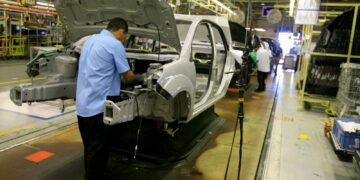



















At a factory built around the rhythm of three shifts, another week without vehicles rolling off the assembly line carries consequences far beyond the plant gates. Stellantis has cancelled production at its Windsor Assembly Plant for the week beginning November 9, 2026, extending a run of four consecutive weeks of scheduled shutdowns.
The facility employs roughly 6,000 workers, with some local reports placing total employment closer to 6,400. Stellantis attributes the interruptions to changing consumer demand and tariff pressures, but the shutdown comes amid unresolved contract negotiations and growing questions about the automaker’s Canadian manufacturing future. For Windsor families, the immediate concern is another disrupted workweek. The larger question is whether the plant can return to the stable production schedule that thousands of workers depend on.
Four Consecutive Weeks of Cancelled Production
Stellantis has cancelled vehicle production at Windsor Assembly for the weeks of October 19, October 26, November 2 and November 9. The latest extension was confirmed in late October, when Unifor Local 444 informed members that another week of production had been removed from the schedule. Production employees were instructed not to report unless specifically directed by a supervisor. Skilled trades employees, however, were expected to continue working their regular shifts. The announcement means the plant is scheduled to go nearly an entire month without normal vehicle assembly operations, creating fresh uncertainty about when manufacturing will resume.
The interruption is part of a longer pattern. Windsor Assembly also experienced two weeks of downtime in late September, bringing the total to six shutdown weeks since the middle of that month, although those weeks were not all consecutive. Stellantis has not confirmed that regular production will resume on November 16. For employees trying to organize household finances, childcare and other responsibilities, that distinction matters. A temporary shutdown with a confirmed return date creates one kind of disruption; repeated extensions without a firm restart schedule create a much more difficult situation.
Thousands of Workers Face an Unpredictable Schedule
The Windsor Assembly Plant is one of Canada’s largest automotive manufacturing facilities, employing approximately 6,000 people according to Stellantis announcements earlier in 2026. More recent reporting has placed the workforce at approximately 6,400. These figures describe the size of the operation, rather than the precise number of employees missing work during the latest shutdown. Not everyone has been instructed to stay home. Production employees have been told not to report unless contacted, while skilled trades workers are expected to continue reporting. The distinction is important when assessing the actual employment impact of the cancellation.
For workers whose shifts have disappeared, the uncertainty extends beyond the number of days away from the assembly line. Regular manufacturing wages can support mortgages, vehicle payments, groceries and other recurring expenses. Even temporary income interruptions can complicate those obligations, particularly when workers cannot predict how many weeks of employment will be available. Experienced employees may also worry about whether changing production schedules signal a longer-term adjustment. Although the latest announcement concerns temporary downtime rather than a permanent closure, the absence of a confirmed restart date leaves thousands of workers facing questions about their immediate financial security.
Windsor’s Third Shift Had Only Recently Returned
The current shutdown is particularly striking because Stellantis expanded Windsor production earlier this year. On February 17, 2026, the automaker officially restored the plant’s third shift, bringing more than 1,700 employees into the additional operation. The expansion increased total employment to approximately 6,000 and restored a production schedule that had been reduced in July 2020. Nearly 250 workers from the company’s Brampton Assembly Plant had also elected to transfer to Windsor, offering an employment opportunity amid uncertainty surrounding the Brampton facility. The return of the third shift was widely viewed as an encouraging development for the region’s automotive industry.
Stellantis initially presented the expansion as a response to anticipated demand for its next-generation Dodge Charger and Chrysler minivan models. The company had invested approximately $1.9 billion in transforming Windsor Assembly since 2022, including extensive manufacturing upgrades to accommodate new vehicle technologies. The expansion required employees across body construction, painting, general assembly and material handling, supported by skilled trades personnel. Months later, the same facility is experiencing extended interruptions. The contrast does not establish that the earlier investment has failed, but it illustrates how quickly manufacturing expectations can change when production volumes, consumer demand and international trade conditions become unpredictable.
Chrysler Minivans and the Dodge Charger Are Caught in the Shutdown
Windsor Assembly is responsible for several important vehicles in Stellantis’ North American lineup. The factory builds Chrysler minivans, including the Pacifica and Canadian-market Grand Caravan, along with the next-generation Dodge Charger. Its manufacturing operations accommodate different vehicle configurations and powertrains, including gasoline-powered SIXPACK Chargers and electric Charger Daytona models. In May 2026, Stellantis celebrated the refreshed 2027 Chrysler Pacifica at Windsor, highlighting updated styling, technology and safety features. The plant has manufactured Chrysler minivans for more than four decades, making it an important production centre for the company’s family-vehicle business.
The mix of vehicles helps explain why the shutdown is significant, but it also makes the underlying demand picture complicated. Stellantis reported that U.S. Chrysler Pacifica sales increased 6% in the third quarter of 2026 compared with the same period a year earlier. Gasoline-powered Dodge Charger sales also improved, while electric Charger sales declined substantially. Those differences illustrate how demand can vary even within the same manufacturing facility. Stronger sales for one model do not necessarily justify maintaining every production shift if other vehicles are moving more slowly. Importantly, company-wide sales results cannot establish the precise production or inventory conditions behind Windsor’s extended shutdown.
Stellantis Blames Changing Demand and Tariff Pressures
Stellantis has connected the Windsor production cancellations to broader market conditions, specifically mentioning consumer demand and the impact of tariffs. The explanation reflects pressures affecting automakers that manufacture vehicles in Canada but depend heavily on the United States for sales. In April 2025, the Trump administration introduced a 25% tariff on imported automobiles, with special provisions allowing qualifying vehicles under the United States-Mexico-Canada Agreement to have the duty calculated on their non-U.S. content. That distinction reduces the applicable tariff base for eligible vehicles but does not eliminate the additional cost associated with cross-border manufacturing.
The financial consequences are substantial. In its October 28, 2026, quarterly results, Stellantis estimated that tariffs would cost the company approximately €1 billion over the full year, with €600 million incurred through September. The automaker also identified aligning production with demand as a priority while managing North American vehicle inventories. These figures help explain why factory schedules have become a sensitive financial decision. However, Stellantis has not publicly provided a precise breakdown showing how much of Windsor’s latest cancellation resulted from tariffs, how much reflected sales volumes or whether other operational considerations contributed. Treating the shutdown as exclusively tariff-driven would therefore go beyond the company’s stated explanation.
Parts Suppliers and Windsor’s Wider Economy Are Exposed
The consequences of repeated assembly shutdowns are not confined to Stellantis employees. Vehicle manufacturing depends on coordinated deliveries from parts producers, logistics companies and other businesses that support the factory’s daily operations. When assembly stops, suppliers can face reduced orders, disrupted delivery schedules and pressure to adjust their own staffing. During Windsor’s earlier two-week shutdown in September, AM800 reported that feeder plants supplying the factory were also experiencing downtime. Windsor Mayor Drew Dilkens has warned that prolonged uncertainty and higher automotive tariffs could affect suppliers throughout the regional manufacturing network, not simply workers directly employed by Stellantis.
The broader economic figures underline those concerns. Statistics Canada reported that 76.4% of Canadian automobile assembly payroll jobs in 2024 were attributable, directly or indirectly, to demand from the United States. Employment in Canadian motor vehicle parts manufacturing subsequently declined 9.3% between December 2024 and December 2025. Ontario’s November 2026 economic update also reported that automobile exports to the United States totalled $34.5 billion during the first eight months of 2026, down 13.7% from the comparable period in 2024. These are industry-wide figures, not losses attributable specifically to Windsor. Nevertheless, they demonstrate the vulnerability of an interconnected manufacturing economy when production decisions and trade policies become increasingly unpredictable.
Stalled Labour Negotiations Create Additional Uncertainty
The Windsor shutdown is unfolding alongside unresolved negotiations between Stellantis and Unifor, the union representing thousands of the automaker’s Canadian employees. Formal bargaining began on September 1, 2026, but talks reached an impasse on September 11. The previous collective agreement expired on September 20 without a replacement agreement. Unifor has identified several unresolved issues, including the future of the Brampton Assembly Plant and commitments concerning production and investment at Windsor and Etobicoke Casting. Local 444 president James Stewart has specifically sought clearer assurances about the long-term future of Windsor’s recently restored third shift.
Union members expressed their frustration through a strike authorization vote held October 17 and 18. Unifor announced that 97.3% of participating members supported authorizing strike action if necessary, giving negotiators a powerful mandate. However, a strike authorization is not the same as a strike. At the time of the announcement, neither party had requested the necessary no-board report, and the union was not in a legal strike position. The Windsor production cancellations are company-directed shutdowns rather than an active labour stoppage. Even so, workers face two overlapping uncertainties: whether Stellantis can restore consistent production and whether bargaining will produce stronger commitments to Canadian manufacturing jobs.
Brampton’s Future Has Become a Major Flashpoint
Much of the disagreement between Stellantis and Unifor centres on another Ontario factory: the company’s Brampton Assembly Plant. That facility has been idle since vehicle production stopped in 2023, leaving more than 2,000 workers on layoff. Stellantis previously planned to manufacture the Jeep Compass there but subsequently shifted the proposed production to Illinois. In September 2026, the automaker confirmed a memorandum of understanding involving a potential sale of the Brampton property to Roshel, a Canadian manufacturer of armoured vehicles. Stellantis has argued that the arrangement could restore productive activity to the site, while Unifor maintains that preserving automotive assembly and its associated jobs should remain the priority.
The dispute intensified on November 6 when Unifor said it believed the sale had been finalized. Union representatives had met with Stellantis to discuss reports of a completed transaction, but the company declined to confirm or deny them. Stellantis and Roshel subsequently said they had nothing to announce, meaning the reported completion of the sale remained unverified. Earlier in the week, Unifor president Lana Payne had requested an urgent meeting involving the union, Stellantis and the federal and Ontario governments. Although Brampton’s situation is separate from Windsor’s production cancellations, both developments have raised questions about Stellantis’ long-term manufacturing commitments in Canada.
Temporary Layoffs Can Create Lasting Financial Pressure
A production shutdown does not automatically mean permanent unemployment, but the financial consequences can still be significant. Workers who lose shifts may need to rely on savings, employment benefits or other income-support arrangements while waiting for production to resume. Canada’s Employment Insurance system provides regular benefits to qualifying workers who experience an interruption of employment through no fault of their own. Eligibility depends on several conditions, including sufficient insurable hours and a qualifying period without work and pay. Federal guidance generally requires between 420 and 700 insurable hours, depending on the unemployment rate in the claimant’s region.
Those protections do not mean every Windsor employee receives the same financial support. Individual circumstances, employment arrangements and benefit eligibility can differ, while available reporting does not establish the precise earnings lost by every affected worker. The distinction between production crews remaining home and skilled trades employees continuing their regular schedules also makes the impact uneven. For families, however, financial planning becomes harder when each potential return date remains uncertain. A delayed vehicle payment, postponed home repair or reduced household spending may appear small individually, but those decisions can accumulate across a community heavily dependent on manufacturing income. Maintaining employment is important; maintaining predictable earnings matters as well.
November 16 Could Be a Turning Point for Windsor
The next critical date for Windsor Assembly employees is November 16, the Monday after the latest scheduled shutdown week. Stellantis has not confirmed that vehicle production will resume that day, meaning workers still lack a definite timetable for returning to normal operations. Any updated production notices, supervisor instructions or announcements from Unifor Local 444 will therefore be important. Employees will also be watching whether the factory’s three-shift structure remains intact and whether production schedules become more consistent. Returning to work for a few days would offer immediate relief, but it would not necessarily establish that the repeated interruptions have ended.
Despite the uncertainty, the Windsor facility remains central to Stellantis’ Canadian manufacturing operations. Its recent investments, expanded workforce and newer Dodge Charger and Chrysler Pacifica programs demonstrate that substantial resources have been committed to the plant. The current shutdown has not been announced as a permanent closure. Nevertheless, unresolved trade pressures, shifting consumer demand and stalled labour negotiations continue to complicate the outlook. For approximately 6,000 workers and the businesses connected to the factory, a lasting recovery will require more than another temporary restart. The most meaningful development would be a dependable production schedule, supported by clear commitments about future vehicle programs and employment in Windsor.