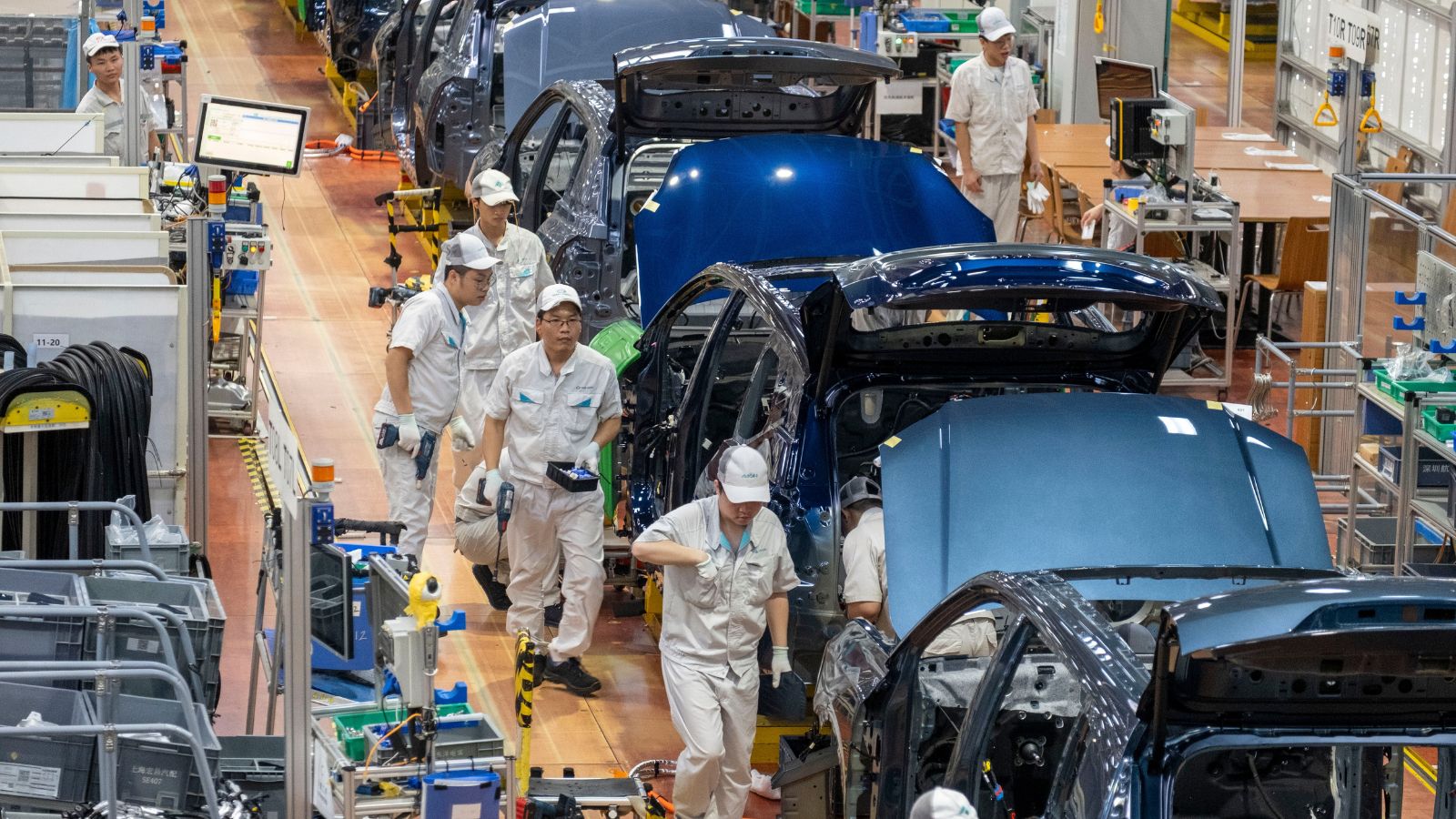
Mexico is offering a major tariff break to its automotive industry, but only a select group of manufacturers will be able to benefit. On October 16, 2026, the Mexican government clarified that its new five-year exemption on certain imported automotive components will be restricted to 11 established vehicle manufacturers with production facilities in the country.
The decision follows an earlier decree eliminating a 10% import tariff on qualifying assembly parts. Initial speculation suggested the measure might benefit emerging Chinese automakers, but Mexican officials have now placed strict limits on eligibility.
The move comes as Canada and Mexico face continuing pressure from U.S. automotive tariffs and uncertainty surrounding the future of their North American trade agreement. For manufacturers, suppliers and workers across all three countries, the stakes extend well beyond the cost of imported parts.
Mexico Removes a 10% Auto-Parts Tariff but Restricts Who Can Benefit
Mexico’s government introduced the tariff exemption through a decree published in its Official Gazette on October 13, 2026. The measure took effect the next day and temporarily reduced the import duty on qualifying automotive assembly parts from 10% to zero. It is scheduled to remain in place for five years, making it a longer-term industrial policy rather than a short promotional incentive. The exemption applies to goods classified under tariff code 9803.00.01, which covers certain parts and components used by authorized vehicle manufacturers. It does not eliminate import duties on every automotive component entering Mexico.
On October 16, the Economy Ministry issued an important clarification after the decree generated conflicting interpretations. Only manufacturers that already operate production facilities in Mexico can potentially qualify, and the government identified 11 eligible light-vehicle manufacturers without publicly naming them. Companies must also satisfy additional authorization and production requirements before receiving the benefit. Mexico’s stated objective is to attract more manufacturing activity, preserve domestic jobs and encourage automakers to increase the amount of work performed inside the country. The policy therefore combines a reduction in import costs with conditions designed to support local industry.
Eleven Established Automakers Could Qualify, but the Government Has Not Named Them
According to industry data reviewed by Reuters, the 11 manufacturers potentially covered by Mexico’s new policy are Audi, BMW, Ford, General Motors, Honda, Kia, Mazda, Nissan, Stellantis, Toyota and Volkswagen. These companies have established vehicle-manufacturing operations in Mexico, giving them a stronger position under the government’s eligibility criteria than brands that primarily import finished vehicles. Their presence spans several major automotive manufacturing regions, where assembly plants support networks of component suppliers, transportation companies and specialized workers. However, the Economy Ministry did not publish an official list naming these manufacturers individually.
That distinction is important because being an established automaker does not mean receiving an automatic tariff exemption. Each company must qualify under Mexico’s applicable customs authorizations, production requirements and import controls. The policy concerns qualifying manufacturers and assembly operations, not a blanket tax reduction covering every brand sold by those companies. For example, a manufacturer with a Mexican factory may also sell vehicles assembled elsewhere, but that alone does not make those imported vehicles eligible for the new treatment. The measure rewards qualifying production activity within Mexico rather than vehicle sales or brand recognition. Its practical value will depend on each manufacturer’s existing operations and future assembly plans.
Strict Import Permits and Production Requirements Will Control the Exemption
Mexico’s tariff reduction comes with several regulatory conditions designed to prevent companies from using the exemption simply to import inexpensive components without developing substantial domestic manufacturing operations. Manufacturers must hold the appropriate customs authorization for assembling and producing vehicles under Mexico’s bonded-warehouse framework. Imports will also require advance approval from the Economy Ministry. The government’s proposed guidelines include minimum production volumes for completed vehicles and restrictions on how many imported assembly components a manufacturer can use relative to its domestic output.
Authorities also intend to monitor exactly how imported components are used. Mexico’s tax administration and customs agency are expected to oversee traceability requirements, including vehicle identification numbers and records linking imported parts to completed vehicles. These measures would allow regulators to check whether a company is complying with the program rather than importing components for unrelated purposes. The government has not yet disclosed all numerical production thresholds or the precise limits on imported components. For manufacturers, that means the financial advantages remain subject to detailed rules. The exemption offers potential savings, but qualifying will require documentation, established production capacity and continuing compliance.
The Five-Year Plan Encourages Automakers to Build More Vehicles in Mexico
The exemption covers certain components imported for semi-knocked-down (SKD) and completely knocked-down (CKD) vehicle assembly. Under SKD arrangements, manufacturers import partially assembled vehicle systems and complete the remaining work locally. CKD operations generally involve importing more extensively disassembled components for assembly at a local facility. Mexico sees these arrangements as potential starting points for attracting vehicle production that might otherwise take place overseas. The government’s intention is for manufacturers to move progressively beyond basic assembly toward more complex manufacturing activities involving local suppliers, skilled workers and additional domestic investment.
General Motors provides a concrete example of the approach Mexico hopes to encourage. In May 2026, the company announced plans to assemble Chevrolet Groove vehicles at its Ramos Arizpe facility beginning in 2027, followed by the Chevrolet Aveo. The project forms part of a previously announced US$1 billion investment commitment, with the Mexican government outlining an ambition to produce 80,000 vehicles for the domestic market by 2030. Both models had previously been supplied through imports from Asia. Mexico’s Economy Ministry identified this type of production relocation as an example of the policy’s intended direction. The new tariff break could help eligible manufacturers begin similar projects, although future investments remain dependent on commercial decisions.
Chinese Automakers Face New Restrictions Despite Rapid Sales Growth
The October 13 decree initially generated speculation that Chinese manufacturers such as GAC and JAC might benefit from importing vehicle assembly kits at a reduced tariff. That possibility attracted attention because Chinese brands have been expanding rapidly in Mexico despite the country’s efforts to restrict certain vehicle imports. According to figures obtained by Reuters from the Mexican Association of Automobile Distributors, Chinese-brand vehicle sales reached 137,525 units during the first six months of 2026, compared with 107,712 a year earlier. Their share of Mexico’s new-vehicle market increased from approximately 14% to 17%, representing nearly 30% sales growth.
Those gains occurred after Mexico introduced tariffs reaching 50% on certain vehicle imports from countries without free-trade agreements, including China, in January 2026. Mexican officials have argued that some of the sales strength reflects inventories imported before the higher duties took effect. Reuters reported that imports of Chinese vehicles declined 43% during the first five months of 2026, even while Chinese-brand retail sales increased. Mexico’s latest clarification makes another distinction: selling vehicles locally, or operating through an importer, does not establish eligibility for its assembly-parts exemption. Companies need qualifying manufacturing operations and the necessary authorizations. Some Chinese manufacturers have local assembly partnerships, but the government has not identified them among the 11 potential beneficiaries.
Mexico’s Automotive Industry Is Under Pressure From Falling Production and Exports
Mexico introduced its latest incentive during a difficult period for automotive manufacturing. Figures released by the country’s national statistics agency, INEGI, show that manufacturers produced 301,803 light vehicles in September 2026 and exported 277,369. Compared with September 2025, vehicle production fell approximately 15%, while exports declined about 12%. Reuters reported that the export contraction was the sharpest since December 2025, reflecting continuing trade pressures and weaker demand. During the first nine months of 2026, Mexico manufactured approximately 2.95 million light vehicles, down 2.4% from the corresponding period a year earlier.
These figures help explain why the government is focusing on keeping existing manufacturers competitive. Vehicle assembly plants support a much wider industrial network that includes parts manufacturers, logistics providers, equipment suppliers and local service businesses. A reduction in vehicle exports can therefore affect companies far removed from the final assembly line. Mexico’s tariff exemption is intended to reduce the cost of launching or relocating production, but it cannot independently resolve weak international demand or U.S. import restrictions. Nor does a lower duty guarantee new jobs. Companies must first decide whether the economics justify additional Mexican investment, particularly when their largest export market is imposing tariffs on finished vehicles.
U.S. Auto Tariffs Continue to Complicate Mexico’s Manufacturing Strategy
Mexico’s tariff relief arrives as negotiations with Washington remain difficult. On October 16, Reuters reported that progress toward a broader U.S.–Mexico tariff agreement had stalled, citing reporting from The Wall Street Journal. The central dispute involves American tariffs on Mexican automobiles, steel and aluminum. U.S. Commerce Secretary Howard Lutnick has reportedly opposed significant reductions to the 25% automotive tariff and 50% metal tariffs. Mexican negotiators have sought better treatment for their automotive exports, including improved tariff relief for vehicles containing American-made components. U.S. officials maintain that discussions are continuing, while Mexican representatives have acknowledged progress on some issues.
These disagreements create a difficult situation for manufacturers. Mexico can lower its own duties on imported assembly components, but it cannot unilaterally remove American tariffs when completed vehicles are exported to the United States. That means an automaker might save money producing a vehicle in Mexico while still facing substantial costs when selling it across the border. The actual tariff burden can depend on a vehicle’s origin and the value of qualifying American content. For companies operating factories in Mexico, investment decisions now require calculations involving both Mexican incentives and American trade restrictions.
CUSMA’s Future Remains Uncertain After the United States Refuses Renewal
The Canada–United States–Mexico Agreement, known as CUSMA in Canada and USMCA in the United States, has governed regional trade since July 1, 2020. During its mandatory joint review on July 1, 2026, the United States declined to renew the agreement in its existing form. That decision did not immediately terminate the pact. Under the agreement’s review mechanism, CUSMA remains in effect, potentially until 2036, unless the parties take further action. Without an agreement to extend its term, annual reviews become part of the process. However, the American refusal to extend the pact has introduced uncertainty for companies making long-term investment decisions.
Automotive manufacturing is particularly sensitive because CUSMA establishes strict rules determining which vehicles qualify as North American products for preferential tariff treatment. These include a 75% regional-value-content requirement for passenger vehicles and light trucks, specific rules for critical components, and requirements involving North American steel, aluminum and labour value. Consequently, assembling a vehicle in Mexico using imported parts does not automatically make it eligible for CUSMA benefits. A tariff exemption on components entering Mexico is legally different from preferential treatment for finished vehicles entering the United States or Canada. That distinction will remain crucial as manufacturers decide where to source parts and locate future production.
Canada’s Automotive Industry Has Billions at Stake in the Trade Dispute
Canada has particularly strong reasons to watch Mexico’s automotive policies. According to the federal government’s February 2026 automotive strategy, more than 90% of Canadian-made vehicles and 60% of Canadian-made automotive parts are exported to the United States. The Canadian automotive sector supports more than 500,000 jobs across manufacturing and related industries, including approximately 125,000 direct manufacturing positions. In 2025, Canada produced more than 1.2 million passenger vehicles. The concentration of exports in one market makes Canadian factories especially vulnerable when American tariffs increase or manufacturers reconsider their North American production arrangements.
Statistics Canada has also documented the depth of this dependence. Its analysis of 2024 manufacturing data found that approximately 76.4% of employment in Canada’s automobile and light-duty vehicle manufacturing industry was supported by American demand. The industry is also geographically interconnected. Components can travel between Canadian and American facilities multiple times before a finished vehicle reaches a dealership. For communities such as Windsor, Ontario, where the automotive sector has long supported local employment, trade uncertainty can influence investment decisions, production schedules and supplier demand. Mexico’s new incentive does not directly impose costs on Canadian factories, but it adds another consideration for manufacturers deciding where to place future work.
Canada Is Responding With Its Own Tariffs, Investment Incentives and Manufacturing Protections
Canada has adopted a different combination of trade measures to defend its automotive industry. Ottawa maintains a 25% tariff on U.S.-assembled light vehicles that fail to meet CUSMA requirements, as well as a 25% tariff on the non-Canadian and non-Mexican content of qualifying U.S.-assembled vehicles. The government also operates a conditional tariff-remission system that allows manufacturers to import specified volumes of American-built vehicles without paying Canada’s retaliatory duties, provided they maintain Canadian production and investment commitments. Canadian–Mexican automotive trade, meanwhile, continues to receive preferential treatment under CUSMA.
Prime Minister Mark Carney’s government has also committed up to C$3 billion through the Strategic Response Fund and C$100 million through the Regional Tariff Response Initiative to support automotive investment and industrial adaptation. These measures are part of a broader strategy involving electric vehicles, battery manufacturing, domestic suppliers and workforce protection. Trade tensions remain unresolved. In August, Carney suspended bilateral negotiations with Washington after describing proposed American terms as economically unacceptable. Canada subsequently introduced additional retaliatory tariffs on selected U.S. products. While Mexico is trying to attract assembly operations by lowering specific import costs, Canada is combining retaliatory measures with incentives tied to maintaining and expanding domestic manufacturing.
The Next Five Years Could Reshape Where North American Vehicles Are Built
Mexico’s new exemption could influence how automakers organize production over the next several years, but its eventual impact remains uncertain. The Economy Ministry reported that imports under the affected tariff classification represented just 0.01% of total automotive imports during 2025. That historically small share suggests the measure is aimed primarily at encouraging new production arrangements rather than immediately transforming existing supply chains. Future results will depend on how extensively the 11 potentially eligible manufacturers use the program, whether production lines move to Mexico and how quickly domestic suppliers gain additional business. The government’s proposed production thresholds and import controls will also determine how attractive the exemption becomes.
For Canada, the development reinforces the increasingly competitive nature of North American manufacturing. Mexico wants more local production, Washington is using tariffs to encourage investment in the United States, and Ottawa is trying to protect its own factories while attracting new automotive technologies. These objectives sometimes overlap, but they can also put the three countries in direct competition for the same investments. The October 16 clarification does not immediately change Canadian vehicle prices or establish new barriers against Canadian-made parts. Its significance lies in the longer-term direction of industrial policy: governments are increasingly tying trade advantages to local production. Whether North America’s integrated automotive industry emerges stronger will depend heavily on the outcome of CUSMA negotiations and the investment decisions manufacturers make.