

























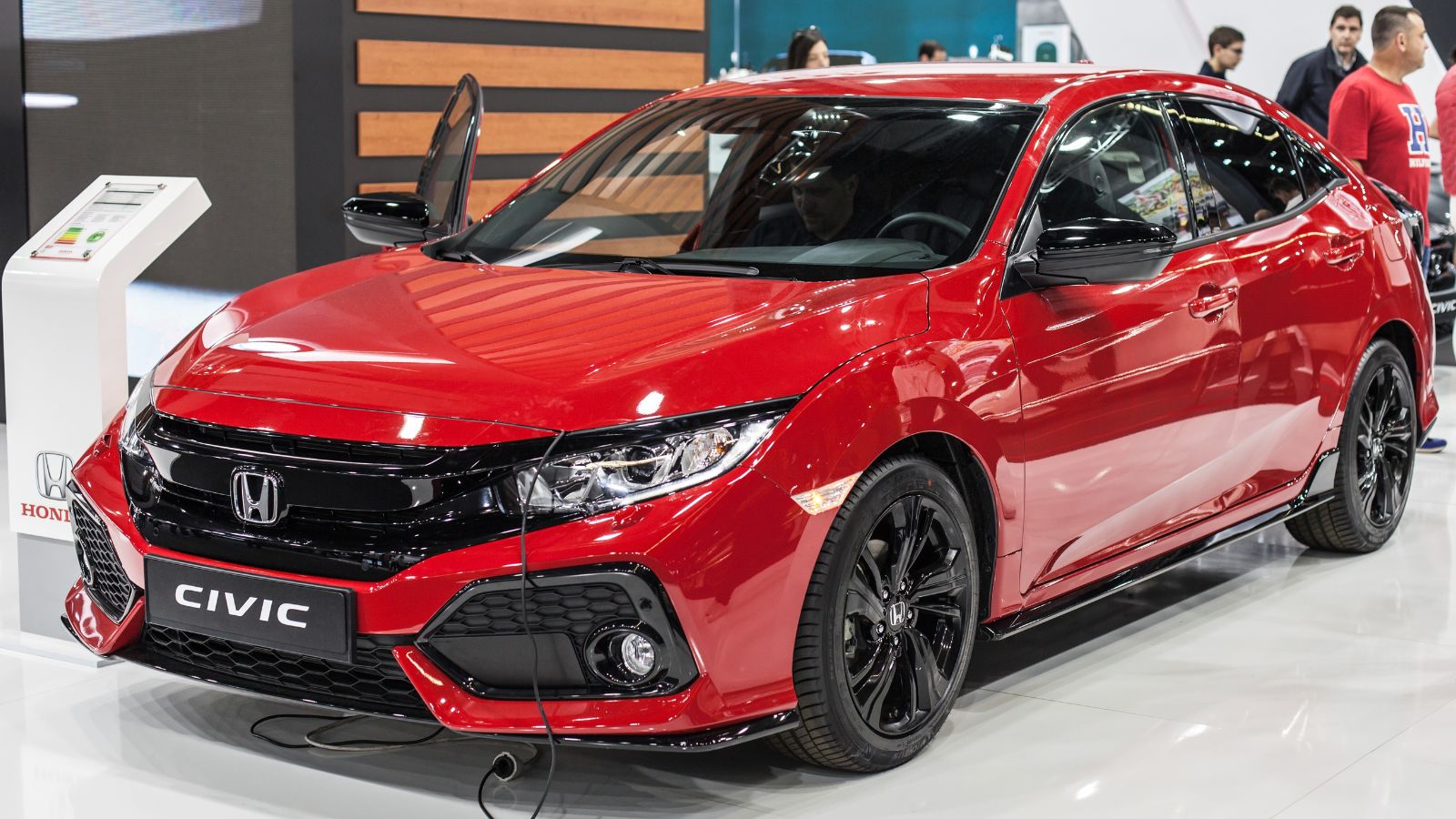
One of Canada’s most familiar affordable cars is becoming noticeably less inexpensive. Honda has priced the base 2027 Civic Sedan LX at a $29,090 MSRP, another $650 increase from the 2026 model. Once Honda’s published freight and applicable fees are included, the listed cash selling price reaches $32,544 before sales tax, licensing and registration.
The increase is particularly notable because the Civic Sedan remains a Canadian-built vehicle. Gasoline and hybrid sedans continue to come from Honda’s Alliston, Ontario, manufacturing operation, where Civic production began in 1988. The latest increase does not suddenly make the Civic expensive by the standards of today’s new-vehicle market, but it demonstrates how quickly the traditional entry point to a major automotive brand has moved beyond the sub-$30,000 purchase many Canadians once associated with compact cars.
The $32,544 Figure Is Not the Civic’s MSRP
Honda’s base 2027 Civic Sedan LX carries an MSRP of $29,090. The company’s official Canadian pricing table then lists a cash selling price of $32,544. Honda says that figure incorporates the MSRP, $1,830 in freight and pre-delivery inspection, the air-conditioning charge, dealer fees, regulatory fees and other applicable levies and duties. In other words, the difference between the advertised MSRP and Honda’s published selling price is $3,454.
That $32,544 should not be mistaken for a nationwide, tax-included drive-away figure. Honda specifically says dealer fees and certain charges can vary by dealership and province, while insurance, licence, registration, premium paint and applicable sales taxes remain extra. It also notes that its published vehicle price applies to a cash purchase rather than automatically describing a lease or financed transaction. In Ontario, where HST is currently 13 per cent, applying HST to $32,544 alone would bring the amount to roughly $36,775 before licensing, registration, insurance or other transaction-specific costs.
The Latest Increase Follows an Even Bigger Jump
The outgoing 2026 Civic Sedan LX carries a $28,440 MSRP, meaning Honda has added exactly $650 for 2027. That works out to an increase of approximately 2.3 per cent. The previous step was larger. When Honda launched the refreshed 2025 Civic Sedan in June 2024, the LX had a $27,540 MSRP. Measured against that original 2025 launch figure, today’s 2027 MSRP is $1,550 higher, an increase of about 5.6 per cent in two model-year steps.
The progression is therefore more revealing than the latest $650 in isolation: $27,540 at the 2025 launch, $28,440 for the 2026 LX and now $29,090 for 2027. Comparing total selling prices over the same period is more complicated because Honda’s published treatment of dealer and regulatory fees has evolved. Its original 2025 announcement listed a $29,520 selling price, for example, but the new 2027 figure incorporates a substantially larger amount of dealer-related fees. MSRP provides the cleaner measure of the underlying model-year price increase.
It Is Still a Canadian-Built Civic
Rising prices do not change one unusually Canadian part of the Civic story. Honda confirms that both gasoline and hybrid 2027 Civic sedans are built at Honda of Canada Mfg. in Alliston, Ontario. The Civic Hatchback, by contrast, is produced in Greensburg, Indiana. Civic production began in Alliston in 1988, two years after Honda opened its first Canadian automobile plant, and Honda says more than six million Civics have since been produced there.
The manufacturing operation is substantial beyond one nameplate. Honda’s 2026 Canadian fact sheet says its two Alliston vehicle plants employ more than 4,200 people, have annual capacity exceeding 400,000 vehicles and produced approximately 401,000 vehicles during 2025. The operation built its 11-millionth vehicle last year and purchases roughly $3 billion in goods annually from Canadian suppliers. That makes the Civic price increase interesting from a consumer perspective: Canadian assembly eliminates an overseas ocean journey, but domestic production by itself does not freeze the retail price of a vehicle or insulate it from wider manufacturing and business costs.
The Base Civic Remains Mechanically Familiar
The 2027 LX continues with a 2.0-litre gasoline engine and continuously variable transmission rather than receiving a major new powertrain to accompany its higher price. Honda lists fuel consumption at 7.4 L/100 km in the city, 5.8 on the highway and 6.7 combined—the same published figures associated with the current gasoline Civic configuration. Honda Sensing driver-assistance technology also remains standard across the 2027 Civic range.
That matters when assessing what the additional $650 buys. This is not a case where the least-expensive Civic suddenly receives an all-new engine or radically different fuel economy. The broader 2027 update instead concentrates some of its attention higher in the range. Honda has introduced a Sport-L trim and added S+ Shift to the Sport Touring Hybrid. For someone walking into a dealership specifically because the LX is the lowest-cost route into a new Civic, the fundamental proposition is therefore familiar: a front-wheel-drive compact sedan with a conventional gasoline engine, established safety technology and comparatively modest fuel consumption, only at a higher starting price.
A New Sport-L Trim Reshapes the Price Ladder
Honda has also changed the space between the basic LX and its hybrid models. The new Sport-L Sedan carries a $33,550 MSRP and a published selling price of $37,004. It adds equipment previously associated with more expensive Civic versions, including leather upholstery, power-adjustable front seats and heated rear seats. That places it $4,460 above the LX on MSRP before considering other charges.
Above it sits the Sport Hybrid Sedan at a $34,850 MSRP and $38,307 published selling price, followed by the Sport Touring Hybrid at $38,350 MSRP and $41,807. The resulting lineup creates an interesting decision for buyers. The Sport-L’s MSRP is only $1,300 below the Sport Hybrid, meaning someone already prepared to move significantly beyond the base car may see the electrified version within relatively easy financial reach. The exact payment difference will depend on interest rates, term, down payment and dealer pricing, but Honda’s own price structure increasingly positions the basic gasoline LX as one proposition and the better-equipped or hybrid models as another.
Half of Civic Buyers Are Already Choosing the Hybrid
Honda says hybrid models account for approximately 50 per cent of Canadian Civic sales so far in 2026. That makes electrification much more than a niche addition to the Civic range. Honda’s 2025 sales data show just how quickly that transformation occurred: it recorded 19,026 Civic Hybrid sales compared with 12,028 conventionally powered Civics during that calendar year. The hybrid has effectively become one of the central versions of the car rather than an unusual high-efficiency alternative.
For 2027, the Sport Hybrid Sedan has a $38,307 published selling price, $5,763 above the base LX figure. Its official combined fuel-consumption rating is 4.9 L/100 km versus 6.7 for the LX. Whether the fuel saving justifies the additional purchase price depends heavily on kilometres driven, gasoline prices and how long the car is kept, so the lower consumption alone does not make the hybrid automatically cheaper to own. It does show why Honda can increasingly rely on buyers considering something more expensive than the entry-level Civic when they visit a showroom.
Toyota Still Undercuts the Civic at the Bottom of the Market
The Civic’s higher starting price becomes clearer beside its longest-running competitor. Toyota has priced the base 2027 Corolla L at a $25,520 MSRP and estimates its vehicle price at $29,008 after freight, PDI, air-conditioning charges and maximum dealer and other applicable fees. On those manufacturers’ published figures, the entry Corolla sits $3,536 below the Civic LX’s $32,544 selling price before taxes and registration.
That does not establish that the Corolla is automatically the better purchase. Equipment, driving characteristics, financing offers, resale value and individual preferences can matter more than the initial sticker difference. The comparison nevertheless illustrates where the Civic now sits in Canada’s compact-car market. Even Toyota’s 2027 Corolla Hybrid LE has an estimated vehicle price of $32,068—slightly below Honda’s published price for the gasoline Civic LX. Manufacturers calculate and describe fees somewhat differently, so shoppers should compare written dealer quotes rather than assuming advertised totals are perfectly interchangeable. Still, the days when Civic and Corolla base prices moved almost in lockstep are not guaranteed.
The Increase Comes as Canadian Vehicle Prices Are Actually Cooling
The timing is noteworthy because Canada’s broader vehicle market has recently shown modest price declines. AutoTrader reported an average new-vehicle price of approximately $63,016 in June 2026, down 2.2 per cent from a year earlier. The average used-vehicle price was about $36,690, down 2.6 per cent. Even after its latest increase, a base Civic remains far below the average new vehicle, partly because today’s market is heavily weighted toward larger SUVs, crossovers and pickups.
Statistics Canada’s inflation data provide another useful benchmark. Its index for purchasing passenger vehicles was 2.3 per cent higher in August 2026 than a year earlier, while overall CPI inflation was 3.0 per cent. The Civic’s roughly 2.3 per cent model-year MSRP increase is therefore similar in size to the recent annual change in Statistics Canada’s passenger-vehicle purchase index, although the two measurements cover different periods and should not be treated as directly equivalent. For households focused on affordability, the bigger issue is cumulative: a few hundred dollars added repeatedly can gradually move an entry-level car into a different budget category.
The Civic’s Price Matters Because It Is Still a Gateway Car
Honda says approximately 2.3 million Civics have been sold in Canada since the model arrived in 1973. It has been Canada’s best-selling passenger car in 26 of the past 28 years, and Honda describes it as particularly important among first-time buyers and younger customers. In 2025 alone, Honda’s North American sales records show 31,054 Canadian Civic sales across gasoline and hybrid versions. Few passenger-car price changes therefore affect a nameplate with the same level of historical reach.
That history is also why the $32,544 figure deserves careful interpretation. The 2027 Civic has not suddenly become a $32,544 MSRP vehicle; its actual base MSRP is $29,090. Nor is $32,544 the final amount every Canadian buyer will hand over, because taxes and regional transaction costs remain. What has clearly changed is the entry point. A Canadian-built Civic that began the refreshed 2025 model year at a $27,540 MSRP now starts $1,550 higher. For a model long associated with affordable, dependable transportation, that gradual upward movement may matter almost as much as any new feature added for 2027.