



















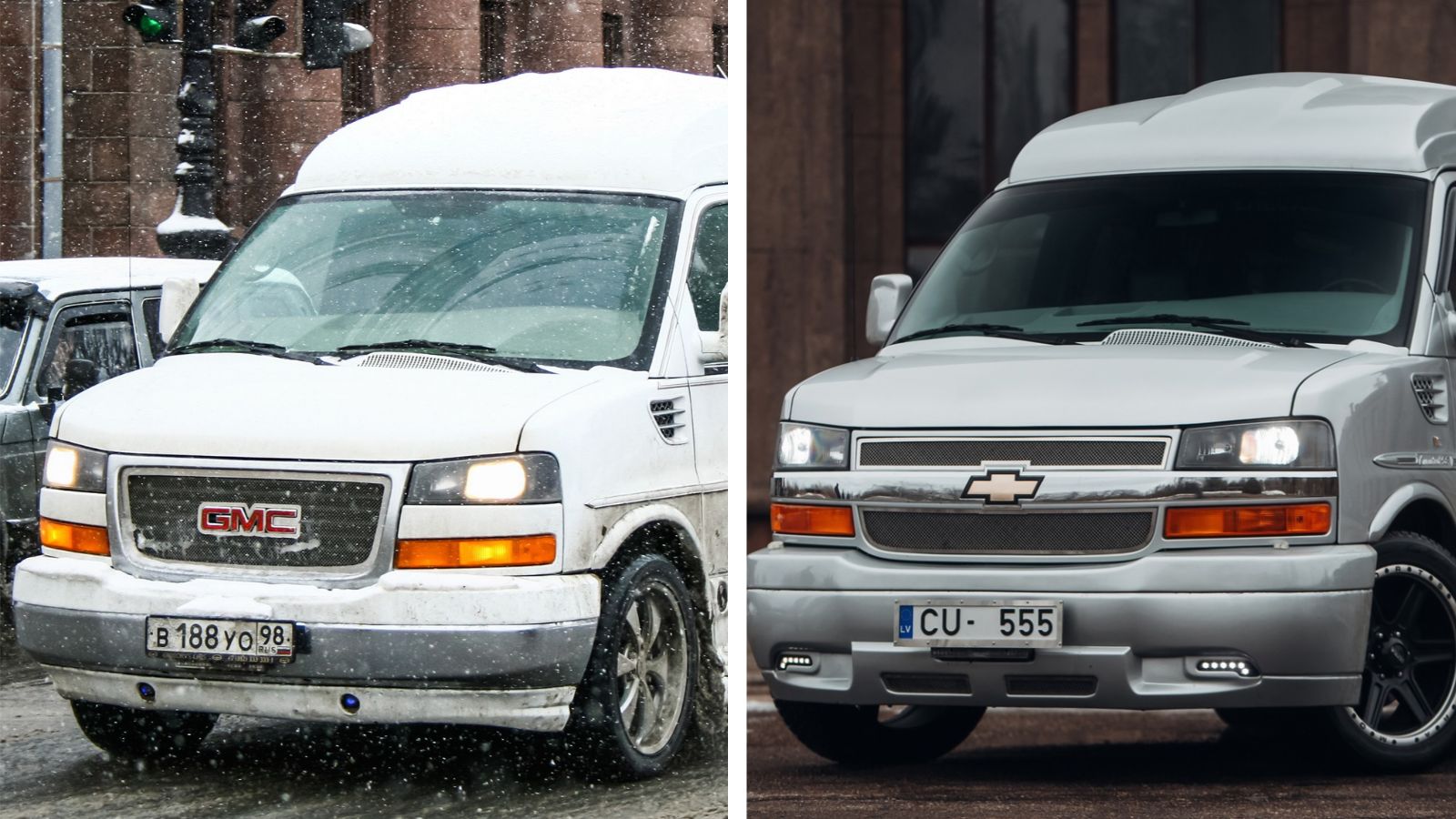
For businesses that rely on a cargo van every day, safety technology can matter just as much as payload or engine output. New testing from the Insurance Institute for Highway Safety has exposed a substantial gap in two familiar General Motors work vans.
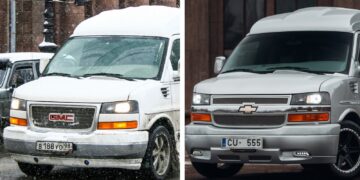
The 2025-27 Chevrolet Express 2500 and GMC Savana 2500 received “Poor” ratings in both of IIHS’s new commercial-vehicle front crash-prevention evaluations: vehicle-to-vehicle and pedestrian protection. The fundamental problem was straightforward. Neither van offers automatic emergency braking, although forward collision warning is available. The results do not mean the vans received poor scores in physical crashworthiness testing. Instead, they show how little assistance the vehicles provide when a driver does not react quickly enough to an impending frontal collision.
The Express and Savana Failed Both New Evaluations
IIHS gave both the Chevrolet Express 2500 and GMC Savana 2500 its lowest rating—Poor—for vehicle-to-vehicle front crash prevention and pedestrian front crash prevention. The ratings apply to 2025 through 2027 models. IIHS physically tested a 2025 Chevrolet Express 2500 and applies the results to the GMC Savana 2500 as well. Both vans can be equipped with Forward Collision Alert, but neither has the automatic braking capability needed to intervene when the driver fails to respond.
That difference proved decisive. In the vehicle-to-vehicle evaluation, the GM vans recorded no automatic speed reduction because there was no AEB system to apply the brakes. The pedestrian result was even more straightforward: IIHS lists pedestrian front crash prevention as unavailable. For a fleet operator, that distinction can easily be overlooked on a specification sheet. A vehicle that warns about a potential collision may sound technologically similar to one that can brake automatically, but the two provide very different levels of intervention when the seconds before a crash begin disappearing.
Warning the Driver Is Not the Same as Applying the Brakes
The optional Forward Collision Alert system in the Express and Savana is designed to tell a driver when the van is approaching another detected vehicle too quickly. GM says it can also issue a tailgating warning when the vehicle is following too closely. What it does not do in these vans is automatically apply the brakes. The human behind the wheel still has to recognize the alert, move a foot to the brake pedal and respond with enough force and time to avoid the collision.
IIHS testing demonstrated that limitation clearly. With a passenger-car target, the system issued timely warnings during the tested 31, 37 and 43 mph approaches, whether the target was centred or offset. Yet the vans produced no automated speed reduction. Performance against the motorcycle target was more troubling: IIHS recorded no timely warning in the tested scenarios. The warning did perform on the stationary semitrailer trials, but those tests assess the alert rather than automatic braking. In other words, the system can help an attentive driver, but it provides no braking safety net afterward.
IIHS Made the Vehicle-to-Vehicle Test Deliberately Difficult
The new evaluation goes considerably further than simply driving toward the back of a parked car at low speed. IIHS tests front crash-prevention technology against stationary targets representing both passenger cars and motorcycles, with targets placed directly ahead and offset from the vehicle’s path. Testing occurs at 31, 37 and 43 mph. A stationary semitrailer is also used to evaluate whether the collision-warning system alerts the driver early enough.
That design reflects the way front crashes occur outside a laboratory. A motorcycle presents a much narrower visual target than a car, while an offset vehicle may be harder for cameras or radar to recognize as a threat. IIHS awards credit for timely warnings and, more heavily, for how much speed automatic braking removes before impact. Speed reduction accounts for two-thirds of the maximum score in the vehicle-to-vehicle evaluation. That scoring approach explains why warning-only technology faces such a disadvantage: an alarm may provide useful information, but an effective AEB system can actively reduce the energy involved in a crash.
Pedestrians Present a Different Challenge
IIHS created a separate pedestrian evaluation because detecting a person requires different capabilities from detecting another vehicle. The commercial-vehicle program examines scenarios involving a child during daylight and an adult at night. Nighttime runs also examine performance with different headlight conditions. That matters for tall commercial vehicles, where sensor position, visibility and the physical shape of the vehicle can make vulnerable road users particularly challenging to detect.
The Express and Savana could not earn performance credit because pedestrian automatic emergency braking is not available. Other vehicles exposed another problem during testing: IIHS found that some systems had more difficulty detecting the shorter child target than the adult. In certain cases, a system initially detected the child but lost track as the vehicle approached. IIHS suggested the high placement of sensors near the rear-view mirror and the tall front ends of commercial vehicles may contribute. For a van moving through loading areas, neighbourhood streets or busy commercial districts, those scenarios represent exactly the type of low-margin situation crash-prevention technology is intended to address.
Rival Vans Showed That Better Results Are Possible
The poor performance was not universal across the commercial-van category. Mercedes-Benz’s Sprinter 2500 earned a Good rating in the vehicle-to-vehicle evaluation and an Acceptable rating for pedestrian crash prevention, making it one of the strongest conventional cargo vans tested. Chevrolet’s own electric BrightDrop 400 achieved an Acceptable vehicle-to-vehicle result and a Good pedestrian rating. The Rivian RCV-Delivery 500 also earned a Good pedestrian score, alongside a Marginal vehicle-to-vehicle rating.
The Ford Transit T250 and Ram ProMaster 2500 performed less strongly, earning Poor ratings in the vehicle-to-vehicle evaluation but Marginal scores for pedestrian prevention. That still placed them above the Express and Savana in one of the two categories. Among the cargo vans in IIHS’s initial comparison, the Express and Savana were the only ones to receive Poor ratings in both evaluations. The comparison is significant because it demonstrates that vehicle size and commercial use do not inherently prevent manufacturers from installing effective crash-avoidance technology. Some competitors already meet a substantially higher standard.
Automatic Emergency Braking Has a Proven Real-World Benefit
The debate over AEB is not based solely on laboratory scores. IIHS research using real-world crash data has found meaningful reductions in collisions when automatic braking accompanies forward collision warning. Earlier research found that systems combining forward collision warning and AEB reduced rear-end striking crashes by roughly 50% and rear-end crashes involving injuries by 56%. Forward collision warning alone produced a smaller 27% reduction in rear-end crashes.
Pedestrian-detecting AEB has demonstrated benefits as well. A peer-reviewed IIHS study published in Accident Analysis & Prevention found the technology was associated with a 25% to 27% reduction in pedestrian crash risk and a 29% to 30% reduction in pedestrian injury-crash risk. Those figures should not be interpreted as a prediction of exactly how the Express or Savana would perform if GM added AEB; they come from broader vehicle populations. They do, however, explain why IIHS places considerably more value on automatic braking than on a system that only asks the driver to react.
GM Already Offers More Advanced Technology Elsewhere
The Express and Savana results stand out partly because automatic braking is hardly unfamiliar technology within General Motors. Chevrolet and GMC offer AEB and pedestrian braking on a variety of newer passenger vehicles and pickups. Even within IIHS testing, GM products equipped with those systems demonstrate that the company possesses the technology. The Chevrolet BrightDrop 400, for example, earned the highest pedestrian crash-prevention rating among the first commercial vans tested.
Canadian Express and Savana buyers still have access to several driver-assistance features. GM lists Forward Collision Alert, Lane Departure Warning, Side Blind Zone Alert, Rear Park Assist and a rear-vision camera among available or offered equipment, depending on configuration. Those systems can all have practical value, especially in a large work vehicle with restricted visibility. The IIHS results highlight a specific missing layer rather than suggesting the vans contain no safety technology at all. The critical gap is what happens after a frontal danger is detected: unlike AEB-equipped alternatives, the Express and Savana continue to depend on the driver to initiate braking.
These Tests Are Part of a New Focus on Commercial-Vehicle Safety
IIHS only began its dedicated commercial-vehicle evaluation program in June 2026. Its first assessments concentrated on basic driver-protection equipment, including airbags, seat-belt pretensioners, force limiters and effective seat-belt reminders. The institute then expanded the program to include front crash-prevention ratings for cargo vans and Class 3 heavy-duty pickups, producing the results that put the Express and Savana at the bottom of both new avoidance categories.
That broader attention matters because commercial vehicles have historically received less consumer-facing safety information than ordinary passenger cars and SUVs. IIHS intends to keep expanding its program, with evaluations of headlights and rear automatic emergency braking planned, while testing of larger Class 4 through Class 6 trucks is expected to be phased in later. The goal is not simply to create another scorecard. Large vans and heavy pickups spend their working lives around motorists, cyclists and pedestrians, often while carrying substantial loads. Better public comparisons can give fleet managers another purchasing criterion besides acquisition cost, payload and operating expenses.
The Express 2500 Falls Within a Weight Class Facing Tougher AEB Standards
The Express 2500 and Savana 2500 each have a gross vehicle weight rating of up to 8,600 pounds, according to GM’s current specifications. That puts them below the 10,000-pound threshold used by the U.S. National Highway Traffic Safety Administration for its light-vehicle automatic emergency braking standard. NHTSA’s existing rule requires AEB, pedestrian AEB and forward collision warning on nearly all new light vehicles covered by the regulation, although the implementation timetable has become part of ongoing federal rulemaking.
The regulatory direction illustrates how quickly warning-only systems are becoming dated. NHTSA estimated when it finalized the standard that widespread compliant AEB could prevent at least 24,000 injuries and save at least 360 lives annually in the United States. Government requirements and IIHS ratings are not identical—the organizations use different procedures and serve different purposes—but both increasingly treat active braking as an important component of modern vehicle safety. A van engineered primarily around an alert that waits for the driver to brake is therefore facing a higher bar than it did several years ago.
Buyers Should Understand Exactly What the “Poor” Rating Means
A Poor crash-prevention rating does not mean IIHS has declared the Express or Savana structurally unsafe in a collision. These particular scores evaluate whether technology can help prevent or mitigate a frontal crash before it happens. They also do not measure every quality a commercial buyer may care about. The vans offer substantial payload capability, multiple body configurations and V6 or V8 power, and have long served businesses that place a premium on straightforward work-vehicle functionality.
What the ratings do provide is a clear comparison of one increasingly important safety capability. A business choosing between vans now has evidence that some competitors can automatically react to hazards that the Express and Savana cannot. For a driver covering thousands of kilometres through traffic, one distracted moment or unexpectedly stopped vehicle may be all it takes for that difference to matter. Forward Collision Alert can still provide valuable warning, but IIHS’s new testing makes the limitation unmistakable: on these GM vans, the final—and most important—braking decision remains entirely with the person behind the wheel.