






















Electric trucks have spent years facing a familiar commercial problem: the technology may work, but buying it can still demand a large financial leap from the companies expected to operate it. JUNA, the electric-truck venture created by Scania and digital freight forwarder sennder, is testing a different route.
The company has now passed 100 electric trucks in active European service, turning what began as a small-scale experiment into a fleet of roughly 110 vehicles. More important than the number itself is how those trucks reach operators. Instead of requiring carriers to purchase expensive battery-electric vehicles outright, JUNA packages trucks, services and operational support into a usage-based model. As European freight companies confront emissions rules, charging challenges and tight margins, that structure is becoming an increasingly significant test of whether electrification can scale without forcing every carrier to become an EV asset owner.
The Fleet Has Grown From Pilot Scale to About 110 Trucks
JUNA says its fleet has reached roughly 110 electric trucks operating in Germany, Italy, Poland and the Netherlands, passing the 100-vehicle threshold a little more than two years after its first trucks entered service. The company expects the fleet to grow to approximately 150 vehicles by the end of 2026. That is a sharp expansion from early 2026, when industry reporting put JUNA at about 50 trucks. The company says its vehicles have now travelled approximately 3.9 million kilometres, roughly equivalent to circling the Earth at the equator close to 100 times.
Those kilometres matter more than an impressive fleet photograph. Heavy trucks earn their keep by moving freight repeatedly, often under demanding schedules where downtime quickly becomes expensive. JUNA says its vehicles are being used on a mix of international routes and shorter shuttle operations rather than remaining confined to demonstrations. The fleet is still tiny compared with Europe’s overall commercial-truck population, but crossing 100 units provides considerably more operating data than a handful of prototypes. It also gives carriers, shippers and Scania a larger laboratory for understanding charging, range, driver behaviour, maintenance and utilisation under normal freight conditions.
JUNA Is Selling Truck Use Rather Than Traditional Truck Ownership
JUNA was formed by Scania and sennder in 2023 around an idea that changes who carries some of the financial risk associated with an electric truck. Instead of requiring a transport company to buy the vehicle, JUNA offers Scania battery-electric trucks through an electric-truck-as-a-service arrangement. Pricing is linked to expected usage, such as kilometres driven, while the package can include maintenance, repairs, liability and comprehensive insurance, telematics and assistance with electrification. Route analysis is also part of the offering, while JUNA works with charging providers when infrastructure must be arranged.
The model also addresses another problem that can undermine expensive commercial equipment: insufficient work. Through sennder, participating carriers can receive priority access to freight loads, giving the truck a better chance of spending productive hours on the road. That combination distinguishes the concept from a basic rental. The vehicle, operating services, data and freight demand are being considered together. For a smaller haulier accustomed to owning diesel tractors, this shifts the question from whether it can finance a costly new technology to whether an electric truck can generate acceptable economics on a specific contract or route. That is a much more practical calculation.
High Purchase Prices Make Risk Sharing Especially Important
The economics explain why this approach has attracted attention. JUNA and Scania say a heavy electric truck can currently cost two to three times as much as a comparable diesel vehicle, although exact premiums depend heavily on specification, market and available incentives. Even when electricity, maintenance or road-toll savings produce favourable lifetime economics, the purchase price can still pose a serious obstacle. The European Automobile Manufacturers’ Association also notes that battery-electric trucks remain more expensive upfront and that operators increasingly have to evaluate the full cost of ownership rather than simply the showroom price.
Europe’s freight industry is also fragmented. The International Road Transport Union reports that 89% of EU truck operators have fewer than 10 employees. A family-owned carrier with a small fleet cannot absorb technology and resale risk in the same way as a multinational logistics group purchasing hundreds of vehicles. Removing the need to own the battery-electric truck outright therefore changes more than financing. Residual value, technology uncertainty and some service responsibilities move away from the carrier. That can make an electric contract easier to contemplate for a company whose existing trucks may represent some of its biggest assets and whose operating margins leave little room for an expensive mistake.
The Scania Hardware Is Designed Around Regional Freight Work
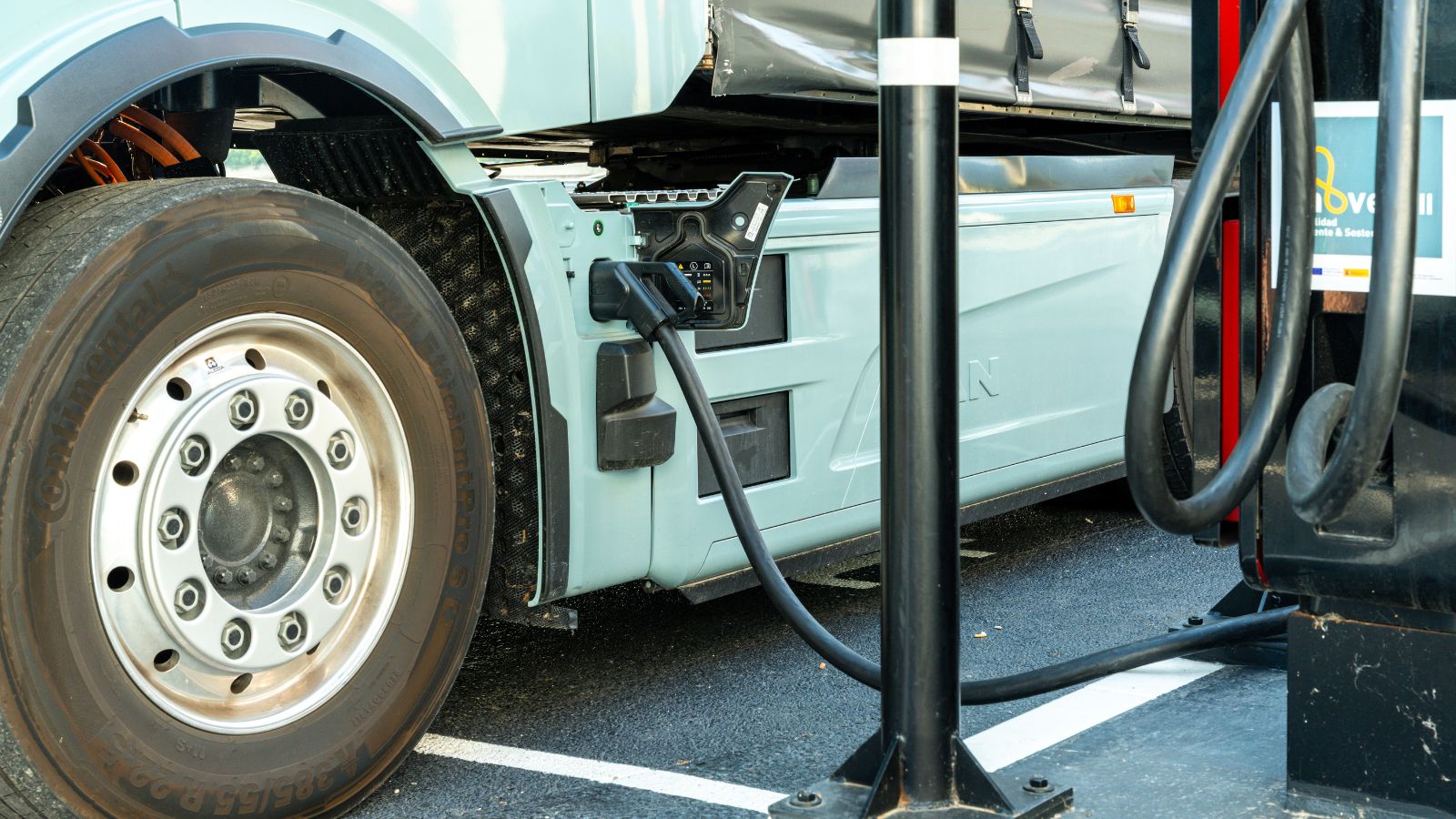
The trucks themselves are no longer lightweight urban delivery experiments. JUNA currently advertises Scania regional battery-electric vehicles with 624 kWh of installed battery capacity, a 450-kW electric powertrain producing roughly 603 horsepower, and gross train weights of up to 64 tonnes. For a 40-tonne combination, Scania has published range figures of around 350 kilometres under suitable conditions. Charging power reaches approximately 375 kW on the relevant generation of truck, putting a substantial recharge inside the kind of scheduled break that already exists in commercial operations.
Those headline figures still require context. Electric-truck range changes with payload, weather, topography, speed and vehicle configuration, which is why Scania provides route-based range tools rather than presenting one number as universal. JUNA takes a similar approach by analysing individual routes before deployment. A truck that reliably runs 250 or 300 kilometres between predictable charging opportunities may be more useful to a fleet than one with a much larger theoretical range but poorly matched infrastructure. That operational discipline is central to the ownership model: the carrier is not simply handed an electric tractor and told to adapt. The route, charger, workload and vehicle are intended to be designed as one system.
Nestlé and DHL Show How Shippers Can Pull Carriers Into Electrification
One of JUNA’s early operating examples emerged from Nestlé’s German logistics network. In an arrangement involving sennder and carrier Schober Logistics, a JUNA truck was deployed on work connected with Nestlé’s THOMY products in North Rhine-Westphalia. The partners reported more than 100 orders and over 10,000 kilometres of electric operation during the first four months. They estimated that electrifying the lane could reduce emissions by approximately 55 tonnes of CO2-equivalent annually. Overnight charging near Nestlé facilities was coordinated with loading schedules and driver hours, illustrating how mundane planning decisions can be just as important as battery capacity.
A more recent example arrived through DHL. On September 15, 2026, JUNA announced a five-year agreement involving 20 electric trucks for Bavarian carrier Pflaum under DHL’s Partner Store program. Pflaum had already taken delivery of 45 trucks of its own during 2026, while the JUNA vehicles are intended to lift its electric fleet to 65 by year-end. The arrangement is notable because owned and service-based trucks can operate side by side. For large shippers, that creates another route to reducing transport emissions without requiring every subcontractor to make the same capital-investment decision.
Operating Economics Can Look Very Different From the Purchase Price
A high sticker price does not automatically mean an electric truck will be more expensive over its working life. Total cost of ownership includes financing, energy, maintenance, tyres, taxes, tolls, charging infrastructure, utilisation and eventual residual value. In September 2026, ACEA emphasized that electricity and charging can account for roughly one-third of an electric truck’s TCO and that utilisation is especially important because commercial vehicles only earn money when they are productive. JUNA’s pay-per-use and freight-allocation structure is effectively built around those two variables: kilometres and productive workload.
Independent modelling also shows why the calculation cannot be reduced to one Europe-wide answer. The International Council on Clean Transportation estimated that, under Germany’s current toll structure, model-year 2026 battery-electric trucks could have a TCO about 10.1% below diesel for regional work and 11.4% below diesel in long-haul applications over a five-year period. Its analysis for other markets shows less favourable economics under different toll, electricity and policy conditions. That variation is crucial. Electric trucking can already make financial sense on some routes while remaining difficult on others. A service model gives operators another way to test those economics without placing the entire technology bet on their own balance sheet.
Electric Truck Sales Are Growing Quickly but Diesel Still Dominates
JUNA’s expansion is taking place against a European market that is clearly moving toward electrification but remains overwhelmingly diesel-powered. ACEA reported 171,933 new truck registrations in the European Union during the first half of 2026. Electrically chargeable truck registrations increased 47.7% from a year earlier and captured 4.8% of the market, up from 3.6% during the comparable 2025 period. Diesel still represented 92.1% of registrations. Germany, the Netherlands and France together accounted for nearly three-quarters of electrically chargeable truck registrations during the period.
That gap between rapid percentage growth and a still-small market share explains why alternative commercial models are receiving attention. Europe’s regulatory direction is also clear. Revised EU heavy-duty vehicle rules require manufacturers to cut the average CO2 emissions of covered new heavy-duty fleets by 45% from the relevant reference levels in 2030, 65% in 2035 and 90% in 2040. Those are manufacturer emissions targets, not mandates requiring those exact percentages of trucks to be electric. Even so, they create powerful pressure to increase zero-emission vehicle sales. For the industry, the challenge is turning regulatory ambition and improving technology into vehicles that ordinary transport companies can operate profitably.
Charging Infrastructure Remains Part of the Business Model
A diesel truck can be refuelled almost anywhere along Europe’s major freight corridors. Heavy electric vehicles still require considerably more planning. JUNA therefore conducts route analysis and works with private and public charging providers rather than treating charging as somebody else’s problem. European policy is gradually creating a denser backbone. Under the EU’s Alternative Fuels Infrastructure Regulation, publicly accessible heavy-duty charging pools are supposed to be spaced no more than 60 kilometres apart on the core TEN-T road network by the end of 2030, with at least two charging points of 350 kW or more at each qualifying pool. On the wider comprehensive network, the maximum spacing is 100 kilometres.
Operators are already testing longer journeys before that network is complete. In January 2026, Scania-related ventures LOTS Group and JUNA, together with carrier HAWA, announced a 1,250-kilometre electric freight corridor operating in daily commercial service across central Europe. LOTS said its software analysed shipment data, routes and charging requirements to structure the operation. Examples such as that do not mean every 1,250-kilometre diesel assignment can immediately be replaced by one battery truck. They do demonstrate why electric freight increasingly depends on software, scheduled charging, relay strategies and high asset utilisation alongside improvements in batteries themselves.
Passing 100 Trucks Is a Test of the Model, Not the End of the Transition
The most significant part of JUNA’s milestone may be what it says about the changing definition of a truck fleet. Traditionally, a carrier chose a vehicle, financed or purchased it, maintained it and accepted the risk of what it would be worth several years later. Electric vehicles introduce new uncertainties around batteries, charging infrastructure, technology development and resale values. JUNA is attempting to bundle some of those risks with the vehicle itself while linking access to actual freight demand. Reaching roughly 110 trucks suggests there is real interest in that arrangement, but it does not establish that electric trucking is already economical for every fleet or every lane.
The next phase should provide a tougher test. JUNA expects around 150 vehicles by the end of 2026, while the broader European electric-truck market is expanding from a low base. Charging access, electricity prices, utilisation, policy incentives and residual values will continue to vary widely by country and route. For operators, the emerging choice may therefore be broader than diesel versus electric. Some fleets could own electric trucks outright, some could lease them conventionally, and others could pay for them as productive capacity. If JUNA continues scaling, its biggest contribution may be proving that changing how a truck is financed and operated can be almost as important as changing what powers it.