




















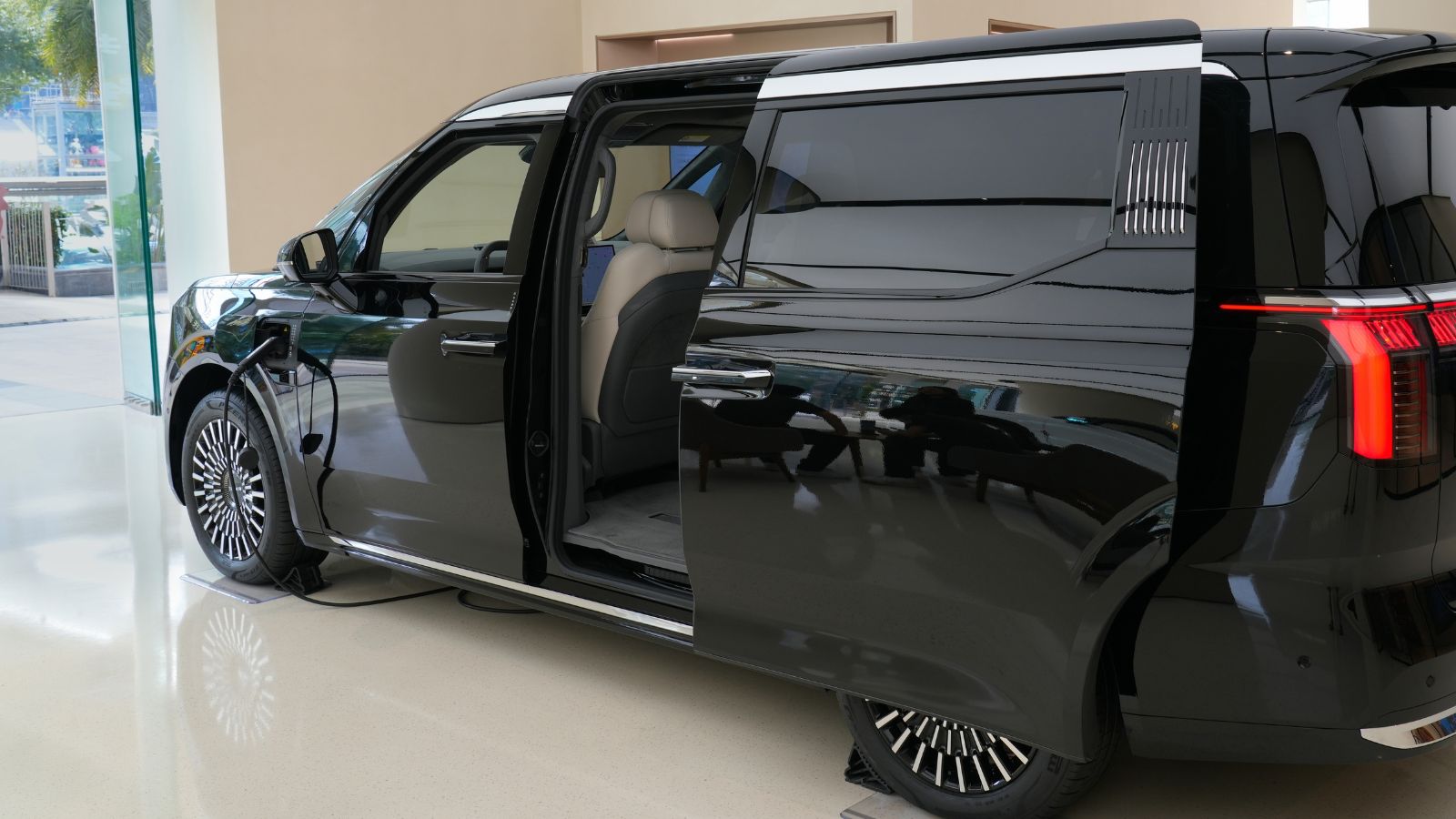
Luxury MPVs are becoming one of the clearest places to see how aggressively Chinese automakers are redefining premium pricing. Voyah’s new Dream 9 has opened pre-sales in China from RMB 429,900, roughly US$63,420 at the exchange rate reported just before the order window opened, with the range stretching to RMB 529,900.
That puts a large, technology-heavy flagship into territory once associated with far more conventional luxury vehicles. The significance is not simply that another expensive Chinese EV has arrived. The Dream 9 combines high-voltage charging, large batteries, Huawei driver-assistance hardware and an unusually elaborate rear cabin while entering a segment already crowded with Denza, Zeekr and Li Auto. Its price therefore becomes another benchmark for how much hardware Chinese brands are now willing to package into a premium vehicle before asking buyers to pay traditional luxury-brand money.
A $63,420 Starting Point Reframes Luxury
Voyah opened Dream 9 pre-sales on September 5 at RMB 429,900 to RMB 529,900, covering five configurations across plug-in-hybrid and battery-electric versions. At the RMB 6.7787-per-dollar exchange rate reported immediately before pre-sales began, the entry price works out to about US$63,420. Buyers were also offered purchase benefits worth as much as RMB 50,000, while display vehicles began arriving at dealerships the same day.
That combination makes the headline price more than a currency conversion. Voyah had positioned the Dream 9 around the RMB 500,000 class, yet the actual opening figure starts below that psychological threshold. For buyers comparing premium MPVs, the message is clear: a flagship-sized vehicle with advanced charging, multiple LiDAR sensors and an elaborate rear cabin can now enter the market in the low-US$60,000 range before incentives. That is the kind of pricing pressure reshaping expectations in China’s luxury EV market.
The Dream 9 Sits Above a Proven Voyah Formula
The new model is not replacing a weak product. Voyah’s existing 2026 Dream MPV launched from RMB 329,900 to RMB 439,900, so the Dream 9 begins almost exactly where the older lineup tops out. That creates a two-tier strategy: the regular Dream covers the lower premium range, while the Dream 9 pushes upward without abandoning the pricing that helped Voyah build volume.
There is evidence that the formula has worked. Voyah said the 2026 Dream collected more than 10,000 firm orders within 18 hours of its September 2025 launch, with more than half going to the two highest-priced Ultra variants. Disclosures showed Dream-series sales rising from 26,518 units in 2023 to 46,687 in 2024 and 76,045 in 2025. The Dream 9 therefore arrives with an established customer base and a record suggesting that buyers are comfortable choosing expensive domestic MPVs over luxury nameplates.
800-Volt Hardware Makes Charging Part of the Pitch
Every Dream 9 uses an 800-volt high-voltage platform, a specification associated with faster charging in premium EVs. The plug-in-hybrid version carries a 65-kWh battery and supports 5C fast charging; Voyah says it can move from 20% to 80% state of charge in 12 minutes. That is an unusually large battery for a PHEV, giving the vehicle more electric-only capability than traditional short-range hybrids.
The battery-electric version uses a roughly 120-kWh pack and carries a CLTC range of 701 kilometres. Regulatory information cited by Chinese automotive media lists a 119.6-kWh pack, while launch material rounds it to 120 kWh. The PHEV is rated at 291 or 300 kilometres of WLTC electric range depending on configuration. These figures help explain the price: Voyah is not treating electrification as a token feature. Both powertrains are designed to let a large MPV spend significant time operating as an EV.
Huawei Technology Is Central, Not Decorative
The Dream 9’s electronics package is an attempt to separate it from traditional luxury vans. Voyah says the vehicle uses an L3-capable electronic architecture and Huawei’s Qiankun ADS 5 driver-assistance system, supported by 37 perception sensors. The hardware list includes an 896-line dual-path imaging LiDAR and three solid-state LiDAR units intended to provide additional coverage around the vehicle.
Inside, the Huawei relationship continues through HarmonySpace 6 and the newer MoLA 2.0 cockpit architecture. The system is promoted as using a much larger multimodal model than the previous generation to improve voice interaction, contextual understanding and cross-domain control. The significance is broader than a bigger screen or faster processor. Chinese premium brands now sell software ecosystems, navigation, parking assistance and cabin intelligence as luxury attributes. In the Dream 9, Huawei technology is not an optional garnish; it is part of the vehicle’s identity and pricing logic.
The Rear Cabin Makes the Luxury Argument Tangible
The Dream 9 becomes clearly an MPV flagship behind the front seats. The second-row chairs can rotate through 45-, 90- and 180-degree positions, slide laterally, provide a zero-gravity reclining mode and offer mechanical massage. The zero-gravity setting can extend the seatback to a claimed 147-degree resting posture, while ventilation, heating and massage are provided throughout the seating rows according to Voyah’s launch information.
Voyah also includes a 21.4-inch ceiling-mounted rear display, a 13-litre heating-and-cooling compartment rated from minus 6 to 50 degrees Celsius, and adaptive-dimming glass for the second and third rows. Up front are dual 15.6-inch Huawei displays, while the cabin uses maple trim and ambient lighting. These details matter because luxury MPVs often serve as chauffeured family vehicles or mobile business lounges. In that context, the Dream 9 competes not only on propulsion technology but on how much first-class-cabin equipment is included.
A 5.3-Metre Vehicle Tries to Feel Smaller From the Driver’s Seat
The Dream 9 measures 5,325 millimetres long, 1,998 millimetres wide and up to 1,823 millimetres tall, with a 3,200-millimetre wheelbase. Those dimensions put it in full-size luxury-MPV territory. Large sliding-door vehicles provide the space buyers want, but they can also become awkward in underground garages, hotel drop-off lanes and dense city streets.
Voyah’s answer is a chassis packed with hardware associated with expensive sedans and SUVs. The vehicle uses three-chamber air springs, variable damping, front double-wishbone and rear five-link suspension, plus rear-wheel steering of up to 10 degrees in each direction. An integrated body-control system coordinates traction, braking and suspension responses. None of that makes a 5.3-metre MPV physically small, but it addresses a real ownership problem: premium passengers may value rear-seat comfort, while the person maneuvering the vehicle still has to deal with its considerable dimensions every day.
The Competitive Set Shows How Tight Pricing Has Become
The Dream 9 enters a crowded category. BYD’s second-generation Denza D9 launched in April from RMB 359,800, with higher trims reaching RMB 469,800. Zeekr’s updated 009 arrived in May with a limited-time starting price of RMB 413,800 after entitlements and official pricing of roughly RMB 439,800 to RMB 469,800. Li Auto then launched its refreshed Mega in early September at RMB 509,800, cutting RMB 50,000 from the previous Home version.
That leaves the Dream 9’s RMB 429,900 starting point in a crowded middle ground. It is more expensive than the least costly Denza D9, close to the Zeekr 009, and below the Li Mega. The result is feature-for-feature pressure: large batteries, high-voltage platforms, LiDAR-heavy driver assistance, premium rear seats and fast charging are becoming normal weapons in the segment. Buyers can increasingly focus on which domestic brand delivers the most convincing technology and comfort package for the money.
Voyah Needs the Flagship to Improve More Than Its Image
The Dream 9 carries financial weight for its manufacturer. Voyah reported 2026 first-half revenue of RMB 18.16 billion, up 42.4% year over year, while deliveries increased 35.9% to 76,264 vehicles. Growth was strong, but profitability moved the other way: gross margin fell to 17.7%, and the company recorded a net loss of RMB 389 million compared with a profit a year earlier.
Management attributed the pressure partly to higher raw-material costs, including lithium carbonate and memory chips, amid intense industry competition. August deliveries of 13,003 vehicles were also lower than a year earlier. That makes the Dream 9 a business-critical halo product. A successful premium model can improve product mix and spread development costs across higher-value sales, but aggressive pricing also limits how much margin a manufacturer can harvest from that positioning. Voyah is therefore trying to balance volume, prestige and profitability simultaneously.
China’s EV Market Leaves Little Room for Comfortable Pricing
The Dream 9 arrives in a market where electrification is dominant but demand remains uneven. Preliminary China Passenger Car Association data showed 1.069 million passenger NEVs sold at retail in August 2026, down 4% from a year earlier but up 12% from July. NEVs still reached a record 65.7% of passenger-vehicle retail sales, showing how deeply electric and plug-in vehicles have penetrated the market.
Competition is equally intense. Industry reporting based on Dongchedi’s launch database counted roughly 630 new or refreshed models introduced in China during the first half of 2026, averaging more than three per day. That helps explain why Voyah cancelled a conventional offline pre-sale event and sent customers directly to showrooms. With so many launches competing for attention, prices and specification sheets must work harder. The Dream 9’s pricing is therefore partly a response to saturation: premium vehicles must look unusually complete before shoppers stop and consider them.
The Benchmark Matters Beyond China’s Domestic Showrooms
Voyah is positioning itself as an export brand, making the Dream 9’s domestic pricing relevant outside China. By mid-2026, the company had entered more than 40 countries and regions and built more than 240 overseas outlets. It has also announced plans for right-hand-drive Dream models and expanded into Saudi Arabia, where it opened showrooms in Riyadh and Jeddah.
The bigger move is in Europe. Stellantis and Dongfeng signed a non-binding memorandum to create a Stellantis-led 51/49 European joint venture to handle Voyah sales in selected markets and potentially localize Dongfeng NEV production at Stellantis’ Rennes plant in France. Local production, tariffs, taxes and equipment differences mean the Dream 9 would not simply carry its Chinese sticker price abroad. Still, a US$63,420-equivalent flagship at home demonstrates the cost and technology baseline Chinese automakers are building from—one that established luxury manufacturers increasingly have to take seriously.