


























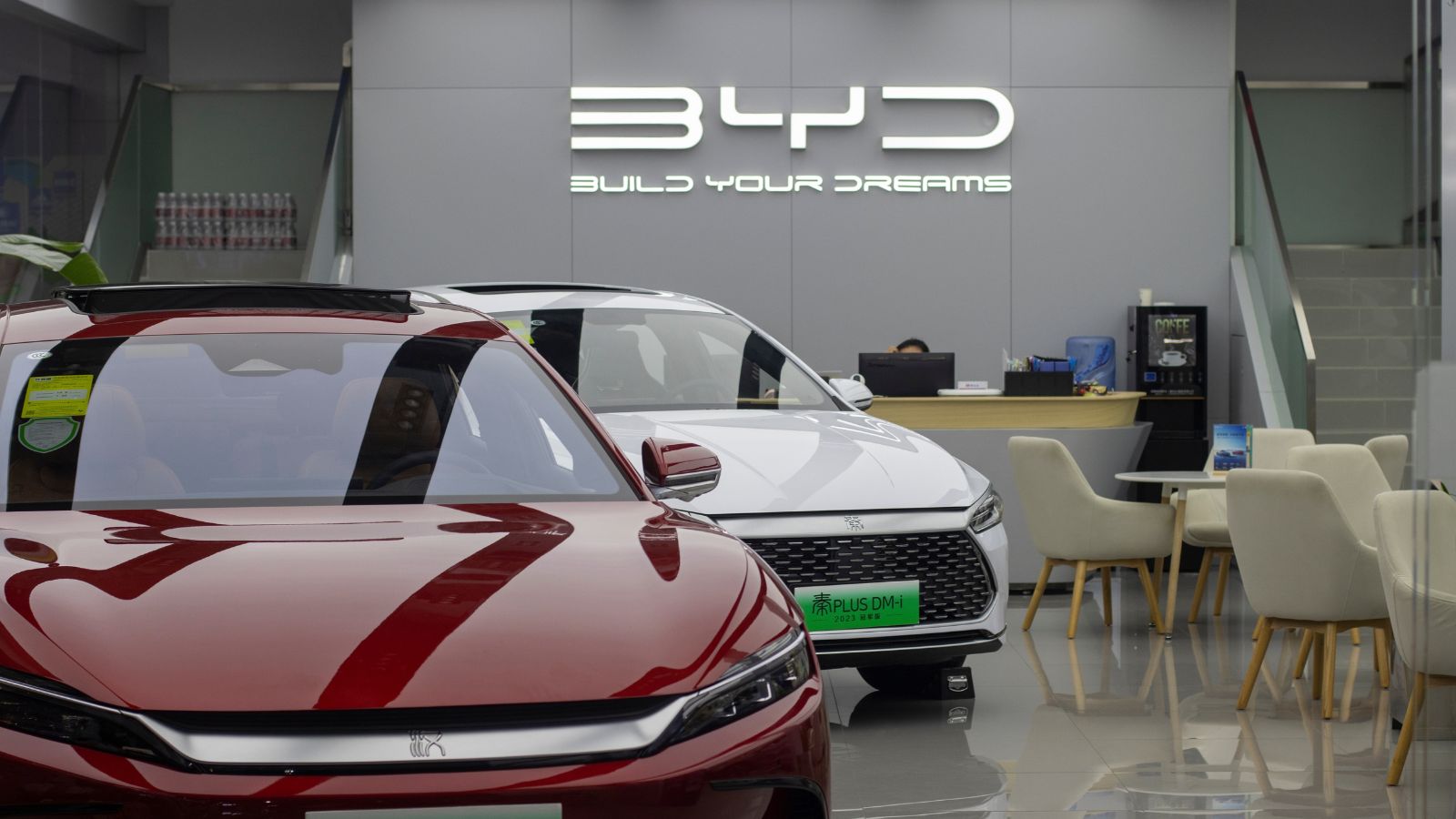
BYD’s international expansion is accelerating at exactly the moment Canada is creating more room for Chinese-made electric vehicles. The Chinese automaker’s overseas shipments jumped 134.5% year over year in August 2026 to a record 189,466 vehicles, helping lift overall monthly sales despite continuing pressure in its home market.
The timing is significant for Canada. On September 1, Ottawa opened the second half of its first annual Chinese EV quota, allowing another 24,500 vehicles, plus unused capacity from the previous six months, to enter under a 6.1% tariff. The system is still tightly controlled, but compared with the 100% surtax that previously applied, it gives BYD and other Chinese manufacturers a much more realistic route into one of North America’s most closely watched auto markets.
Overseas Sales Are Becoming BYD’s Growth Engine
BYD sold 440,293 new-energy vehicles globally in August 2026, up 17.8% from the same month a year earlier and its strongest monthly result of the year. The more revealing number, however, came from outside China. Overseas shipments reached 189,466 vehicles, a 134.5% year-over-year increase and roughly 43% of BYD’s worldwide monthly volume. That represents a dramatic shift for a company whose enormous scale was built largely inside the Chinese market.
The export surge is also changing what drives BYD’s growth. Estimated domestic sales fell year over year in August, meaning overseas buyers did more than provide incremental volume—they compensated for weakness at home. BYD has spent years building distribution, manufacturing and brand awareness across Europe, Southeast Asia, Latin America and other regions. The August figures suggest that strategy is no longer a side business. International markets are increasingly central to whether BYD can continue expanding as aggressively as it has during the past several years.
China’s Crowded Market Is Giving BYD Another Reason to Look Abroad
BYD’s overseas push is occurring against a difficult backdrop in China, where automakers have been fighting for consumers through rapid model launches, technology upgrades and intense pricing competition. Domestic demand has become less dependable for BYD even while its overall scale remains enormous. In August, overseas shipments were strong enough to offset declining estimated domestic volume and keep total company sales growing.
That international expansion is beginning to show up in BYD’s finances as well. Reuters reported that exports exceeded 790,000 vehicles in the first half of 2026, while overseas business became increasingly important to revenue and profitability. BYD’s second-quarter net profit rose 30% from a year earlier to 8.2 billion yuan even though quarterly revenue declined. Stronger overseas margins helped cushion pressure in China. For management, that creates a powerful incentive to keep opening new markets. Every country where BYD establishes a sustainable retail operation reduces its dependence on an increasingly competitive Chinese marketplace.
Canada Has Replaced a 100% Surtax With Managed Access
Canada’s policy shift fundamentally changed the economics of importing Chinese-built EVs. Beginning March 1, 2026, Ottawa replaced the previous 100% surtax with an initial annual quota of 49,000 Chinese EVs that can enter at Canada’s 6.1% most-favoured-nation tariff rate. The federal government described the quota as a return to import volumes close to those seen before the recent trade dispute rather than an unlimited opening of the Canadian market.
The distinction matters. Forty-nine thousand vehicles represent less than 3% of Canada’s annual new-vehicle market, according to the federal government. Imports also require shipment-specific permits, and vehicles outside the authorized quota cannot simply enter under the lower tariff. Ottawa has therefore tried to balance competing objectives: increasing consumer choice and trade with China while limiting the immediate competitive shock to Canadian assembly plants and established manufacturers. For companies such as BYD, the barrier has fallen dramatically, but access remains scarce enough to make every quota allocation commercially important.
September 1 Opens Another 24,500-Vehicle Window
The newest opportunity arrived on September 1, when Global Affairs Canada began the second period of the first quota year. The government made 24,500 vehicles available for the September 1, 2026-to-February 28, 2027 period, with any unused volume from the first six months added to that total. Import permits continue to be distributed on a first-come, first-served basis, making timing especially important for manufacturers preparing Canadian launches.
There is another provision that could matter to companies entering Canada for the first time. Global Affairs Canada says it may set aside part of the available quota to provide equitable access to original equipment manufacturers, including new entrants. That does not guarantee BYD any specific volume, but it means the system is not necessarily designed to allow established importers to consume every available permit before newcomers have an opportunity. Companies still need Canadian import arrangements, regulatory compliance, vehicles suitable for the market and a distribution network before quota access becomes meaningful.
BYD Is Showing Increasingly Visible Signs of a Canadian Entry
BYD has been laying foundations for a Canadian passenger-vehicle business even though customers cannot yet place orders. Its Canadian website now identifies BYD Canada Company Limited in Markham, Ontario, and carries a “Coming Soon” presence. BYD’s Canadian terms of use explicitly state that the website does not currently accept purchases, leases, financing applications, reservations, pre-orders or deposits, underscoring that retail operations have not formally begun.
The broader preparations extend beyond a web page. Reuters reported earlier in 2026 that BYD was among several Chinese automakers pursuing Canadian expansion, alongside companies such as Chery, Changan and Geely-owned brands. Establishing a sustainable operation means considerably more than shipping vehicles to Vancouver or Toronto. Automakers need certification, parts inventories, technicians, financing relationships, dealers and warranty support. Those less visible pieces often determine whether a new entrant becomes a long-term competitor or a niche importer. Canada’s tariff change removes one major obstacle, but building consumer trust remains the harder part.
Canada’s EV Market Still Has Plenty of Demand to Rebuild
Chinese manufacturers are arriving after a difficult year for Canadian electric-vehicle sales. Statistics Canada reported that 169,972 zero-emission vehicles were sold in 2025, down 35.7% from 2024. ZEVs represented approximately 8.7% of new-vehicle sales, compared with 13.8% a year earlier. Changes to federal and provincial purchase incentives contributed to the slowdown, illustrating how price-sensitive the Canadian EV market remains.
There are signs of recovery. In May 2026, Canadians bought 18,308 new ZEVs, 19.7% more than in May 2025, lifting their share of monthly new-vehicle sales to 9.6%. That combination—a market with substantial long-term electrification ambitions but considerable sensitivity to purchase prices—helps explain why lower-cost Chinese vehicles have attracted political and commercial attention. BYD has built much of its global reputation around producing EVs and plug-in hybrids across a wide price spectrum. Whether that translates into Canadian sales will depend heavily on which models arrive and how aggressively they are priced after transportation, tariffs and dealer costs.
Ottawa Wants More of the Quota Reserved for Affordable EVs
Canada’s agreement with China is designed to change gradually rather than remain fixed at 49,000 vehicles indefinitely. The annual quota is scheduled to increase by 6.5% per year. Starting in the second year, 10% of the quota is to be reserved for vehicles with a free-on-board value of C$35,000 or less. That affordable-vehicle share is scheduled to rise until it reaches 50% in the fifth year.
Those rules could become especially important for BYD. The company competes internationally with everything from inexpensive urban EVs to premium vehicles, giving it several possible ways to approach Canada. Ottawa’s structure creates a growing incentive for Chinese manufacturers to offer less-expensive models rather than using the limited quota exclusively for high-margin luxury vehicles. For Canadian households that found early EV choices too costly, the policy could expand the lower end of the market. For domestic manufacturers, however, it also raises the competitive pressure to make locally sold EVs affordable without relying indefinitely on large purchase incentives.
Canada Is Becoming a Strategic North American Test Market
Canada matters to Chinese automakers for reasons that extend beyond its roughly two-million-vehicle annual market. Reuters reported in June that industry participants increasingly view Canada as a potential “practice run” for Chinese brands interested in North America. Canadian consumers buy many of the same crossovers, pickups and larger vehicles preferred in the United States, while Canadian safety expectations, weather conditions and dealership practices offer useful lessons for operating elsewhere on the continent.
That does not mean a Canadian launch automatically unlocks the United States. Washington maintains significant tariff, technology and national-security barriers affecting Chinese vehicles, and U.S. policymakers have closely watched Canada’s changing relationship with Chinese automakers. Still, succeeding north of the border could give companies valuable experience with cold-weather validation, English- and French-language marketing, North American retail expectations and regulatory processes. For BYD, Canada can therefore be both a sales opportunity and a laboratory. A modest share of Canadian demand could carry strategic importance well beyond the vehicles sold here.
Beijing Is Now Trying to Keep Its Export Boom From Becoming a Price War
BYD’s record overseas expansion coincides with a warning from Chinese regulators about how domestic automakers behave abroad. On September 1, China issued new guidance telling carmakers expanding internationally to follow local laws, avoid disruptive competition and base prices on costs and market conditions. Authorities also warned against predatory pricing and misleading marketing as Chinese manufacturers rapidly increase their global presence.
The timing illustrates the scale of the transformation. China exported 8.32 million vehicles in 2025 to more than 200 countries and regions, according to figures cited by Reuters, while Chinese auto manufacturers have invested in production operations across dozens of overseas markets. That growth inevitably puts pressure on established automakers and increases the risk of political backlash if Chinese companies are perceived as exporting their fierce domestic price competition abroad. For BYD, continued international success may therefore require more than offering inexpensive vehicles. Governments increasingly expect local investment, responsible pricing, regulatory compliance and evidence that new entrants contribute economically to the markets where they sell.
Canada’s Opening Is Small, but the Direction Has Changed
The most important feature of Canada’s new policy is not that Chinese EVs suddenly have unrestricted access—they do not. The initial 49,000-vehicle annual ceiling remains a fraction of the Canadian new-car market, imports need permits, and companies must still satisfy Canadian regulatory requirements. Yet the difference between a controlled 6.1% tariff window and the previous 100% surtax is enormous from an automaker’s perspective.
BYD’s August export performance shows why that opening matters. An automaker shipping nearly 190,000 vehicles overseas in a single month is constantly searching for new markets capable of absorbing additional production. Canada is now one of those possibilities. Its value to BYD will depend on quota access, pricing, dealer coverage, model selection and consumer confidence, while Ottawa will be watching whether Chinese competition delivers the promised affordability and investment without seriously damaging domestic manufacturing. The quota keeps the gate narrow. What has changed is that the gate is now genuinely open.