





















Volkswagen’s problems have moved well beyond an ordinary downturn in car sales. The German automotive giant has warned that roughly €10 billion, or about US$11.5 billion, in special effects will weigh on its 2026 operating profit as weakness at Porsche, restructuring costs and deteriorating conditions in China force another dramatic reset of expectations.
The warning arrives while Volkswagen is already confronting expensive U.S. tariffs, aggressive Chinese competitors, changing electric-vehicle demand and one of the largest restructuring programs in its history. Management now expects an operating return on sales of no more than 1% for 2026, sharply below its previous 4% to 5.5% guidance. The scale of that revision shows how several once-manageable problems have begun reinforcing one another.
The $11.5 Billion Headline Is Only Part of the Story
Volkswagen expects approximately €10 billion in special effects to reduce its operating profit during 2026. At the exchange rate cited by Reuters when the warning was announced, that translates to roughly US$11.5 billion. About €900 million of those effects had already been recorded during the first half of the year. The largest new component is an approximately €6 billion non-cash impairment of goodwill associated with Porsche, reflecting Volkswagen’s reduced expectations for the sports-car business. Additional charges are connected with restructuring and assets in China.
The distinction between those exceptional charges and Volkswagen’s underlying business is important. The company estimates that its operating return on sales would be around 4% if the special effects were excluded. Even that adjusted figure is hardly comfortable for a manufacturer facing enormous spending requirements for software, batteries, new vehicles and factory modernization. Volkswagen Chief Financial Officer Arno Antlitz has said the adjusted performance remains insufficient to finance the company’s future ambitions as aggressively as management believes necessary.
Porsche Has Become the Most Painful Part of the Problem
Porsche once represented one of the strongest profit engines inside the Volkswagen empire, but changing conditions in China and the United States have transformed it into a major source of uncertainty. Porsche reported a group operating return on sales of only 1.1% for 2025 after extraordinary expenses. Performance improved during the first half of 2026, when operating profit reached €1.35 billion and the operating margin recovered to 7.8%, compared with 5.5% in the same period a year earlier.
The recovery has not eliminated the long-term concerns. Porsche delivered 122,306 vehicles worldwide in the first half of 2026, 16.5% fewer than a year earlier. China was particularly difficult: deliveries there dropped 32% to 14,501 vehicles. Volkswagen’s decision to write down roughly €6 billion of goodwill assigned to Porsche therefore reflects expectations extending beyond one reporting period. The parent company revised its medium- and long-term assumptions after Porsche updated its own outlook, effectively acknowledging that the premium brand’s future earnings may not resemble the exceptional profitability investors once expected from it.
U.S. Tariffs Are Eating Into an Already Narrower Margin
The United States presents a different challenge. Volkswagen sells vehicles there through several brands, but important premium models from Porsche and Audi continue to arrive from overseas factories. That makes tariff costs especially difficult to avoid quickly. Volkswagen reported that U.S. tariffs created an approximately €600 million burden during the first quarter of 2026 alone. Porsche, meanwhile, built about €700 million in tariff costs into the assumptions behind its full-year outlook earlier this year.
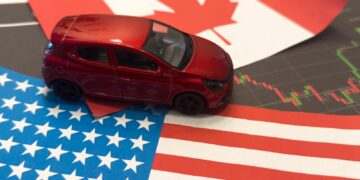
The broader U.S.-EU trade framework has subjected covered European automobiles to a combined tariff rate of 15%, substantially changing the economics of importing European-built vehicles. Localizing production could reduce that exposure, but building or expanding American factories requires billions of dollars and years of planning. Porsche is particularly exposed because its vehicles are produced in Europe. Audi also relies heavily on imports. Tariffs therefore create a difficult choice: absorb the duties and accept lower margins, increase vehicle prices and risk reducing demand, or commit substantial capital to more North American production.
China Has Shifted From Profit Engine to Strategic Problem
China was once the market that helped make Volkswagen one of the world’s dominant automotive groups. That relationship is changing rapidly. Volkswagen Group deliveries in China fell 25.9% in the first six months of 2026, to approximately 973,000 vehicles. Management said the overall Chinese market relevant to its business had contracted sharply, while intense competition continued to pressure sales. Audi deliveries in China also dropped by nearly 20% during the first half, while Porsche’s 32% decline was even steeper.
The longer-term numbers illustrate why executives are treating China as a structural issue rather than a temporary slump. Reuters reported in June that Volkswagen’s earnings from China had fallen by more than 80% over the previous decade as domestic automakers became much stronger, particularly in electric vehicles. Volkswagen also lost its long-held position as China’s largest automaker in recent years. Companies such as BYD can now compete on price, battery technology, software and rapid product-development cycles, forcing established foreign manufacturers to rethink a business model that had produced enormous profits for decades.
Electric Cars Are Growing in Europe but Creating a Complicated Profit Equation
Volkswagen is not simply suffering from weak electric-vehicle demand. In parts of Europe, the opposite is happening. The group said its European order backlog for battery-electric vehicles was more than 50% higher at the end of the first half of 2026 than at the end of 2025. New lower-priced electric models from Volkswagen, Škoda and Cupra also generated tens of thousands of orders shortly after launch. Across Europe more broadly, battery-electric registrations have been increasing strongly during 2026.
The problem is converting that demand into the type of profitability Volkswagen historically generated from premium combustion-engine vehicles. Management specifically identified an accelerated shift toward battery-electric cars as one factor lowering expectations for Volkswagen Passenger Cars and Audi. Electric models bring significant battery, software and development costs, while intense competition limits pricing power. Volkswagen therefore faces an uncomfortable transition: it needs successful EVs to remain competitive, particularly against Chinese manufacturers, but faster EV adoption can pressure earnings when those vehicles generate thinner margins than the combustion models they replace.
Audi and the Volkswagen Brand Are Feeling the Pressure Too
Porsche may account for the largest single impairment, but Volkswagen’s revised outlook makes clear that the problems stretch across the group. Management said worsening conditions in China and the accelerating shift toward electric vehicles were causing results to fall below previous expectations particularly at Audi and Volkswagen Passenger Cars. Audi’s worldwide deliveries dropped about 7% during the first half of 2026, with China falling by almost 20% and North America declining by roughly 17%.
There are some brighter areas. Volkswagen’s Brand Group Core, which includes its major volume brands, generated €3.61 billion of operating profit during the first six months of 2026, an increase of 4.5% from the previous year. Its operating margin reached 4.9%. Cost control and cooperation across brands helped offset some external pressure. That contrast is significant: Volkswagen is demonstrating that parts of its efficiency program can work, but gains inside individual divisions are being overwhelmed at group level by Porsche impairments, China weakness, tariff exposure and restructuring expenses.
Volkswagen Is Responding With Its Biggest Restructuring in Decades
Volkswagen’s answer is becoming increasingly radical. Its supervisory board approved the Future Plan 2030 in September, a group-wide overhaul intended to reduce costs, simplify decision-making and make the sprawling organization easier to manage. The plan calls for approximately 50,000 additional position reductions across roughly 170 companies, with about half expected in Germany and half elsewhere. Volkswagen says management positions alone are expected to decline by roughly a quarter, from about 21,500 to approximately 16,000 worldwide.
Those cuts come in addition to workforce-reduction programs already agreed at Volkswagen, Audi, Porsche and software unit Cariad. Reuters reported that the combined initiatives could bring the total number of agreed reductions to roughly 100,000 positions. The future of several German factories is also under examination as existing model programs expire. At Osnabrück, Volkswagen has already reached terms for a potential sale involving investment firm Aurelius and the state of Lower Saxony, with plans to gradually shift the location toward security and defence-related industrial work.
The Crisis Reflects a Wider Problem for Europe’s Auto Industry
Volkswagen’s difficulties cannot be separated from what is happening across European manufacturing. Chinese automakers are becoming more visible in Europe while German producers face relatively high labour and energy costs, heavy capital requirements and weaker profitability than they enjoyed earlier in the decade. Reuters Breakingviews reported that Chinese brands reached about 9% of EU car sales during the first half of 2026 and cited expectations that their share could rise further by 2030.
For Volkswagen, that means competition is now arriving from both directions. In China, domestic manufacturers are taking business away from foreign brands. In Europe, many of those same Chinese companies are expanding exports and local operations. Meanwhile, tariffs make selling European-built vehicles in the United States more expensive. Volkswagen therefore cannot solve its problems simply by shifting attention from one geographical market to another. Its restructuring is ultimately an attempt to lower the company’s cost base enough to remain competitive in a world where its three most strategically important regions are changing simultaneously.
Investors Now Want Proof That the Turnaround Can Produce Cash and Profit
Markets reacted sharply to Volkswagen’s latest warning. Its shares closed 5.6% lower after the revised outlook was announced, while Porsche shares declined 3.3% and Porsche SE, Volkswagen’s largest shareholder, dropped 4.9%. The response reflected more than the size of the impairment. Volkswagen had already reduced expectations earlier in the year, meaning another major revision raised questions about how predictable earnings have become during the restructuring.
There is still a substantial financial cushion. Volkswagen continues to forecast automotive net cash flow of €3 billion to €6 billion for 2026 and net liquidity of €32 billion to €34 billion. Revenue is expected to reach roughly €315 billion, compared with €321.9 billion in 2025. Those numbers make clear that Volkswagen remains an enormous industrial company rather than a business facing an immediate liquidity crisis. The bigger question is whether it can turn that scale into acceptable profitability again. With a reported 2026 operating margin now expected at no more than 1%, cost reductions, China recovery efforts and tariff management have become increasingly urgent.