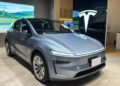
























China’s electric-vehicle market is moving so quickly that even a relatively new model can find itself needing a reset. FAW Toyota has responded by giving the 2027 bZ5 a sharper technological pitch and, more importantly, a much lower temporary entry price.
The electric crossover is now being offered from 109,800 yuan, or about US$16,170, under a limited-time incentive program. That arrives as July retail sales fell to just 529 vehicles, 64.59% below the same month a year earlier. The combination tells a larger story about Toyota’s challenge in China: competitive range and a familiar global badge are no longer enough. Price, software, driver-assistance technology and the speed of product updates are increasingly deciding which EVs get noticed.
The US$16,170 Price Comes With an Important Catch
FAW Toyota has not technically rewritten the bZ5’s official sticker price. The refreshed 2027 model continues to carry official prices ranging from 129,800 yuan to 199,800 yuan across six versions. Instead, the company is offering limited-time prices of 109,800 yuan to 179,800 yuan. That effectively removes 20,000 yuan from each version during the promotional period and puts the least-expensive bZ5 at roughly US$16,170 at the exchange rate used when the model was announced.
The structure of the offer matters. Reporting on the launch says the discount combines a 16,000-yuan cash incentive with a 4,000-yuan trade-in subsidy. FAW Toyota is also dangling other ownership benefits, including interest-free financing, a home charger and a lifetime warranty on the battery, motor and electric-control system for the original owner. In other words, Toyota is attacking the affordability question from several directions without formally cutting the model’s published MSRP.
A 64.59% Sales Drop Explains the Urgency
The pricing move becomes easier to understand when the bZ5’s retail numbers are placed beside it. The crossover recorded 529 retail sales in China during July 2026, down 64.59% from 1,494 units in July 2025. It was also below the 723 units recorded in June. The model briefly looked more promising earlier in its life, reaching a retail peak of 3,019 vehicles in September 2025, according to sales data compiled from company and China Passenger Car Association figures.
That means July volume was less than one-fifth of the model’s peak monthly performance. It is important, however, to distinguish retail sales from wholesale shipments to dealers. Different Chinese industry datasets can produce dramatically different monthly numbers because they measure different stages of the distribution chain. The nearly 65% decline in the headline refers specifically to retail sales to the market, making it a useful gauge of end-customer demand rather than production or dealer deliveries.
Toyota Is Cutting Price in an EV Market Already Dominated by EVs
The bZ5 is not struggling because Chinese consumers have rejected electrification. Quite the opposite. New-energy vehicles accounted for a record 65.1% of Chinese passenger-vehicle retail sales in July, according to final China Passenger Car Association data. Approximately 951,000 NEVs were sold at retail during the month. Overall passenger-car retail volume fell 20.9% year over year, while NEV retail declined by a much milder 3.9%.
That creates an unusually difficult environment for an individual EV. Electric models are taking a larger share of the market even as buyers become more selective and overall demand contracts. BYD, Geely, Leapmotor, Changan and other domestic companies occupy enormous portions of the NEV rankings, forcing foreign manufacturers to compete not merely on electrification but on price, software and equipment. Toyota has already demonstrated how aggressive it is willing to become: GAC Toyota launched the smaller Bozhi 3X from 104,800 yuan in 2025 and reported more than 10,000 orders within its first hour.
The Biggest Upgrade Is in the Car’s Electronic Brain
Rather than radically redesigning the bZ5, Toyota concentrated much of the 2027 update on driver assistance. The refreshed Toyota Pilot system moves from technology based around Momenta 5.0 to Momenta 6.0, incorporating Momenta’s R6 reinforcement-learning foundation model. The system uses a computing platform rated at 544 TOPS and supports functions including navigation-assisted driving in urban environments.
That choice says something about how international automakers are adapting to China. Toyota is not trying to recreate every software layer internally. Momenta is a Chinese autonomous-driving technology company whose systems have increasingly found their way into vehicles from established manufacturers. Pairing Toyota’s safety systems and vehicle engineering with locally developed driving software gives FAW Toyota a faster route toward features Chinese shoppers increasingly encounter across domestic EV brands. The hardware-software race has become particularly important as sophisticated driver-assistance packages migrate into progressively cheaper vehicles, reducing the ability of established brands to charge a premium simply for their badge.
The Battery and Powertrain Formula Remains Familiar
Underneath the software changes, the basic bZ5 mechanical package remains largely recognizable. The crossover uses a front-mounted electric motor producing up to 200 kW, equivalent to roughly 268 horsepower. Buyers can choose lithium-iron-phosphate battery packs with capacities of 65.28 kWh or 73.98 kWh. The batteries are supplied by BYD and use the company’s Blade Battery technology.
Those packs correspond to claimed CLTC driving ranges of approximately 550 kilometres and 630 kilometres, depending on version. The bZ5 itself measures 4,780 millimetres long, 1,866 millimetres wide and 1,510 millimetres high, riding on a 2,880-millimetre wheelbase. Inside, Toyota continues to emphasize a large 15.6-inch central display, while higher equipment levels add comfort and entertainment features. The result is not an entirely new EV. Toyota is effectively trying to make an existing package more compelling by changing two areas that can quickly influence showroom comparisons: intelligent-driving capability and the effective purchase price.
The bZ5 Shows How Far Toyota’s China Localization Has Gone
The bZ5 is significant beyond its own sales totals because it represents Toyota’s attempt to build vehicles around Chinese consumer expectations rather than simply adapting global products after they arrive. When the model was introduced in 2025, FAW Toyota described it as an important product developed under a structure in which Chinese teams played a leading role. Its technology mix reinforces that approach: battery cells and battery technology come from BYD, while advanced driving functions rely heavily on Momenta.
That fits Toyota’s broader strategic shift. Reuters previously reported that the automaker intended to give China-based executives and engineers greater authority over product development, particularly in electrification and connected technologies, as it tried to recover ground lost to domestic manufacturers. Toyota’s other Chinese joint venture has pursued a similar approach. The GAC Toyota Bozhi 3X combined aggressive pricing with local technology and received more than 10,000 orders within an hour of its 2025 launch, providing a striking example of what a more localized formula could accomplish.
The Discount Changes the Value Equation More Than the Vehicle
For the entry bZ5, a 20,000-yuan incentive represents roughly 15% of its 129,800-yuan official starting price. That is enough to materially change how the vehicle appears in an online comparison. At 109,800 yuan, the bZ5 is also only 5,000 yuan above the 104,800-yuan launch price Toyota used for the entry-level Bozhi 3X, bringing two of the company’s China-focused EVs into a much tighter affordability band.
The difficult question is whether price was the main obstacle in the first place. The bZ5 already offered respectable claimed range, a large touchscreen and locally sourced EV technology, yet its retail performance still faded after the initial launch period. Toyota is therefore pairing the financial incentive with stronger software rather than relying on a rebate alone. That is a more consequential strategy. In China’s current market, the comparison taking place in the showroom is increasingly about the entire technology package buyers receive for every 10,000 yuan they spend.
The Next Few Months Will Show Whether the Reset Worked
The clearest test will come in the bZ5’s post-refresh retail numbers. A temporary promotional price can generate attention quickly, but sustained improvement would require the model to hold buyers after the initial launch campaign. Toyota will also have to determine whether 109,800 yuan remains a short-term acquisition tool or whether intense competition makes something close to that price the bZ5’s effective market level over the longer term.
The wider market will not make that test easy. During the first 23 days of August, Chinese passenger NEV retail sales reached about 614,000 vehicles, while NEV penetration stood at 64.3%. Electrified vehicles therefore remain central to the market even as overall demand remains under pressure. Toyota’s response is revealing: instead of retreating, it is pushing a nearly 4.8-metre EV toward the equivalent of a roughly US$16,000 starting price while adding more sophisticated Chinese-developed driver-assistance technology. The coming sales data will show whether that combination is strong enough to restore momentum.