


























A driving position can feel relaxed for the first few minutes and still leave the body working overtime an hour later. The common mistake is sliding the seat too far from the pedals and steering wheel, then compensating with straighter legs, reaching arms, a rounded back, or a forward-leaning head. None of those adjustments looks dramatic, which is why the resulting fatigue is often blamed on traffic, age, or the vehicle itself.
These 12 points explain how excessive seat distance triggers a chain of muscular strain, reduced support, pressure buildup, and poorer control—and how a careful reset can make an ordinary commute or highway trip feel noticeably less demanding.
The “Relaxed” Position Can Be Deceptive

Moving the seat rearward often creates an immediate sense of space. The knees open, the cabin feels less cramped, and the driving position may resemble a lounge chair. The problem begins when the driver can no longer steer or press the pedals while keeping the shoulders, pelvis, and back supported. The body then bridges the extra distance with low-level muscular effort that continues through every straightaway and turn.
A laboratory study involving 27 young adults tested steering-wheel distances equal to 50, 70, and 90 percent of arm length. Steering torque and muscle strength changed significantly with distance, and muscle strength was greatest at the middle setting of 70 percent. The lesson is not that every driver needs one mathematical ratio. It is that farther is not automatically more comfortable. A driver whose elbows nearly lock or whose shoulder blades leave the backrest has probably traded visible space for hidden work.
Straight Arms Turn Steering Into Shoulder Work

When the wheel is too far away, the elbows straighten and the shoulders roll forward. That posture asks the upper back and shoulder muscles to hold the arms in space rather than letting the seat carry more of the body’s weight. A driver may not notice pain immediately; the first signs are often shrugging, changing hand positions, rubbing the neck at a stoplight, or feeling unusually drained after an otherwise routine trip.
In a study of 40 participants, different shoulder-and-elbow configurations affected steering precision, steering speed, and perceived comfort. Mid-range arm positions performed better than more extreme configurations. This helps explain why a small seat adjustment can make the wheel feel lighter even when the power steering has not changed. The practical test is simple: with both shoulders resting against the seat, the hands should reach the normal steering position while the elbows remain comfortably bent. If the shoulders must peel forward during an ordinary turn, the setup is demanding too much reach.
Nearly Straight Legs Can Undermine Pedal Control

A seat that is too far back does more than stretch the arms. It can leave the right leg nearly straight at the accelerator and force the driver to point the toes or slide the pelvis forward. During an emergency stop, that long-legged posture can make it harder to generate a quick, controlled pedal movement while the back remains planted against the seat.
A pilot study evaluated 12 lower-body seating configurations using four knee angles and three seat heights. Among the 11 participants whose data were analyzed, a very open 145-degree knee angle reduced emergency-braking performance. At the other extreme, a tighter 110-degree knee angle increased foot dorsiflexion, shin-muscle activity, and discomfort. The useful position lies between crowding and overreaching. The brake should be fully depressible with the whole foot while the knee stays bent and the hips remain against the backrest. If braking requires the body to lunge forward, the seat is too distant.
Too Much Recline Makes the Neck Compensate

Drivers sometimes move the seat back and recline the backrest together, believing the combination will reduce fatigue. A mild recline can be comfortable, but excessive recline places the eyes and head farther from the road-facing position. Many drivers then bend the neck forward to see clearly, creating a posture in which the torso leans back while the head reaches ahead.
Canadian occupational-health guidance warns that leaning too far back can lead to forward bending of the head and neck, contributing to muscle fatigue, neck or shoulder pain, and even tingling in the fingers. The mismatch is easy to spot in profile: the upper back touches the seat, but the head floats several centimetres in front of the restraint. A better adjustment supports the full length of the back while allowing the head to remain balanced over the torso. The goal is not rigid uprightness; it is support without needing a continuous neck “crunch” to watch the road.
Lost Lumbar Contact Makes the Lower Back Work Harder

When the seat is too far away, drivers often slide the hips forward to recover pedal reach. That movement creates a gap behind the lower back and flattens its natural curve. The driver may then alternate between slouching and pulling upright, asking small spinal muscles to stabilize a pelvis that is no longer firmly supported.
A two-hour simulated-driving study let participants choose among lumbar-support settings from zero to four centimetres. Pelvic discomfort increased significantly during the trial, and most participants later said they would prefer a setting between two and three centimetres. The finding does not make one support depth universal, but it shows why adjustability and continuous contact matter. Lumbar support should fill the lower-back curve without feeling like a hard knob. A rolled towel can sometimes help in a vehicle with limited adjustment, but it should never push the driver so far forward that pedal or airbag distance becomes unsafe.
Seat Height Can Create a Reach Problem in Disguise

Horizontal distance is only part of the fit. A seat set very low can make the pedals feel farther away, encourage the pelvis to roll backward, and tempt the driver to raise the chin to see over the dashboard. A seat set too high can crowd the roof, increase pressure under the thighs, or force the steering wheel into an awkward low position.
The Canadian Centre for Occupational Health and Safety recommends raising the seat as high as is comfortable while preserving headroom and being able to see at least 76 millimetres, or three inches, over the steering wheel. Height should be adjusted before the final forward-and-back setting because the two controls change each other’s effect. Consider a shorter driver who moves close enough to reach the pedals but still sits low: raising the seat may improve the view and permit a slightly safer rearward position. Good fit comes from coordinating height, distance, wheel reach, and mirrors—not treating the seat track as the only control.
The Seat Edge May Be Pressing Behind the Knees
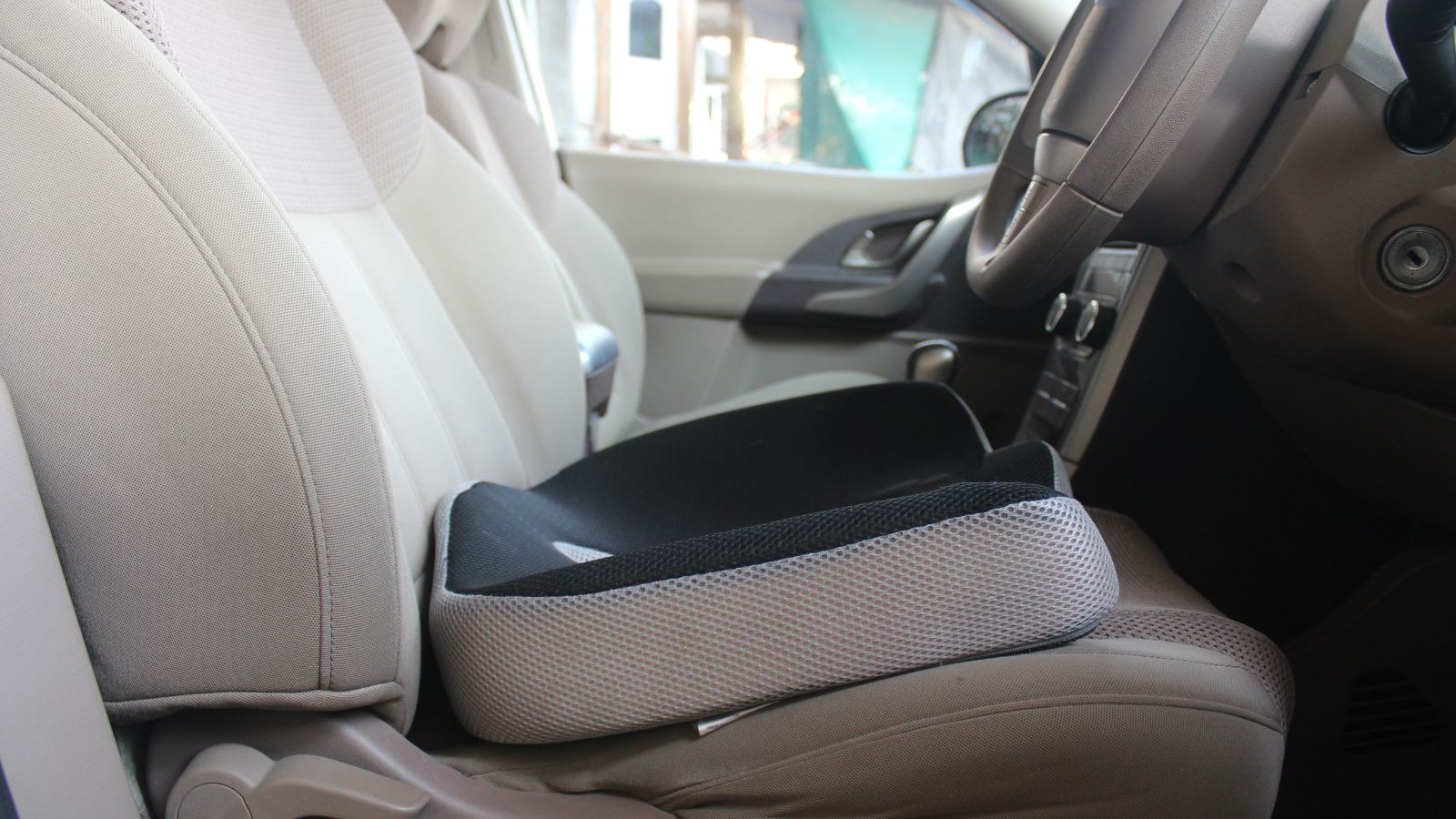
A driver can be close enough to the pedals yet still become tired because the cushion is too long or tilted poorly. If the front edge presses into the backs of the knees, it creates a localized pressure point and may affect blood flow to the lower legs and feet. The discomfort may appear as fidgeting, numbness, heavy legs, or an urge to stretch soon after leaving the car.
Ergonomic guidance recommends leaving roughly three to six centimetres—about two or three finger widths—between the seat edge and the back of the knee. The thighs should be supported, but the cushion should not act like a tight shelf beneath the joints. This matters in vehicles shared by drivers of different heights, because the same cushion setting may fit one person and crowd another. Where cushion length is adjustable, shorten it before moving the whole seat forward. Where it is fixed, changing seat height or cushion angle may reduce pressure without sacrificing pedal control.
The Steering Wheel Should Come to the Driver
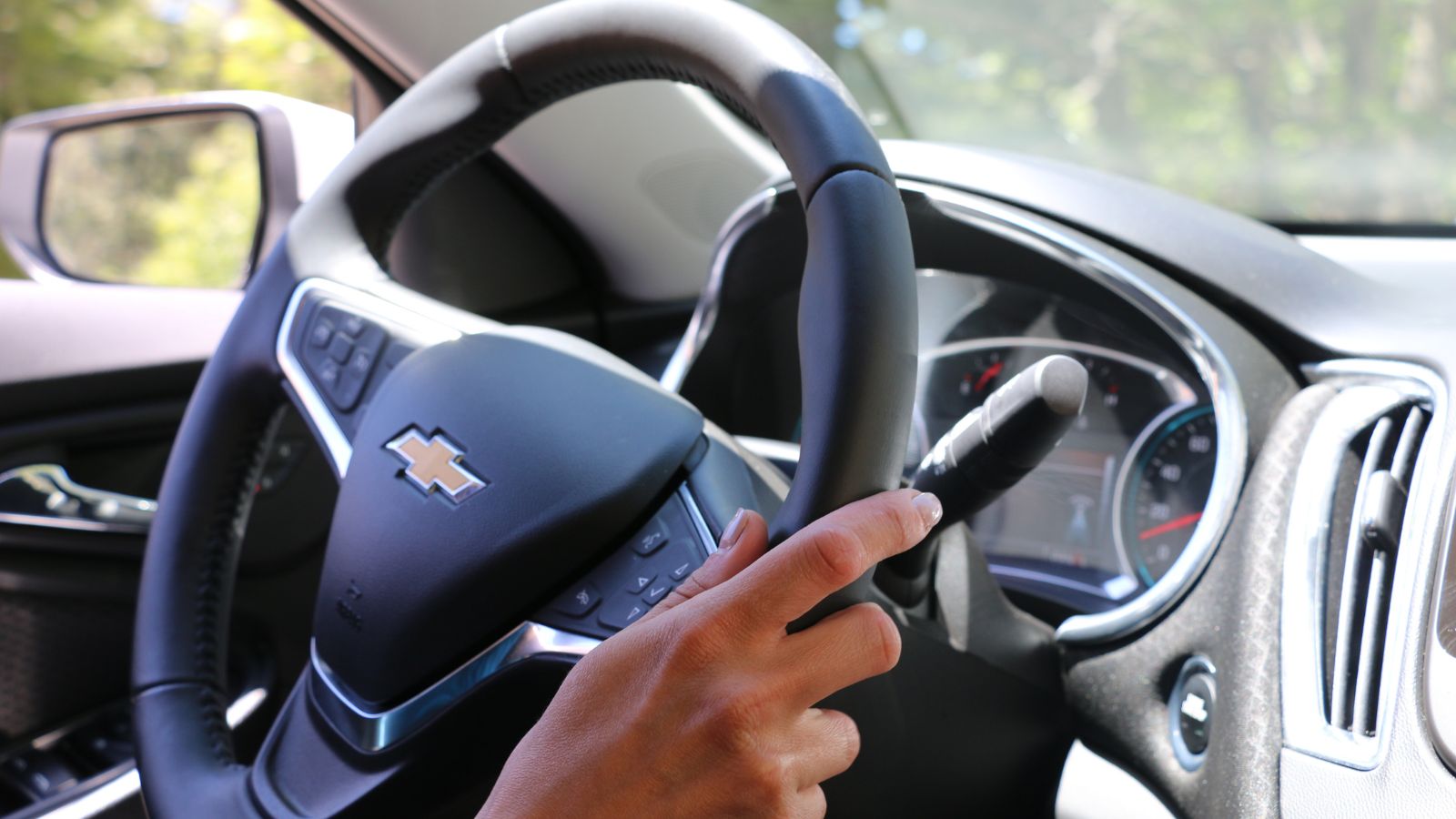
Many drivers adjust only the seat, even though modern steering columns often telescope and tilt. That can create a bad compromise: the legs are positioned correctly, but the seat is moved forward solely so the hands can reach. The result may be crowded knees, a tight hip angle, or a chest positioned unnecessarily close to the airbag.
NHTSA recommends maintaining at least 10 inches between the driver’s breastbone and the steering-wheel airbag while still being able to reach the pedals comfortably. Canadian ergonomic guidance gives the same practical range as approximately 25 to 30 centimetres. The safest solution is often to set the legs first, then bring the wheel toward the driver rather than dragging the entire body toward the wheel. The wheel should point toward the chest, not the face or abdomen, and the arms should remain comfortably bent. If the vehicle lacks telescopic adjustment, finding a balanced compromise becomes even more important.
Static Posture Turns Small Errors Into Big Discomfort

A seat position does not need to be dramatically wrong to become exhausting. Driving restricts movement: the feet remain organized around the pedals, the hands repeatedly return to the wheel, and the eyes stay oriented toward the road. A small reach or pressure point repeated for 60 to 120 minutes can matter more than a posture that feels awkward for only a few seconds.
Research on prolonged real-world and simulated driving consistently shows discomfort rising with time. In one long-duration study comparing different seat designs, whole-body discomfort increased during every driving condition, with the neck and lower back producing the highest local discomfort scores. Another two-hour lumbar-support study found pelvic discomfort increased even when participants selected their preferred support. These findings explain why a driver may feel fine during a five-minute dealership test but sore on a weekend trip. Seat evaluation should include time, not just first impressions, and occasional safe posture variation can reduce continuous loading.
Road Vibration Magnifies Weak Support

On smooth pavement, an overreaching posture may seem merely inefficient. On patched roads, expansion joints, or gravel, the seat also transmits repeated vibration through the pelvis and spine. If the back is not firmly supported, the body must stabilize itself against both gravity and vehicle motion. That can make the same seat setting feel tolerable in town but exhausting on a rough highway.
Government of Canada ergonomic guidance for long-haul drivers notes that vibration causes muscles to contract and relax repeatedly, increasing fatigue. It also warns that prolonged vibration can contribute to mental fatigue and sleepiness. Seat condition matters: worn padding, faulty suspension in a truck seat, poor tires, and deteriorated shocks can increase the problem. A better posture cannot repair a damaged vehicle, but full back contact and correct adjustment reduce unnecessary muscular bracing. When fatigue or sleepiness appears, however, changing the seat is not a substitute for stopping safely and resting.
The Head Restraint Is a Useful Alignment Check

The head restraint is primarily a safety device, not a pillow, but its relationship to the head can reveal a poor driving posture. When the seat is too far back or too reclined, the driver often cranes forward, leaving a large gap behind the skull. That gap indicates the neck is carrying the head away from the support line of the torso.
Canadian guidance recommends positioning the restraint as high as the top of the head, or at least no lower than the top of the ears. It also advises keeping the back of the head as close as possible, with roughly seven centimetres or less considered acceptable and more than 10 centimetres discouraged. Those measurements are intended mainly to improve protection in a rear impact, but they are also a useful posture check. If the head cannot approach the restraint without looking upward or losing road vision, the backrest angle, seat distance, or restraint angle may need another adjustment.
A Good Setup Is Built in a Specific Order

Randomly moving every control can turn seat adjustment into guesswork. A more reliable reset begins with the hips fully against the backrest. Set the height for clear vision and headroom, then move the seat until every pedal can be pressed through its full travel with the whole foot and a bent knee. Adjust cushion angle and lumbar support next, keeping pressure away from the backs of the knees.
Only after the lower body is stable should the backrest, telescoping wheel, steering-wheel tilt, head restraint, seat-belt anchor, and mirrors be finalized. Recheck that the shoulders remain supported during normal steering and that the chest-to-airbag distance remains appropriate. On long trips, posture still needs movement: Canadian workplace guidance suggests slight seat adjustments about every 30 minutes for professional drivers, while the UK Highway Code recommends at least a 15-minute break after every two hours. A correct seat reduces avoidable physical work; it does not cancel sleep debt, illness, medication effects, or true drowsiness.
22 Things Canadians Do to Their Cars in Spring That Mechanics Hate

Spring brings relief to many Canadian drivers after months of snow, freezing temperatures, and icy roads that put serious strain on vehicles. As temperatures rise across the country, drivers begin washing cars, switching tires, and preparing vehicles for warmer weather and upcoming road trips. However, mechanics across Canada notice the same mistakes every spring when drivers attempt to recover from winter damage. Road salt, potholes, and harsh winter driving conditions often leave vehicles with hidden problems that drivers ignore. Some spring habits even create new mechanical issues that could have been avoided with proper maintenance. Here are 22 things Canadians do to their cars in spring that mechanics hate.