

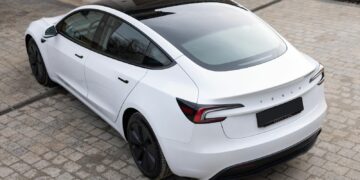











Tesla is preparing to expand its collision-repair footprint in Canada, choosing Port Coquitlam, British Columbia, for what is expected to become its first factory-owned collision centre in Western Canada. The move would give Tesla owners in the region a new manufacturer-operated option for everything from cosmetic damage to major structural repairs.
Recruiting is already underway for technicians, estimators, paint-preparation workers, detailers and collision-management staff. Once operational, Port Coquitlam would join Tesla’s existing factory-owned collision centres in Oakville, Ontario, and Montreal, Quebec. The expansion comes as British Columbia remains one of Canada’s largest markets for zero-emission vehicles. Important details are still missing, however: Tesla has not publicly confirmed the collision centre’s exact address or announced when it will begin accepting vehicles.
Port Coquitlam Becomes Tesla’s Western Collision-Repair Hub
Tesla’s decision marks a notable expansion of its Canadian after-sales network. The automaker currently identifies only two factory-owned collision centres in Canada: Tesla Collision Oakville in Ontario and Tesla Collision Montreal in Quebec. A Port Coquitlam operation would therefore become the company’s third such facility nationally and the first located west of Ontario.
Port Coquitlam is not new territory for Tesla. The company already operates a store, service centre and delivery centre at 1028 Nicola Avenue, giving it an established presence in the community and an existing flow of customers and vehicles. That does not mean the new collision operation will occupy the same property. The collision facility’s location has not been made public, and Tesla’s current listing for Nicola Avenue identifies store, service and delivery operations rather than a collision centre. The distinction matters because full collision facilities require specialized body-repair equipment, structural-repair space, paint preparation and production workflows that differ significantly from routine vehicle service.
Tesla Is Recruiting Across the Entire Repair Process
Tesla’s hiring activity offers one of the clearest signs that the Port Coquitlam project is moving beyond an early concept. Current career listings associated with the city include collision technicians, apprentice collision technicians, paint preppers and vehicle detailers. Tesla has also advertised collision-estimating and management positions tied to Port Coquitlam.
That range of jobs resembles the staffing structure of a complete collision-repair operation rather than a small body-repair addition to an ordinary service centre. An estimator assesses damage and develops the repair plan, technicians perform structural and cosmetic work, paint employees prepare restored surfaces, detailers handle finishing work and management keeps the production process moving. Tesla’s B.C. collision leadership has described the recruitment effort as building the centre’s founding team. For workers in the Lower Mainland automotive sector, the opportunity is also unusual because hires would be working inside an automaker-operated collision program instead of a conventional franchised dealership or independently owned body shop.
The Job Postings Reveal a Serious Structural-Repair Operation
Tesla’s technician listings show that the planned facility is intended to do considerably more than repair parking-lot scratches. Collision technicians are expected to perform structural and cosmetic repairs on vehicles including the Model S, Model 3, Model X and Model Y. Duties include working with frame fixtures, attaching replacement structural components through welding, adhesives and riveting, repairing exterior panels and replacing damaged items such as suspension components, radiators, airbags, trim and vehicle structures.
The compensation ranges also show Tesla competing for workers at several skill levels. Recent listings put experienced collision technicians at roughly $35.20 to $75.24 per hour, while apprentice technicians have been advertised at approximately $23.76 to $45.14. Collision-estimator pay has been listed at $32.56 to $48.84 per hour, paint-prepper compensation at $26.40 to $46.20 and vehicle-detailing roles at $18.48 to $27.72. Tesla has also advertised an associate collision-manager position with an expected salary of $101,200 to $151,800, before potential additional cash or stock awards and benefits.
Factory-Owned Is Different From Tesla-Approved
Tesla already works with independently operated collision shops, so the significance of a factory-owned location can be easy to miss. Tesla describes its own collision centres as facilities owned, trained and operated by the company. They can carry out cosmetic work, lighter collision repairs and full structural repairs. Tesla-Approved Collision Centers, by comparison, are independent businesses that receive manufacturer training and access to approved tooling and repair processes.
That creates two different repair channels for an owner after an accident. An approved independent shop can remain an important local option, particularly when it is closer or has earlier capacity. A factory-owned centre puts the repair directly inside Tesla’s own operation. Tesla also integrates collision appointments into its app-based service system, through which customers can provide details about damage, review estimates and communicate with service teams. Port Coquitlam therefore does not eliminate B.C.’s existing independent Tesla repair network. Instead, it adds a manufacturer-operated alternative for owners whose vehicles require body or structural work.
British Columbia Has a Large and Growing EV Population
The business case for additional EV collision capacity is particularly strong in British Columbia. Provincial figures showed more than 238,000 light-duty zero-emission vehicles registered in B.C. as of April 1, 2026, compared with only a few thousand roughly a decade earlier. The province also reported more than 8,900 public charging ports by that date, reflecting how deeply electric vehicles have become integrated into the transportation system.
More recent Statistics Canada data showed that new zero-emission vehicle registrations in British Columbia increased 31.5% year over year during the second quarter of 2026. That figure covers the broader ZEV market rather than Tesla alone and includes battery-electric and plug-in hybrid vehicles, so it should not be interpreted as Tesla sales growth. Still, a growing population of battery-powered vehicles inevitably creates a larger long-term market for technicians familiar with EV structures, high-voltage systems and manufacturer-specific repair procedures. As those vehicles age and accumulate kilometres, collision infrastructure becomes as important to ownership as charging networks and regular service capacity.
Port Coquitlam Fits Tesla’s Existing Metro Vancouver Footprint
Port Coquitlam offers several practical advantages for an automotive operation serving the Lower Mainland. The city describes itself as strategically located within Metro Vancouver, with access to major transportation corridors and a mix of commercial and industrial areas. Its population is above 61,000, while the number of business licences issued in the city increased from 4,420 in 2024 to 4,605 in 2025.
Tesla already has the more important advantage of an operating base there. Its Nicola Avenue location combines sales, service and vehicle delivery, meaning the company has already established a customer-facing presence in the community. A collision centre would broaden that local ecosystem. Tesla has not publicly detailed its site-selection criteria, however, so transportation access, industrial capacity and proximity to its existing operation should be viewed as logical advantages rather than confirmed reasons for the decision. The eventual collision-centre address will also determine how closely the new operation is integrated with Tesla’s existing Port Coquitlam facility.
Finding Skilled Collision Workers Will Be Part of the Challenge
The recruitment campaign arrives in a labour market where experienced collision-repair skills remain valuable. WorkBC estimates that auto-body collision, refinishing and glass technicians and damage-repair estimators will generate about 1,210 job openings across British Columbia between 2025 and 2035. Approximately 870 of those openings are forecast for the Mainland/Southwest region, which includes Metro Vancouver. WorkBC lists annual earnings for the occupational group at about $66,074 and emphasizes growing demand for workers who can adapt to new materials, technologies and repair methods.
Tesla’s requirements illustrate that evolution. Modern EV collision work can involve structural alignment, specialized welding and adhesives, electronic systems and high-voltage components alongside traditional bodywork. British Columbia’s apprenticeship system reflects the depth of training involved: SkilledTradesBC lists 25 weeks of technical education spread over four years and 6,450 hours of work-based training for the Auto Body and Collision Technician trade, which carries Red Seal certification. For Tesla, recruiting experienced workers while developing apprentices could become just as important as outfitting the physical shop.
Tesla’s Factory-Owned Canadian Collision Network Is Still Small
Tesla’s collision network in Canada remains far smaller than its network of sales and service locations. Oakville became home to the company’s first dedicated Canadian collision centre in 2022, giving Ontario customers a factory-operated facility capable of handling structural work as well as smaller dents and cosmetic damage. Montreal subsequently became the second location. Tesla’s current Canadian collision directory continues to show those two centres.
That makes the Port Coquitlam expansion geographically significant even if the ultimate facility is relatively modest. Western Canadian Tesla owners have had access to independent approved repair facilities, but they have not had the same factory-owned collision-centre option available to customers near Oakville or Montreal. Adding B.C. would begin to reduce that regional imbalance. It could also provide Tesla with direct experience handling collision-repair demand in a province with a large EV fleet. The move should not be interpreted as a replacement for approved independent shops; Tesla itself continues to distinguish between company-owned collision centres and third-party approved repair facilities within its support network.
Several Important Details Still Haven’t Been Announced
The hiring activity makes Tesla’s Port Coquitlam intentions increasingly clear, but several practical questions remain unanswered. Tesla has not publicly announced an opening date for the collision centre, its repair capacity, the number of people it ultimately expects to employ or the precise property where the operation will be located. Tesla’s Canadian collision directory also does not yet list a British Columbia factory-owned centre.
That means owners should not assume the existing Tesla facility at 1028 Nicola Avenue is the future collision-centre address simply because both operations are in Port Coquitlam. At present, Tesla identifies Nicola Avenue as a store, service and delivery site. The more meaningful milestones will come when Tesla publicly adds a Port Coquitlam collision location to its network and begins offering appointment availability. Until then, the recruitment campaign is the clearest indication of progress. What is already apparent is that Tesla is preparing to bring a part of its repair business in-house in Western Canada, adding a new layer to its growing service infrastructure in British Columbia.