



















Artificial intelligence is moving off the phone screen and into one of the most ordinary places Canadians spend time: the family SUV. Mazda Canada says Google Gemini is now available to eligible users in the all-new 2026 CX-5 equipped with Google built-in, turning the vehicle’s voice interface into a more conversational assistant rather than a system built around memorized commands.
The timing matters because the CX-5 is not a low-volume technology showcase. It remains Mazda Canada’s best-selling vehicle, which gives the Gemini rollout a far more mainstream audience. Drivers can use natural language for navigation, entertainment, messaging, supported climate controls and vehicle information, while Google’s broader in-car platform continues to expand through software rather than waiting for the next vehicle generation.
A Software Update Turns Voice Control Into a Conversation
The most important change is not that the CX-5 can hear a driver. Cars have offered voice commands for years. Gemini is meant to understand ordinary phrasing, maintain context and respond to follow-up questions without forcing the driver to restart a request from the beginning. Mazda says eligible CX-5 users can ask for destinations, restaurants and other points of interest, then refine the result conversationally. Instead of learning a syntax such as “navigate to” followed by a precisely stated address, the driver can speak more naturally and continue the exchange as conditions change. That makes the technology feel less like a menu operated by voice and more like a digital assistant that happens to be embedded in the dashboard.
Google’s support documentation adds another useful detail: the switch from Google Assistant to Gemini is optional on eligible Google built-in vehicles. A signed-in user with a supported language can accept the upgrade when prompted, and Google says the vehicle can be switched back to Assistant later. In practical terms, that makes the transition less disruptive for owners who prefer the older system or want to wait until they are comfortable with the new interface. The familiar “Hey Google” wake phrase remains part of the experience, while compatible vehicles can also invoke the assistant from the screen or steering-wheel controls.
Gemini Is Built Into the CX-5, Not Simply Mirrored From a Phone
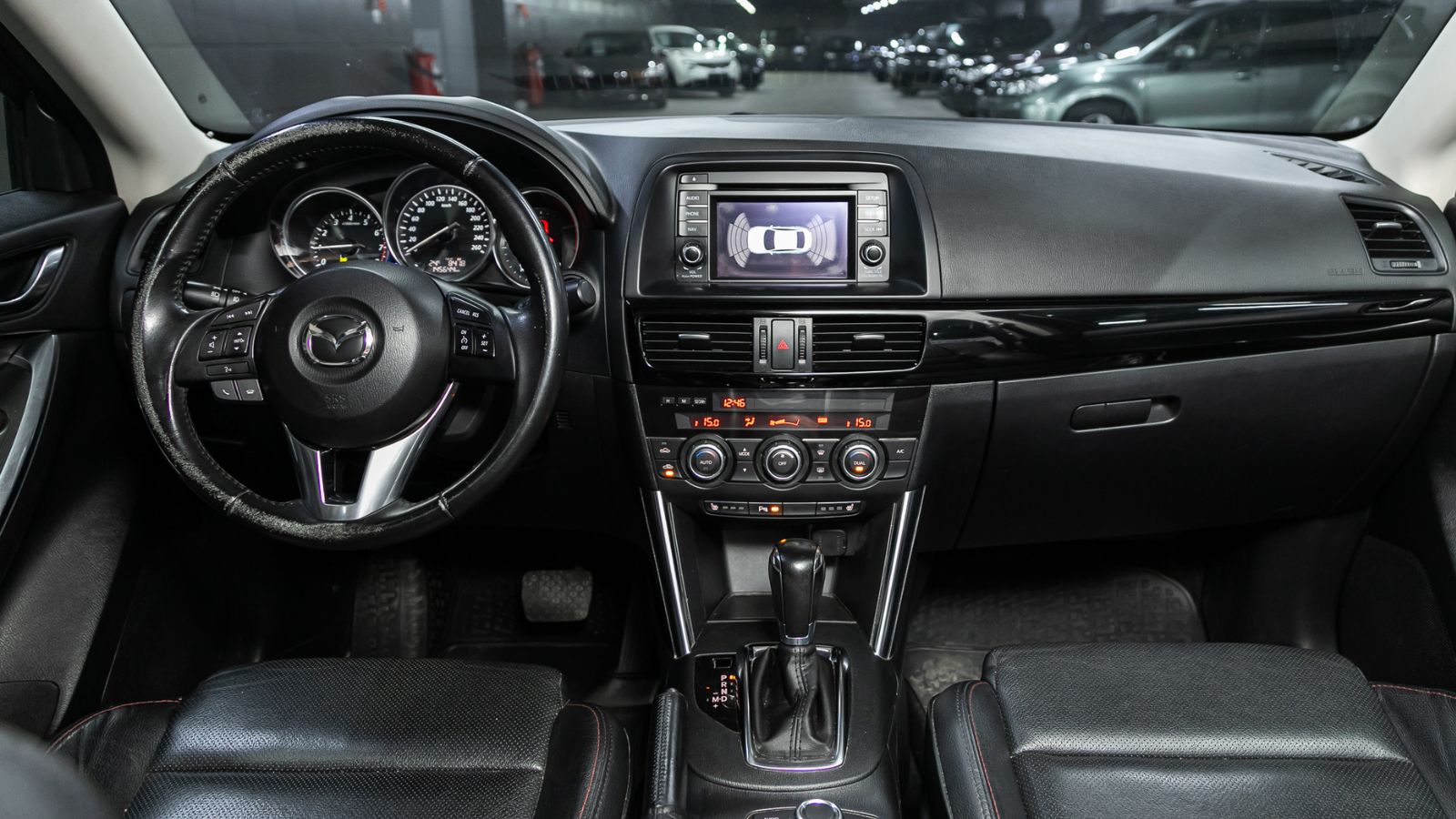
Mazda’s implementation matters because Google built-in is different from Android Auto. Android Auto projects services from a connected Android phone onto a vehicle display. Google built-in, by contrast, runs Google services directly through the car’s infotainment system on Android Automotive OS. That allows the CX-5 to use Google Maps, Google Play and the in-car assistant without requiring a phone to provide the basic interface. The vehicle can still support smartphone projection, including Apple CarPlay and Android Auto, so owners are not locked into one approach. Mazda’s Canadian specifications show Google built-in across the 2026 CX-5 lineup, with a 12.9-inch centre touchscreen on most configurations and an available 15.6-inch display with the GT Premium Package.
There is still a connectivity requirement behind the convenience. Mazda includes a one-year trial of Mazda Connected Services with Google built-in, beginning from the vehicle’s in-service date. After that trial, the company says continued use of select connected Google built-in features requires an eligible paid Mazda Connected Services plan, or owners can tether a personal mobile device and use their own data plan. That distinction is easy to miss during a test drive, but it matters over a multi-year ownership period: the software is built into the SUV, yet many of its online capabilities still depend on an ongoing data connection.
Everyday Tasks Are Where Gemini Could Matter Most
Mazda is not positioning Gemini as a novelty for obscure questions. The advertised use cases are deliberately mundane: finding a restaurant, checking traffic, changing music, sending a message, sharing an arrival time or adjusting the cabin temperature. Google Maps can provide real-time traffic information, route guidance and recommendations, while compatible entertainment services such as Spotify and YouTube Music can respond to more conversational requests. A driver could ask for a playlist that fits a particular mood rather than hunting through menus, then follow up without restating the entire request. Mazda also says supported vehicle functions, including climate settings, can be adjusted with everyday speech.
That is the part of generative AI that may be most noticeable during a normal commute. The value is not necessarily in asking the car a complicated factual question; it is in reducing the number of steps required to complete small tasks repeatedly. Consider a parent leaving work late who wants to message home, share an updated arrival time, avoid a traffic jam and find a quick dinner stop on the route. Those actions once meant several taps across multiple screens or a sequence of rigid commands. Gemini’s promise is to connect them through a more continuous conversation. Whether it performs that smoothly in every accent, road-noise condition and app combination will depend on real-world use, but the intended workflow is clear.
Mazda Is Putting Its New AI in Its Most Important Canadian Model
The choice of the CX-5 gives this rollout more significance than if Mazda had limited Gemini to a flagship or a low-volume EV. Through September 2026, Mazda Canada reported 21,807 CX-5 sales, up 4.5 per cent from the same period a year earlier. Mazda sold 56,148 vehicles in Canada during those first nine months, meaning the CX-5 represented nearly 39 per cent of the brand’s total volume. The previous-generation CX-5 also set a Canadian annual sales record in 2025 with 28,288 units. In other words, Mazda is introducing one of its most visible software changes in the vehicle that reaches the largest share of its Canadian customers.
The 2026 redesign makes that decision even more notable. The third-generation CX-5 starts at a Canadian MSRP of $36,300 and arrives with standard all-wheel drive, a 2.5-litre four-cylinder engine producing 187 horsepower and 186 lb-ft of torque, plus a substantially revised cabin. Mazda stretched the vehicle by about 4.5 inches, with most of that increase going into the wheelbase, while adding larger digital displays and a more smartphone-like infotainment layout. Gemini is therefore not an isolated add-on. It is part of a broader effort to make Mazda’s core crossover feel more spacious, digitally connected and easier to operate in daily use.
The Safety Pitch Is Strong, but Hands-Free Does Not Mean Distraction-Free
Mazda’s argument for Gemini is closely tied to driver attention. The company says more natural voice interaction can reduce the need to work through menus and settings, allowing drivers to keep more attention on the road. There is a reasonable basis for that design goal. Transport Canada specifically warns that using entertainment and navigation systems can distract drivers and recommends interfaces that minimize lengthy visual interactions. Research summarized by the Insurance Institute for Highway Safety has also found that voice interfaces can reduce visual demand compared with manual controls in some tasks. A system that correctly understands a request the first time can therefore have an advantage over one that requires repeated glances and corrections.
The caution is that voice control does not eliminate distraction. Transport Canada says distracted driving contributed to an estimated 22.5 per cent of fatal collisions and 25.5 per cent of serious-injury collisions in 2021. The IIHS-cited research found that voice systems still imposed cognitive and other demands even when they reduced the amount of time drivers looked away from the road. That makes Gemini’s accuracy, response speed and ability to handle interruptions especially important. A conversational assistant can be helpful when it shortens a task; it can become another source of workload if the driver has to argue with it, correct it repeatedly or listen to an unnecessarily long answer.
Privacy Becomes Part of the Ownership Experience
Putting a more capable AI assistant in the dashboard also turns privacy settings into something car owners need to understand, not just smartphone users. Google says drivers can control permissions for services such as Gemini, Maps and Google Play, including access to location and the microphone. When users choose to share data, Gemini can use information such as vehicle location, navigation routes and data from connected apps to complete requests. Google also says conversations may be saved to a user’s Google Account, depending on settings, and that people can view, delete or disable Gemini activity history. Connected third-party apps may receive portions of a request when needed to complete a task.
Those controls matter because the car can become a shared space. A household may have multiple drivers, borrowed vehicles or passengers who can hear personalized responses. Google built-in supports driver profiles, and Mazda directs owners to link a Google Account to access saved locations and other personalized services. The sensible approach is to treat the infotainment system as another signed-in personal device: review permissions, use separate profiles where appropriate and remove accounts before selling or returning the vehicle. Google provides controls to remove an account, delete a profile or erase infotainment data entirely. The convenience of a car that knows more about its driver is directly connected to the responsibility of deciding what it is allowed to know.
Canadian Owners Should Expect the Experience to Keep Changing
Gemini’s arrival also changes what “new car technology” means after delivery. Mazda says the assistant can evolve through future software updates, expanded functionality and added language support. Google has been making the same argument across its automotive ecosystem, where Google built-in is now available in more than 100 models from 16 brands. The company says the in-car Google Play catalogue has grown to more than 700 apps, while new software and infotainment functions are increasingly being rolled out after vehicles have entered service. For the CX-5, that means the digital experience purchased in 2026 may not be identical to the one owners use in 2027 or 2028.
That flexibility brings both upside and uncertainty. New functions can arrive without replacing hardware, but features can also depend on accounts, subscriptions, regional availability, supported languages and changing third-party services. Mazda cautions that compatibility and availability can vary, and its documentation reminds owners to use connected services responsibly rather than treating their output as infallible. The practical takeaway is that Gemini should be viewed as an evolving layer of the vehicle rather than a fixed feature like heated seats. That is a major cultural shift for mainstream car ownership, where software behaviour is becoming part of the long-term product experience.
The Bigger Story Is AI Becoming Ordinary Automotive Equipment
The most consequential part of Mazda’s announcement may be how unremarkable the hardware looks from the outside. The CX-5 remains a compact gasoline-powered SUV with standard all-wheel drive, a conventional six-speed automatic transmission and a familiar mission: commuting, school runs, errands and road trips. Yet inside that conventional package is an AI assistant capable of maintaining conversational context, controlling supported vehicle functions, navigating with live data and interacting with communication and entertainment services. Generative AI is therefore moving into the same category as navigation, Bluetooth and smartphone integration before it — technology that begins as a headline feature and gradually becomes part of everyday vehicle expectations.
Google’s scale suggests that transition is already underway. By May 2026, the company said more than 250 million vehicles supported Android Auto, while Google built-in had expanded to more than 100 models across 16 brands. Mazda joining that ecosystem with its best-selling Canadian model broadens the reach further. The next competitive question will not simply be which automaker has an AI assistant, but which one integrates it with the least friction, the clearest privacy controls and the lowest distraction cost. For Canadian CX-5 owners, Gemini is an early example of that contest becoming tangible in a vehicle designed for ordinary daily life.