

























Li Auto is giving its most unconventional vehicle another chance to prove itself. The Chinese automaker plans to unveil a next-generation Li MEGA on September 2, with a heavily upgraded cabin, additional driver-assistance hardware and four LiDAR sensors replacing the earlier single-sensor arrangement. The changes arrive at a difficult moment for the luxury electric MPV. MEGA deliveries totaled just 3,179 vehicles from January through July 2026, down 63.1% from the same period a year earlier.
The challenge extends beyond one model. Li Auto reported weaker company-wide deliveries, sharply lower vehicle margins and another quarterly loss as competition in China’s electric-vehicle market intensified. That makes the redesigned MEGA more than a routine product refresh. It has become an important test of whether better technology and a more family-focused interior can restore momentum to a flagship that once represented Li Auto’s boldest expansion beyond range-extended SUVs.
Li Auto Is Treating the MEGA Refresh as a Major Relaunch
The next-generation MEGA is scheduled to make its formal debut on September 2, with Li Auto positioning the vehicle as a new version of its “mobile home” concept. Founder and chief executive Li Xiang has emphasized the vehicle’s Chinese design identity, while early images and regulatory information point to substantial changes inside the cabin. The Home variant features upgraded seating, more flexible second-row arrangements, improved rear-seat amenities and a redesigned dashboard. Rather than abandoning the MEGA’s unusual shape, Li Auto appears determined to strengthen the experience around it.
That matters because the MPV has always been built around a very specific proposition: a large electric vehicle that functions almost like a family lounge. The existing MEGA is more than 5.3 metres long and has a 3.3-metre wheelbase, giving designers considerable room for three-row seating. Li Auto’s current specifications also advertise a 102.7-kWh battery and extremely high charging power, with a claimed 500 kilometres of additional CLTC range in roughly 10 minutes under suitable fast-charging conditions. The new model is therefore trying to make an already unusual vehicle feel substantially more sophisticated rather than simply newer.
A 63% Delivery Collapse Explains the Urgency
The scale of the MEGA’s sales decline makes the September relaunch especially important. Data compiled from company reports and China Passenger Car Association figures show that Li Auto delivered only 3,179 MEGAs between January and July 2026, a 63.1% drop from the corresponding 2025 period. Monthly performance had already become troubling before that. After reaching a record 3,277 deliveries in September 2025, the MEGA fell below 1,000 monthly units in November and remained at comparatively low levels afterward.
The 2026 numbers illustrate how difficult the recovery has been. Deliveries were reported at 414 in January, 388 in February, 576 in March, 670 in April, 469 in May and 326 in June. Those are modest volumes for a vehicle that was once expected to establish Li Auto in the premium battery-electric segment. For perspective, the MEGA’s original March 2024 launch price was RMB559,800, placing it firmly in luxury territory. A buyer at that price is not simply comparing specifications; expectations for refinement, technology, service and resale confidence are considerably higher. The redesigned MEGA therefore has to persuade affluent families that its premium positioning is still justified.
The 2025 Recall Remains Part of the MEGA’s Recent History
The MEGA’s commercial difficulties cannot be discussed without acknowledging the major recall announced in October 2025. China’s State Administration for Market Regulation said Li Auto would recall 11,411 examples of the 2024 MEGA produced between February and December 2024. Regulators identified insufficient corrosion resistance in the coolant used in affected vehicles. Under certain conditions, corrosion could cause leaks around cooling components for the battery and front motor controller, potentially resulting in warning lights, reduced power or an inability to start the vehicle.
In extreme circumstances, regulators said the problem could contribute to battery thermal runaway. The recall came shortly after a MEGA caught fire in Shanghai, although the recall documentation itself focused specifically on the coolant-related defect and corrective measures. Li Auto offered affected customers replacement coolant, a replacement battery and a replacement front motor controller without charge. The recall covered a strikingly large portion of the MEGAs that had reached customers by that stage. For a high-priced family vehicle marketed around safety and comfort, rebuilding confidence is therefore likely to require more than adding equipment. Product quality, owner reassurance and a trouble-free launch will matter just as much as headline technology.
Four LiDAR Sensors Turn the Refresh Into a Technology Statement
The most eye-catching hardware change is the expansion from one LiDAR sensor to four. Chinese vehicle-registration filings show additional solid-state sensors positioned to expand perception toward the sides and rear of the MEGA. The updated model also adopts semi-hidden door handles, while published regulatory specifications list dimensions of roughly 5,355 millimetres long, 1,965 millimetres wide and 1,850 millimetres tall, with the same 3,300-millimetre wheelbase. That makes the revised vehicle only slightly longer, even though many of its important changes are underneath the familiar body.
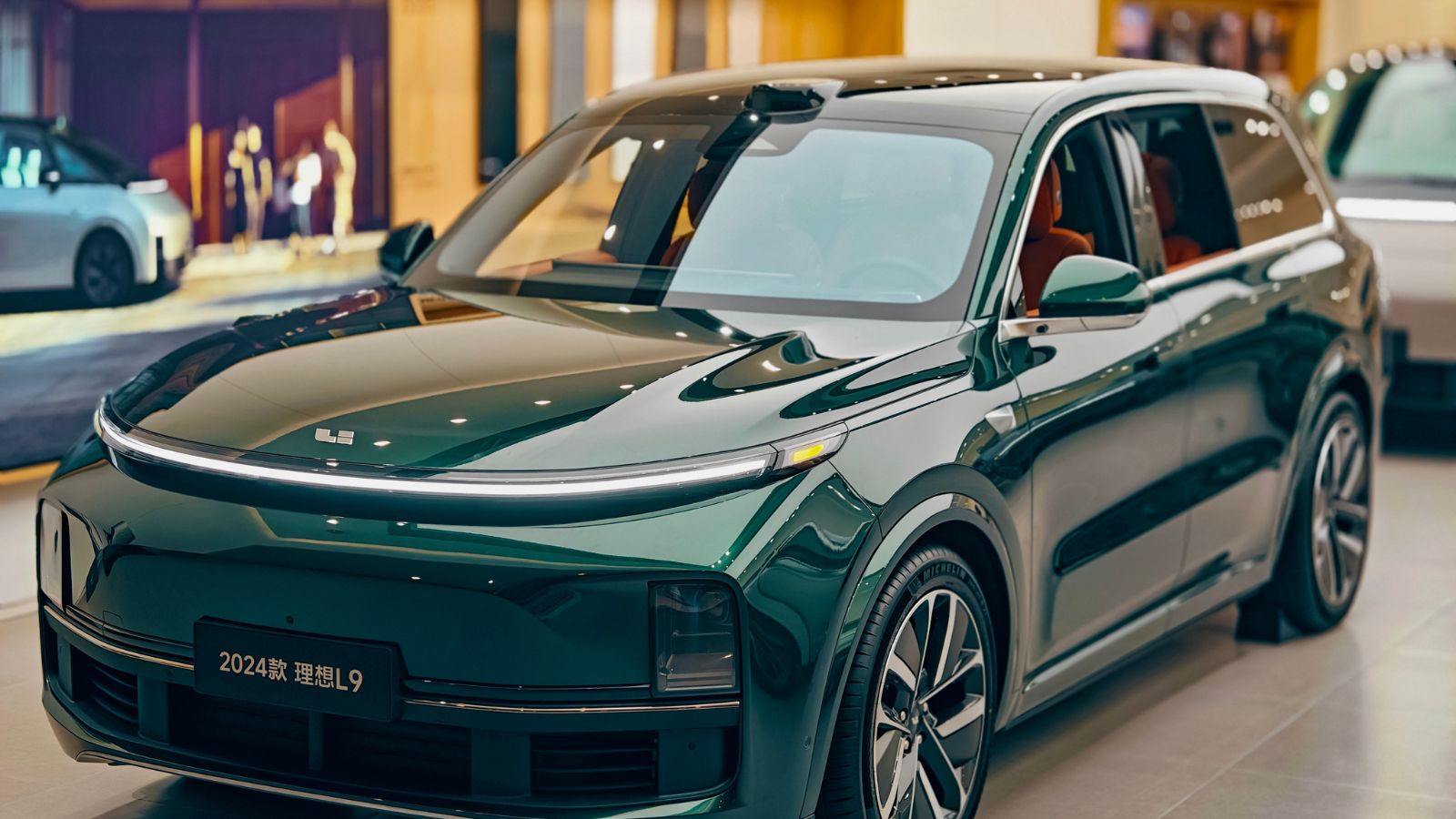
Reports based on the regulatory filing also indicate rear-wheel steering and a dual-motor system producing a combined 413 kW. Rear steering is particularly relevant on something the MEGA’s size because low-speed manoeuvrability can become a daily concern in dense urban parking areas. Meanwhile, four LiDAR units underline how aggressively Chinese automakers are competing on assisted-driving hardware. Li Auto has already introduced multi-LiDAR configurations elsewhere in its newest product range, including higher-end versions of the latest L9. The MEGA refresh effectively brings the company’s most visually distinctive model back toward the front of its technology portfolio.
The MEGA Reboot Comes as Li Auto’s Financial Pressure Builds
The timing is particularly significant because Li Auto is trying to repair more than MEGA sales. The company delivered 98,330 vehicles in the second quarter of 2026, down 11.5% from 111,074 a year earlier. Vehicle sales revenue fell 16.7% to RMB24.1 billion, while total revenue declined 15.1% to RMB25.7 billion. Most strikingly, vehicle margin was 9.4%, compared with 19.4% in the second quarter of 2025. Li Auto attributed much of the margin movement to changes in its product mix.
The company also recorded a RMB1.7-billion net loss, reversing a RMB1.1-billion profit in the year-earlier quarter. Still, there were signs of sequential improvement: vehicle margin had been only 6.1% in the first quarter, while Li Auto expects third-quarter deliveries of between 95,000 and 100,000 vehicles. The MEGA alone cannot solve the company’s broader challenges, particularly in an intensely competitive Chinese market. But a successful relaunch would demonstrate that Li Auto can revive a struggling premium product instead of retreating from it. The September 2 unveiling will therefore be watched as both a vehicle launch and a test of Li Auto’s ability to turn costly product lessons into something customers actually want.