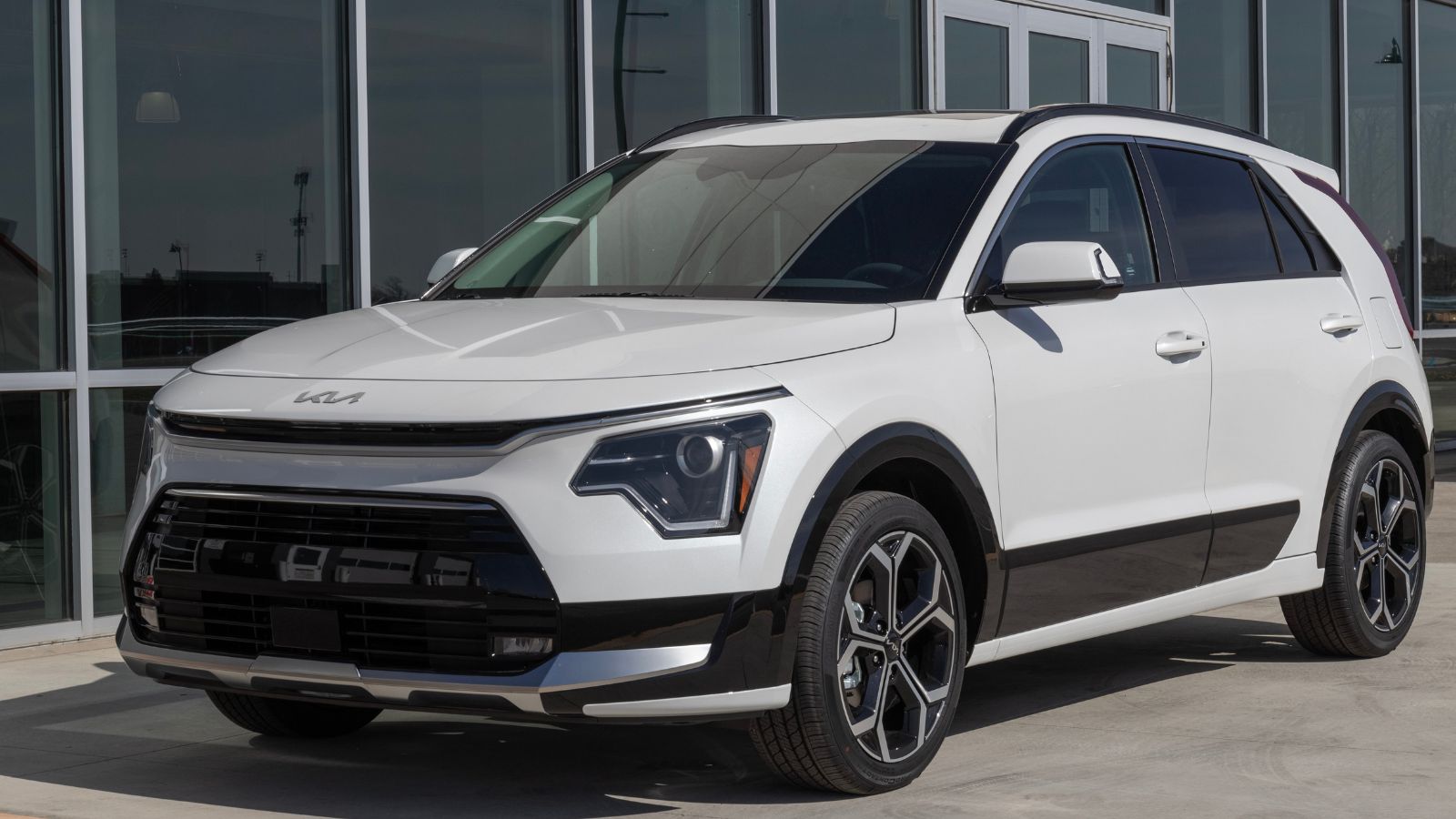
The Kia Niro is leaving Canada at an unusual moment: Canadians have been buying more of them, not fewer.
Kia Canada has confirmed that the 2026 model year will be the last for the Niro, ending a Canadian run that began in 2017. The decision covers the remaining hybrid and electric versions after the plug-in hybrid was already removed from the lineup. Yet Niro sales jumped 45.9 per cent in 2025 to more than 10,000 units, followed by another increase during the first half of 2026.
Across the border, Kia is making a different call. Americans are getting a refreshed 2027 Niro, now offered exclusively as a conventional hybrid. The split provides a revealing look at how Kia is reorganizing its electrified vehicles around two increasingly different national product strategies.
Canada Is Losing the Niro After 2026
Kia Canada has confirmed that there will be no 2027 Niro for Canadian buyers. The current 2026 model year will close out the nameplate after roughly a decade on the market. As of October, Kia Canada continues to advertise both the 2026 Niro Hybrid and Niro EV, meaning existing inventory has not suddenly disappeared. The decision concerns what happens next: once the remaining 2026 vehicles work their way through dealerships, there will be no direct Canadian successor carrying the Niro badge.
That outcome had not been inevitable. Kia redesigned the Niro for the 2023 model year and continued updating it internationally, so Canadians could reasonably have expected another model-year transition. Instead, Kia Canada told Canadian automotive media that its changing product mix made maintaining the Niro unnecessary. The company is preparing newer vehicles to cover its hybrid and fully electric roles separately. For owners accustomed to the Niro’s unusual combination of compact dimensions and electrified powertrains, that means the replacement will depend on which part of the formula mattered most.
A 45.9% Sales Increase Makes the Decision Stand Out
Most discontinued vehicles leave showrooms after demand has faded. The Niro is doing almost the opposite. Canadian sales surpassed 10,000 units during 2025, representing a 45.9 per cent increase from 2024. Published model-sales figures put the previous year at 6,867 units, making the increase substantial rather than a statistical change caused by a tiny customer base. It was one of the strongest periods the Niro had experienced since arriving in Canada.
Momentum continued into 2026. Kia sold 5,449 Niros in Canada during the first six months of the year, according to Canadian automotive reporting, roughly 21 per cent more than during the corresponding period in 2025. Those numbers make it difficult to describe the withdrawal simply as a market rejection. A model can sell reasonably well and still become redundant inside a rapidly changing portfolio. Kia’s decision appears to reflect that broader calculation: rather than continuing one vehicle across multiple electrified powertrains, the company is assigning those customers to newer, more specialized products.
The Niro Occupied an Unusually Efficient Corner of the Market
Part of the Niro Hybrid’s appeal has been how little fuel it consumes without asking its owner to plug anything in. Kia Canada rates the most efficient 2026 Niro Hybrid configurations at 4.4 litres per 100 kilometres combined. Electricity recovered during braking assists the gasoline engine automatically, so day-to-day operation remains familiar to drivers coming from a conventional vehicle. For someone without a driveway charger or dependable access to public charging, that simplicity can be meaningful.
The trade-off was that the Niro never tried to be a rugged compact SUV. Canadian versions are front-wheel drive, and buyers wanting all-wheel drive have had to look elsewhere. Instead, it has emphasized efficiency, a relatively compact footprint and crossover practicality. That distinction helped it occupy a narrow space between traditional hybrids and increasingly sophisticated battery-electric SUVs. The formula also proved durable: when Kia originally introduced the Niro to Canada for 2017, it promoted the vehicle as its first model built around a dedicated eco-car platform. Nearly a decade later, fuel efficiency remains one of its strongest attributes.
The Three-Powertrain Niro Experiment Is Ending
The second-generation Niro arrived in Canada with an unusually broad choice. Kia announced the 2023 model in three versions: a regular hybrid, a plug-in hybrid and a fully battery-electric Niro EV. A shopper could essentially choose how far to move into electrification while keeping the same basic vehicle. That made the Niro distinct in a market where manufacturers often place gasoline hybrids and EVs on completely different platforms with different names.
That strategy has been dismantled gradually. Kia Canada now explicitly describes the Niro PHEV as discontinued on its website, although information for previous models remains available for existing owners. The 2026 Hybrid and EV are still marketed, but neither will continue into 2027 in Canada. The Niro EV currently advertises up to 407 kilometres of estimated range, while the hybrid remains the no-plug alternative. Rather than updating both branches again, Kia is dividing their jobs among newer nameplates. The change effectively turns the 2026 model year into a final clearing point for the Niro’s once unusually broad electrified lineup.
Americans Get a Refreshed 2027 Niro Hybrid
The Niro is not disappearing everywhere. Kia America officially unveiled an updated 2027 model in July and chose to continue the vehicle as a hybrid only. The American Niro receives refreshed exterior styling, updated technology and an expanded trim structure that includes LX, S, EX, SX and SX Touring versions. The previous EV and plug-in-hybrid branches do not return for the new model year, making the U.S. Niro a much more focused product than it once was.
Kia’s American website lists the 2027 Niro LX from US$29,890 before destination charges and estimates combined fuel economy at 50 mpg. The powertrain uses a 1.6-litre gasoline engine and electric assistance, producing a combined 139 horsepower and 195 lb-ft of torque. Kia also estimates up to 555 miles of total driving range. More important than any individual specification is the contrast with Canada: Kia America believes there is still a place for a dedicated small hybrid crossover called Niro, while Kia Canada believes that role can be absorbed elsewhere.
The 2027 Seltos Hybrid Will Take Over Much of Its Job
Kia Canada has pointed directly toward the redesigned Seltos as one reason the Niro no longer needs to remain. The second-generation 2027 Seltos introduces a hybrid powertrain for the first time, pairing a 1.6-litre gasoline engine with electric assistance and a six-speed dual-clutch transmission. Kia has also confirmed front-wheel-drive and available electric all-wheel-drive configurations, giving the Seltos something the outgoing Canadian Niro Hybrid never offered: an AWD option.
The Seltos is already an important vehicle for Kia Canada. The company said more than 110,000 examples had been delivered nationally between its 2020 introduction and June 2026. Gasoline versions of the redesigned model started at C$28,495 before additional fees, while pricing for the hybrid was being held until closer to its arrival. Kia Canada expects the hybrid to reach the market by the end of 2026. From a portfolio perspective, the overlap is obvious. Keeping both a Niro Hybrid and a Seltos Hybrid would leave Kia with two similarly sized electrified crossovers chasing many of the same customers.
The EV3 Gives Niro EV Shoppers a More Modern Alternative
On the electric side, Kia has an even clearer replacement. The 2027 EV3 has already gone on sale in Canada with a starting MSRP of C$36,995 before fees and incentives, positioning it below many established electric crossovers. Depending on configuration, Kia advertises up to 517 kilometres of available driving range, substantially more than the Niro EV’s maximum advertised 407 kilometres. All-wheel drive is also available on the EV3, addressing another limitation of the outgoing Niro EV.
That price-and-range combination helps explain why keeping the older EV becomes difficult to justify. Kia Canada has been aggressively expanding its dedicated battery-electric lineup, and the EV3 was designed from the outset around the company’s E-GMP electric architecture rather than sharing a nameplate with hybrid models. It also offers much newer technology, including rapid DC charging capability and available vehicle-to-load functionality. For a shopper primarily interested in the Niro because it was one of Kia’s smaller EVs, the EV3 now performs that role more directly—and does so at a price intended to attract mainstream buyers.
The Timing Comes as Canadian Hybrid Demand Is Surging
The most striking part of the Niro Hybrid’s departure may be what is happening in the broader market. Statistics Canada reported that registrations of conventional hybrid-electric vehicles increased 39.5 per cent year over year during the second quarter of 2026. That was the strongest increase of any major fuel type measured in the quarter, narrowly ahead of the 37.4 per cent increase for battery-electric vehicles. Canadians registered 91,868 conventional hybrids during the quarter, according to Statistics Canada’s underlying registration data.
The longer trend is equally telling. Annual hybrid registrations climbed from roughly 79,000 in 2021 to more than 230,000 in 2025. Buyers who want lower fuel consumption without planning charging stops have increasingly embraced the technology. The Niro’s own sales growth fits neatly into that movement, which makes Kia’s Canadian strategy less about abandoning hybrids than relocating them. With a Seltos Hybrid joining the range and existing hybrid versions of larger Kia products such as the Sportage and Sorento, Kia can continue pursuing those customers without keeping the Niro name alive.
The Niro’s Exit Shows How Different the Two Kia Lineups Are Becoming
The Canadian and American decisions initially look contradictory. One division sees enough value in the Niro to refresh it for 2027, while the other is retiring it immediately after a year of sharp sales growth. But the difference makes more sense when viewed through the surrounding products. Canada is receiving a new Seltos Hybrid as well as the EV3, giving Kia two newer vehicles capable of replacing the Niro’s most important functions. The U.S. Niro can instead remain as a dedicated front-wheel-drive hybrid positioned around efficiency.
For Canadian buyers, the result is still significant. The Niro spent almost a decade providing an unusually approachable route into electrified driving, beginning as a hybrid before expanding into plug-in-hybrid and fully electric forms. It leaves not because Canadians suddenly stopped buying it, but as Kia reorganizes those customers around newer models. That makes its final year unusually noteworthy: the Niro is being retired while sales are rising and hybrids are gaining popularity nationally. Sometimes a successful vehicle does not lose its market. Its own showroom simply moves on without it.