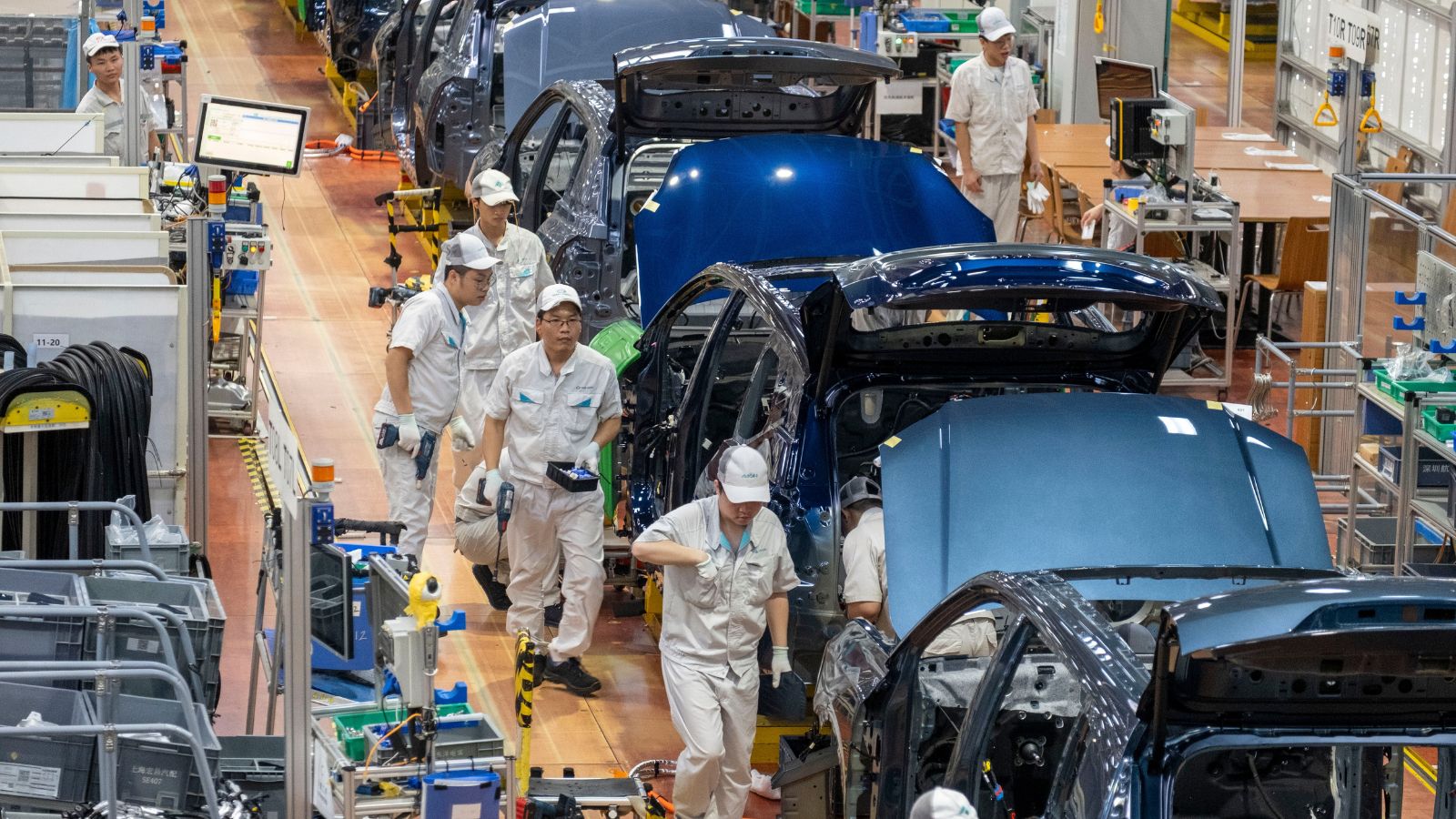
General Motors is treating China’s auto industry less like a distant threat and more like a working benchmark. At a September 23 investor conference, GM Chief Financial Officer Paul Jacobson praised Chinese manufacturers for keeping costs exceptionally low, while stressing that GM does not intend to win by simply stripping vehicles down to the lowest possible price.
The tension captures a broader shift across the global auto business. Chinese companies are forcing established manufacturers to rethink engineering, sourcing and factory economics just as GM, Ford, Hyundai, Stellantis and others commit billions of dollars to American plants. The result is a two-front race: automakers need to lower vehicle costs fast enough to remain globally competitive while investing heavily in domestic production, supply chains and new technology.
GM Is Publicly Acknowledging China’s Cost Advantage
Chinese automakers have become a benchmark for cost discipline, and GM is now saying so publicly. At the J.P. Morgan U.S. All Stars Conference on September 23, CFO Paul Jacobson said Chinese manufacturers had done a “pretty stellar job” of keeping costs down and linked that discipline to their growing success around the world. His point was not that GM should copy every low-cost vehicle, but that the company still has structural costs it needs to attack.
That distinction matters. Jacobson said many GM vehicles contain more premium features and content than lower-priced competitors, making a race toward the cheapest possible product potentially counterproductive. Instead, GM is emphasizing operating discipline, supplier efficiency and stronger execution while protecting the parts of its brands that customers continue to value. China is therefore setting the cost tempo even when Detroit chooses a different product strategy. Competing increasingly means learning from Chinese efficiency without necessarily reproducing Chinese vehicles.
China’s Manufacturing Scale Changes the Economics
The cost pressure is not simply a perception inside Detroit. The International Energy Agency estimates that China produced nearly three-quarters of the world’s electric cars in 2025. Chinese battery packs were also about 30% cheaper than those produced in North America, while nearly 70% of battery-electric cars sold in China were already cheaper than comparable conventional vehicles before government incentives.
Scale is a major part of that advantage. China produced roughly 16 million electric cars in 2025, while intense competition pushed manufacturers to squeeze costs, accelerate development and spread engineering expenses across enormous volumes. Battery chemistry has helped as well. Lithium iron phosphate packs were more than 40% cheaper on average than nickel-rich alternatives in 2025. Those economics cannot simply be transplanted into North America, where wages, regulations and supplier networks differ, but they create a reference point global manufacturers can no longer ignore when designing future vehicles.
GM Does Not Want a Race to the Cheapest Car
GM’s response is not built around abandoning the products that generate much of its North American profit. Jacobson told investors the company still sees considerable value in premium content, brand loyalty and a broad lineup that includes full-size pickups and SUVs. In the first half of 2026, GM sold roughly 1.3 million vehicles in the United States and held an estimated 16.7% market share.
The company is instead trying to eliminate costs customers never notice. GM has highlighted lower warranty expenses, improved EV economics and tighter operating discipline while resisting the temptation to chase every additional sale with heavier incentives. Detroit has learned that lesson repeatedly: manufacturers can increase volume and still destroy profitability when discounts, excess factory capacity or unnecessary product complexity become too expensive. GM’s challenge is therefore more complicated than simply building cheaper cars. It must make the organization underneath Chevrolet, GMC, Buick and Cadillac less costly while preserving the features and capability that support pricing.
GM Is Spending Billions While Trying to Cut Costs
GM is backing its efficiency campaign with unusually large domestic spending. The company says it expects to spend approximately $9 billion across its U.S. manufacturing footprint in 2026, alongside more than $7 billion in American research and development. In April, GM said its domestic manufacturing investments had climbed above $6 billion during the previous 12 months, including new spending on propulsion facilities supporting next-generation trucks and SUVs.
Those figures translate into visible changes at individual plants. GM has announced projects involving facilities in Romulus, Spring Hill, Saginaw and Wentzville, covering everything from transmission capacity and engine programs to paint-shop modernization and future Cadillac production. For communities built around those factories, cost competitiveness is more than an accounting target. Tooling, modernization and new product assignments can determine whether a plant has decades of work ahead. GM is effectively attempting to make its global business leaner while keeping a broad and capital-intensive American manufacturing network productive.
GM Is Building Flexibility Into Its U.S. Factory Network
A separate $4 billion plan announced in 2025 shows how GM is reshaping its manufacturing system around flexibility rather than betting everything on one powertrain. Investments across Orion Assembly in Michigan, Fairfax Assembly in Kansas and Spring Hill Manufacturing in Tennessee are designed to expand domestic capacity for both gasoline-powered and electric vehicles. GM said the changes would eventually give it capacity to assemble more than two million vehicles annually in the United States.
The product assignments reveal the strategy. Orion is being prepared for gasoline full-size SUVs and pickups, while Fairfax is adding the gasoline Chevrolet Equinox alongside Bolt EV production. Spring Hill is adding Chevrolet Blazer production while continuing to support Cadillac vehicles. GM has also committed substantial money to next-generation V-8 engines. Operationally, the approach acts as a hedge. Flexible factories allow GM to follow customer demand and regulatory changes while spreading expensive plants, equipment and labor across products capable of supporting high production volumes.
Ford Is Trying to Engineer Cost Out Before Assembly
Ford is pursuing another version of the same cost challenge. The company has committed roughly $5 billion to its Universal EV platform and accompanying production system, including investments at Louisville Assembly in Kentucky and BlueOval Battery Park Michigan. Ford says the initiative will create or secure nearly 4,000 jobs and support a midsize electric pickup scheduled to arrive in 2027.
The manufacturing strategy centers on eliminating complexity before a vehicle reaches the showroom. Ford says its new approach can reduce the number of parts by approximately 20% compared with a typical vehicle while changing how major sections are assembled. That thinking reflects one of the lessons coming from Chinese manufacturers: vehicle cost is determined long before a purchasing department negotiates the final price of a component. Ford now has to prove those savings can produce an affordable EV using American factories and labor. Success would provide Detroit with a domestic answer to the manufacturing efficiency helping Chinese brands expand globally.
Hyundai Is Localizing More of Its American Supply Chain
Hyundai Motor Group is spending at a scale that makes the American investment race difficult to overlook. The group increased its planned U.S. investment to $26 billion for 2025 through 2028, covering automobiles, steel and robotics. Hyundai expects the program to create approximately 25,000 direct jobs and plans investments including a Louisiana steel mill, expanded vehicle-production capacity and a U.S. robotics facility.
Localization sits at the centre of the plan. Hyundai has said it wants nearly 80% of vehicles sold in the United States to be assembled domestically by 2030, while increasing U.S. supply-chain content to approximately the same level. Greater localization can do more than reduce exposure to tariffs. It can shorten logistics networks, place suppliers closer to assembly operations and provide greater control over production schedules. For a Korean manufacturer competing simultaneously against Detroit companies and rapidly expanding Chinese brands, American manufacturing has become part of the cost strategy rather than simply a branding or political consideration.
Stellantis Is Making a $13 Billion U.S. Bet
Stellantis has made its own major commitment to American production. The Jeep and Ram parent announced a $13 billion U.S. investment program spanning four years, describing it as the largest such commitment in the company’s U.S. history. Plans include five new vehicles, 19 other product actions, more than 5,000 additional jobs and an increase in domestic manufacturing capacity.
Older industrial sites are central to the strategy. Stellantis plans to reopen Belvidere Assembly in Illinois for Jeep production, add a midsize truck in Toledo, expand work at Warren Assembly in Michigan and invest in Indiana engine operations. The plans reflect a problem shared across the industry: factories need sufficient volume and the right products to spread enormous fixed costs efficiently. Chinese manufacturers have shown how brutal competition becomes when too much production capacity chases too few buyers. Stellantis is betting that more products, greater plant utilization and localized manufacturing can strengthen its economics in the crucial North American market.
Honda Shows the Cost War Is Bigger Than Detroit
The pressure extends far beyond America’s traditional automakers. Honda is pursuing more than $9 billion in cost reductions through 2030 as it responds to Chinese competitors gaining ground across international markets. Reuters reported that the company has asked suppliers for substantial price reductions involving areas such as pressed and forged components, electrical parts and software-defined vehicle systems, with some reduction targets around 30%.
That represents a significant change for an industry accustomed to long supplier relationships and multi-year product cycles. Chinese automakers have compressed that rhythm. New models, software features and battery improvements can reach the market quickly, leaving established companies with less time to recover expensive engineering and tooling programs. Honda’s response demonstrates why the current contest is better understood as a worldwide cost battle rather than merely a fight over whether Chinese cars reach U.S. dealerships. Even where Chinese brands have limited presence, their economics increasingly influence purchasing decisions, supplier negotiations, engineering targets and future vehicle programs.
U.S. Barriers Buy Time, but They Do Not Remove the Pressure
American trade and technology barriers still provide domestic manufacturers with considerable protection. Chinese EVs face a 100% Section 301 tariff rate, while connected-vehicle regulations begin restricting certain China-linked software and manufacturers beginning with model-year 2027 vehicles. Those barriers make a large-scale arrival of inexpensive Chinese vehicles in U.S. showrooms far more difficult than expansion into many European or emerging markets.
Protection at the border, however, does not erase the global benchmark. Chinese manufacturers can build volume in Europe, Southeast Asia, Latin America and the Middle East, using that scale to improve technology and lower costs further. GM sees the competitive environment directly through its Chinese joint ventures, which remained profitable in the first half of 2026 despite a difficult Chinese market. The larger race is therefore about industrial capability. American factories may have significant insulation from direct Chinese competition, but GM and its rivals still have to compete against the economics Chinese manufacturers are establishing throughout the rest of the world.