
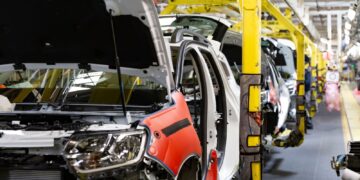

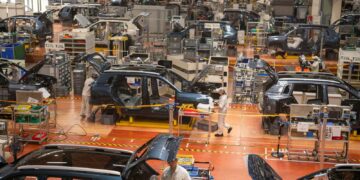





















North America’s auto factories are already filled with machines that can weld a vehicle body with precision. Now General Motors is preparing to lean on them even more heavily. According to Reuters reporting published November 17, 2026, the automaker aims to expand its use of robots and other automation by 20% across North American plants by 2028. The target arrives as U.S. production costs climb and Canadian workers face an unsettled mix of tariffs, plant cutbacks and new investment promises.
For employees in Ontario, the question is not simply how many robots arrive. It is whether a changing production system creates safer, more durable jobs—or leaves more people waiting for the next vehicle program. GM has not disclosed a Canadian-specific rollout or job reduction tied to the automation target.
GM’s 20% Ambition Has a Two-Year Deadline
Reuters reported on November 17 that GM wants to increase the use of robotics and other automation at its North American factories by 20% by 2028. The target, attributed to people familiar with the plan, reaches beyond a single assembly plant. It follows decades of industrial robots welding panels, positioning parts and carrying out repetitive tasks in vehicle production. The new push is about expanding that reach, not introducing robots to manufacturing for the first time.
There is an important limit to the headline figure. A 20% increase in automation is not a forecast of 20% fewer workers, nor has GM published a breakdown of how many machines would go to Canada. The company told Reuters it sees automation as a way to improve safety, quality and efficiency while supporting manufacturing teams. For workers and suppliers, however, the practical effect will depend on which tasks change, how quickly factories adopt the technology and whether GM uses productivity gains to expand production or reduce labour hours.
New Machines Will Move Parts, Not Just Weld Them
GM is doing more than purchasing ready-made robots. Sources cited by Reuters say the company is developing and assembling some of its own machines in Kokomo, Indiana, while still buying equipment from outside vendors. A central focus is autonomous mobile robots: machines designed to carry components between points on a factory floor. Unlike an industrial arm fixed to a welding station, a mobile unit can change the way materials reach workers along an assembly line.
That distinction matters because a vehicle factory depends on thousands of small handoffs. When a part arrives late, the issue can ripple across the line; when deliveries are reliable, employees can spend less time moving materials and more time on assembly, inspection and problem-solving. In a March 2026 interview with McKinsey, GM robotics strategy director Mikell Taylor argued that future factories would still rely on human judgment and dexterity. Her point was collaboration, not an entirely workerless plant—and the final division of tasks remains a management choice.
Rising Costs Are Pushing Automation Up the Agenda
In 2023, the United Auto Workers secured substantial gains in negotiations with GM, Ford and Stellantis. GM estimated that its U.S. labour agreement would add about US$575 in cost for each vehicle. That figure applies to the American contract; it should not be mistaken for a calculation of Canadian wages. Still, it helps explain why Detroit automakers are scrutinizing the time and labour required to assemble vehicles while competing with producers around the world.
The pressure extends well beyond payroll. On GM’s October 2026 earnings call, executives said the company was spending roughly US$1 billion to US$1.5 billion that year to bring production to the United States, reinforce supply chains and expand software capabilities. They also identified significant costs from commodities and logistics. Automation offers a potential efficiency lever amid those expenses, but the trade-off is sensitive: processes designed to use fewer hours per vehicle can alter the number and type of jobs plants need, even when total output holds steady.
Canadian Parts Suppliers Face Their Own Automation Test
GM’s plan also reaches companies that sell it parts. According to Reuters, suppliers seeking new business have been asked to explain how they intend to automate their operations. GM is reportedly scoring those plans and considering the results in purchasing decisions. An efficiency target at an automaker can therefore become a competitive test for a stamping shop, plastics producer or components maker that never appears in a vehicle advertisement.
For Canada, the consequences could spread far beyond GM’s own gates. Federal industry briefing material published in May 2026 identified nearly 700 automotive parts manufacturers across the country, employing more than 67,500 people in 2025. Many are embedded in cross-border supply chains and must compete on delivery, quality and cost. Companies able to finance modern equipment may strengthen their bids, while smaller firms could face difficult choices about capital spending and staffing. Reuters did not establish that GM has imposed a single automation quota on every Canadian supplier, and suppliers’ individual plans have not been made public.
Oshawa’s Job Losses Predate the New Robotics Push
In Oshawa, the anxiety predates this robotics report. GM confirmed in January 2026 that it would return its assembly operation to two shifts on February 2, placing about 500 employees on layoff. The company said it had prepared support including supplemental unemployment benefits and continued health-care coverage for eligible workers. Those arrangements mattered, but they did not erase the impact of losing a regular paycheque or the worries affecting nearby suppliers and local businesses.
There is also a longer-term commitment. GM said the plant was preparing for next-generation gasoline-powered pickup trucks, and the August 2026 agreement with Unifor committed another C$144 million toward next-generation heavy-duty GMC Sierra production. The plant’s importance is clear; so is its exposure to changing output decisions. Nothing in the Reuters automation report establishes that robots caused Oshawa’s shift reduction. Instead, the episode illustrates why employees will judge any new technology against a recent history of layoffs as well as assurances of future investment.
CAMI Shows Why a New Machine Is Not a New Vehicle Program
Ingersoll offers a starker reminder that a plant can have advanced equipment yet no vehicle program to build. GM ended production of its BrightDrop electric delivery van in October 2025 after saying commercial EV demand had developed more slowly than expected. CAMI Assembly had been idled since May of that year, and Unifor reported in August 2026 that most members there were on indefinite layoff. The uncertainty is about product demand and future allocation, not a confirmed decision to replace those workers with robots.
The new Canadian labour deal offered a bridge rather than an immediate restart. Unifor said GM agreed to continue seeking work for CAMI, to give it first consideration for potential Canadian Armed Forces production if GM won such a contract, and to extend income-maintenance support for eligible laid-off members until May 2028. For affected households, a possible future program is not the same as a shift schedule. It explains why announcements about robotics can feel distant from the more urgent question of when production returns.
St. Catharines Offers Investment, but the Timetable Matters
At St. Catharines, GM’s Canadian strategy includes investment rather than simply a search for savings. Under the contracts ratified in August, Unifor highlighted C$215 million to establish next-generation transmission production, with work expected to begin in late 2029. The agreement also preserved an earlier C$691 million commitment for a sixth-generation V8 engine program. GM Canada said the combined propulsion investment exceeded C$900 million, a substantial sign that the company still sees a manufacturing role for Ontario.
The important qualification is timing. A program expected to start in 2029 does not instantly resolve today’s workforce concerns, and new equipment can change the skills needed before a new line reaches full production. The union has said the transmission work could bring roughly 250 jobs, though hiring and final staffing will depend on how the program unfolds. Skilled tradespeople who commission, maintain and troubleshoot advanced equipment may find expanding responsibilities. Others will want clear answers on training, shift assignments and how productivity targets affect staffing as the investment takes shape.
A New Canadian Labour Deal Does Not End the Debate
Canadian GM workers entered the automation debate with a newly ratified collective agreement. More than 4,600 Unifor members at Oshawa, St. Catharines, Woodstock and CAMI were covered by agreements approved in August 2026. Unifor said the three-year deals provide annual wage increases of 3%, renewed cost-of-living protection and a C$10,000 productivity-and-quality bonus for eligible members. These terms offer meaningful economic protection, but a contract cannot by itself determine how every future manufacturing task will be performed.
The United States has a separate bargaining timetable. Reuters says the UAW represents about 50,000 GM factory workers and expects automation to be contentious when American contracts approach expiry in 2028. UAW officials have openly argued that efficiency initiatives can cost people their jobs. Canadian negotiations, by contrast, produced agreements running into 2029. It would be inaccurate to treat the American contract expiry as a Canadian one, although decisions made across GM’s integrated North American operations can influence bargaining expectations on both sides of the border.
Robot Adoption Is Rising, but Job Effects Are Not Simple
Industrial robotics is already expanding in Canada, independently of this GM plan. The International Federation of Robotics reported in September 2026 that Canadian factories installed almost 4,000 industrial robots in 2025, up 5% from the previous year. Worldwide, the federation counted approximately five million industrial robots in operation, more than double the stock seven years earlier. Those figures illustrate a broad manufacturing trend, not a count of machines bought or deployed by GM specifically.
Research offers a more complicated picture than the claim that every new robot eliminates a job. A 2026 peer-reviewed study of 52 economies found that more industrial robot adoption was associated with higher productivity and real-wage growth, while reducing manufacturing’s share of employment. Those findings do not predict the fate of any particular Oshawa employee. They do suggest that productivity gains and workforce displacement can coexist. Whether a community benefits depends in part on new product mandates, demand, redeployment options and how readily workers can move into higher-skill roles.
The Unanswered Questions Will Matter More Than the Headline
The next test for GM will be transparency, not merely speed. Reuters did not report a Canadian factory-by-factory deployment schedule, a dollar value for the robotics initiative or projected Canadian job losses. Without those details, a 20% target describes a corporate efficiency ambition rather than a reliable estimate of its effect on Ontario payrolls. Employees will need to know which activities are being automated, whether vacancies will be filled and what opportunities exist for retraining or transfer.
There are reasons to treat those questions seriously. A 2026 federal industry briefing said Canadian automotive manufacturing employed 121,587 people in 2025, down approximately 12% from 2018. At the same time, Ottawa’s automotive strategy emphasizes investment and worker training as the sector adapts to tariffs and new technologies. The strongest outcome would be factories that remain competitive while retaining valuable expertise. For now, GM’s robotics push adds urgency to a longstanding challenge: making sure the people who build the vehicles share in the benefits of making them more efficiently.