





















Ottawa has escalated its confrontation with Cleveland-Cliffs over hundreds of threatened steel jobs in southern Ontario, putting a firm deadline behind weeks of warnings. Industry Minister Mélanie Joly has given the Ohio-based steelmaker 15 days to address what the federal government says are violations of legally binding commitments made when Cleveland-Cliffs bought Stelco in 2024.
At stake are as many as 500 jobs at Stelco’s Hamilton Works and Lake Erie Works, along with a much bigger question about how aggressively Canada will enforce promises attached to foreign takeovers. If Cleveland-Cliffs fails to satisfy Ottawa’s demand, the government says it could ask a court for remedies ranging from financial penalties to an order forcing the company to sell its Canadian business.
Ottawa Has Moved From Warnings to a Formal Deadline
The October 22 escalation is more than another political warning. Joly sent Cleveland-Cliffs an 11-page formal demand giving the company 15 days to address Ottawa’s allegations. The government says Cleveland-Cliffs has failed to respect commitments connected with its acquisition of Stelco, particularly employment obligations. The company can respond by correcting the alleged breaches, demonstrating that no violation has occurred or attempting to justify any failure to comply.
That distinction matters because a forced sale is not automatic once the deadline expires. The 15-day period is part of an enforcement process under the Investment Canada Act. If Ottawa remains unsatisfied after the deadline, the minister can seek a superior-court order. A judge would then consider whether the government was justified in issuing its demand and whether Cleveland-Cliffs failed to comply. Only after that process could remedies such as divestiture become available. The immediate pressure, therefore, is designed to force a negotiated or operational solution before a potentially lengthy court battle begins.
The Dispute Goes Back to Cleveland-Cliffs’ $3.4-Billion Takeover
Cleveland-Cliffs announced its agreement to acquire Stelco in July 2024, valuing the Canadian steelmaker at roughly US$2.5 billion, or C$3.4 billion. The deal closed on November 1 of that year, giving the Cleveland-based company control of a Canadian steel name stretching back more than a century. At the time, Cleveland-Cliffs promoted the acquisition as a way to expand its integrated North American steel business while adding approximately 1,800 United Steelworkers members to its workforce.
Federal approval did not come without conditions. Ottawa required a package of binding undertakings lasting five years. Those commitments covered employment, Stelco’s Hamilton head office, collective agreements, pensions and benefits, capital and research spending, environmental performance and preservation of the Stelco name. That is why the current disagreement is fundamentally different from a routine corporate restructuring. Ottawa is not simply objecting to job losses on policy grounds; it argues that the federal government approved the foreign takeover partly because specific promises were made about what would remain in Canada afterward.
The Employment Promise Is More Specific Than Previously Known
The latest government letter adds important detail to the employment commitment. Ottawa says Cleveland-Cliffs agreed to maintain an annual average of at least 1,766 full-time-equivalent unionized employees and 603 full-time-equivalent salaried employees. Those figures make the fight more complicated than a simple promise that no employee could ever be temporarily laid off during the five-year period.
Cleveland-Cliffs has leaned heavily on that distinction. Stelco has argued that its undertakings do not explicitly prohibit layoffs or require employment to remain above a fixed threshold every single day. Ottawa interprets the obligations more aggressively, particularly in light of the scale and indefinite nature of the planned cuts. That difference may become central if the dispute reaches court. An annual-average requirement potentially gives an employer some flexibility during temporary downturns, but it does not necessarily allow a company to make operational changes that ultimately push yearly employment below the promised level. The timing, duration and number of layoffs could therefore become as important as the initial decision to reduce the workforce.
The Job Cuts Are Already Moving From Plans to Paycheques
Stelco announced on September 28 that changing market conditions would force it to idle finishing operations in Hamilton, with as many as 500 employees potentially affected across Hamilton Works and Lake Erie Works in Nanticoke. Union officials subsequently estimated that roughly 330 Hamilton workers could lose their positions during the shutdown, with another 40 to 50 workers potentially affected at Lake Erie.
For employees, this is no longer an abstract fight between lawyers and cabinet ministers. Individual layoff notices began arriving in early October. United Steelworkers Local 1005 said roughly 90 Hamilton workers were expected to receive notices during the first wave, with the reductions unfolding over several weeks as equipment was shut down and prepared for possible future restarting. The company characterizes the reductions as temporary or indefinite rather than permanent terminations and says workers could return if market conditions improve. That offers some hope, but it does not solve the immediate reality for households suddenly facing an uncertain income and no clear date for a recall.
Hamilton Works Is Losing the Operations Most Exposed to the Trade Fight
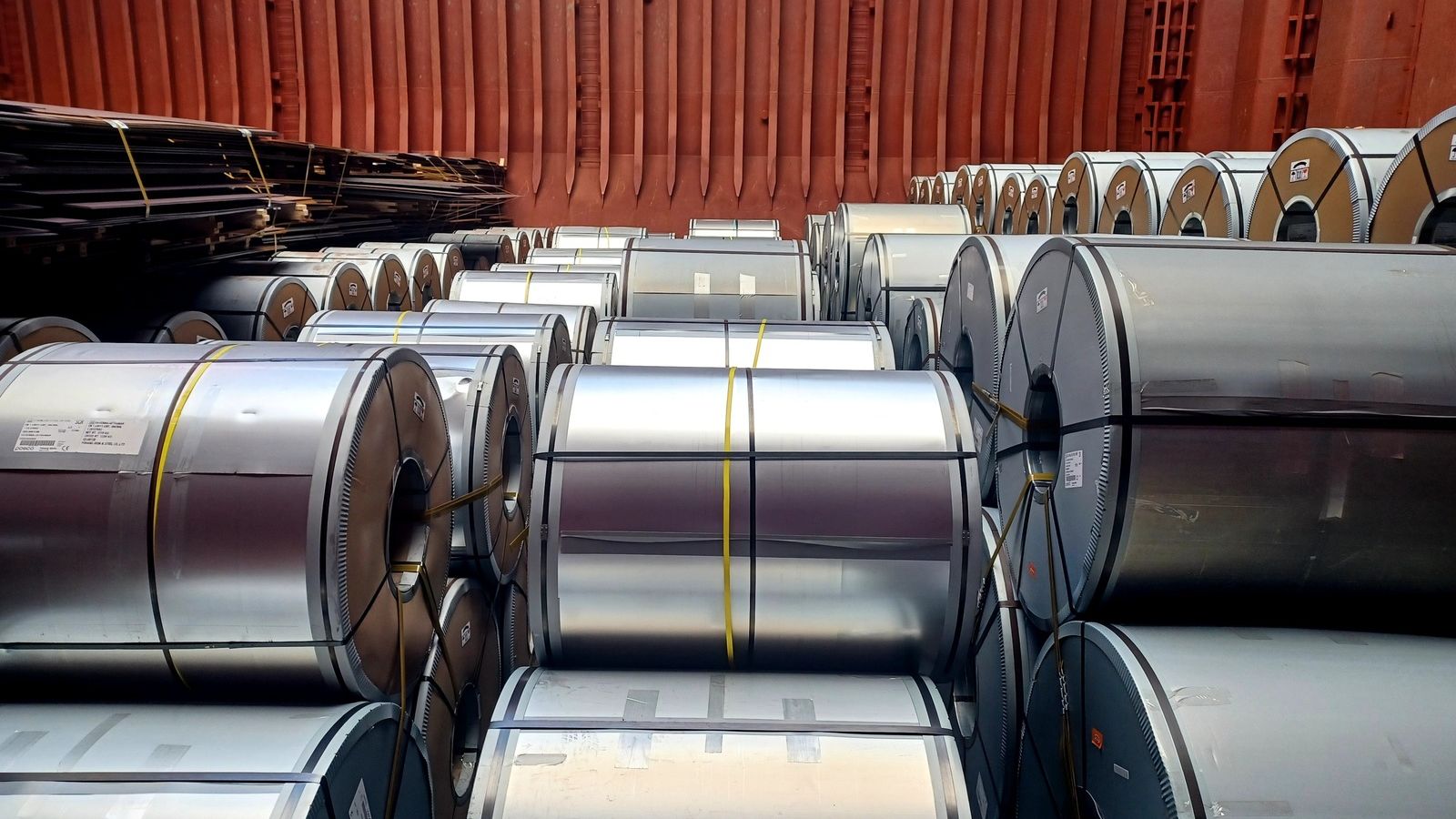
The shutdown is concentrated around the cold-rolled and coated steel business at Hamilton Works rather than the disappearance of Stelco’s entire Canadian production system. Hamilton has long specialized in finishing steel, including galvanized and galvannealed products used in sectors such as automobiles, agriculture and infrastructure. Stelco has described its zinc-coating line there as capable of producing hundreds of thousands of tons annually.
Cleveland-Cliffs instead plans to concentrate more of Stelco’s business on hot-rolled steel produced through Lake Erie Works. The parent company says total Canadian production tonnage can be maintained even while the Hamilton finishing lines are idled because the mix of products being sold will change. That distinction helps explain why the company views the layoffs as economically rational while Ottawa sees them as a threat to strategic industrial capacity. A mill can continue shipping large quantities of steel while still eliminating specialized jobs and equipment tied to higher-value finishing. For Hamilton, losing those operations therefore represents more than a reduction in tonnage or headcount.
Cleveland-Cliffs Says the Galvanized-Steel Market Has Collapsed
The company’s defence rests heavily on market data. In an October response to Ottawa, Stelco said Canadian exports of cold-rolled and coated steel to the United States had fallen 58 per cent from pre-trade-war levels. It said those exports were down by approximately 226,000 tonnes in the second quarter of 2026 compared with the quarterly average in 2024.
Stelco also argued that imports still accounted for about 45 per cent of the Canadian market for those products. Combined with weaker domestic demand, the company estimated that the available market for the products made at Hamilton Works had contracted by more than one million tonnes annually — roughly twice the plant’s historical production of cold-rolled and coated steel. Earlier, Stelco said demand in its traditional markets during the second quarter was almost 25 per cent below the 2024 quarterly average, including a 10 per cent decline in Canadian demand. From Cleveland-Cliffs’ perspective, keeping underused finishing lines running indefinitely would simply generate losses rather than preserve sustainable employment.
The Layoffs Came During Stelco’s Strongest Quarter Under Cleveland-Cliffs
Ottawa’s position became politically easier to defend after Cleveland-Cliffs released its third-quarter financial results. Chief executive Lourenco Goncalves said Stelco had just completed its strongest quarter since Cleveland-Cliffs acquired it in 2024. The Canadian hot-rolled business had improved enough to make Stelco a positive contributor to earnings before interest, taxes, depreciation and amortization.
The wider Cleveland-Cliffs group also recorded a much stronger quarter, reporting US$5.6 billion in revenue, US$165 million in GAAP net income and US$612 million in adjusted EBITDA. Those figures do not prove that Hamilton’s galvanized-steel lines were profitable; a company can make money overall while one product or facility remains uneconomic. Still, the timing complicates the public argument for layoffs. Goncalves has said the Canadian operation should become even more profitable by concentrating on hot-rolled steel and that roughly 2,000 Canadian positions will remain. Ottawa, however, is focused on the jobs that Cleveland-Cliffs specifically promised to maintain when government approval for the acquisition was granted.
U.S. Tariffs Have Created an Uncomfortable Contradiction
Cleveland-Cliffs has repeatedly pointed to the Canada-U.S. trade fight as one reason Stelco’s finishing business has become difficult to operate. American Section 232 measures have subjected many foreign steel products to steep tariffs, with rates reaching 50 per cent. That has damaged Canadian producers’ access to their largest foreign market and contributed to a reshuffling of steel flows throughout North America.
The politically explosive part is that Goncalves has also been an outspoken supporter of strong U.S. steel tariffs. Joly has seized on that position, arguing that Cleveland-Cliffs cannot enthusiastically advocate American tariff protection and then treat those same trade barriers as an unforeseeable event that excuses Canadian employment commitments. Cleveland-Cliffs counters that Canada has not done enough to stop low-priced foreign steel from taking domestic market share, particularly in galvanized products. The dispute therefore exposes two competing visions of industrial protection: Cleveland-Cliffs wants stronger national steel barriers on both sides of the border, while Ottawa argues that the company must first honour the Canadian obligations it already accepted.
A Forced Sale Is Possible — But Ottawa Would Need a Court
The phrase “forced sale” makes the dispute sound as though the federal government can simply order Cleveland-Cliffs out of Canada when the 15 days expire. The Investment Canada Act gives Ottawa substantial enforcement powers, but the process is more structured. If a foreign investor does not comply with a ministerial demand, the government can apply to a superior court for an enforcement order.
The court can order an investor to comply with its written undertakings, restrict actions involving the investment or require the investor to divest control of the Canadian business. The legislation also provides for monetary penalties, and Joly’s latest warning points to a potential penalty of up to C$10,000 for each day of contravention under the applicable provision. Cleveland-Cliffs would retain legal rights throughout such proceedings, including appeal rights. As a result, divestiture should be viewed as Ottawa’s strongest potential legal remedy rather than an inevitable outcome on day 16. Its significance lies partly in demonstrating that foreign-takeover promises can carry consequences long after a transaction has closed.
Stelco Has Been at the Centre of This Kind of Fight Before
There is a striking historical precedent involving the same Canadian steel operations. U.S. Steel acquired Stelco in 2007 and made commitments under the Investment Canada Act covering areas including production and employment. After the global financial crisis hit and U.S. Steel curtailed Canadian production, Ottawa concluded that the company was not meeting its obligations and issued a formal demand in May 2009.
The federal government ultimately filed a court application against U.S. Steel that July. The litigation tested Ottawa’s ability to enforce foreign-investment undertakings, and the Federal Court rejected a constitutional challenge to the enforcement provisions. The dispute did not end with a judicial order forcing a sale. Instead, Ottawa and U.S. Steel reached a settlement in 2011 under which the company accepted new commitments, including continued Canadian steel production, operation of the Hamilton and Lake Erie plants until 2015, at least C$50 million in additional capital investments and C$3 million for community and education programs. The history shows that aggressive enforcement can also become leverage for a negotiated settlement.
For Steelworkers, the Legal Debate Has an Immediate Cost
Employment guarantees and annual averages may dominate a courtroom, but workers experience the dispute one shift at a time. The first wave of Hamilton notices began in October as Stelco wound down finishing equipment. Union officials said employees were being removed in stages because the plant had to be prepared so operations could potentially restart if orders returned.
That possibility of recall matters, but uncertainty carries its own burden. Hamilton employees have spent decades working within an industry accustomed to booms, downturns, ownership changes and trade disputes, yet this episode comes only two years after a takeover approved with explicit employment commitments. At Lake Erie Works, union leaders have also been trying to move potentially affected employees into other work where possible, including jobs normally performed by contractors. Cleveland-Cliffs says the restructuring is intended to preserve the bulk of Stelco’s Canadian workforce. The unions see the current cuts as evidence that takeover promises require active enforcement rather than trust alone. Both realities can exist simultaneously: most jobs may survive while hundreds of households still face disruption.
Carney and Ford Are Backing Ottawa’s Hard Line
Prime Minister Mark Carney has publicly said companies must respect commitments made to the Government of Canada and has indicated Ottawa is prepared to act quickly if Cleveland-Cliffs refuses to reverse course. Ontario Premier Doug Ford has also supported federal efforts to enforce the agreement, saying a commitment made during an acquisition should remain a commitment afterward.
That united federal-provincial position is significant because the two governments are simultaneously trying to keep Ontario manufacturing competitive under extraordinary trade pressure. Ottawa says it offered financial assistance aimed at sustaining operations and avoiding layoffs before the dispute reached its current stage. Cleveland-Cliffs has argued that subsidies alone cannot create demand for a product that the market cannot absorb. That difference helps explain why negotiations have struggled: governments are trying to preserve capacity and employment, while management is focused on product-level economics. The 15-day deadline effectively tests whether those interests can still be reconciled without putting ownership of Stelco itself into question.
Billions in New Steel Support Raise the Stakes
The Stelco fight is unfolding just as Ottawa and Queen’s Park are dramatically increasing support for Ontario industry. On October 21, Carney and Ford announced an $8.7-billion package covering steel, automotive manufacturing and critical-mineral infrastructure. Its centrepiece for steel is a Joint Steel Action Fund with five-year commitments of C$3.55 billion from Ottawa and C$1.67 billion from Ontario.
Governments want that funding to help Canadian mills diversify products, modernize operations, serve sectors such as defence and advanced manufacturing and find new customers outside the United States. They are also expanding Buy Canadian and Buy Ontario procurement policies and promising stronger enforcement against unfairly traded imports. The scale helps explain why Ottawa is unwilling to treat the Stelco cuts as a normal corporate decision. The federal government says Canada’s steel industry directly supports more than 23,000 jobs and feeds a fabricated-metals sector supporting roughly 172,000. Protecting those capabilities has therefore become part of a broader strategy involving trade security, defence procurement, infrastructure and economic sovereignty.
Divestiture Would Raise a New Question: Who Owns Stelco Next?
Even if Ottawa eventually wins an order requiring Cleveland-Cliffs to divest control, that would not automatically mean Stelco becomes a Crown corporation. Section 40 of the Investment Canada Act allows a court to require a foreign investor to sell control or dispose of investments or assets on terms the court considers appropriate. Finding a new owner, structuring a transaction and preserving operations would still be major practical questions.
Joly has separately said the federal government is prepared to consider financing and even equity positions when strategically important Canadian industrial capabilities are threatened. She has not, however, announced a plan for Ottawa to nationalize Stelco. Political calls for public ownership have come from elsewhere, including New Democrats concerned that ordinary litigation could take too long. For workers, the difference is important. A court-ordered sale could theoretically result in another private owner rather than government ownership. That uncertainty is one reason an agreement keeping Cleveland-Cliffs in compliance may still be more straightforward than divestiture, even as Ottawa keeps the threat available as leverage.
The Next 15 Days Could Decide Whether This Becomes a Landmark Case
Cleveland-Cliffs now faces three broad paths contemplated by the Investment Canada Act process: remedy the alleged breach, persuade Ottawa that no breach exists, or justify why it cannot comply with its undertakings. The company has already made clear that it believes the layoffs are permitted and economically necessary, while Joly has made equally clear that the government rejects that interpretation.
A compromise could involve recalls, revised production plans, transfers, financial support or other measures sufficient to convince Ottawa that the employment commitments are being respected. If that does not happen, the dispute could move from ministerial letters into a courtroom, where the precise wording of Cleveland-Cliffs’ undertakings will matter more than political rhetoric. Whatever the outcome, the consequences extend far beyond several hundred Stelco jobs. Foreign companies seeking approval for major Canadian acquisitions will be watching to see how seriously Ottawa enforces promises made during takeover reviews. For Hamilton and Nanticoke, however, the question is much more immediate: whether workers who expected five years of employment protection will still have those jobs when the 15-day clock runs out.