

























A policy change that looked modest on paper is beginning to move metal at a much faster pace. Canada’s latest quota report shows 9,235 Chinese-made electric vehicles have entered under the country’s new low-tariff program, up from 6,531 in the earlier comparison—a jump of about 41% in 10 days. The increase means nearly 38% of the first 24,500-vehicle allotment has already been used.
The numbers do not yet amount to a Chinese takeover of Canada’s auto market. They do, however, show how quickly manufacturers can redirect supply when tariffs, pricing and market access change. The surge is also revealing what kind of vehicles are arriving, which companies appear best positioned to benefit and why Ottawa’s experiment is becoming a much bigger test of affordability, trade diversification and domestic auto jobs.
The Surge Is Concentrated in July
The latest Global Affairs Canada report was executed on July 17 and shows that 5,104 of the 9,235 vehicles counted so far were recorded in July. That means more than half of all quota use since the program began on March 1 appeared during the first part of one month. By comparison, the official table lists 3,510 vehicles in May and 621 in June, with none recorded in March or April.
The increase from 6,531 to 9,235 represents 2,704 additional vehicles between the two public snapshots. Measured across the 10-day interval reflected in the headline, that averages roughly 270 vehicles a day, although shipments rarely arrive in a perfectly even flow. Cars often move in large batches by ship, clear customs together and then spread through distribution networks. For dealers and buyers, the change can feel sudden: a model that was scarce or uncompetitive can become widely available within weeks once a vessel unloads and inventory begins appearing online.
Most of the First-Half Quota Is Still Open
Even after the sharp increase, Canada is not close to exhausting the first allocation period. The March 1-to-August 31 quota is capped at 24,500 vehicles, leaving 15,265 permits unused as of the July 17 report. In percentage terms, utilization stands at about 37.7%, so nearly two-thirds of the first-half capacity remains available.
The program is being administered on a first-come, first-served basis for eligible automakers and Canadian importers. Each shipment requires a permit, and permits can be requested up to 30 days before a vehicle is expected to enter the country. The rules also allow unused first-period volume to roll into the second period beginning September 1. That rollover matters because it prevents the remaining space from simply disappearing at the end of August. If importers do not fill the current allotment, the next six-month window could open with substantially more than 24,500 vehicles available, giving late-arriving brands room to build inventory.
Lower-Value Cars Are Driving the Increase
The most revealing change is not just the total number of vehicles but the customs categories they entered under. The latest report counts 4,657 electric passenger cars with a customs value of C$35,000 or less, up from 2,430 in the earlier snapshot. That is an increase of 2,227 vehicles and accounts for most of the overall surge.
Higher-value electric passenger cars increased more modestly, rising from 4,080 to 4,553. The SUV and passenger-van category moved from 21 to only 25 vehicles. These figures suggest that lower-cost sedans are currently doing most of the work, not a broad flood of electric crossovers. One caution is essential: customs value is not the price displayed on a dealership window sticker. It reflects the value used for import classification before retail markups, transportation, taxes and other costs. A vehicle counted below C$35,000 at the border may therefore sell for noticeably more once it reaches a Canadian customer.
Tesla Has the Clearest Early-Mover Advantage
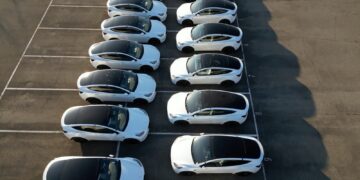
Global Affairs Canada does not identify manufacturers in its public quota table, so no brand can be assigned a precise share from the government data alone. Still, Tesla is widely viewed as the most likely source of the majority of early imports. It already configured its Shanghai plant to build vehicles for Canada, previously shipped tens of thousands of China-made cars into the country and has an established national retail, service and charging network.
Reuters reported that Tesla began selling a Shanghai-made Model 3 in Canada for about C$40,000 in early May. That gave the company a ready-made way to use the quota without waiting years to establish dealerships or educate consumers about an unfamiliar badge. The situation also shows why “Chinese-made” does not always mean “Chinese brand.” A vehicle can be assembled in China by an American company and still count against the same country-of-origin quota. For buyers, the badge may look familiar even though the supply chain behind it has changed dramatically.
The 6.1% Tariff Changed the Economics
The import surge follows a major reversal in Canadian trade policy. Vehicles entering under the quota face Canada’s 6.1% most-favoured-nation tariff, while the 100% surtax introduced in 2024 was repealed when the new system took effect. Removing that surtax dramatically changed the landed cost of qualifying vehicles and made Chinese production economically viable for the Canadian market again.
Ottawa did not make the change in isolation. The EV quota formed part of a broader Canada-China arrangement that also improved access for Canadian agricultural and seafood exports. China reduced the combined tariff on Canadian canola seed to 14.9% from nearly 85%, while suspending additional tariffs on products including canola meal, peas, lobster and crab through the end of 2026. The political calculation is clear: Canada accepted limited, lower-tariff EV access in exchange for relief in sectors that had been heavily exposed to Chinese trade barriers. The faster imports rise, the more visible that trade-off becomes.
Canada’s EV Market Was Ready for New Supply
The quota is arriving as Canadian EV demand begins to recover from a difficult 2025. Statistics Canada recorded 43,113 new zero-emission vehicle registrations in the first quarter of 2026. That represented 10.8% of all new registrations and a 15.8% increase from the same quarter a year earlier. Battery-electric registrations rose 12.9%, while plug-in hybrids increased 22.9%.
That rebound followed a steep decline. In 2025, zero-emission registrations fell 34.7% and accounted for 9.5% of new vehicles, down from 14.6% in 2024. The suspension of earlier rebates contributed to that downturn, while the federal government has identified affordability as one of the leading barriers to adoption. A shopper may support electrification in principle and still walk away when the monthly payment is too high. More lower-cost imports could narrow that gap, especially in passenger-car segments that many automakers have abandoned in favour of larger, more expensive SUVs.
Chinese-Made Models Face a Rebate Disadvantage
Canada’s new Electric Vehicle Affordability Program offers up to C$5,000 for qualifying battery-electric and fuel-cell vehicles and up to C$2,500 for plug-in hybrids. The program generally applies to vehicles with a final transaction value of C$50,000 or less, although Canadian-made EVs are exempt from that price ceiling. It is a powerful incentive, but it comes with an origin rule.
Eligible vehicles must be made in Canada or in a country that has a free-trade agreement with Canada. China does not meet that condition, so a Chinese-made EV can enter under the 6.1% quota and still fail to qualify for the federal rebate. That creates an unusual two-track market. Ottawa has lowered the border cost of a limited number of Chinese-built vehicles while reserving consumer subsidies for domestic and free-trade-partner production. A competitively priced import may still win without the rebate, but its sticker price must overcome a potential C$5,000 advantage enjoyed by an eligible rival.
BYD and Other Brands Are Preparing
Tesla may have the early lead, but the quota was designed to accommodate more than one company. Transport Canada records cited by Reuters show BYD began procedures to import passenger vehicles from plants in Shenzhen and Xi’an. A Canadian dealership adviser said the company was working toward six dealerships in 2026, although BYD’s executive vice-president said the brand was still choosing models and would likely begin Canadian sales in 2027.
That timeline explains why the current quota numbers should not be mistaken for the final shape of the market. Building a retail operation involves safety certification, parts supply, technician training, financing, warranties and consumer trust. Established brands can move quickly; newcomers must build the plumbing behind every sale. Volvo, which is owned by China’s Geely, has also been identified as a possible user of Chinese production, although it had not committed to Canadian exports when Reuters reported on the issue. The next competitive phase will begin when multiple brands can import at meaningful scale, not merely when permits exist.
China’s EV Scale Is Pushing Exports Outward
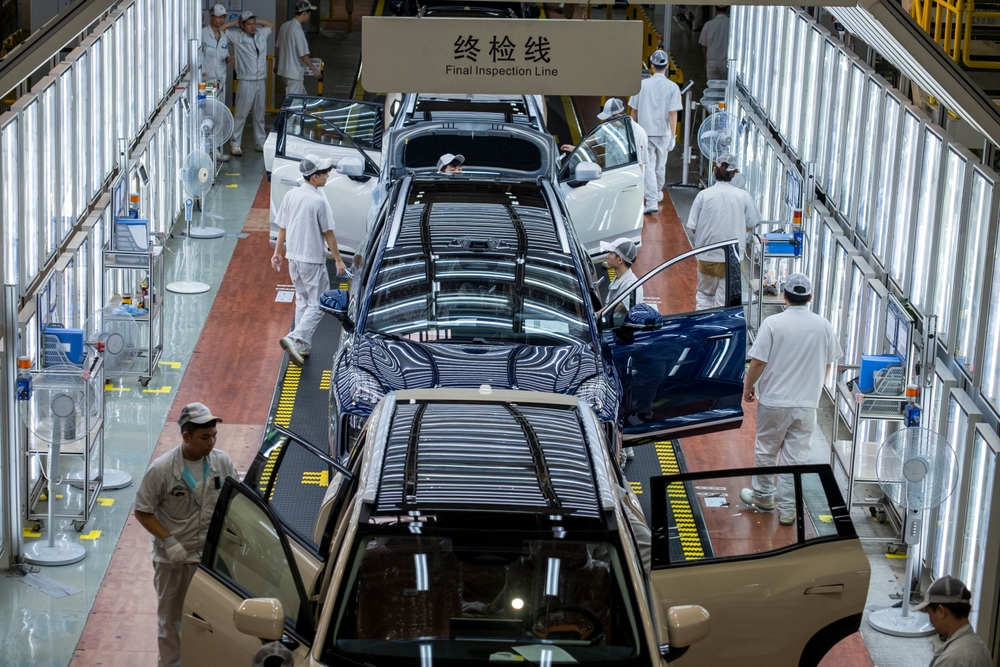
Canada’s rising imports are part of a much larger global shift. The International Energy Agency estimates that China accounted for nearly three-quarters of the electric cars produced worldwide in 2025. Chinese electric-car exports doubled to more than 2.5 million vehicles that year as domestic competition intensified and manufacturers looked abroad for growth and better margins.
The advantage extends beyond final assembly. China produced more than 80% of the world’s battery cells in 2025 and held even larger shares in key battery materials. That tightly integrated supply chain helps manufacturers shorten development cycles, lower costs and offer more models. The IEA counted nearly 700 electric-car models available in China by the end of 2025—far more variety than most markets can offer. Canada’s 49,000-vehicle annual quota is small beside that industrial scale, but it gives global manufacturers another outlet. For Canadian automakers, the concern is not merely cheaper imported cars; it is competition with an ecosystem that has already reached enormous volume.
Ottawa Is Betting Imports Will Lead to Investment
The federal government argues that the quota is limited enough to protect the domestic industry while large enough to attract attention from global manufacturers. Ottawa says the 49,000-vehicle annual volume represents less than 3% of Canada’s new-vehicle market. It has also tied the China strategy to the goal of attracting joint ventures, battery investment, research facilities and vehicle assembly in Canada. The broader auto sector supports roughly 500,000 Canadian jobs, making that promise politically important.
The long-term design will determine whether the bet succeeds. The annual quota is scheduled to grow by 6.5% each year, while the share reserved for vehicles with a free-on-board value of C$35,000 or less is expected to rise to 50% by the fifth year. In the near term, attention will remain on the August 31 deadline, the size of the rollover and any new allocation rules for September. If imports keep accelerating without firm investment commitments, critics will say Canada traded market access for promises. If new plants or partnerships follow, the 9,235 vehicles may look like the opening move in a broader industrial strategy.