





















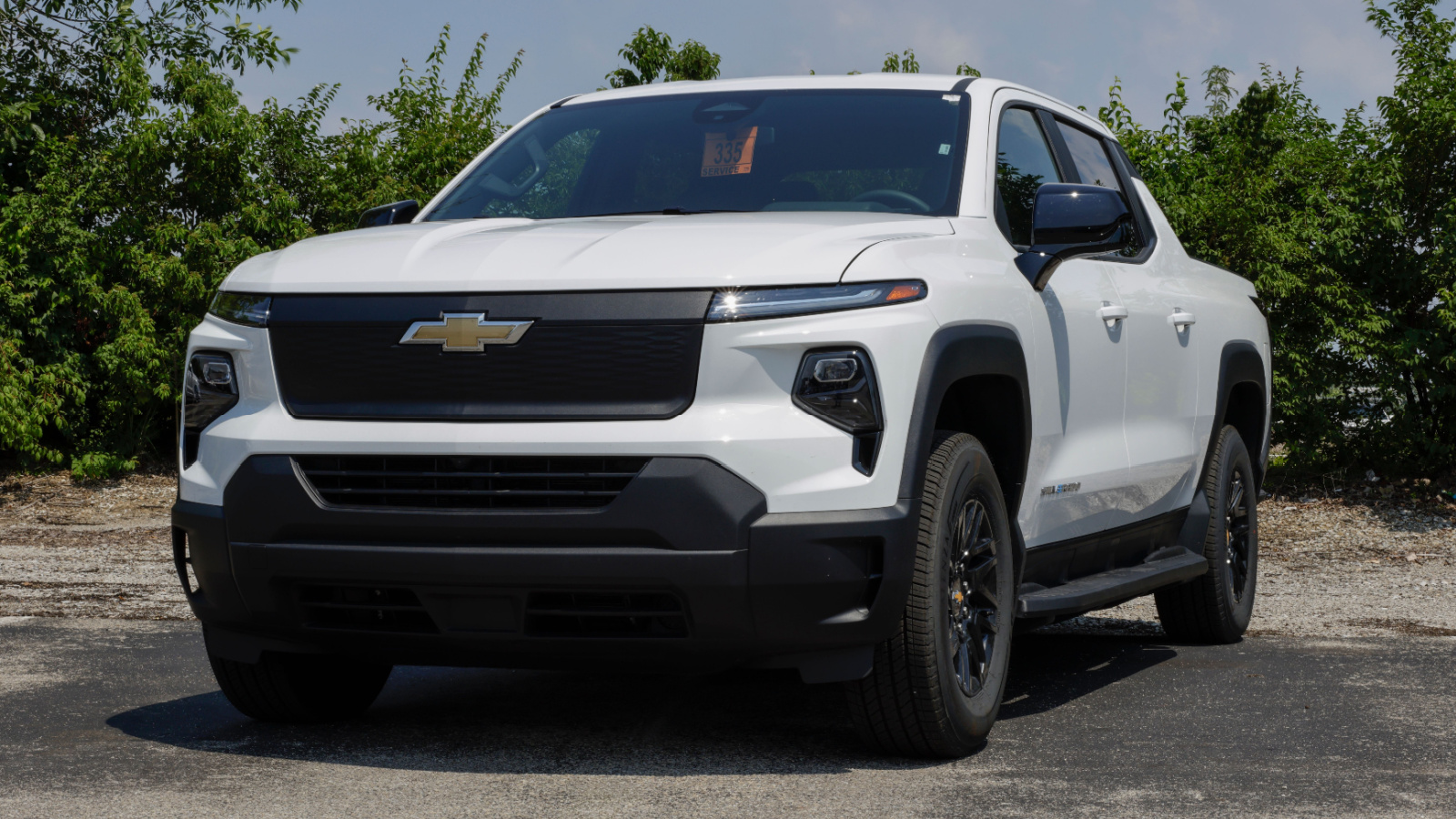
A pickup that can deliver 750 horsepower sounds like a machine built for the drag strip, not the hardware store. Yet Chevrolet’s latest Silverado EV update is as much about everyday convenience as outright speed. For 2027, the electric truck gains more peak power in its most expensive Trail Boss configuration, a factory-installed Tesla-style charging port and new camera features.
Prices are climbing at the same time, while a simplified trim lineup changes which versions ordinary buyers can order. The result is a truck with an impressive specification sheet but some important qualifications, particularly around where that horsepower is available, how charging compatibility works and what the advertised price actually buys.
The 750-Horsepower Figure Comes With a Catch
Chevrolet has lifted the 2027 Silverado EV Trail Boss Max Range to a maximum of 750 horsepower, up from 725 in the comparable 2026 version. Torque remains 775 pound-feet. Just as important, that output is limited to the Trail Boss fitted with the largest battery. It should not be confused with the ratings of the lower-priced LT or the fleet-oriented Work Truck. The truck retains a dual-motor, four-wheel-drive layout across its range.
The headline number also requires Wide Open Watts, or WOW, mode. Designed for maximum acceleration, the setting is not intended for continuous use, and its availability can be restricted when the battery’s charge is low. Chevrolet has not published an equivalent horsepower figure for normal driving with WOW switched off. For owners, the distinction matters: 750 horsepower describes what the truck can unleash under specific conditions, not a promise that every press of the accelerator delivers that output.
Tesla-Style Charging Becomes Standard Equipment
The most noticeable change for many owners may be a connector rather than a performance figure. Every 2027 Silverado EV now comes with a native North American Charging Standard port, called NACS or SAE J3400. It is the Tesla-style plug. Earlier Silverado EV trucks used a CCS1 charging inlet and needed a compatible adapter at NACS fast chargers. The new hardware removes that extra step when the destination has the matching connector.
That is valuable during a long drive, when the aim is simply to pull into a compatible charging bay and get moving again. General Motors has said its 2027 electric-vehicle lineup is moving toward native NACS connections, making the Silverado part of a company-wide transition. The change does not transform the truck into a Tesla or guarantee access to every Tesla station. It does, however, make an increasingly common charging format the default rather than an accessory-dependent convenience.
The Adapter Question Has Flipped, Not Disappeared
A built-in NACS port means the 2027 Silverado EV can connect directly to compatible Tesla Superchargers, but it creates a different consideration at charging sites. Many existing DC fast chargers still have CCS1 cables, while numerous Level 2 chargers use the J1772 plug. A NACS-equipped Silverado needs an appropriate adapter for those connectors. Chevrolet offers approved CCS1 DC and J1772 AC adapters, and the truck’s ordering guide lists packages that bundle them together.
But Tesla does not open every Supercharger to vehicles from other manufacturers. Drivers must check whether a site supports General Motors vehicles before treating it as a dependable stop. GM’s Energy Pass, integrated into the myChevrolet app, can help locate participating chargers and manage charging payments across supported networks. For a household with an existing J1772 home charger, or a driver who regularly visits older public stations, keeping the right adapter in the truck remains practical advice.
The Price Increases Are Real, but the Sticker Needs Explaining
The 2027 improvements arrive with higher U.S. prices. Published model-year comparisons put increases in the hundreds of dollars for the entry Work Truck and around $1,000 for certain LT and Trail Boss Extended Range versions. The top Trail Boss Max Range is listed at US$90,395 including destination, roughly $1,200 above its 2026 counterpart. The premium brings off-road equipment and largest-battery performance, but it also pushes the truck toward luxury-vehicle territory.
Chevrolet’s U.S. consumer site, meanwhile, advertises the 2027 LT from US$61,900 before destination charges. Add the reported US$2,595 destination fee and that becomes US$64,495 before taxes, options and dealer-related costs. Those figures describe essentially the same advertised starting point. For someone comparing a Silverado EV with a conventional truck, the important number is the fully equipped, final drive-away estimate, not the smallest figure on a promotional page. Canadian prices should not be inferred by simply converting these U.S. dollar amounts.
A Simpler Lineup Also Means Fewer Choices
Chevrolet has reduced the Silverado EV from ten configurations to seven, under Work Truck, LT and Trail Boss. The former RST models and the LT Max Range disappear from the ordering menu. Trail Boss now tops the retail range, while LT suits drivers prioritizing comfort over rugged styling. All versions retain dual-motor four-wheel drive, but battery choice determines range and power. LT horsepower ranges from 605 to 645, depending on battery selection.
There is also a wrinkle at the bottom of the price ladder. The Work Truck Standard Range was initially listed at US$56,095 including destination, but GM-focused reporting in October said it was no longer available for retail ordering. Longer-range Work Trucks were fleet or government only. That left the LT Standard Range, at US$64,495 including destination, the cheapest retail version reported then. A published base price, therefore, does not necessarily represent a truck a walk-in buyer can purchase.
Long Range Remains One of the Silverado EV’s Biggest Arguments
The Trail Boss Max Range carries a General Motors estimate of up to 478 miles on a full charge, roughly 769 kilometres. It is an impressive figure for an off-road-oriented pickup fitted with large all-terrain tires. Chevrolet identifies it as a manufacturer estimate rather than a final real-world guarantee. Temperature, terrain, speed, battery condition and the weight being carried all influence how far a truck will travel between charging stops.
That matters especially to people who use pickups for more than commuting. A contractor travelling between distant job sites or a family hauling recreational equipment may prefer reliable highway range over another 25 horsepower. Towing a heavy trailer can make those planning calculations more demanding. The sensible reading of 478 miles is that it establishes the truck’s potential under the conditions behind the estimate, not the distance every owner should expect on a windy winter highway with a loaded trailer.
Fast Charging Still Depends on the Battery and the Station
Silverado EV versions charge at different maximum rates. The 2027 ordering information lists DC fast-charging capability of up to 220 kilowatts for Standard Range trucks, 300 kilowatts for Extended Range versions and 350 kilowatts for Max Range configurations. The top battery uses an 800-volt arrangement. Those figures represent peaks, not rates maintained throughout a session under real driving conditions.
Chevrolet cautions that charging speed also depends on the station’s output, battery temperature and state of charge. A charger labelled 350 kW does not guarantee that every truck plugged into it will draw 350 kW, and access to a Tesla-style plug does not automatically deliver the Silverado’s maximum charging rate. The practical benefit of NACS is wider access to compatible equipment. Fastest charging still requires a suitable high-output station and favourable conditions. On a long-distance trip, the location and reliability of the next charger may matter more than a laboratory peak.
Trail Boss Hardware Gives the Power an Off-Road Purpose
Chevrolet has not merely added power to an ordinary pickup. The Trail Boss includes a two-inch suspension lift, 18-inch wheels wrapped in 35-inch all-terrain tires and standard four-wheel steering. Its Sidewinder feature can angle all four wheels in the same direction to move the truck diagonally at low speed. That manoeuvre assists on rough ground or in tight spaces, without replacing careful driving or adequate clearance. Four-wheel steering provides a useful manoeuvring advantage beyond sheer motor output.
The model also has distinctive trim, red tow hooks and a Black and Artemis interior with red accent stitching. Those details go beyond acceleration. That may appeal to drivers reaching campsites, cottage tracks or muddy work entrances on weekends. Still, 35-inch tires and off-road equipment do not eliminate the truck’s size or weight. Trail Boss capability should be judged against the terrain and the driver’s actual needs, not just an impressive horsepower figure.
Traditional Truck Work Remains Central to the Design
For buyers replacing gasoline pickups, towing and cargo flexibility matter more than acceleration. Chevrolet lists up to 12,500 pounds of maximum towing capacity for properly equipped Silverado EV Extended Range models, not a blanket rating for every configuration. Available Super Cruise also assists while trailering on compatible roads, although drivers must remain attentive. Both features support hauling equipment or taking boats to lakes.
Its electric power creates other workday possibilities. Chevrolet advertises up to 11 available outlets and up to 10.2 kilowatts of offboard power with the appropriate equipment, useful for tools or campsite appliances. The available Multi-Flex Midgate and tailgate can provide a load floor as long as 10 feet 10 inches in a specific fully opened configuration. With compatible GM Energy home equipment, the truck can even support backup power during an outage. Each capability has equipment requirements, making the option sheet as important as the headline numbers.
New Cameras Add Convenience, With Some Conditions
Three camera functions join the 2027 Silverado EV: Cabin Glance, Security Recording and Surround Vision Recorder. Cabin Glance provides a live view of the interior on the central display, helping drivers check rear passengers without turning around. Security Recording can capture footage when the vehicle alarm is triggered. Surround Vision Recorder can save video from exterior cameras during driving, potentially preserving evidence after a collision or incident. The interior camera comes standard on every 2027 Silverado EV model.
These functions do not mean unlimited, automatic footage storage. Chevrolet says the recording system requires a compatible USB drive, and its support information distinguishes live cabin viewing from saved recordings. GM says footage stored through these USB recording features is not collected by the company. Drivers still need to review the system’s setup and local rules about recording. As pickups gain advanced technology, clarity about recording matters as much as the cameras.
Canadian Buyers Face a Different Price and Charging Calculation
U.S. price increases show Chevrolet’s direction but are not Canadian retail prices. Chevrolet Canada’s consumer page still highlighted 2026 Silverado EV configurations, priced in Canadian dollars with kilometre-based range estimates. Taxes, freight and availability make direct currency conversion misleading. Buyers should verify the model year and final quote locally. A customer comparing a discounted 2026 model with a newly ordered 2027 truck must also check for hardware differences.
Charging access needs the same local scrutiny. Tesla lists Canada among markets where selected Superchargers accommodate eligible non-Tesla vehicles, but access is site-specific. A mapped charger may have an incompatible connector or deliver limited power. That is why the native NACS port is a meaningful step rather than a complete solution. The strongest Canadian buying case combines a suitable battery, local pricing and dependable routes. That distinction may matter outside major cities, where the next compatible fast charger could be far away.