

























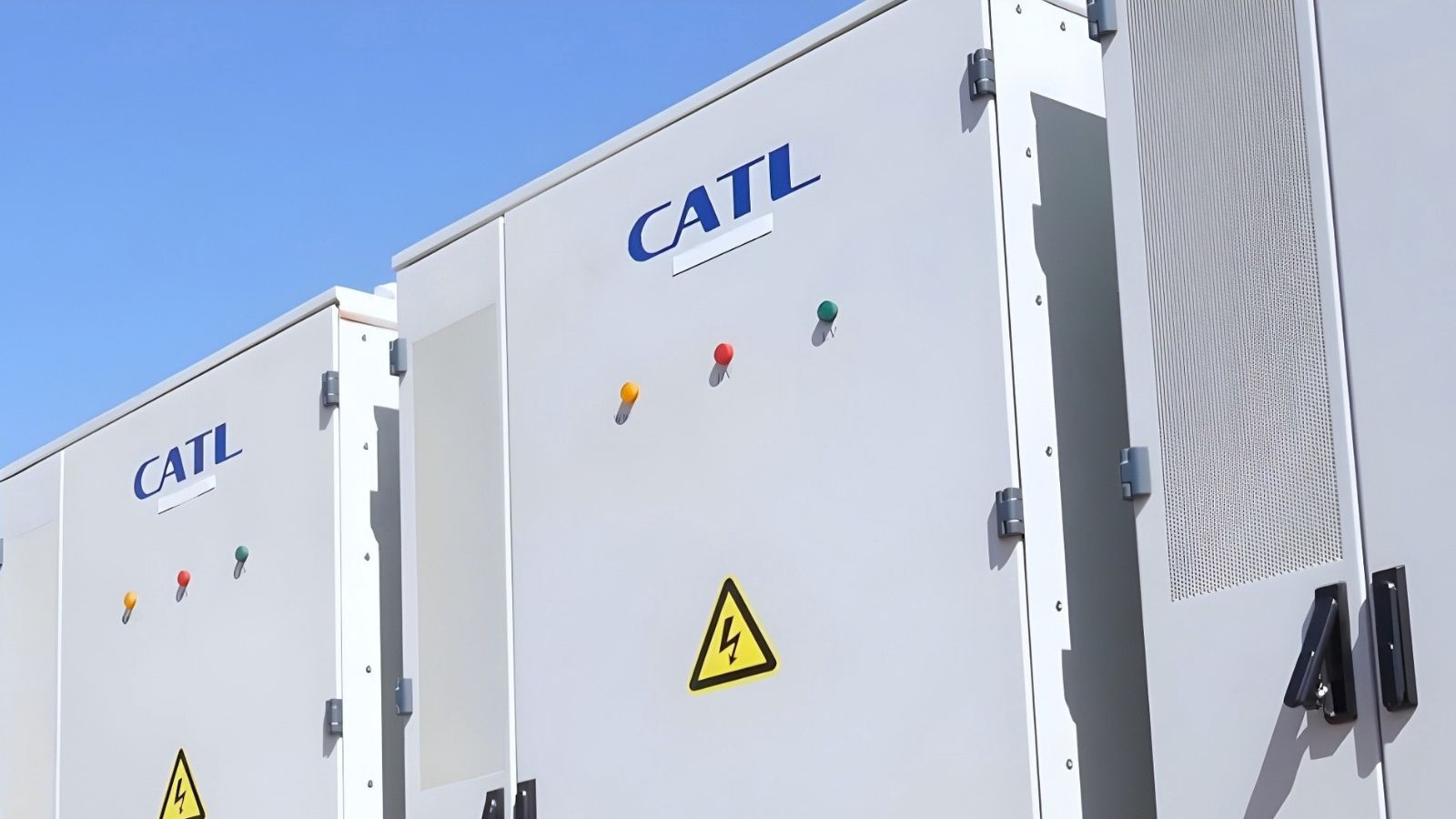
CATL’s huge Hungarian battery project has crossed one of its most important thresholds. On September 22, 2026, the Chinese battery giant began trial cell production at its new factory in Debrecen, putting the first two production lines through the testing and optimization work required before series manufacturing can begin.
The milestone comes after a more difficult summer than CATL had planned. Hungarian authorities temporarily stopped work in several areas after elevated nickel exposure was detected among employees and inspectors identified shortcomings involving protective equipment. CATL says the necessary conditions for trial operations have now been met. Still, the launch is best viewed as the beginning of a closely watched industrial ramp-up rather than the arrival of full 100-GWh production.
Trial Production Has Officially Begun
CATL began trial production at its newly constructed battery-cell factory in Debrecen on September 22, starting with the first two cell-production lines. The company says this phase is intended to set up, optimize and validate manufacturing equipment and processes before series production begins. In practical terms, cells may now move through the production system, but the priority is proving that machinery, quality controls and manufacturing steps can operate reliably together.
That distinction is important because trial production is not the same thing as commercial production at the plant’s headline capacity. Manufacturers commonly use this stage to fine-tune equipment, identify process variation and confirm that finished products consistently meet specifications. CATL has not announced a firm date for the start of full series production. For Debrecen, September 22 therefore represents an operational milestone rather than the completion of the factory’s lengthy ramp-up.
The First Two Cell Lines Are the Starting Point
Opening two production lines gives CATL a controlled environment in which to move from equipment commissioning toward repeatable battery-cell manufacturing. The company spent much of 2026 installing and preparing equipment in the completed cell building. Construction of that first building had begun in the summer of 2023, roughly a year after CATL announced the wider Hungarian investment.
The work occurring now is especially important in battery manufacturing because small differences during coating, cutting, winding, drying and other production stages can affect cell consistency and performance. The objective of a trial run is therefore not simply to prove that machines switch on. It is to establish a stable manufacturing process that can eventually be repeated thousands or millions of times. CATL says its Debrecen equipment has been designed around flexible production lines so that manufacturing can be adapted to customer requirements as the plant moves toward commercial output.
August’s Nickel Exposure Problem Put Safety Under Scrutiny
The September start follows a significant occupational-safety intervention only weeks earlier. CATL informed Hungarian authorities after biological monitoring identified elevated nickel exposure in nine workers. The Hajdú-Bihar County Government Office subsequently inspected the site and found shortcomings in the provision of protective equipment, according to an official government statement.
Authorities prohibited work in three areas until the identified problems were addressed. Those areas included operations involving cathode and anode foil laser cutting, electrode-foil winding and cell drying. The episode was particularly sensitive because the cell plant was still being commissioned rather than operating in full commercial production. CATL said it suspended affected commissioning work, continued biological monitoring and introduced stricter occupational-safety measures while the source of the exposure was investigated. The intervention made worker protection one of the central issues surrounding the plant’s eventual start-up.
Regulators Had to Clear the Path to Trial Operations
The regulatory process did not end with correcting workplace-safety shortcomings. CATL also needed the necessary building and environmental approvals before beginning the trial run. Hungarian authorities granted an occupancy permit for the first stage of the cell-production building on August 25 after required documentation and deficiencies were addressed. A separate application covering another stage had earlier been rejected because of an issue with how the completed structure was represented on a site plan.
CATL said on September 22 that it had since obtained the relevant permits and fulfilled conditions associated with its Integrated Pollution Prevention and Control permit. The company also said representatives of the county government office had confirmed that deficiencies identified during the permitting process had been corrected. The episode illustrates how the Debrecen start-up has become more than an engineering exercise: each step toward commercial manufacturing is now occurring under substantial regulatory and public scrutiny.
The 100-GWh Figure Represents the Full Project
CATL’s Debrecen investment is enormous, but the often-cited 100-GWh figure describes the planned capacity of the completed development rather than what the factory is producing today. CATL announced the Hungarian project in August 2022 with an expected investment of €7.34 billion and an eventual annual capacity of 100 GWh. The development covers roughly 221 hectares in Debrecen’s Southern Industrial Park.
If the entire project is completed as planned, CATL says Debrecen will become its largest manufacturing base outside China. That helps explain why the factory has attracted so much attention in Hungary and across the European automotive industry. A 100-GWh facility is large enough to represent a meaningful source of battery supply for European vehicle manufacturing, although the actual number of vehicles supported would depend heavily on battery-pack sizes and product mix. For now, the important point is that Debrecen is still progressing toward that long-term scale rather than operating at it.
Debrecen Was Already Making Battery Modules
September 22 was the beginning of local cell trial production, but it was not CATL’s first manufacturing activity in Debrecen. Battery-module assembly has been underway there since the autumn of 2024. By the time cell trial production began, the company said approximately 537,000 battery modules had been produced at the Hungarian site.
Local reporting based on CATL’s announcement said those modules were being used in roughly 134,300 vehicles across Europe. CATL also expanded module operations in May 2026 when a newly constructed assembly facility started operating beside the cell factory. That additional production line has a stated annual capacity of 5 GWh. The earlier module work has given the company experience recruiting workers, operating equipment and managing automotive-quality requirements in Hungary before taking on the more complex task of manufacturing the electrochemical cells themselves. Cell production now brings a much larger share of the battery value chain into the Debrecen operation.
Hungary Places CATL Close to Major European Carmakers
Location was one of CATL’s main arguments for choosing Debrecen. When the project was announced, the company highlighted its proximity to manufacturing operations associated with major European customers including Mercedes-Benz, BMW, Stellantis and Volkswagen. Producing cells inside Europe can shorten logistics routes and give a battery supplier greater flexibility when dealing with automotive customers that demand high-volume, just-in-time deliveries.
Hungary’s own automotive footprint has also continued to evolve. BMW’s new Debrecen factory began series production of the electric Neue Klasse iX3 at the end of 2025, while Mercedes-Benz expanded electric-vehicle production at its Kecskemét operation in 2026. Those developments help show why Hungary has become such an important location in Europe’s emerging EV manufacturing network. CATL’s strategy is therefore about more than adding factory capacity. Debrecen is intended to place large-scale battery manufacturing closer to the factories where European electric vehicles are actually being assembled.
CATL Is Bringing Global Scale to a Local Ramp-Up
The company arriving in Debrecen is already the dominant supplier in the global EV battery market. SNE Research reported that CATL batteries accounted for 289.6 GWh of global EV battery usage during the first seven months of 2026, up 26.6% from the same period a year earlier. That represented a 39.9% global market share, compared with 38% during the corresponding period of 2025.
CATL’s 2025 results underline the manufacturing scale behind those numbers. The company reported total lithium-ion battery sales of 661 GWh for the year and global production capacity of 772 GWh. Yet size does not eliminate the challenges of opening a new overseas factory. Debrecen requires CATL to combine its existing manufacturing technology with Hungarian labour regulations, environmental requirements, local suppliers and a newly recruited workforce. The nickel-exposure incident demonstrated that transferring industrial know-how across borders involves operational details that cannot be solved simply by installing advanced machinery.
Employment Will Grow Along With Production
The factory’s progress also has a significant employment dimension. CATL reported in June that approximately 1,470 people were working at its Debrecen operations, including local and contracted employees. The company was targeting a workforce of around 2,300 by the end of 2026 as cell manufacturing and other activities expanded.
Recruitment has focused on production, logistics, quality assurance and occupational safety, while Chinese technical specialists have also been helping install equipment and transfer manufacturing knowledge to Hungarian employees. That training role becomes more important during trial production, when workers learn how equipment behaves under actual manufacturing conditions rather than during installation alone. The safety problems identified in August add another layer to that process. Expanding employment rapidly will need to be matched by training, monitoring and consistent safety procedures if the plant is to move smoothly from trial operations into sustained series production.
The Next Test Is Stable Series Production
The immediate objective at Debrecen is now straightforward: prove that the first two lines can repeatedly produce cells while meeting technical, quality, environmental and workplace-safety requirements. CATL says employee health, safety and environmental indicators will continue to be monitored during trial operations and that results will be proactively provided to Hungarian authorities.
There is still no publicly confirmed date for full series production, and that uncertainty is worth preserving. Trial runs can uncover equipment or process problems that require additional adjustments before production volumes increase. What has changed is that Debrecen is no longer merely a construction project or a module-assembly location. Battery cells are now entering the manufacturing process there. If the validation phase proceeds successfully, CATL will move considerably closer to its original vision of making Hungary one of the central production hubs in its European battery network. After the regulatory setbacks of August, that transition will be watched particularly closely.