


























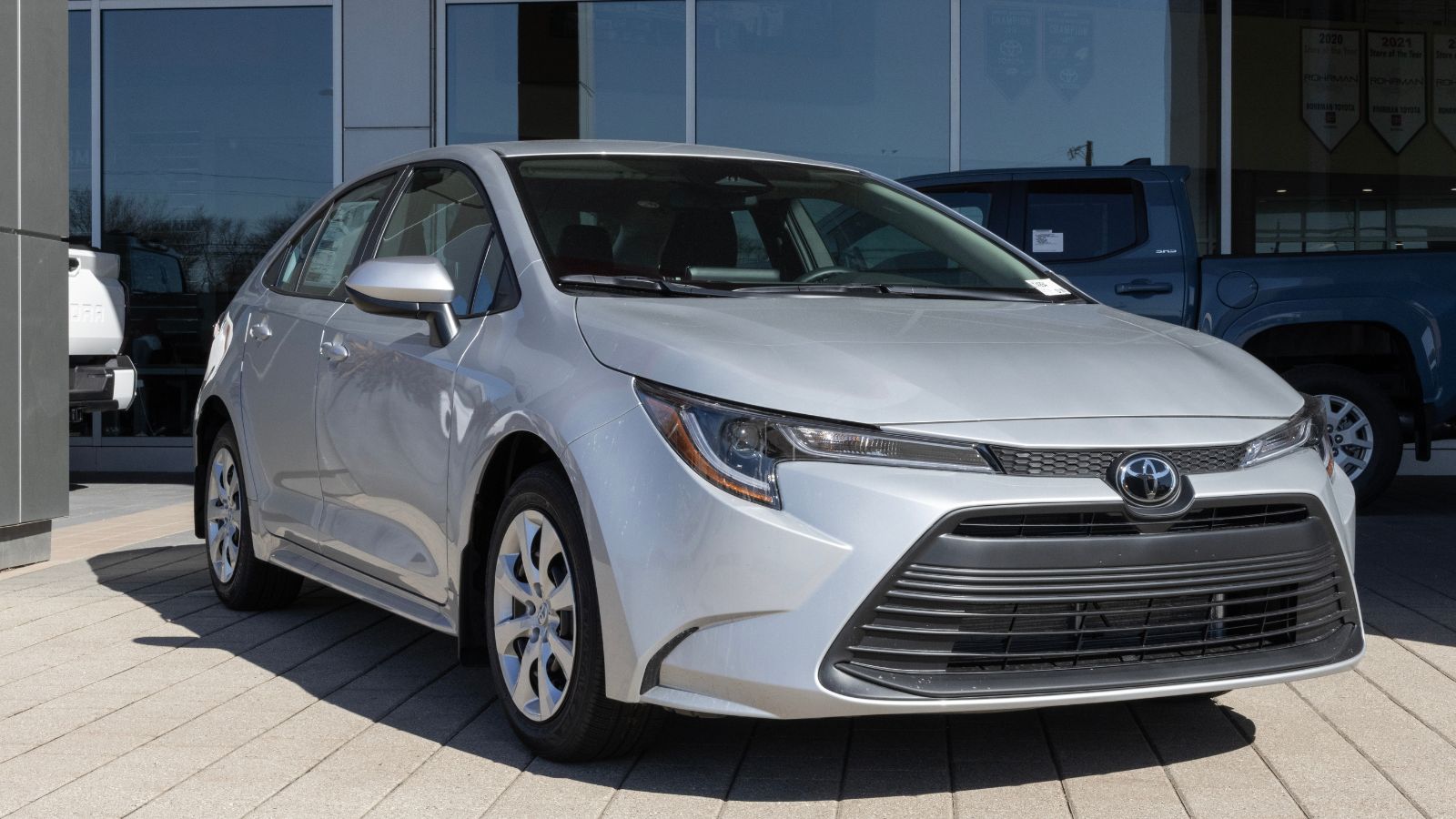
Canada’s least-expensive hybrids are moving closer to prices that ordinary new-car shoppers already encounter, weakening the old assumption that electrification always requires a large upfront premium. A Canadian affordability ranking published August 16 puts the 2027 Toyota Corolla Hybrid LE at $32,915 when MSRP and applicable fees are included. More strikingly, Hyundai’s 2026 Sonata Hybrid is priced barely $100 above the gasoline version positioned below it, despite using substantially less fuel. Across the affordable end of the market, buyers can now find hybrids ranging from compact sedans to crossovers and even a pickup truck. The numbers also show an important divide: some models make the strongest case through exceptionally low fuel consumption, while others combine electrification with all-wheel drive, added power or greater practicality.
Toyota Corolla Hybrid LE — $32,915
The 2027 Toyota Corolla Hybrid LE sits at the bottom of the Canadian hybrid price ladder at $32,915 under The Car Guide’s pricing methodology, which includes MSRP and applicable fees. Toyota lists the compact sedan with a 1.8-litre four-cylinder hybrid system producing 138 horsepower. The front-wheel-drive LE is the least expensive configuration, while electronic all-wheel-drive versions remain available higher in the range. Combined fuel consumption is approximately 4.7 L/100 km, putting the Corolla among the most economical gasoline-electric vehicles sold in Canada.
That efficiency becomes easier to appreciate over an ordinary commuting year. At 20,000 kilometres, a vehicle averaging 4.7 L/100 km would consume roughly 940 litres of gasoline under rated conditions. The Corolla therefore does not need dramatic technology or luxury equipment to make its case. Its attraction is simpler: familiar compact-car dimensions, no charging requirement and fuel consumption more commonly associated with much smaller vehicles. For households hesitant to make the jump to a battery-electric vehicle, the cheapest hybrid in Canada represents a relatively conventional way to reduce fuel use.
Kia Niro LX — $33,811
At $33,811, the 2026 Kia Niro LX lands only $896 above the cheapest Corolla in the affordability ranking. Unlike a traditional compact sedan, the Niro uses a crossover-style body, giving it a different kind of appeal for shoppers who prefer a taller cabin and hatchback access. Its hybrid system produces 139 horsepower, while its rated combined fuel consumption is just 4.4 L/100 km. Among the ten lowest-priced hybrids identified in the Canadian ranking, that is the best fuel-consumption figure.
For a driver covering 20,000 kilometres annually, 4.4 L/100 km translates to approximately 880 litres of gasoline under the official test rating. That helps explain why the Niro can make sense even without all-wheel drive, which is not offered on the hybrid. Kia instead focuses the model heavily on efficiency and everyday utility. The absence of AWD may matter to some Canadian buyers, particularly those shopping specifically for winter traction, but it also keeps weight and consumption down. For city commuters and suburban families, the Niro demonstrates how a hybrid crossover can approach compact-sedan running costs without adopting a sedan body.
Hyundai Elantra Hybrid Luxury — $34,816
Hyundai’s 2026 Elantra Hybrid Luxury takes third place at $34,816. Unlike several competitors that spread their hybrid systems across numerous trim levels, Hyundai offers the Elantra Hybrid in a single Luxury configuration. Its 1.6-litre gasoline-electric powertrain develops 139 horsepower. Hyundai rates combined consumption at 4.7 L/100 km, with the company citing Natural Resources Canada data in describing the model’s efficiency. The hybrid also uses a smaller 42-litre fuel tank than conventional Elantra versions, yet its lower consumption allows it to stretch each litre considerably farther.
The Elantra illustrates another shift in the hybrid market: efficiency is increasingly being bundled with a comparatively well-equipped trim rather than reserved for a stripped-down economy model. A commuter travelling 20,000 kilometres annually would theoretically use about 940 litres at the combined rating. The regular Elantra lineup remains cheaper, so choosing the hybrid still involves examining purchase price against expected fuel savings. However, the $34,816 position shows that buyers no longer need to move deep into $40,000 territory simply to access a highly efficient electrified sedan.
Honda Civic Sport Hybrid — $37,347
The 2026 Honda Civic Sport Hybrid enters the ranking at $37,347 for the sedan, but its appeal extends beyond saving fuel. Honda’s two-motor hybrid system produces 200 horsepower and 232 lb-ft of torque, giving it dramatically more output than many economy-focused hybrids. The rated combined fuel consumption is still only 4.9 L/100 km. That combination makes the Civic unusual in this group: it provides output comparable with genuinely sporty compact cars while maintaining fuel consumption below five litres per 100 kilometres.
Honda also offers the hybrid system in the Civic hatchback, although The Car Guide notes that the hatchback costs about $1,900 more than the sedan used in the affordability ranking. For commuters, the sedan’s 4.9 L/100 km rating equates to about 980 litres over 20,000 kilometres under test-cycle conditions. The Civic therefore gives buyers another way to think about hybridization. Rather than paying for electrification solely to save gasoline, the electric motors also contribute immediate torque and stronger acceleration. That can make the added technology feel like a performance upgrade as well as an efficiency measure.
Toyota Camry SE — $38,010
Toyota has taken the hybrid concept even further with the 2026 Camry. There is no conventional gasoline-only Camry in the Canadian lineup to compare against because the current generation is hybrid throughout. The entry-level Camry SE appears at $38,010 in The Car Guide’s ranking and sends 225 horsepower to the front wheels. Higher all-wheel-drive versions increase combined system output to 232 horsepower. Despite being a larger midsize sedan than the Corolla, the front-drive Camry SE is rated at approximately 5.0 L/100 km combined.
That figure works out to roughly 1,000 litres over 20,000 kilometres at the rated consumption, an impressive number for a five-passenger midsize car with more than 200 horsepower. The Camry’s position also demonstrates how completely hybrids have moved into the mainstream at Toyota. Instead of asking shoppers to select an electrified alternative to the standard model, Toyota has effectively made electrification the standard model. At a time when many family-sized crossovers have moved well beyond $40,000, a sub-$40,000 midsize hybrid sedan remains a notable alternative.
Ford Maverick Hybrid XL — $38,195
The 2026 Ford Maverick Hybrid XL is the outlier in this group because it has a pickup bed. Its Canadian starting figure in the ranking is $38,195, only $185 above the Camry. The hybrid powertrain produces 191 horsepower and is offered with front-wheel drive as standard. Ford also makes all-wheel drive available with the hybrid, expanding its appeal beyond fair-weather urban use. Rated combined fuel consumption for the front-drive version is approximately 6.2 L/100 km, with a particularly strong city rating of about 5.6 L/100 km.
A 6.2 L/100 km combined figure would translate to approximately 1,240 litres over 20,000 kilometres. That is higher than the small sedans here, but the Maverick is doing a different job. It offers five-passenger seating and an open cargo bed while consuming far less fuel than many traditional pickups. There is another unusual pricing twist: The Car Guide notes that the optional 2.0-litre EcoBoost configuration costs roughly $300 more than the base hybrid setup. In this case, choosing the hybrid is not necessarily an expensive upgrade at all.
Toyota Corolla Cross Hybrid SE AWD — $39,160
The 2026 Toyota Corolla Cross Hybrid SE AWD reaches the list at $39,160, bringing standard electrified all-wheel drive into the discussion while remaining below $40,000 under the ranking’s pricing method. Toyota’s fifth-generation hybrid system combines a 2.0-litre four-cylinder engine with electric motors for 196 total horsepower. Official Canadian material lists combined fuel consumption at 5.6 L/100 km across the hybrid grades, and Toyota says the system can accelerate the Corolla Cross Hybrid from zero to 100 km/h in approximately 8.2 seconds.
For many Canadian households, this may be closer to the vehicle they actually want than an ultra-efficient sedan. It provides a higher seating position, crossover cargo access and standard electronic AWD while still using fuel at a rate that would equal roughly 1,120 litres over 20,000 kilometres. There is a price to that added versatility: the Corolla Cross Hybrid is more than $6,000 above the cheapest Corolla Hybrid in this ranking. Still, the comparison shows how quickly hybrid technology has spread beyond specialized economy cars and into mainstream compact SUVs with year-round capability.
Hyundai Sonata Hybrid Preferred Trend — $39,216
The 2026 Hyundai Sonata Hybrid Preferred Trend may offer the most eye-catching value equation on the list. At $39,216 in the Canadian ranking, the hybrid reportedly costs barely $100 more than the gasoline-only Sonata positioned immediately below it. Yet the hybrid produces 192 horsepower—one horsepower more than that gasoline model—and consumes roughly 5.0 L/100 km combined. The Car Guide calculates that the difference in average consumption exceeds 3.5 L/100 km, making the tiny purchase-price gap particularly significant.
Hyundai says the Sonata Hybrid combines its 5.0 L/100 km Natural Resources Canada rating with a 50-litre fuel tank. On paper, that gives the car a calculated potential range of up to about 1,000 kilometres, although the company stresses that this is a calculation rather than an official driving-range figure. The more important point is economic. Hybrid premiums traditionally forced buyers to calculate how many years of fuel savings would be needed to recover thousands of dollars upfront. A premium measured in roughly $100 changes that equation almost immediately, assuming comparable dealer pricing and availability.
Toyota RAV4 LE — $40,505
The redesigned 2026 Toyota RAV4 LE appears at $40,505 using The Car Guide’s price calculation. Toyota itself announced a starting MSRP of $37,500, illustrating why comparisons can differ depending on whether freight and other applicable charges are included. More important than the accounting is what happened mechanically: the new Canadian RAV4 lineup is fully electrified, offering hybrid and plug-in hybrid powertrains rather than a conventional gasoline-only version. The standard hybrid system produces 236 net horsepower, and Canadian RAV4 hybrids are equipped with all-wheel drive.
Toyota rates combined fuel consumption for the entry hybrid at about 5.5 L/100 km. At 20,000 kilometres, that would represent approximately 1,100 litres under rated conditions. The model also has a distinctly Canadian connection. Toyota says all 2026 RAV4 hybrids sold in Canada are assembled by Toyota Motor Manufacturing Canada. With the RAV4 among the country’s most widely purchased passenger vehicles, its switch to an entirely electrified powertrain lineup is significant. Hybrid technology is no longer sitting at the edge of the compact-SUV market; it is becoming the default in one of its biggest nameplates.
Toyota Prius XLE AWD — $41,935
The 2027 Toyota Prius XLE AWD rounds out the ten most affordable hybrids at $41,935. The Prius once defined the hybrid category almost by itself, but it now sits above less expensive electrified models from Toyota, Kia, Hyundai and Honda. Its current powertrain is also far more powerful than early generations: a 2.0-litre gasoline-electric system produces 196 horsepower, and the Canadian model comes with all-wheel drive. Combined fuel consumption remains excellent at approximately 4.9 L/100 km.
The Prius therefore occupies a different role than it did two decades ago. Buyers no longer need to choose it simply because they want hybrid technology; there are numerous less-expensive alternatives. Instead, the modern Prius combines unusually low consumption with AWD, substantially more power and distinctive styling. At the official rating, 20,000 kilometres of driving would require about 980 litres of gasoline. What may be most revealing is that the Prius now sits at the expensive end of Canada’s ten cheapest hybrids. The technology it helped popularize has become common enough that several mainstream cars, crossovers and even a pickup now undercut it.