






















Electric-bus electrification can look deceptively simple from the street: replace diesel coaches with battery-powered ones and plug them in at night. In Lévis, Quebec, the harder part has been rebuilding the depot behind the service. Société de transport de Lévis now has a 3-megawatt charging installation built around 40 ceiling-mounted Kempower charging points, according to an October 26 announcement from Kempower and Canadian partner EV-olution Charging Systems. The project gives STLévis a large shared pool of DC charging power without filling precious garage floor space with pedestals. It also arrives as the agency’s battery-electric fleet grows from 20 buses today toward a much larger 2027 fleet, turning a once-conventional garage into a high-power energy hub.
A 3-Megawatt Charging Hub Built Around the Depot
The headline number is 3 megawatts, but the more important detail is how that power is distributed. Kempower says the STLévis installation uses 40 ceiling-mounted Control Units with cable-retraction systems. The company describes the project as one of Canada’s largest public-transit depot-charging installations. Instead of treating every parking position as an isolated charger with its own fixed block of power, the system is designed as a shared charging network. Central power equipment feeds multiple charging points, and available capacity can be directed to the buses that need it at a given moment. That architecture matters in a depot where vehicles return at different states of charge and have different departure times the next morning.
For STLévis, the result is infrastructure that is larger than the fleet currently using it. Kempower’s October announcement says the agency operates 20 electric buses today, while 40 charging positions have been installed. Building ahead of the immediate vehicle count can reduce the need to repeatedly reopen a working garage as more buses arrive. It also gives the operator room to manage outages or maintenance without leaving every bus dependent on a single charging position. In practical terms, the charging project is not only about supplying energy; it is about making the depot flexible enough to absorb the next stage of fleet electrification.
The 40 “Overhead Chargers” Are Retractable Cable Units
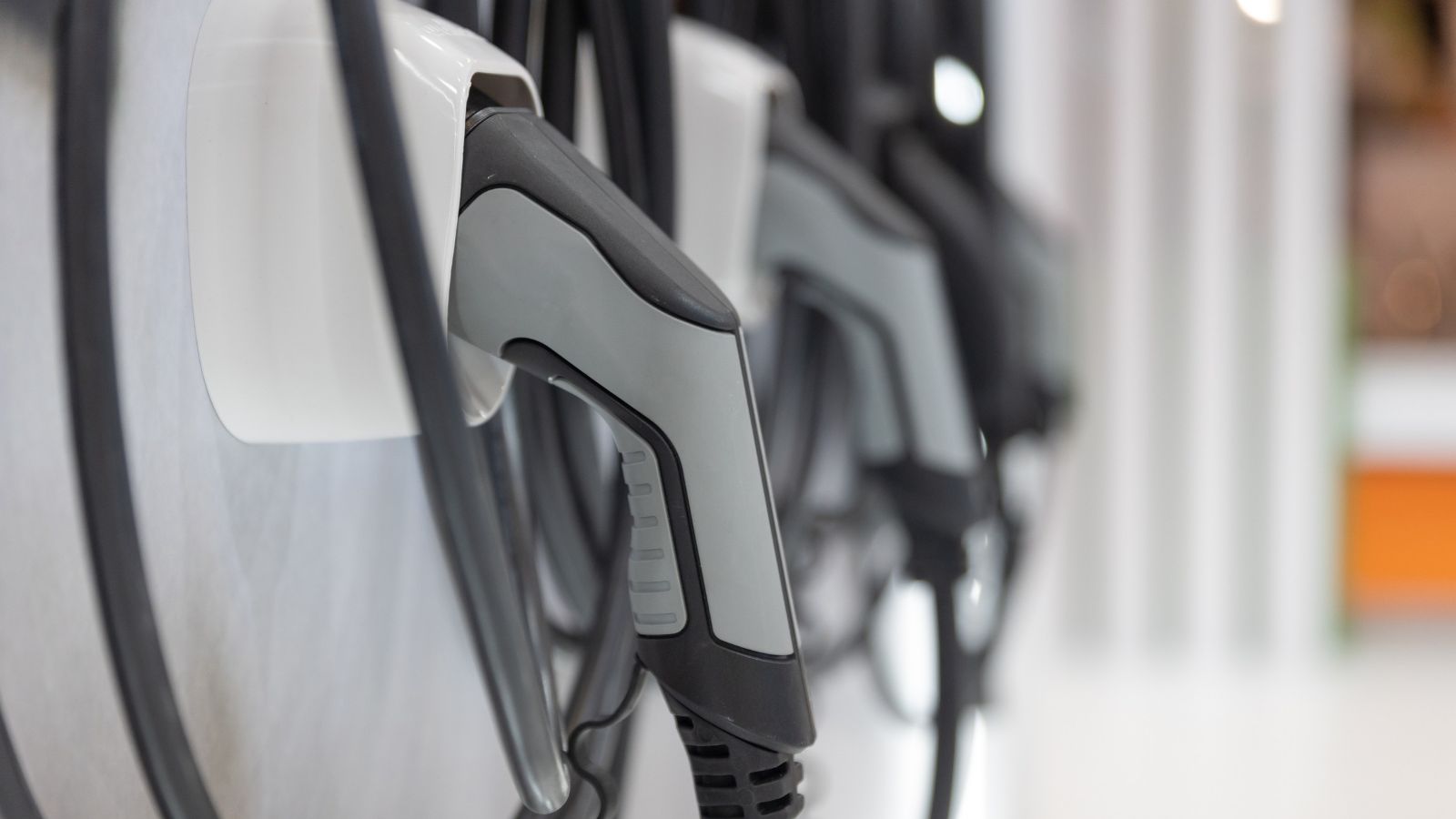
The phrase “overhead charger” can create the wrong picture. The Lévis announcement does not describe 40 automatic pantographs descending onto bus roofs. It identifies 40 Kempower Control Units mounted at the ceiling and paired with cable-retraction systems. Kempower’s own technical material describes a Control Unit as a charging point connected to a separate charging power unit, with a vehicle connector and charging cable. In North America, the company markets the Control Unit with CCS1 cables and says it can be installed on walls, overhead truss structures, bollards or other configurations. Pantographs are a separate option within Kempower’s broader distributed-charging lineup.
That distinction matters because retractable cables solve a very ordinary depot problem: clutter. Bus garages have to accommodate drivers, mechanics, cleaning crews and large vehicles moving through tight lanes every day. Bringing the cable down from above keeps bulky charging hardware and loose cable runs away from much of the floor area. Kempower says an individual Control Unit can deliver up to 240 kW, although the actual power available at any moment depends on the wider system and how power is being shared. In Lévis, the sitewide charging pool is 3 MW, so the value is not 40 chargers running at their individual maximums; it is 40 convenient connection points sharing a managed source of power.
Dynamic Power Sharing Is the Key to Making 3 MW Work
If 3 MW were divided evenly across all 40 connected buses at the same time, the arithmetic works out to 75 kW per bus. That is not a fixed charging rate, but it is a useful way to understand the scale. The International Energy Agency says heavy-duty depot chargers are typically in the 50-to-150-kW range, while much higher charging rates are generally associated with faster opportunity charging. A bus that returns early and needs a large energy refill may need more power for a period, while another bus near a full battery may need much less. Treating those two vehicles identically would waste available capacity.
Kempower’s distributed architecture is built around dynamic power sharing. Its power units can reroute available charging capacity among connected outputs as vehicle demand changes. For a transit operator, that creates an opportunity to prioritize buses according to charging requirements, scheduled departure and available site power rather than simply turning every charger on at full output. The broader industry is moving in the same direction. The IEA says poorly optimized depot charging can increase peak demand and that shifting or managing charging loads can materially reduce a depot’s maximum power requirement. For STLévis, software and power allocation are therefore as important as the physical cables hanging from the ceiling.
Twenty Electric Buses Are Already in Service
The charging system is arriving alongside the first major wave of battery-electric buses in Lévis. Kempower’s latest announcement says STLévis currently operates 20 electric buses. Earlier agency documents show how quickly that number has been changing. In June 2026, STLévis said its first 10 electric buses had entered service and that 30 more were expected by the 2027 school-year period. Its 2024 annual report, prepared before those deliveries began, referred to 42 new electric buses expected by the end of 2027. Those figures come from different planning dates, so the clearest current benchmark is the 20 buses confirmed in operation in the October announcement, with further expansion planned for 2027.
The mismatch between 40 charging positions and a planned fleet that may be slightly larger is not inherently a problem. Transit buses do not all have to charge at maximum power simultaneously, and fleet operators can schedule charging around service assignments. STLévis had already planned the garage conversion around at least 40 buses while its vehicle procurement continued to evolve. The important operational shift is that electric buses are no longer a small demonstration in Lévis. They are becoming a meaningful share of a fleet that STLévis has described as roughly 100 vehicles, forcing charging, maintenance, dispatch and energy management to become part of everyday transit operations rather than a special pilot.
STLévis Chose to Retrofit St-Omer Before Building a New Depot
Lévis did not start with a blank sheet of land and a purpose-built electric garage. STLévis’s 2024 annual report says the agency revised its electrification strategy and made adaptation of the existing St-Omer operations centre the priority, while pushing a new depot toward the 2029 horizon. That decision put a premium on fitting high-power electrical equipment into a building that still had to function as a bus garage. The same report described phase one as an adaptation for at least 40 electric buses and budgeted for a new electrical entrance, charging equipment, roof reinforcement and a Hydro-Québec connection.
The transformation reaches beyond chargers. STLévis also reported building two electric-bus maintenance bays in 2024, covering 636 square metres, with equipment suited to working on battery-electric buses and an overhead crane intended to handle batteries mounted on vehicle roofs. That is the less visible side of fleet electrification. A bus can arrive with a battery and electric motors, but the depot still needs technicians, lifting equipment, fire-protection upgrades, electrical distribution and safe work areas. By reusing St-Omer first, STLévis has been trying to keep the transition moving while postponing the much larger capital commitment of a new depot.
The Financial Scale Goes Well Beyond the Chargers
STLévis’s own planning documents show why depot electrification can become a capital project in its own right. The 2024 annual report described roughly $12 million for adapting the existing garage. Its phase-one breakdown listed $3.5 million for Kempower charging equipment, $2.5 million for a new 25-kV electrical entrance capable of 6 MW, $3 million for roof reinforcement and installation work, $1 million for the Hydro-Québec connection and $0.8 million for plans and design. That 6-MW figure and Kempower’s newly announced 3-MW figure describe different layers of the project: STLévis documented a 6-MW-capable electrical entrance, while Kempower is reporting 3 MW of installed bus-charging power.
Public funding is a major part of making projects like this possible. In March 2025, the federal government allocated $7.625 million through the Zero Emission Transit Fund for conversion of the St-Omer garage and another $4.72 million for a new STLévis bus depot. Quebec also supports electric transit through its capital-assistance programs; the province’s current schedule lists a 90% assistance rate for eligible purchases and replacements of fully electric buses by transit agencies. The funding structure underscores a basic reality: electrifying a fleet requires investment in vehicles, electrical service, buildings and charging systems at the same time.
Grid Capacity Can Become the Real Bottleneck
Three megawatts sounds modest compared with a provincial power system, but distribution grids are built around local conditions. Transport Canada’s medium- and heavy-duty vehicle grid-integration study found that fleet size and per-vehicle charging power are major cost drivers, with modeled projects above 3 MW of required distribution capacity often encountering step changes in grid-upgrade needs. In its 200-bus transit-depot archetype, the study modeled more than 10 MW of capacity and the need for a new substation. That example is much larger than STLévis and should not be read as a prediction for Lévis, but it shows why utility planning can become one of the hardest parts of electrifying a depot.
The IEA makes a similar point from a global perspective. Its 2026 outlook says depot charging is crucial for urban electric-bus fleets, yet grid-connection delays, limited substation capacity and construction inside active depots can slow vehicle deployment. This is where Lévis’s distributed approach becomes strategically important. A 3-MW pool that can be shared across 40 positions gives the operator a way to avoid treating every bus as if it needs peak power at the same time. The engineering challenge shifts from “How big can every charger be?” to “How intelligently can available power be scheduled across the fleet?”
Quebec’s Electricity Mix Strengthens the Emissions Case
Electric buses can only be as low-carbon in operation as the electricity used to charge them, and Quebec starts from an unusually favourable position. Hydro-Québec reports that more than 99% of the electricity it generates comes from renewable sources, with hydropower dominating its generating fleet. That means moving a city bus from diesel fuel to grid electricity in Quebec eliminates tailpipe emissions while drawing energy from a power supply that is already overwhelmingly renewable. The Lévis charging announcement does not quantify greenhouse-gas savings, however, so a precise emissions-reduction figure would require data on route mileage, vehicle energy consumption and the fuel displaced.
The clean electricity supply does not eliminate operational challenges. Electric buses still require careful charging schedules, high-power electrical infrastructure and equipment capable of performing reliably in Quebec’s climate. STLévis’s 2024 report specifically highlighted Kempower equipment’s use in northern conditions and noted deployments in countries including Finland, Norway, Sweden and Denmark. The practical payoff for riders is quieter, locally emissions-free propulsion, but the system behind that experience is industrial: transformers, switchgear, cables, controls and specialized maintenance spaces. Lévis’s project makes that hidden infrastructure unusually visible.
Lévis Offers a Preview of the Next Electrification Challenge
Quebec has been pushing transit agencies toward battery-electric fleets for years. The province continues to target the electrification of 55% of urban buses by 2030, while supporting electric-bus purchases and the adaptation or construction of depots capable of serving them. As more agencies move beyond pilot fleets, the challenge increasingly becomes less about whether an electric bus can perform urban transit work and more about whether the garage, utility connection and operating plan can support dozens of them every night.
That is what makes the STLévis installation significant beyond Lévis. Forty ceiling-mounted charging points, a 3-MW managed charging pool and an electrical system built with further expansion in mind represent the kind of behind-the-scenes infrastructure Canadian transit agencies will need at larger scale. The project also shows why chargers cannot be evaluated only by their maximum kilowatt rating. Space, grid capacity, vehicle schedules, maintenance access and software coordination can determine whether a depot works smoothly. If STLévis can expand its 2027 electric fleet without turning charging into a daily operational constraint, the strongest proof of the system’s value may be something passengers barely notice: buses simply leaving the garage on time.