


























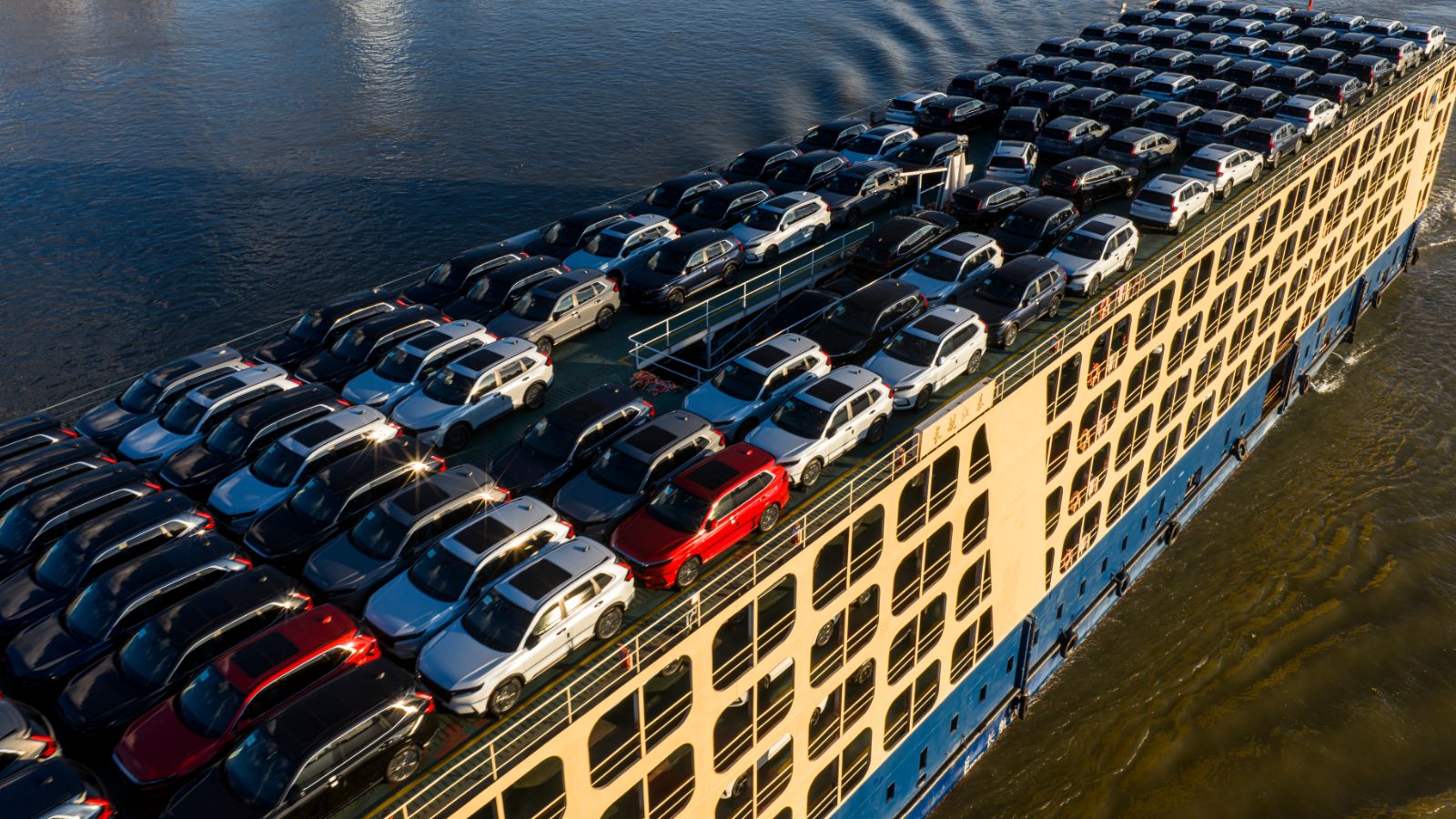
Canada has joined the United States and 13 other economies in warning that structural manufacturing overcapacity is distorting global markets, with automobiles and electric vehicles placed at the top of the sectors targeted for deeper scrutiny.
The timing makes Ottawa’s signature particularly notable. Only months ago, Canada removed its 100% surtax on Chinese-made EVs and replaced it with a managed quota allowing 49,000 vehicles from China to enter annually at the normal 6.1% tariff. That policy has divided governments, automakers and unions while attracting Chinese brands to the Canadian market.
The new declaration does not name China, nor does it require Canada to restore its old EV tariff. Instead, it puts Ottawa inside a U.S.-led effort to investigate overproduction and coordinate future responses—while Canada simultaneously tests a more open approach to Chinese electric vehicles at home.
Canada Is One of 15 Signatories
The Office of the U.S. Trade Representative announced the initiative on October 7 after senior officials met on the sidelines of the OECD Trade Committee. Fourteen economies joined the United States: Argentina, Australia, Canada, the European Union, France, Germany, India, Italy, Japan, South Korea, Mexico, Poland, Türkiye and the United Kingdom. The unusual list includes both the European Union and several individual EU members.
The statement builds on discussions held at the G20 Trade Ministers’ Meeting in Milwaukee on September 30 and October 1. Those talks failed to produce G20-wide agreement on excess industrial capacity, so the smaller group moved forward separately. Canada had already participated in the Milwaukee discussions, where International Trade Minister Maninder Sidhu highlighted rules-based trade and supply-chain resilience. The October declaration moves beyond discussion by committing participants to establish sector-specific platforms, exchange information and examine possible coordinated action. It is therefore more substantial than a general expression of concern, although it is not itself a new tariff agreement.
Autos and EVs Are First on the List
The five initial areas identified by the signatories are automobiles and electric vehicles, batteries, chemicals, foundational semiconductors and solar panels. The statement argues that structural overcapacity can create production that exceeds global demand because of government intervention or policies that would not exist under normal market conditions. According to the document, the consequences can include depressed prices, reduced private investment, displaced domestic production and greater dependence on concentrated foreign suppliers.
For Canada, putting autos and EVs first carries particular weight. Vehicle manufacturing is deeply intertwined with the United States, and Canadian policy has spent years trying to attract battery plants, EV assembly projects and critical-mineral processing. Ottawa said in July that more than 90% of Canadian-made vehicles and 60% of Canadian-made auto parts are exported to the United States. That integration means changes in global EV production are not simply a matter of Canadian consumers gaining access to cheaper cars. They potentially affect factories, suppliers and investment decisions on both sides of the border.
The Statement Never Actually Names China
China is the obvious backdrop, but accuracy matters: the two-page ministerial statement does not accuse China by name. It calls on all countries to eliminate structural excess capacity and end non-market practices that contribute to it. It also says overcapacity in any country can harm trading partners by distorting prices, weakening competition and increasing vulnerability to economic coercion. China was not among the signatories, nor were Brazil, Indonesia, Russia, Saudi Arabia or South Africa.
U.S. Trade Representative Jamieson Greer has been much more explicit outside the document. He has repeatedly tied the overcapacity debate to Chinese subsidies and industrial policy, arguing that state-supported production is spilling into foreign markets. Beijing rejects that characterization and has portrayed Western overcapacity allegations as a justification for protectionism. The disagreement was evident at the G20 meeting, where no consensus emerged on the issue. Canada’s signature therefore aligns Ottawa with the countries willing to advance the U.S.-backed framework, but it does not amount to Canada formally declaring that every Chinese EV export is the product of unfair overcapacity.
China’s EV Scale Explains Why the Issue Is So Politically Charged
The scale of China’s electric-vehicle industry makes the dispute difficult to separate from the global EV market. The International Energy Agency estimates that China produced about 16 million electric cars in 2025, roughly 70% of global production. Chinese output exceeded domestic demand by approximately 20%, while electric-car exports doubled to more than 2.5 million vehicles. China also produced more than 80% of the world’s battery cells and an even larger share of key battery materials.
Those numbers can support different political conclusions. Governments worried about manufacturing jobs see a highly concentrated industrial system capable of sending increasingly large volumes of competitively priced cars abroad. Consumers may see something different: more models, improving technology and potentially lower prices. The IEA found that Chinese-made EVs are already playing a major role in expanding electrification across emerging markets. The central policy argument is therefore not simply whether China can build EVs efficiently—it clearly can. The dispute is over how much of that advantage reflects genuine innovation and scale, how much reflects state intervention, and what trading partners should do about it.
Canada Has Already Chosen a Different EV Policy From Washington
Canada stood closely beside the United States in 2024 when Ottawa imposed a 100% surtax on EVs manufactured in China. That changed dramatically this year. Following Prime Minister Mark Carney’s January visit to Beijing, Canada repealed the surtax and introduced a country-specific quota allowing 49,000 qualifying China-origin vehicles per year to enter at the existing 6.1% most-favoured-nation tariff rate. The new system took effect March 1.
Washington remains much more restrictive. The United States raised its Section 301 tariff on Chinese EVs to 100% and has separately adopted national-security restrictions involving Chinese technology in connected vehicles. Canada has therefore moved away from U.S. policy on direct EV market access even while signing Washington’s overcapacity declaration. That apparent contradiction is central to the current debate. Ottawa’s position is that limited, managed Chinese imports can coexist with protection for domestic manufacturing. Critics argue that North America’s integrated auto sector works best when Canada and the United States apply more closely aligned policies toward Chinese vehicles and technology.
The 49,000-Vehicle Limit Is a Quota, Not an Open Border
Canada’s new policy does not allow unlimited Chinese vehicle imports. The first-year quota is capped at 49,000 vehicles, with the government saying that represents less than 3% of Canada’s overall new-vehicle market. Shipment-specific permits are required, and imports beyond the annual quota are not authorized. The allowance is scheduled to grow by 6.5% each year, while an increasing share is reserved for lower-priced vehicles.
By 2030, half of the quota is intended for EVs with a free-on-board import price of $35,000 or less. Ottawa argues that the arrangement can increase access to affordable EVs while keeping market entry predictable for Canadian manufacturers. There is another important distinction: the rules apply to vehicles originating in China, rather than exclusively to Chinese-owned brands. China has manufactured vehicles for foreign automakers as well. That distinction was particularly important before the original 100% surtax, when China-assembled Teslas made up a significant portion of Canadian EV imports. The quota therefore regulates production origin, not simply the nationality of the badge on the hood.
Nearly 16,000 Vehicles Had Already Used the Quota by Early October
The Chinese import arrangement is no longer theoretical. Global Affairs Canada’s official utilization report, updated October 2, showed that 15,931 vehicles had been counted against the 49,000-unit first-year quota, leaving 33,069 available. Most of that activity occurred during the first six-month period running from March through August, when 15,603 quota units were utilized. Another 328 were recorded for September in the report available at the beginning of October.
Quota utilization should not be confused with retail sales to Canadian drivers. The figures track imports using the controlled-access program, not dealership registrations or consumer deliveries. Still, they demonstrate that the policy has resulted in meaningful trade flows. Chinese automakers have also been preparing for more direct participation in Canada. Reuters reported in June that companies including BYD, Chery and Changan were pursuing Canadian market entry, dealer relationships or regulatory work. That makes the political argument increasingly concrete: policymakers are no longer debating a hypothetical future in which Chinese automakers might become visible in Canada. The process of establishing that presence is already underway.
Ottawa Says the EV Deal Bought Canada More Than Cheaper Cars
The federal government presents the Chinese EV agreement as part of a broader economic bargain rather than a stand-alone concession to automakers. In exchange for Canada lowering the barrier on a controlled number of China-made vehicles, Beijing sharply reduced trade restrictions affecting major Canadian agricultural exports. China lowered the combined tariff on Canadian canola seed to 14.9%, down from roughly 84%, and suspended retaliatory tariffs on products including canola meal, peas, lobster and crab through the end of 2026.
Ottawa estimated that the canola change improved access for a market worth roughly $4 billion annually, while the other affected agricultural products represented another $2.6 billion in exports. The government also says limited EV access could encourage Chinese companies to establish joint ventures and invest in Canadian manufacturing rather than simply ship finished vehicles across the Pacific. That investment is an expectation, however, not a guaranteed result embedded in every import permit. The political gamble is that Canada can use market access to gain investment, lower consumer prices and restore agricultural trade without seriously weakening its domestic automotive base.
Automakers and Unions See a Much Bigger Risk
Canadian auto-sector critics have challenged Ottawa’s argument from the beginning. The Canadian Vehicle Manufacturers’ Association and the American Automotive Policy Council, representing the policy interests of Ford, General Motors and Stellantis, jointly warned in January that the Chinese EV quota could undermine Canada’s auto sector and threaten the integrated North American supply chain. Their concern is not simply the first 49,000 vehicles; it is what a growing Chinese presence could mean for future investment and market share.
Unifor has taken an even tougher position. The union described the policy as a self-inflicted wound and argued that Chinese manufacturers benefit from state support, enormous production scale and supply chains with little Canadian content. Ontario Premier Doug Ford has also repeatedly attacked the agreement and urged Canadians not to purchase Chinese-made EVs. Ottawa counters that the quota starts below 3% of the overall new-vehicle market and is intended to produce Chinese investment in Canada. The disagreement comes down to which risk deserves greater weight: protecting existing industrial capacity from low-cost imports, or keeping Canadian consumers and manufacturers connected to the world’s largest EV-production ecosystem.
Washington Is Watching Canada’s Chinese EV Experiment Closely
The Canadian decision has implications beyond domestic politics because the North American auto industry functions as a cross-border production system. Ford, GM and Stellantis routinely move components and vehicles between Canada, the United States and Mexico. The Council on Foreign Relations has warned that diverging policies toward Chinese EVs could become a serious challenge for that integrated market. American and Canadian automaker associations have made the same argument.
Reuters reported in June that industry figures viewed Canada as a potential testing ground for Chinese automakers interested in eventually reaching the much larger U.S. market. The United States currently combines steep tariffs with restrictions aimed at Chinese connected-vehicle software and hardware, making direct entry difficult. A car legally sold in Canada does not automatically qualify for tariff-free sale in the United States, and CUSMA contains detailed rules of origin. Even so, Washington is concerned about where supply chains, investments and technology ecosystems develop. That helps explain why Canada signing the new overcapacity statement matters: it signals that Ottawa still shares U.S. concerns about industrial distortions even though the two governments have chosen different immediate policies for Chinese EV imports.
Signing the Statement Does Not Mean Canada Is Restoring the 100% Tariff
Nothing in the October 7 declaration requires Canada to reverse the China agreement. The signatories commit to creating new sectoral platforms, sharing non-confidential information, identifying data gaps and considering effective and, where possible, complementary action. The statement does not establish common tariff rates, import quotas or automatic penalties. Ottawa can therefore participate without immediately changing the 49,000-vehicle program.
That distinction may become increasingly important. Canada is trying to occupy a difficult middle position: maintaining deep manufacturing integration with the United States while also diversifying trade and rebuilding commercial ties with China. The Chinese EV quota is one example of that strategy, and the overcapacity coalition is another. They point in different directions but are not legally incompatible. The harder question is whether they remain politically compatible as Chinese imports rise and Washington increases pressure for coordinated action. If the new platforms eventually recommend common safeguards for autos, batteries or semiconductors, Canada may have to decide how much policy independence it is prepared to preserve.
The Next Test Comes Before December
The 15 participants have committed to meet at the technical level before December 2026. Officials are expected to establish terms of reference, exchange data about capacity and production, assess damage to affected sectors and identify gaps in available information. Autos and EVs will be one of the first five areas examined. Other countries are also being invited to join, meaning the initiative could expand beyond its original membership.
For Canada, those meetings could expose the tension in its strategy more clearly. Ottawa has accepted the premise that structural excess capacity can destroy jobs and weaken domestic industry, yet it is simultaneously allowing a growing volume of vehicles from the country at the centre of the international overcapacity debate. That does not make Canadian policy inherently contradictory: a tightly controlled import quota can be viewed as a different response from a complete tariff wall. But it does make evidence increasingly important. Future decisions will depend on whether Chinese EV imports produce promised investment and affordability benefits, whether Canadian plants lose market share or investment, and whether Washington demands stronger North American alignment. The October statement begins that next stage rather than settling it.