

























Floodwater does not have to enter an assembly line to stop vehicle production. In Thailand, severe flooding has disrupted the flow of components to Toyota, prompting temporary production suspensions at four manufacturing sites as the country struggles with widespread transportation and infrastructure problems. The interruption covers Toyota Motor Thailand’s three main plants and a Toyota Auto Works facility, with the automaker working alongside suppliers to restore deliveries. The shutdown comes at a sensitive time for Thailand’s auto sector, where factories serve both domestic buyers and major export markets. With Bangkok receiving roughly a month’s worth of September rainfall in only three days and authorities still watching the threat from additional rain, Toyota’s challenge is increasingly about logistics: getting the right parts, people and transport routes functioning together again.
Parts Deliveries Became the Immediate Breaking Point
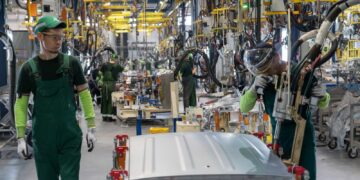
Toyota’s shutdown was triggered by a problem outside the final assembly process: components were no longer reaching factories reliably because of the flooding. Toyota Motor Thailand suspended operations at its three production plants, while another manufacturing facility operated by Toyota Auto Works was also affected. The company said it was coordinating with suppliers in an effort to restore deliveries and restart production as quickly as conditions allowed. Reports did not identify major physical damage to Toyota’s assembly plants as the reason for the stoppage. Instead, the immediate constraint was the disrupted movement of parts through a region coping with flooded roads, transportation difficulties and workers struggling to reach their jobs. That distinction matters. A modern vehicle factory can have equipment, workers and unfinished vehicles ready for production, but a shortage of required components can still prevent an assembly line from continuing normally.
The three Toyota Motor Thailand factories are Samrong, Gateway and Ban Pho. Toyota’s latest corporate information lists annual production capacity at 240,000 vehicles for Samrong, 300,000 for Gateway and 230,000 for Ban Pho, giving the three facilities combined nameplate capacity of about 770,000 vehicles per year. Samrong and Ban Pho primarily handle commercial vehicles, while Gateway is focused on passenger vehicles. Toyota Auto Works forms another piece of the company’s Thai manufacturing network. Toyota’s global production information shows that the wider operation in Thailand builds vehicles ranging from the Camry and Corolla family to the Hilux, Fortuner, Yaris models and electrified vehicles. Not every model or line will necessarily be affected to the same degree, and nameplate capacity is not the same as actual daily output, but temporarily stopping all three main Toyota Motor Thailand plants gives the disruption considerably more significance than an isolated production-line pause.
Thailand’s Toyota Network Is Too Large to Treat as a Minor Disruption
Thailand has spent decades developing into one of Southeast Asia’s most important vehicle-production centres, and Toyota is deeply embedded in that manufacturing ecosystem. The scale is visible not only in Toyota’s factory footprint but also in the country’s broader production statistics. The Federation of Thai Industries reported that Thailand built 124,646 vehicles in August 2026, up 10.93% from a year earlier. Production during the first eight months of the year reached 959,711 vehicles. Particularly important for understanding a disruption such as Toyota’s is the export component: 83,612 vehicles produced in August were intended for overseas markets, equal to 67.08% of the country’s total output that month. That means manufacturing interruptions in Thailand can become relevant well beyond Thai showrooms if they persist long enough to affect shipping schedules or inventories.
Pickups are especially important to that industrial network. Thailand produced 73,273 one-ton pickup trucks in August alone, accounting for nearly 59% of all vehicle production during the month, according to the Federation of Thai Industries. Toyota’s Thai manufacturing operations include several versions of the Hilux alongside the Fortuner, giving the company a substantial presence in precisely the vehicle category around which Thailand has built much of its automotive expertise. At the same time, the country’s industry is changing rapidly as hybrid and battery-electric production grows. Thailand produced 13,126 battery-electric passenger vehicles in August, a 77.38% year-over-year increase, while hybrid passenger-vehicle production rose 51.54%. Toyota’s current Thai lineup similarly spans conventional, hybrid and battery-electric models. The flood interruption therefore arrives as factories and suppliers are already managing an increasingly diverse mix of powertrains, components and export requirements.
Flooding Has Strained Transport and Communities Across the Region
The factory shutdowns are one part of a much larger emergency. Bangkok was declared a disaster-affected area after roughly 320 millimetres, or 12.6 inches, of rain fell over three days late in September. Reuters reported that the amount was approximately what the capital normally receives during the entire month of September. By September 30, authorities said flooding had affected 44 of Thailand’s 77 provinces, while the government spokesperson cited Health Ministry figures putting the death toll at 40. Earlier government disaster-management figures from September 28 showed how quickly the emergency had expanded: Bangkok and 27 provinces had already recorded 576,449 affected households and almost 1.8 million affected residents. Samut Prakan, where Toyota has significant operations, was among the provinces reporting particularly large numbers of affected households.
Transportation problems illustrate why manufacturers can remain vulnerable even when their own factory buildings are intact. Thai Airways temporarily stopped accepting inbound and outbound cargo through October 6 after flooding prevented many employees from reaching work. At Bangkok’s Suvarnabhumi Airport, about half of the airline’s workforce was unable to report at one stage, contributing to cancelled flights and thousands of delayed bags even though the airport itself remained open. Railway services on Thailand’s Eastern Line were also being restored gradually as conditions improved, with some trains operating shortened routes while track conditions farther east continued to be assessed. For an automaker, the relevance is straightforward: factories depend on a network of suppliers, warehouses, trucking routes and employees extending far beyond their gates. The Toyota stoppages show how flooding can interrupt that network at multiple points without necessarily damaging the final assembly machinery itself.
The Restart Clock Depends on Suppliers, Safety and the Weather
Toyota has not tied the affected factories to a fixed public restart date in the initial reporting. Instead, the company said it was working with suppliers to restore parts deliveries and intended to resume production as soon as possible. Additional reporting on Toyota Motor Thailand’s position indicated that operations would restart when necessary parts were secured and conditions were considered safe. That leaves the timetable dependent on more than receding water outside a factory. Supplier facilities must be able to operate, workers need access to workplaces, components must move through the transport network, and disrupted inventories have to reach the correct production lines. Thai authorities were working to drain floodwater in Bangkok and hoped to restore more normal conditions within several days, but the weather remained an important uncertainty. Thailand’s weather agency was forecasting another period of heavy rainfall from October 5 through October 8.
Toyota has faced a remarkably similar supply-chain problem in Thailand before. During the catastrophic 2011 floods, Toyota said its Samrong, Gateway and Ban Pho plants initially escaped direct physical damage, yet supplier delays still forced all three factories to stop production. The halt was repeatedly extended as the company assessed parts availability, and shortages eventually contributed to production adjustments at Toyota facilities outside Thailand. The 2026 situation should not automatically be assumed to follow the same path; no comparable global production disruption had been announced in the initial reports on the current shutdown. Still, the earlier episode explains why Toyota is closely coordinating with suppliers rather than focusing only on conditions at its own plants. For customers, dealers, factory employees and parts makers, the next meaningful development will be evidence that component flows are stable enough for production to restart—not simply that floodwater has begun to recede.