























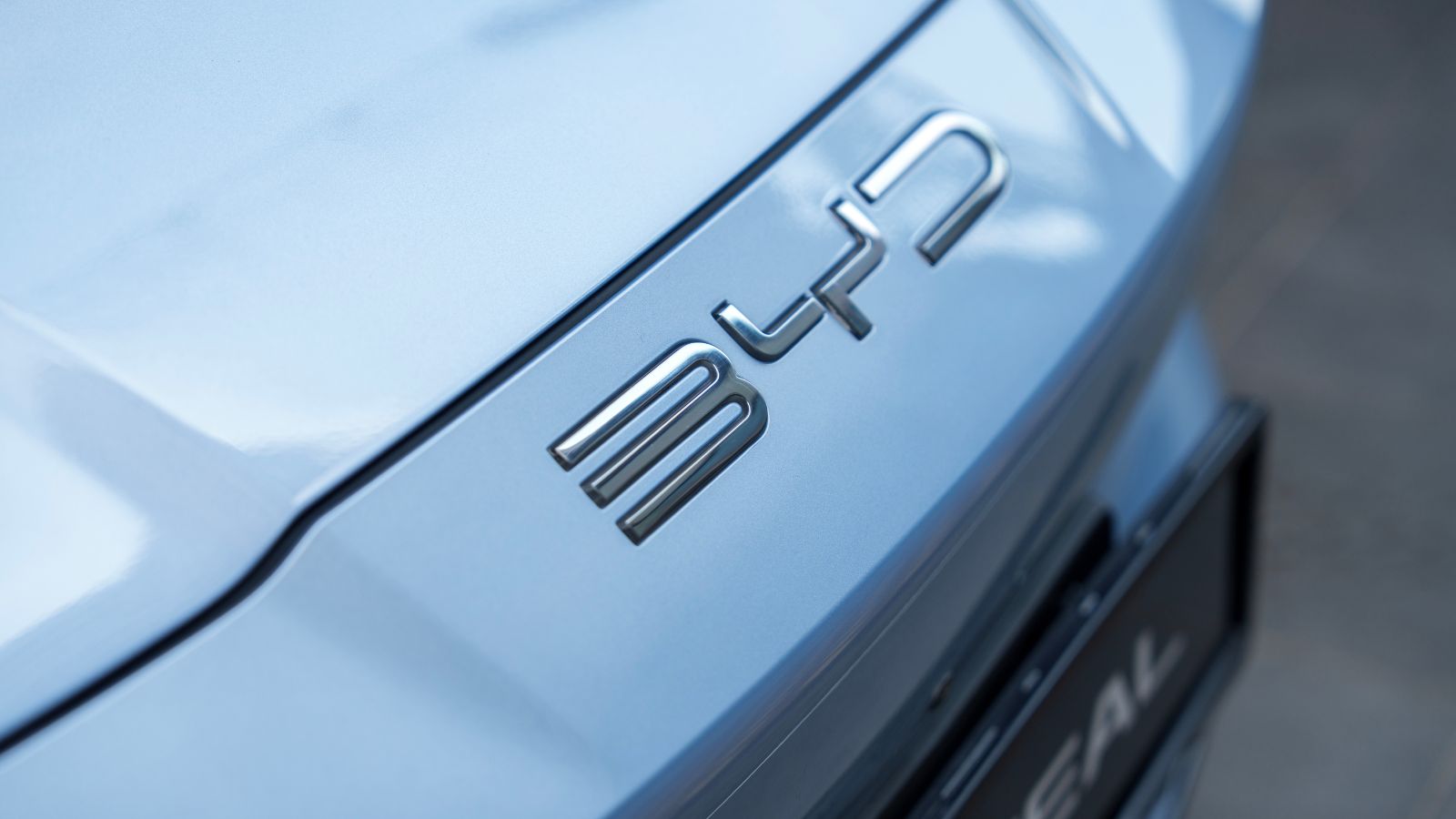
BYD is preparing a very different kind of Seagull for its second generation. New design sketches released on September 22 show a sharper, more substantial electric hatchback, while Chinese regulatory filings reveal that the car has grown dramatically in length and wheelbase and will move to a five-seat layout. The redesign arrives as competition in China’s low-cost EV market remains relentless and rivals such as Geely have raised expectations for space, range and technology at entry-level prices.
For Canada, the timing is especially interesting. Ottawa has reopened limited access to Chinese-built EVs under a tariff-rate quota, and BYD now operates a Canadian website. But BYD has not announced the second-generation Seagull for Canada, so any local launch, name, pricing or timing remains unconfirmed.
BYD Has Finally Put a Name to the Bigger Seagull
The car had spent much of the summer circulating under the informal “Great Seagull” or “Big Seagull” label after its specifications appeared in China’s regulatory process. That changed when Zhang Zhuo, general manager of sales for BYD’s Ocean network, released official design sketches and referred to it as the second-generation Seagull. The drawings show a cleaner, more mature hatchback with trident-like headlamps, a rising beltline, a floating-roof effect and noticeably fuller body sides than the current city car.
The naming matters because it suggests BYD sees the model as a true generational replacement rather than simply an extra derivative. Zhang had previously said the larger Seagull would launch in China during 2026, although the latest teaser still does not provide a firm on-sale date or official price. For shoppers, that leaves an unusual mix of certainty and suspense: the basic dimensions and powertrain have already surfaced through filings, while the final showroom positioning is still being held back.
The Size Increase Changes What the Seagull Is
The second-generation Seagull measures 4,205 mm long, 1,810 mm wide and 1,570 mm tall, with a 2,650 mm wheelbase. Compared with the current Chinese-market Seagull, that adds 425 mm of overall length and 150 mm between the axles. The new car also moves to a five-seat layout. Those figures are large enough to change the model’s role: this is no longer simply a tiny urban EV stretched around a small battery pack, but a hatchback approaching the footprint of BYD’s larger Dolphin.
The comparison with Geely’s Xingyuan is even more revealing. Geely lists the Xingyuan at 4,135 mm long, 1,805 mm wide and 1,570 mm tall, also with a 2,650 mm wheelbase and five seats. In other words, BYD’s new Seagull lands almost directly on the dimensions of the car that became one of China’s biggest sales stories. For families using one small EV for school runs, commuting and weekend errands, that extra cabin length can matter more than another styling flourish.
Power and Driver Assistance Are Moving Up Too
Regulatory information points to a 95 kW permanent-magnet motor, equivalent to about 127 horsepower, a major increase from the 55 kW motor used in the current Chinese Seagull. Reports based on the filing data indicate FinDreams lithium-iron-phosphate battery options of roughly 30 kWh and 39.2 kWh, with claimed CLTC driving ranges in the 320 km to 420 km band. A top speed of 150 km/h has also been reported. Those numbers are preliminary consumer context rather than a final global specification sheet, but they show how much more capable the replacement is intended to be.
Technology is moving upward with the car’s physical size. One filed configuration shows LiDAR availability along with additional radar and sensor hardware for more advanced driver assistance. That is less surprising than it would have been a year ago: BYD already introduced an optional LiDAR-equipped “God’s Eye B” package on the 2026 Seagull in China. The small-EV segment is becoming a showcase for features that were recently reserved for much more expensive vehicles.
The Geely Xingyuan Is the Rival Hiding in Plain Sight
BYD is not redesigning the Seagull in a vacuum. Geely’s Xingyuan became China’s top-selling passenger-vehicle model in 2025 by retail volume, with China Passenger Car Association data putting the total at 465,775 units. Geely separately said the model had surpassed 530,000 cumulative sales by the end of that year. Its formula is straightforward: a compact footprint, five usable seats, LFP batteries, 310 km or 410 km CLTC range in core versions, and a 2,650 mm wheelbase that makes the cabin feel larger than the exterior suggests.
The second-generation Seagull now mirrors that wheelbase exactly and is slightly longer overall. That does not prove BYD designed the car solely around the Xingyuan, but the market logic is difficult to ignore. Chinese buyers have shown that an inexpensive EV can no longer rely on price alone; space, software, charging, assistance systems and perceived quality all matter. BYD’s answer appears to be a Seagull that has grown into the same practical zone rather than defending the smallest possible footprint.
Price Is Still the Most Important Missing Number
The current 2026 Seagull is priced in China from 69,900 yuan to 85,900 yuan before adding the optional LiDAR package on eligible trims. That positioning has helped make the name synonymous with affordable electric motoring, but it also sits at the centre of one of the industry’s harshest pricing battles. During a major promotional push in 2025, BYD temporarily cut the entry price of its cheapest Seagull to 55,800 yuan, a move that drew attention across the industry and intensified concern about how long weaker automakers could survive repeated discounting.
The new car creates a difficult pricing puzzle. Its larger body, stronger motor, five-seat packaging and more sophisticated sensor suite all add value, yet pushing it too far upward would bring it closer to BYD’s own Dolphin and to a crowded field of Chinese compact EVs. BYD has not disclosed the second-generation model’s official price. That omission is arguably more important than any unrevealed trim detail because the Seagull’s identity has always depended on delivering an unusually high amount of EV for the money.
The Original Seagull Became More Than a China-Only City Car
The Seagull has already proved that BYD can turn a low-cost domestic EV into an international product family. Cumulative Seagull sales passed 1.5 million units from its April 2023 launch through August 2026, according to sales data compiled from company reports. Outside China, related versions have appeared under different names and specifications, including the Dolphin Surf in Europe. BYD’s European Dolphin Surf is 3,990 mm long, uses 30 kWh or 43.2 kWh Blade Battery packs and offers up to 322 km of WLTP combined range, depending on trim.
That history is important when considering the second generation. A future export version does not have to match the Chinese car line-for-line, and it may not even keep the Seagull badge. BYD already adjusts dimensions, power outputs, batteries and equipment for different regions. For a Canadian audience, that means a Chinese filing can reveal the engineering direction without revealing the eventual Canadian product. A locally certified version, if one comes, could arrive with different battery capacity, charging hardware, winter equipment or even a different name.
BYD’s Overseas Boom Masks Real Pressure at Home
BYD’s overall sales have recovered strongly in recent months, but the split between China and overseas markets tells the more useful story. The company sold 440,293 new-energy vehicles in August 2026, up 17.8% from a year earlier. Overseas shipments reached 189,466 vehicles, more than doubling year over year, while domestic sales fell 14.3% to 250,827. Exports are no longer a side business; they are increasingly carrying growth while China’s home market becomes harder to defend.
The financial results underline that tension. BYD reported first-half 2026 revenue of about 344.8 billion yuan, down 7.1% year over year, while net profit fell 20.5% to roughly 12.3 billion yuan. The second quarter improved, but fierce domestic competition continued to weigh on the company even as overseas growth strengthened margins. Against that backdrop, a larger and more feature-rich Seagull is not merely another model update. It is part of BYD’s effort to protect volume in the most contested part of its home market.
China Is Trying to Cool the Price War Without Ending Competition
Chinese regulators have spent 2026 trying to make the car market less destructive. In February, the State Administration for Market Regulation issued guidelines aimed at curbing unfair pricing behaviour, misleading promotions and other practices associated with the long-running price war. The broader “anti-involution” campaign reflects concern that endless discounting can damage suppliers, dealers and manufacturers even while consumers enjoy lower sticker prices. Industry officials have increasingly talked about shifting from a pure price war toward a “value war.”
That shift does not mean competitive pressure has disappeared. Promotional campaigns remain common, and China’s passenger-car market has been weak enough that automakers still have strong incentives to chase volume. On September 22, Volkswagen’s China chief said he expected the country’s passenger-car market to shrink sharply in 2026, highlighting the strain on established brands and margins. In that environment, BYD’s second-generation Seagull looks like a textbook value-war product: more space, more power and more technology, with the final price still being the decisive weapon.
Canada Is More Plausible Than Before, but the Seagull Is Not Confirmed
Canada’s policy landscape changed substantially in 2026. Ottawa created an initial annual quota for 49,000 EVs originating in China that can enter at the 6.1% most-favoured-nation tariff rate, replacing the previous 100% surtax for eligible imports under the quota. The quota took effect March 1, and the government says the volume will rise over time while an increasing share is reserved for lower-priced vehicles. That creates a legal pathway for affordable Chinese EVs that did not exist under the earlier tariff structure.
BYD has also established a Canadian consumer website operated by BYD Canada Company Limited. Its terms say vehicles will be sold through approved dealers, but the site does not currently allow purchases, leases, reservations, pre-orders or deposits. Crucially, the site also warns that international-market vehicles shown online may never be offered in Canada. No Canadian page currently confirms the second-generation Seagull as a local model. The policy door is open; the product announcement has not happened.
What Still Has to Be Confirmed Before Launch
Several important details remain unresolved despite the unusually revealing regulatory trail. BYD has not published a final Chinese price list, exact retail launch date, full trim walk, charging-speed figures or a complete consumer specification sheet for the second-generation Seagull. Battery capacities and CLTC ranges reported from filing-related data provide a strong indication of what is coming, but they should not be treated as guaranteed export specifications. The exact scope of LiDAR availability and advanced driver-assistance functions may also vary by trim.
For Canada, the list of unknowns is longer. There is no confirmed local model name, price, range rating, dealer launch schedule, certification date or allocation under the Chinese-EV quota. Canadian rules require vehicles to meet national safety standards, and Ottawa has said it will work with Chinese manufacturers on certification. Until BYD publishes Canadian product information, the defensible conclusion is narrow but significant: the second-generation Seagull is real, much larger, more powerful and more sophisticated than the current Chinese car, while a Canadian launch remains entirely unconfirmed.