























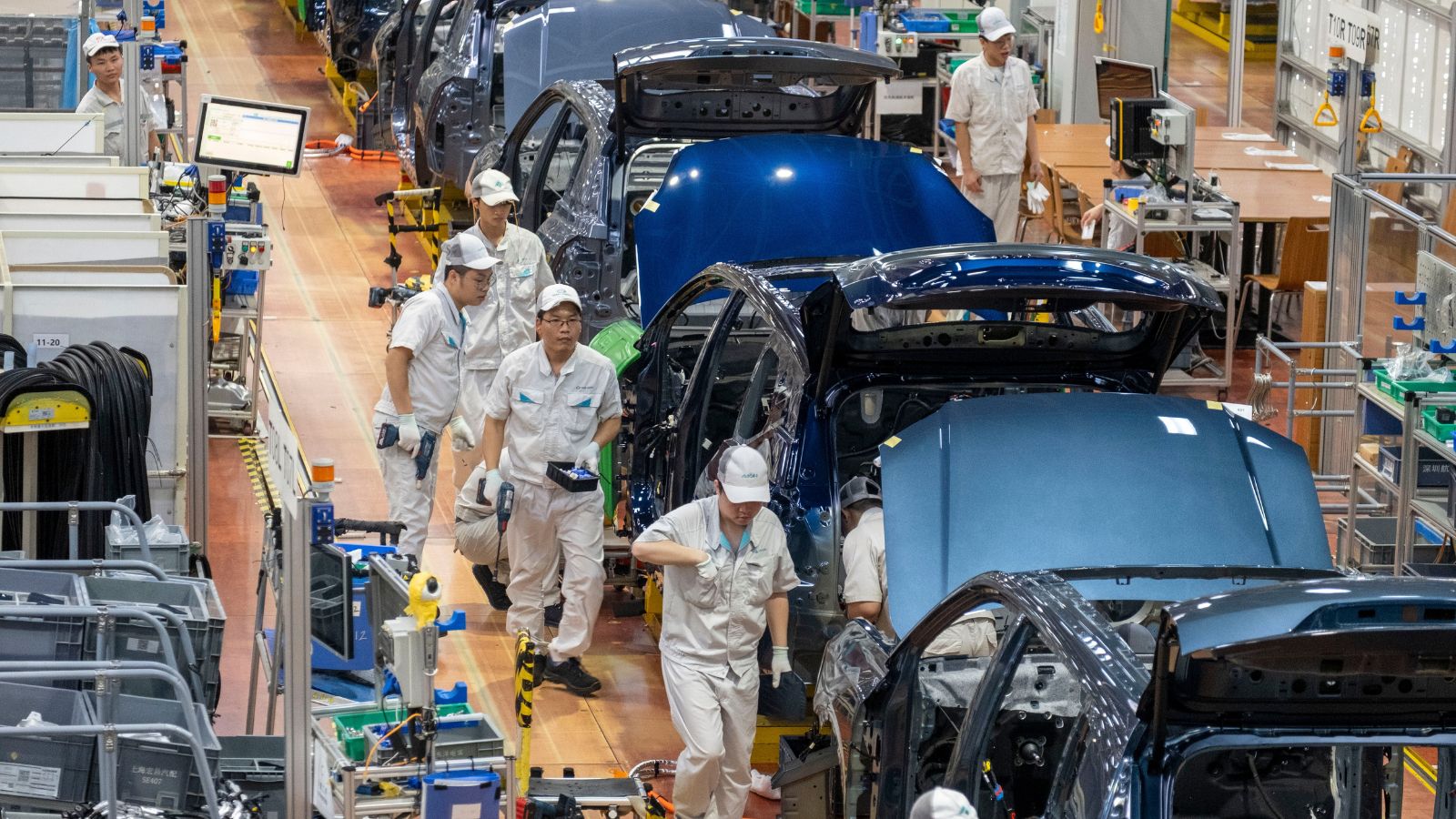
For several years, new battery plants and electric-vehicle factories were pitched as the foundation of a North American manufacturing revival. Communities prepared industrial sites, trained workers and planned housing around projects expected to employ thousands. That map is now changing much faster than many local economies anticipated.
U.S. electric-vehicle and battery projects cancelled between January 2025 and August 24, 2026 had collectively promised about 27,000 jobs, according to a Reuters analysis of Atlas Public Policy data. That estimate does not include every delayed or scaled-back project, meaning the broader employment exposure is larger. Yet the shift is more complicated than a wholesale industrial retreat. Automakers are converting battery plants to energy storage, replacing planned EVs with hybrids or gasoline vehicles, and reconsidering where future North American production should be located.
The 27,000 Jobs Were Mostly Jobs That Were Supposed to Arrive
The most important distinction in the 27,000 figure is that it largely represents promised employment attached to projects that were subsequently cancelled, rather than 27,000 people simultaneously receiving layoff notices. Reuters found that projects cancelled from the beginning of 2025 through August 24, 2026 had carried job commitments totalling roughly that amount. The publication also cautioned that the figure is probably an undercount because some investment announcements did not specify employment estimates, while scaled-back projects were excluded when their EV portions could not be separated cleanly.
Other investment tracking points in the same direction. The Clean Investment Monitor, produced by Rhodium Group and MIT’s Center for Energy and Environmental Policy Research, found that $23 billion of manufacturing investment was cancelled in 2025 alone. About 97% of that cancelled investment was associated with the EV supply chain. Battery manufacturing accounted for roughly $11 billion, while vehicle assembly represented another $9 billion. In two quarters during 2025, cancelled manufacturing investment actually exceeded newly announced investment, illustrating how quickly the pipeline had changed.
Lordstown Shows How Quickly an EV Revival Can Change Direction
Lordstown, Ohio, offers one of the clearest examples of how the EV investment cycle can affect an individual community. General Motors and LG Energy Solution built a $2.3-billion battery-cell plant near the former GM assembly complex, bringing large-scale automotive manufacturing back to an area that had spent years dealing with plant closures and job losses. The facility opened in 2022 and grew into an important employer in a region that had even begun promoting itself as “Voltage Valley,” a reference to hopes that battery production could replace some of the industrial activity lost over previous decades.
Those expectations were tested when Ultium Cells stopped battery-cell production in January 2026 as GM adjusted output to weaker EV demand. Hundreds of workers were temporarily laid off and hundreds more faced indefinite job losses. The story did not end with a permanently dark factory, however. Production restarted in August after a roughly seven-month pause, with about 1,400 employees expected to be working at the plant. The restart provides relief, but Lordstown also demonstrates how uncertain employment can become when large factories are built around sales forecasts that later change.
Ford’s Battery Belt Plans Are Being Rebuilt Around Different Products
Ford’s original BlueOval investment was one of the largest manufacturing commitments of the EV boom. In 2021, Ford and SK Innovation announced an $11.4-billion plan covering a giant Tennessee manufacturing campus and battery factories in Kentucky. The companies initially projected nearly 11,000 jobs, including approximately 5,000 at the Kentucky battery complex. Local officials prepared for far more than factory employment alone. Roads, housing and other infrastructure were planned around expectations that thousands of workers and their families would move into the surrounding communities.
The industrial assets are not simply being abandoned, but their purpose and employment footprint are changing. Ford ended its BlueOval SK joint venture structure and is converting its Kentucky operations toward battery energy-storage systems for data centres, utilities and industrial customers. Ford has said the reconfigured operation should employ about 2,100 workers, substantially below the original 5,000-job projection. In Tennessee, the planned next-generation electric pickup was dropped and the complex was repositioned as the Tennessee Truck Plant, where Ford now plans gasoline-powered trucks beginning in 2029. What began as an EV corridor is increasingly becoming a multi-powertrain manufacturing network.
Stellantis Is Also Paying Billions to Rewrite Its Product Plan
Stellantis provides another example of how expensive an automotive strategy change can become. The company and Samsung SDI originally planned two battery factories in Kokomo, Indiana, representing more than $6.3 billion of investment and about 2,800 expected jobs. Reuters reported that part of the complex has since stalled as Stellantis adjusts its North American battery requirements. The automaker also cancelled its planned battery-electric Ram 1500 pickup, one of several decisions that reflected weaker projected EV volumes and a substantially different U.S. regulatory environment.
The financial consequences have been enormous. Stellantis reported €25.4 billion in unusual charges for 2025 as part of a broad strategic reset. Its filings show roughly €9.1 billion in charges tied specifically to product-plan realignments and programme cancellations, along with about €2.1 billion connected with efforts to resize battery manufacturing capacity. Yet this is not simply a story of Stellantis withdrawing from American manufacturing. The company separately announced a $13-billion U.S. investment programme involving more than 5,000 jobs and a mix of internal-combustion, hybrid and range-extended products. Capital is still moving into factories; the technologies receiving that capital have changed.
Policy Changes Hit an EV Market That Was Already Losing Momentum
Federal policy has played a significant role in the timing of the reset. A 2025 reconciliation law terminated the U.S. clean-vehicle tax credit for vehicles acquired after September 30, 2025, eliminating a benefit worth as much as $7,500 for qualifying new vehicles. The effect on near-term buying patterns was dramatic. Consumers rushed to purchase EVs before the deadline, followed by a sharp fourth-quarter correction. Cox Automotive estimated only about 234,000 EVs were sold during the fourth quarter of 2025, down 46% from the previous quarter and 36% from a year earlier.
Regulatory incentives changed as well. In February 2026, the Environmental Protection Agency rescinded the greenhouse-gas endangerment finding that had underpinned federal vehicle greenhouse-gas rules and repealed associated standards. Automakers therefore face substantially less regulatory pressure to increase EV sales. Still, government policy is only part of the explanation. EV demand had already been growing more slowly than automakers once projected, while high prices, charging concerns and weak profitability on some models were forcing companies to reconsider spending. The White House has argued that earlier subsidies created artificial EV demand, while several automakers have described their revisions as responses to both regulation and customer behaviour.
Canada and Mexico Are Being Pulled Into the Same Investment Reassessment
The shift does not stop at the U.S. border. Honda originally planned a C$15-billion EV supply chain in Ontario, including new battery capacity and electric-vehicle production around its existing Alliston manufacturing operation. The project was expected to add approximately 1,000 jobs while supporting thousands already employed at Honda’s established Canadian operations. Honda postponed the programme in 2025 as EV demand softened, then went further in May 2026 by indefinitely suspending the Canadian EV value-chain plan as part of a broader reassessment of its global electrification strategy.
Mexico faces a different form of uncertainty. The country remains deeply integrated with U.S. vehicle production, but current negotiations over the U.S.-Mexico-Canada Agreement could change where automakers source components and assemble vehicles. U.S. negotiators have proposed that vehicles contain 50% U.S.-made content to receive preferential treatment, according to Reuters, while Mexico has resisted country-specific content requirements. Automakers have said uncertainty over USMCA and tariffs complicates decisions involving billions of dollars and production cycles that can stretch for a decade. North America’s manufacturing map is therefore being redrawn by trade rules as well as EV demand.
The Global EV Market Is Moving Differently From the United States
The U.S. pullback is especially notable because electric-vehicle demand continues to expand globally. The International Energy Agency reported that more than 20 million electric cars were sold worldwide in 2025, an increase of about 20% from the previous year. EVs represented roughly one-quarter of global new-car sales. China remained the largest market, where close to 55% of new vehicles sold were electric, while European EV sales rose by more than 30% to approximately 4.2 million vehicles.
Manufacturing concentration is even more significant. The IEA estimates China produced nearly three-quarters of the world’s electric cars in 2025 and more than 80% of global battery cells. Chinese manufacturers supplied more than half of global battery-electric vehicle models and sales, while North American automakers accounted for only about 15% of worldwide electric-car sales. That does not mean every U.S. EV investment would have succeeded commercially. It does mean North American manufacturers are changing strategy while much of the international industry continues to build scale, creating a long-term competitive calculation alongside the immediate pressure to make current factories profitable.
Battery Plants May Find a Second Life Outside Electric Cars
One of the most important developments is the rapid effort to find other uses for factories originally designed around EV growth. Large battery plants can potentially serve markets far beyond passenger vehicles, particularly stationary energy storage. Ford plans to use Kentucky capacity for lithium-iron-phosphate battery energy-storage systems, targeting at least 20 gigawatt-hours of annual output by late 2027. GM and LG Energy Solution have similarly retooled their Tennessee operation toward energy-storage batteries, bringing workers back as demand grows for grid and data-centre applications.
At the same time, conventional auto investment has not stopped. Toyota has announced plans for $10 billion of additional U.S. investment over five years, while Hyundai has outlined $26 billion through 2028. Automakers nevertheless continue to warn that tariff and USMCA uncertainty makes long-term factory decisions difficult. The emerging picture is therefore not the disappearance of North American automotive investment. Instead, capital is being redistributed among gasoline vehicles, hybrids, lower-cost EVs, energy-storage batteries and different geographic locations. The factories, jobs and technologies eventually built across the continent may look considerably different from those promised during the EV investment boom only a few years ago.