

























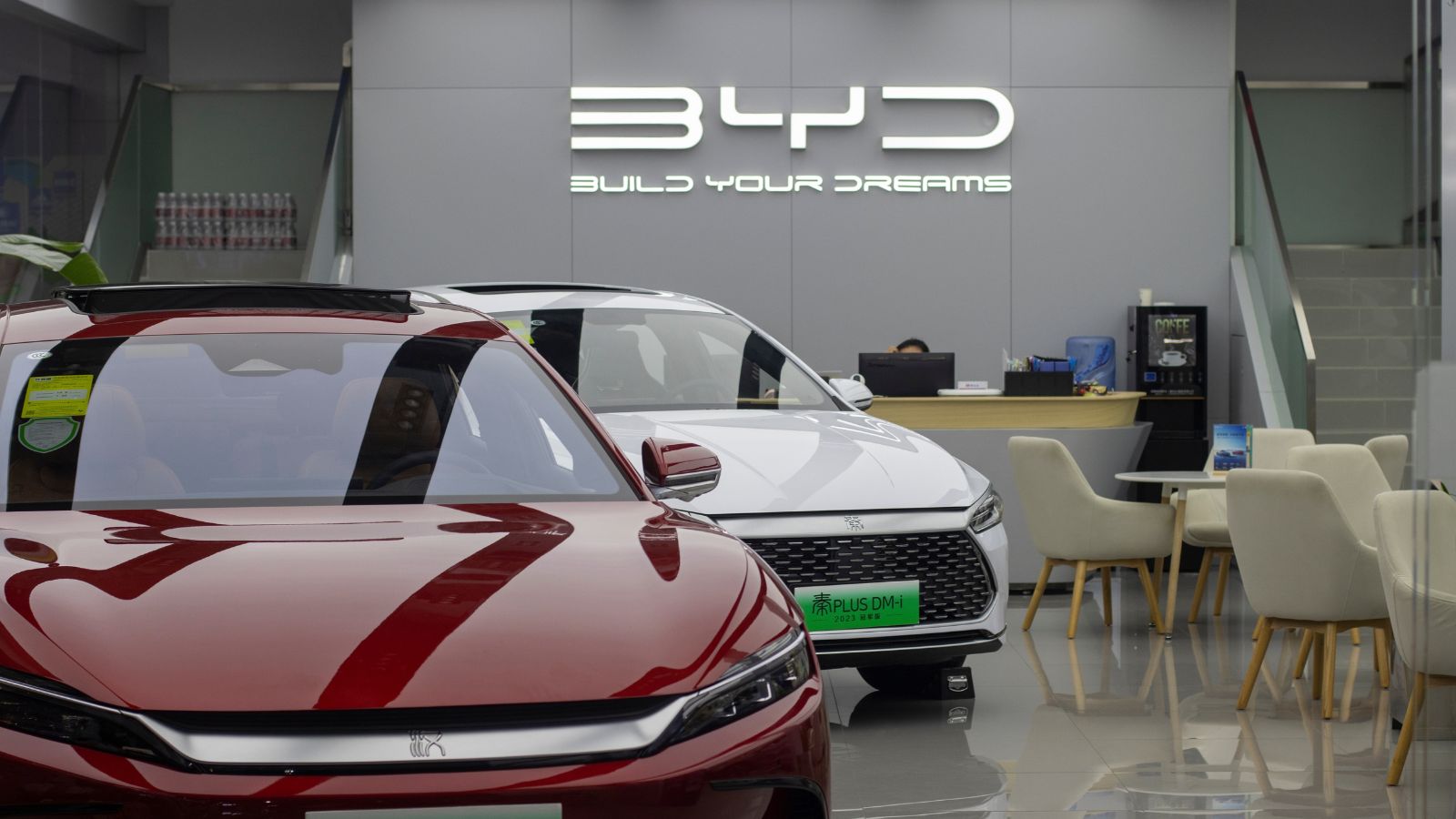
BYD has finally broken a losing streak that had begun to challenge the idea that relentless sales growth automatically translates into stronger earnings. The Chinese automaker’s second-quarter net profit rose about 30% from a year earlier to roughly 8.2 billion yuan, marking its first quarterly profit increase in more than a year and ending four consecutive quarters of declines. The rebound came even as quarterly revenue slipped, highlighting a significant change beneath the headline numbers: overseas business is becoming much more important to BYD’s profitability. Exports surged during the first half of 2026, while operations outside China generated more than half of group revenue. The turnaround offers BYD some breathing room after a punishing first quarter, but weak domestic demand and fierce competition mean the company has not escaped its biggest challenges.
Profit Growth Returns After Four Difficult Quarters
The second quarter delivered the earnings reversal BYD had been waiting for. Net profit reached approximately 8.2 billion yuan, up about 30% from the same quarter of 2025. That ended four consecutive quarters in which year-over-year profit had declined. The contrast with the opening months of 2026 was particularly striking: BYD’s first-quarter profit had plunged 55.4% to roughly 4.1 billion yuan, following a 38.2% decline in the fourth quarter of 2025. In only three months, the company moved from its steepest quarterly profit decline in years to renewed growth.
The rebound was not quite as strong as investors and analysts had anticipated. Reuters reported that estimates from Morgan Stanley, UBS, Citi, Deutsche Bank and CMBI implied average profit growth of about 48%, considerably above the 30% BYD ultimately delivered. Revenue also remained under pressure, declining 3.2% year over year in the second quarter to about 194.6 billion yuan. That means this was not a traditional recovery in which both sales and earnings accelerated together. Instead, BYD generated more profit from a revenue base that was still shrinking, making the composition of its business increasingly important.
Exports Have Become the Biggest Source of Relief
BYD’s international expansion is no longer a side project designed merely to supplement Chinese sales. Company figures show that exports reached 792,000 vehicles during the first half of 2026, an increase of 67.8% from a year earlier. With BYD reporting about 1.81 million new-energy vehicle sales over the period, exports represented roughly 44% of volume. That is an extraordinary shift for a company whose rapid ascent was originally built almost entirely around China’s enormous electric-vehicle market.
The geographic footprint is also becoming much broader. BYD said its new-energy vehicle operations now span 121 countries and regions across six continents, with strong business across Europe, Latin America, Asia-Pacific, the Middle East and Africa. Its first-half report cited leading positions in markets including the United Kingdom, Italy, Spain, Brazil, Thailand and Indonesia. Those overseas customers are increasingly important because vehicles sold internationally can carry a different mix of models, pricing and profitability than cars battling through China’s intense discounting environment. That shift helped turn rapidly rising exports into something more valuable than additional unit sales: they became an earnings buffer.
China Remains the Hard Part of BYD’s Story
The international momentum masks a much more difficult domestic environment. BYD acknowledged that competition continued to intensify in China and that domestic demand was under particular pressure during the first quarter. Reuters reported that overall vehicle demand remained weak amid reduced trade-in subsidies, continuing economic uncertainty and aggressive price competition among Chinese automakers. Rivals including Geely, Leapmotor and an expanding group of technology-focused brands have made the Chinese new-energy vehicle market one of the toughest automotive battlegrounds in the world.
That pressure helps explain why the export surge matters so much. BYD cannot simply assume that the enormous Chinese market will keep delivering the volume and margins it enjoyed during its rapid expansion phase. There were, however, some signs of improvement inside its portfolio. BYD said combined sales of its Fangchengbao, Denza and Yangwang brands increased 61% during the first half, raising those brands to 12.8% of passenger-vehicle sales. The higher-end push gives BYD another way to defend profitability, particularly if premium vehicles can reduce dependence on the fierce pricing battles surrounding lower-cost models.
The Margin Numbers Show Why Overseas Sales Matter
The clearest evidence of the international strategy’s financial importance can be seen in margins. BYD’s overall gross profit margin increased to 18.85% in the first half of 2026 from 18.01% a year earlier, despite first-half revenue falling 7.13% to 344.8 billion yuan and attributable profit declining 20.54% to 12.3 billion yuan. Overseas revenue reached approximately 181.3 billion yuan, meaning operations outside mainland China accounted for about 53% of total group revenue during the period.
Reuters reported that the gross profit margin for BYD’s overseas business climbed by 1.9 percentage points to roughly 22%, while overseas operating revenue increased 34% and costs rose at a slightly slower 31% pace. Those percentages help explain how second-quarter earnings could improve even though consolidated revenue continued falling. International growth is changing BYD’s sales mix in a financially favourable direction. The result also illustrates why simple vehicle-delivery rankings do not tell the whole story: where a car is sold and the margin earned on it can matter as much as how many vehicles leave factories.
BYD Is Building the Infrastructure for a Global Carmaker
Exporting hundreds of thousands of additional cars requires considerably more than signing new dealership agreements. BYD has been constructing a physical network intended to support a permanently international business. The company said factories in Brazil and Thailand are already operating, while additional overseas manufacturing projects continue to advance. It has also put eight of its own roll-on/roll-off vessels into operation, giving the company dedicated capacity to move vehicles between production centres and international markets rather than relying entirely on outside shipping companies.
That localization strategy became especially visible in Brazil, where BYD said its plant produced its 100,000th new-energy vehicle in July and its workforce exceeded 5,500 employees. Europe is also becoming a showcase for more expensive vehicles. BYD introduced the Denza Z9GT and D9 in Europe during an event at Paris’s Palais Garnier, with the Z9GT carrying a starting price of about €115,000. Such products are far removed from the inexpensive electric cars that first established BYD’s reputation and show how international expansion is being paired with an attempt to move the brand higher up the value chain.
One Strong Quarter Does Not End the Pressure
The second-quarter turnaround demonstrates that BYD has found a credible counterweight to its domestic slowdown, but international expansion creates challenges of its own. Analysts cited by Reuters warned that tariffs in overseas markets, along with rising marketing and research costs, could limit the profit benefit. Establishing factories, dealer networks, logistics fleets and unfamiliar brands across dozens of countries requires substantial investment. At the same time, competitors from China are pursuing many of the same overseas markets, meaning BYD cannot assume today’s export growth rates will translate automatically into lasting pricing power.
Technology spending remains another major commitment. BYD reported approximately 28.9 billion yuan in research and development investment during the first half of 2026, taking cumulative R&D investment above 270 billion yuan. Its current product push includes its second-generation Blade Battery and new fast-charging technology, while it continues expanding premium brands and localized models. The latest earnings therefore represent an important inflection point rather than an uncomplicated victory. Exports have stopped the profit slide; the harder test will be whether BYD can turn that international surge into sustainable earnings growth while rebuilding momentum at home.