

























Kia’s newest electric SUV arrives with an unusual advantage: in North America, the EV5 belongs to Canada alone. Its boxy EV9-inspired shape, family-friendly cabin and aggressive pricing give it the ingredients to become one of the more important mainstream EV launches of 2026. The headline number is especially compelling—C$46,209 for the least-expensive version when Kia’s published all-in pricing is used.
Yet a fresh weeklong Canadian road test has complicated that value story. The EV5 impressed with space, efficiency and straightforward technology, but the evaluation also highlighted three everyday weaknesses that specification sheets cannot reveal: unsettled road manners, front seats that may not suit every body type, and regenerative braking that lacks the polish expected from a modern one-pedal system.
A Canadian Exclusive With a Clear Mission
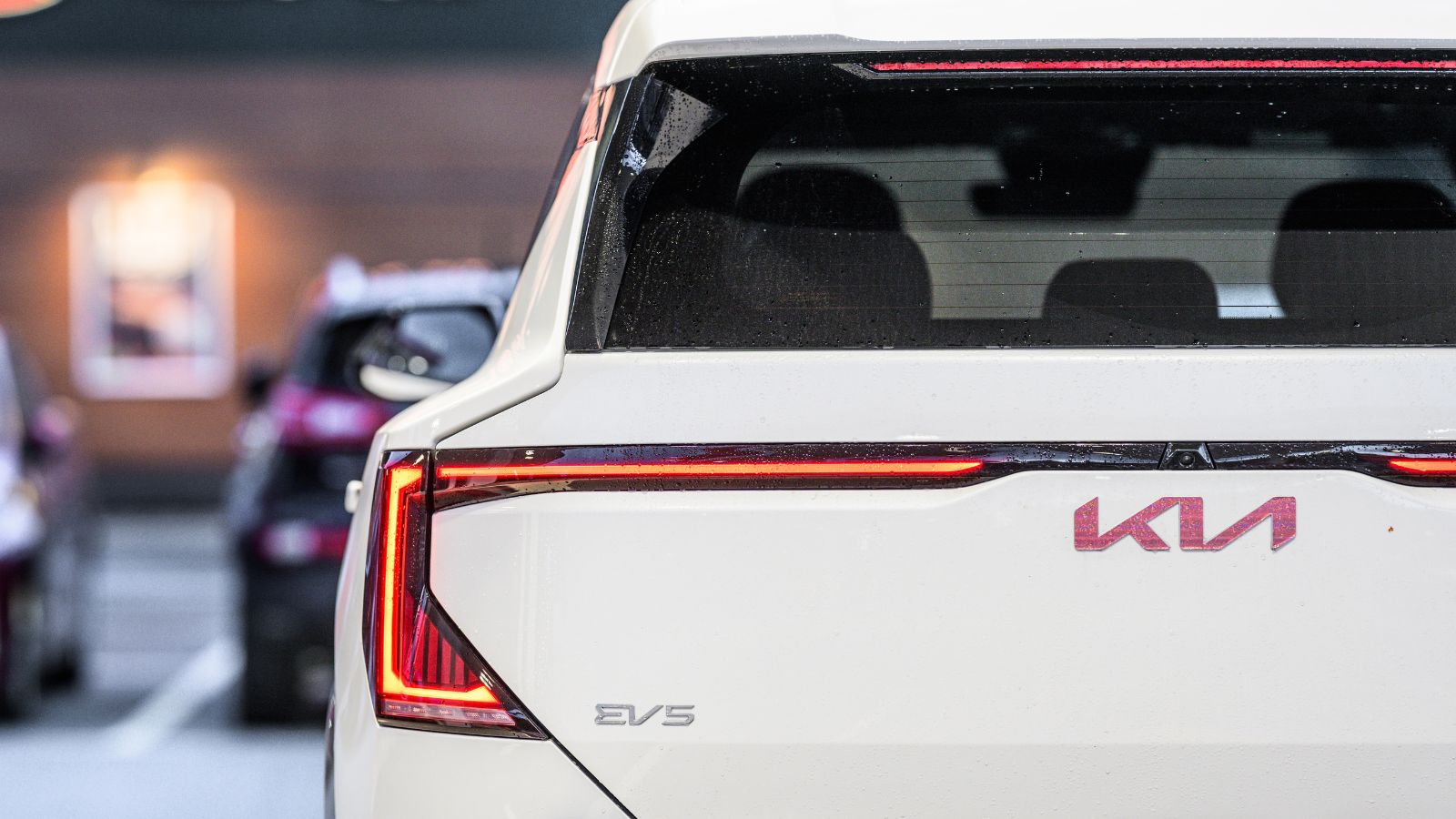
The EV5 is not a Canada-only vehicle globally, but Canada is the only North American market receiving it. Kia confirmed that strategy well before launch, positioning the compact electric SUV as a more accessible entry into the country’s extremely important utility-vehicle market. Canadian-market production takes place at Kia’s Gwangju plant in South Korea. The EV5 also adopts styling cues from the larger three-row EV9, including a squared-off profile and Kia’s distinctive lighting treatment, but packages them into dimensions closer to a conventional compact family SUV.
That positioning matters because practicality, rather than outright performance, is central to the EV5’s pitch. The Canadian model seats five, offers a flat-folding second row and incorporates a small front trunk for charging accessories. Long-range versions use an 81.4-kWh battery, while the entry Light FWD gets a smaller 60.4-kWh pack. A native NACS fast-charging port also gives the EV5 access to compatible Tesla Superchargers without requiring the adapter arrangement faced by some earlier EVs. In other words, Kia has tailored the vehicle around routine Canadian ownership rather than treating it as a niche technology showcase.
The C$46,209 Headline Needs a Pricing Footnote
Kia officially lists the 2027 EV5 Light FWD at C$43,495 MSRP, but the more realistic published all-in figure is C$46,209 before applicable sales taxes and incentives. That distinction explains why both numbers appear in coverage of the vehicle. At the other end of the range, the performance-oriented EV5 GT reaches C$63,495 MSRP and C$66,247 using Kia’s all-in pricing. Between those extremes sit Wind, Land and GT-Line variants with a mix of front- and all-wheel drive, battery capacity and equipment.
There is one important wrinkle for bargain hunters: the Light FWD is scheduled for late 2026 rather than being part of the earliest launch mix. Its low price also comes with meaningful compromises—a 60.4-kWh battery, 154 horsepower, an estimated 335 kilometres of range and no heat pump. Buyers considering federal support have another calculation to make. Canada’s Electric Vehicle Affordability Program provides up to C$5,000 on qualifying battery-electric vehicles in 2026, subject to eligibility and a C$50,000 final-transaction-value ceiling for imported vehicles. Transport Canada currently lists the EV5 Wind FWD, Wind AWD and Land FWD among eligible 2027 EV5 configurations.
A Fresh Weeklong Test Changes the Conversation
The newest Canadian road test is important because it moves beyond launch-event impressions. The Car Guide spent a week with a Land AWD, a mid-range configuration carrying an 81.4-kWh battery and a C$52,495 MSRP. The publication ultimately rated the EV5 3.5 out of five, praising passenger and cargo space, intuitive controls and warranty coverage while reserving its strongest criticism for the driving experience. That is a considerably more mixed verdict than several earlier drives, some of which described the EV5 as composed, comfortable and potentially class-leading.
Not everything deteriorated under longer scrutiny. The tested vehicle proved notably efficient. Two highway runs returned consumption between 16.6 and 17.5 kWh/100 km, while the overall city-highway result was 15.9 kWh/100 km. The tester also reported roughly 25 to 27 minutes for partial fast-charging sessions under two different conditions, with the EV5 reaching a maximum charging rate of about 150 kW. Cabin practicality remained another major strength: cargo volume is listed at 965 litres behind the rear seats and more than 2,000 litres with them folded. The concern, therefore, is not that the EV5 fails at being useful—it is that its dynamic polish does not always match its practicality.
Ride Quality Is the Biggest Dynamic Question
The most significant criticism involves the way the EV5 behaves once roads stop being perfectly smooth and straight. In the new test, the Land AWD’s relatively soft suspension absorbed potholes and surface imperfections reasonably well, yet that softness was also blamed for excessive body movement. The reviewer described a sense of instability in some situations, noticeable roll through corners and steering that required more frequent corrections than expected. The tested Land AWD also rides on 19-inch wheels, which can influence how a vehicle responds to broken pavement and road undulations.
That verdict is notable partly because it is not unanimous. DoubleClutch, after driving another Canadian EV5, praised its body control, steering response and isolation from harsh pavement. AutoTrader’s earlier first drive similarly found a convincing balance between comfort and handling. International evaluations have landed somewhere between those positions, often describing the EV5 as comfortable but not especially athletic. Such disagreement underscores why chassis impressions are difficult to reduce to a single score: trim, wheel size, road surface, speed and driver expectations all matter. Still, the weeklong Canadian evaluation raises a legitimate concern for anyone expecting the planted, low-centre-of-gravity feel commonly associated with dedicated electric platforms.
Front Seats Become an Unexpected Weak Point
Interior space is one of the EV5’s obvious advantages, but spaciousness and seat comfort are not the same thing. The latest test praised headroom and legroom in both rows while finding the front chairs much less convincing over time. The seat bottoms were described as relatively long—potentially helpful for taller drivers—while the upper seatbacks narrowed around the shoulder area. Firm cushioning, and particularly firm headrests, also drew criticism. Lateral torso support was considered acceptable, but it could not completely offset the reviewer’s dissatisfaction with the overall seating position and padding.
Again, this is an area where experiences differ sharply. DoubleClutch called the EV5’s seats very comfortable and praised the driving position, while another recent European evaluation found the front seats supportive overall but noted that headrest positioning and limited steering-wheel reach could make an ideal posture harder to achieve for taller occupants. Equipment also changes with trim. Land models move from cloth to synthetic leather and add more power adjustment, while GT-Line versions bring ventilation and additional comfort features. That variability makes a physical test sit unusually important: a cabin can offer generous dimensions on paper yet still fit two drivers very differently after an hour behind the wheel.
One-Pedal Driving Works—but Its Calibration Divides Testers
The EV5 gives drivers steering-wheel paddles to adjust regenerative braking, along with an i-Pedal-style one-pedal function. In the current version evaluated by The Car Guide, the system can bring the vehicle to a complete stop, but the reviewer found the regeneration less consistent and less smooth than desired. That distinction matters. The criticism is not that the EV5 lacks regenerative control or cannot perform one-pedal stops; it is that the transition and modulation reportedly need additional refinement to feel natural every time.
Other evaluations show how subjective that calibration can be. AutoTrader previously found the EV5’s one-pedal behaviour easy to learn and modulate, while an international test praised i-Pedal for reliably stopping the vehicle and allowing intuitive speed control. DoubleClutch described the regenerative braking on a single-motor model as relatively mild but strong enough to avoid the brake pedal during most sensible driving. Taken together, those reports suggest a shortfall of polish rather than capability. For commuters who rely heavily on one-pedal driving in stop-and-go traffic, however, small inconsistencies are magnified because the system is used hundreds of times during a routine week. The EV5’s hardware appears capable; the newest road test simply argues that its tuning still has room to mature.