



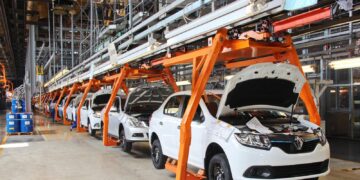




















Canada’s auto sector is warning that the tariff fight with the United States is no longer a theoretical threat measured in future factory closures or hypothetical price increases. Global Automakers of Canada says the current trade and tariff environment has already cost the sector more than $100 billion. The figure needs an important qualification: the association’s more detailed estimate refers to nearly US$110 billion in increased costs for automakers across North America, rather than a Canada-only economic loss. Even with that distinction, the scale is striking. Canada’s factories are deeply embedded in a continental production system in which vehicles, engines and components routinely depend on work performed on both sides of the border. As negotiations deteriorate, those connections are turning what once made the industry efficient into a source of unusually concentrated risk.
What the $100 Billion Figure Actually Measures
Global Automakers of Canada sharpened the meaning of its cost estimate earlier this summer. President Lucas Malinowski told a parliamentary committee that U.S. tariffs had produced nearly US$110 billion in increased costs for automakers across North America over the previous year. That is considerably different from saying Canadian manufacturers alone have lost more than C$100 billion in revenue, profits or economic output. The number captures the wider North American industry’s tariff burden and reflects how difficult it has become to separate a “Canadian” vehicle from an “American” supply chain. Manufacturers operating in Canada frequently use American components, while U.S. plants depend on Canadian and Mexican production.
Independent modelling provides useful context for the size of the figure. The Center for Automotive Research previously estimated that a uniform 25% tariff on imported vehicles and parts could increase costs for automakers operating in the United States by roughly US$107.7 billion. Its researchers warned that even this estimate could understate the full impact because it did not fully capture repeated cross-border parts movements, steel and aluminum tariffs, aftermarket parts or secondary effects on prices and vehicle demand. The industry group’s current figure should therefore be understood as a measure of a continent-wide disruption rather than a precise accounting of Canadian losses alone. That distinction matters, but it does not make the underlying problem small.
Canada Is Especially Exposed to a U.S. Auto Shock
Canada enters the tariff fight with one of the most concentrated automotive export relationships in the developed world. The federal government says more than 90% of Canadian-made vehicles and roughly 60% of Canadian-made auto parts are exported to the United States. Canada produced more than 1.2 million passenger vehicles in 2025, while the wider sector supports about 125,000 direct manufacturing jobs and hundreds of thousands more through parts suppliers, dealerships, transportation, logistics and related services. In other words, losing easy access to the American market cannot be offset simply by selling the same volume elsewhere.
The dollar value illustrates the same dependence. Canada exported approximately $44.4 billion worth of finished vehicles to the United States in 2024 and imported about $35.6 billion from its southern neighbour. Those flows are concentrated around communities where auto manufacturing is not simply another employer. Southern Ontario cities such as Windsor, Oshawa, Cambridge, Woodstock, Alliston and their surrounding supplier corridors have developed around decades of cross-border production. A production cut at one assembly plant can therefore spread quickly to stamping operations, seat manufacturers, trucking companies and small tool-and-die businesses. That multiplier effect is one reason relatively modest changes in vehicle schedules can become major local economic events.
The Border Has Effectively Become Part of the Factory
Modern North American vehicles do not move through a simple supply chain in which one country makes all the pieces and another buys the finished product. Canada’s own regulatory analysis says about 13% of vehicles imported into the United States are produced in Canada, and approximately half of the value in those Canadian vehicles comes from U.S. parts. More than 40% of vehicles sold in Canada, meanwhile, are assembled in the United States. Those numbers help explain why tariffs can end up taxing economic activity that originated inside the country imposing them.
CUSMA was designed around that integration. Passenger vehicles and pickup trucks generally need 75% North American regional value content to qualify under the agreement, while additional rules apply to core parts, steel, aluminum and high-wage production. The current U.S. automotive tariff nevertheless applies to the non-U.S. value in qualifying Canadian vehicles. Canada responded with its own 25% counter-tariff structure covering non-CUSMA-compliant U.S. vehicles and the non-Canadian and non-Mexican content of compliant American vehicles. The result is an unusually complicated system in which companies must calculate not merely where a vehicle was assembled, but where significant portions of its value originated. Compliance itself becomes another cost.
Tariffs Reach Far Beyond the Imported Car on a Dealer Lot
The most visible tariff is the one attached to a finished vehicle crossing the border, but manufacturers can face substantial exposure before a vehicle ever reaches a dealership. The Center for Automotive Research estimated that imported content used in U.S.-built vehicles could generate thousands of dollars in additional costs per vehicle under a broad 25% tariff structure. Its 2025 analysis estimated roughly US$108 billion in additional annual costs across automakers operating in the United States, including about US$42 billion for Ford, General Motors and Stellantis. Vehicles assembled domestically were still exposed because domestic assembly does not mean every transmission, electronic module or other component was produced domestically.
Companies then face several imperfect choices. They can absorb part of the tariff and accept weaker margins, raise prices, pressure suppliers, modify where components are purchased or move production over time. None is painless. Ottawa’s own assessment of Canada’s retaliatory tariffs acknowledged that vehicle prices could rise in the short term if importers pass additional costs to customers, although sourcing could eventually shift toward Canadian or other non-U.S. production. Large manufacturing investments also cannot be relocated as quickly as consumer-goods imports. An assembly plant represents billions of dollars, specialized equipment, trained workers and a supplier ecosystem developed over years. That makes sudden border costs particularly disruptive.
Trade and Employment Data Are Starting to Show the Strain
Statistics Canada’s latest detailed examination of manufacturing exposure shows a sector already moving in the wrong direction on several measures. Canadian motor-vehicle exports to the United States fell 9.6% in 2025 compared with 2024. Because more than 93% of Canadian motor-vehicle exports were still destined for the American market, stronger shipments to other countries were not nearly large enough to offset that decline. Auto-parts exports to the United States performed better, rising 2.3%, demonstrating that the disruption has not affected every piece of the industry in the same way.
Employment figures also weakened. Motor-vehicle-parts manufacturing employment declined 9.3% between December 2024 and December 2025, while employment in motor-vehicle manufacturing fell 1.3%. It would be inaccurate to attribute every lost shift or reduced shipment directly to tariffs. Statistics Canada specifically noted that production was also affected by factors including plant retooling and semiconductor shortages. That nuance is important because the auto sector was already navigating an expensive transition toward electric and connected vehicles before the trade fight intensified. Tariffs have therefore landed on an industry already juggling technology changes, shifting consumer demand and major capital-spending decisions, magnifying uncertainty rather than creating every underlying problem.
Factory Decisions Quickly Become Family Decisions
The human cost becomes clearer when production changes move beyond corporate earnings calls. In Brampton, Ontario, more than 200 Stellantis workers relocated roughly 350 kilometres to the company’s Windsor operation after plans for future production at the Brampton assembly plant were cancelled. The Brampton facility had employed close to 3,000 people before its shutdown and retooling period. CityNews documented workers moving families, changing schools and reorganizing care responsibilities simply to remain attached to the industry. For households built around an assembly-line income, a production decision can effectively become a relocation decision.
The tariff dispute should not be presented as the sole explanation for every Canadian factory change. Automakers make production decisions based on demand, labour costs, product cycles, capacity utilization, incentives and global strategy as well as trade policy. Ottawa nevertheless regarded recent moves by General Motors and Stellantis as serious enough to reduce their Canadian tariff-remission allowances. GM’s annual allowance was cut 24.2% after production reductions involving Oshawa and Ingersoll, while Stellantis’ was cut 50% after cancellation of the Brampton production plan. Those actions show how the government is increasingly tying access to tariff relief directly to maintaining Canadian assembly and investment.
Ottawa Is Spending Billions to Keep the Industrial Base Intact
Canada’s response has expanded well beyond reciprocal tariffs. The federal automotive strategy announced in 2026 includes billions of dollars intended to encourage investment, support workers and reduce the risk that companies gradually shift production elsewhere. Measures include up to $3 billion through the Strategic Response Fund, up to $100 million through the Regional Tariff Response Initiative and $570 million for employment assistance and reskilling that can support as many as 66,000 workers across affected sectors. The broader package of automotive measures announced by the government totals more than $6.9 billion.
Ottawa has also turned tariff relief itself into an industrial-policy tool. Automakers producing vehicles in Canada can import a limited number of eligible U.S.-assembled vehicles without paying Canadian counter-tariffs, but the benefit depends on maintaining Canadian production and fulfilling investment commitments. The remission system was renewed through April 8, 2027. That structure effectively says tariff relief comes with conditions: companies receive valuable access to the Canadian market when they continue building here. It may soften the immediate impact and discourage sudden production losses, but it does not remove the fundamental disadvantage created when Canadian-built vehicles enter their overwhelmingly important U.S. market carrying tariffs that competing American production avoids.
The Deal That Almost Cut Auto Tariffs Has Now Fallen Apart
Only days ago, the industry appeared close to meaningful relief. Reuters reported that a proposed Canada-U.S. agreement could have reduced the headline tariff on Canadian-built cars and trucks from 25% to 15%, before deductions for qualifying U.S.-made content. Canadian auto interests were pushing for a 10% rate. Such a reduction would not have restored the tariff-free environment manufacturers enjoyed before the dispute, but it would have materially changed the economics of producing vehicles in Canada for American customers. After months of uncertainty, even a partial settlement offered companies something they could begin incorporating into investment plans.
That opening disappeared when the latest negotiations collapsed. One significant dispute involved medium- and heavy-duty vehicles: Canada wanted favourable treatment proposed for light-duty autos extended to larger Canadian-built trucks, while the United States resisted. The broader breakdown has left sectoral auto tariffs unresolved while another round of U.S. tariffs has intensified the overall trade confrontation. For Canadian automakers, the objective remains straightforward even if the diplomacy does not: predictable, tariff-free continental trade. With investment decisions measured in decades and assembly plants costing billions, the industry can adapt to many things. What it struggles to price is a border whose cost can change with every round of negotiations.