

























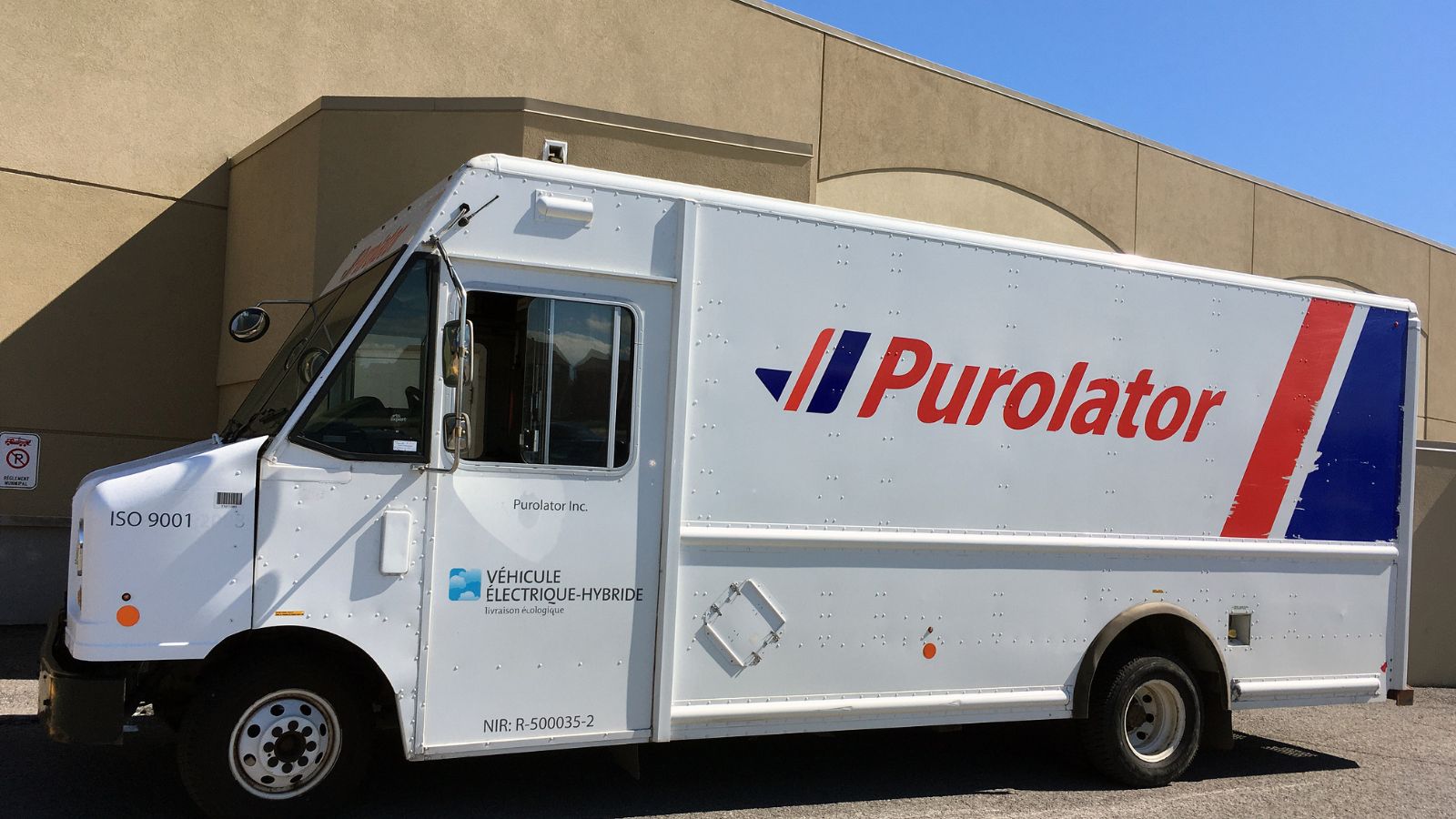
Electric delivery trucks are moving from trial projects into the daily machinery of one of Canada’s largest courier networks. Purolator says it added 274 all-electric delivery trucks during 2025, pushing its Canadian EV fleet above 550 vehicles and giving the company a much larger base for zero-tailpipe-emission last-mile deliveries.
The expansion is not limited to vehicles. More than 825 chargers are now installed at 17 Purolator sites, while electric operations handled more than seven million packages during 2025. At the same time, the company replaced more than five million litres of petroleum diesel with renewable diesel elsewhere in its network. Together, those figures show how fleet decarbonization is becoming a broader operational project involving vehicles, depots, fuels and delivery planning rather than a simple truck-replacement program.
A Fleet Expansion Big Enough to Change Daily Operations
Adding 274 electric delivery trucks in a single year represents a significant acceleration for Purolator. The company says its total electric fleet now exceeds 550 vehicles across Canada, meaning electric trucks are no longer confined to a handful of experimental routes. The change is especially noticeable compared with earlier stages of the program. In 2023, Purolator reported deploying 80 new all-electric trucks across three pilot terminals. Its 2024 sustainability results then showed the procurement of another 150 last-mile electric delivery trucks.
That steady sequence matters because large commercial fleets normally expand new technology in stages. Operators first determine whether vehicles can complete routes reliably, whether charging can be scheduled without disrupting departures and whether drivers and maintenance teams can work with the equipment effectively. Purolator’s latest expansion suggests the company has moved considerably further along that process. More than 550 vehicles remains only one portion of its overall delivery operation, but it is large enough to produce meaningful operating data across different Canadian routes, climates and delivery conditions.
Seven Million Packages Put the Trucks to Real Work
The more revealing number may be the packages rather than the vehicles. Purolator says more than seven million packages were delivered through all-electric last-mile operations during 2025. That indicates the trucks are being used for normal commercial work instead of spending most of their time in controlled demonstrations. Every parcel placed on an electric route represents another opportunity to learn how battery vehicles perform during repeated stops, loading cycles, traffic delays and the tight delivery windows common in courier operations.
Last-mile delivery is frequently identified as a promising use case for electrification because vehicles often return to a depot after completing relatively predictable routes. Academic and industry research has also found that electric delivery vehicles can offer substantial environmental advantages, although infrastructure, route design and vehicle utilization strongly influence the economics. For a courier company, successful electrification therefore depends on more than buying trucks. Seven million packages provide Purolator with something particularly valuable: large-scale operational experience that can inform where the next electric vehicles should be deployed.
More Than 825 Chargers Become Part of the Delivery Network
Electric fleets cannot expand much faster than their charging systems. Purolator reports that it has installed more than 825 chargers across 17 sites, creating a substantial depot-charging network behind the 550-plus vehicles. The charging total is particularly notable because commercial vehicles generally need dependable access to electricity at predictable times. A delivery truck that finishes its route with a depleted battery must be ready again when the next shift begins, making charger availability, electrical capacity and scheduling part of the company’s core logistics operation.
The infrastructure buildout has accelerated alongside the vehicles. Purolator reported installing more than 260 EV chargers during 2024, before announcing the larger network total for 2025. Research into commercial fleet electrification consistently identifies depot charging as one of the central requirements for scaling electric delivery vehicles. Transport Canada has similarly highlighted the need for charging solutions suited to workplaces, commercial transportation and cold climates. For Purolator, those 825-plus chargers effectively become another category of delivery infrastructure, comparable in importance to loading equipment, terminals and route-planning systems.
The Rollout Has Been Built Around Different Vehicle Types
Purolator did not begin its electric transition with a single truck design. Earlier stages included Ford E-Transit vans, Motiv Power Systems EPIC4 vehicles and BrightDrop Zevo 600 models, allowing the company to test different configurations against the varied demands of courier work. In its 2023 electrification announcement, Purolator outlined deployments in places including London, Ontario; Richmond, British Columbia; and Quebec City, illustrating an effort to test electric vehicles outside a single metropolitan market.
That diversified approach is important because a courier route in a dense downtown core can look very different from one covering suburban industrial parks or widely spaced residential stops. Cargo volume, daily kilometres, winter temperatures and time spent stationary can all influence the type of electric vehicle that works best. Purolator has also experimented with smaller electric options such as e-bikes and low-speed vehicles for urban deliveries. The result is less a single electric-truck program than a collection of technologies intended to match different parts of the last mile with an appropriate vehicle.
The 550-Vehicle Fleet Is Still Part of a Much Bigger 2030 Plan
The current fleet milestone needs to be viewed against Purolator’s longer-term commitment. In 2023, the company announced plans to invest approximately $1 billion over seven years to electrify its Canadian network. The plan included purchasing more than 3,500 fully electric last-mile delivery vehicles and electrifying more than 60 terminals. Purolator has also set a goal of electrifying 60 per cent of its last-mile delivery fleet by 2030.
The environmental targets extend beyond the vehicle count. Purolator has said its investment could reduce greenhouse-gas emissions by approximately 80,000 tonnes of carbon-dioxide equivalent in 2030. Its stated climate goals include reducing absolute Scope 1 and Scope 2 emissions by 42 per cent from a 2020 baseline and reaching net-zero emissions by 2050. Those targets mean the newly reported 550-plus EV fleet should be regarded as an interim milestone rather than the destination. The next challenge is continuing to add vehicles and charging capacity fast enough to close the distance between present operations and the much larger 2030 commitment.
Renewable Diesel Is Filling Some of the Electrification Gap
Not every vehicle in a national logistics network can necessarily be replaced by a battery-electric model at the same pace. Purolator is therefore combining electrification with lower-carbon fuels in areas where diesel equipment remains in service. The company says more than five million litres of petroleum diesel were replaced with renewable diesel during 2025. That represents another substantial increase after more than 3.1 million litres were replaced in 2024 and more than 500,000 litres were shifted in 2023.
Renewable diesel does not turn a combustion vehicle into a zero-emission vehicle, and its overall climate impact depends on the fuel’s production pathway and feedstock. Canada’s federal life-cycle assessment framework specifically evaluates fuels across production, distribution and use rather than considering tailpipe emissions alone. For Purolator, however, the strategy illustrates the practical reality of fleet decarbonization. Battery trucks may work particularly well on defined last-mile routes, while heavier or more demanding operations can require transitional solutions. The company is effectively pursuing several emissions-reduction tools simultaneously instead of waiting for one technology to cover every route.
Canada’s Freight Emissions Make the Shift More Consequential
The significance of Purolator’s investment becomes clearer when placed against Canada’s transportation emissions. Environment and Climate Change Canada reported that transportation generated 151 megatonnes of carbon-dioxide equivalent in 2024, accounting for 22 per cent of national greenhouse-gas emissions and making transport the country’s second-largest emitting sector. Freight has proved especially difficult to decarbonize: emissions from freight transportation increased 55 per cent between 1990 and 2024.
Heavy-duty trucks were a major contributor to that growth. Federal data show emissions from freight heavy-duty trucks rose 87 per cent between 1990 and 2024. Transport Canada has separately noted that medium- and heavy-duty vehicles represented only about nine per cent of on-road vehicles in 2023 but generated approximately 26 per cent of transportation emissions. Purolator’s delivery trucks represent only one corner of this much larger freight system, particularly because long-haul transportation presents different technical challenges. Even so, replacing combustion vehicles on high-frequency urban routes addresses an area where fuel use is repeated every working day.
Commercial EV Adoption in Canada Is Still at an Early Stage
Purolator’s fleet expansion stands out partly because zero-emission commercial vehicles remain uncommon in the broader Canadian market. Federal progress reporting shows that zero-emission medium- and heavy-duty vehicles represented only 1.4 per cent of new registrations in 2024. The share had risen from 0.2 per cent in 2021 to 1.9 per cent in 2023 before slipping in 2024, indicating that commercial electrification has not yet developed the momentum seen in some passenger-vehicle categories.
The policy environment has also shifted. Canada’s Incentives for Medium- and Heavy-Duty Zero-Emission Vehicles program, launched in 2022 with roughly $547.5 million allocated, officially ended on March 31, 2026. The program had offered incentives of as much as $200,000 for eligible commercial zero-emission vehicles. Purolator’s newest fleet numbers therefore arrive at a moment when companies are increasingly being asked to justify electric trucks through operating performance as well as subsidies. Large fleets with predictable routes, centralized depots and high annual utilization may be among the businesses best positioned to make that calculation.
Last-Mile Routes Can Help the Economics, but There Are Limits
The business case for an electric delivery truck depends heavily on how it is used. Battery vehicles generally have higher upfront costs than comparable combustion vehicles, while electricity and maintenance can offer savings over time. Research from the International Council on Clean Transportation found that battery-electric last-mile delivery trucks could achieve total-cost-of-ownership parity with diesel models under many operating conditions. Other academic studies have similarly found improving economics for electric last-mile vehicles as battery costs, utilization and charging strategies improve.
Those findings do not mean every delivery fleet can switch immediately. Recent research has continued to identify charging infrastructure, vehicle range, route characteristics and capital costs as major barriers. One 2025 simulation examining courier and express delivery in smaller and medium-sized cities found that electric trucks were not necessarily cost-effective when introduced as a stand-alone logistics measure. That nuance matters for Purolator. Its scale allows vehicles to be assigned to routes where electrification makes the most operational sense, while other technologies remain available for routes that are longer, heavier or harder to support with charging.
Canada’s Electricity Mix Strengthens the Case, With Regional Differences
An electric truck eliminates tailpipe emissions, but the broader climate benefit also depends on how its electricity is generated. Canada has a relatively low-carbon power system by international standards. Federal reporting shows that 79.4 per cent of Canadian electricity in 2024 came from renewable or other non-greenhouse-gas-emitting sources. Hydroelectricity provided 56.1 per cent, nuclear power 13.4 per cent and wind another 7.5 per cent.
National averages, however, can hide significant provincial differences. Some regions rely heavily on hydroelectricity or nuclear generation, while others still use larger shares of natural gas or other fossil fuels. That means the life-cycle emissions associated with charging an identical Purolator truck can vary depending on where it operates and when electricity is consumed. The distinction is important when evaluating fleet decarbonization honestly. Battery vehicles remove combustion from neighbourhood delivery routes, but maximizing their climate benefit also requires attention to electricity sourcing, charging management and the continuing decarbonization of provincial power grids.
The Next Test Is Whether the Numbers Keep Moving
Purolator’s newest sustainability disclosure provides unusually concrete measures for tracking its progress: 274 electric trucks added, more than 550 EVs in operation, seven million-plus packages delivered electrically, more than 825 chargers across 17 sites and over five million litres of petroleum diesel replaced. Those figures make it possible to judge future reports against observable operational changes rather than broad environmental promises alone.
The company says its 2025 reporting references Global Reporting Initiative standards, Sustainability Accounting Standards Board guidance and Canada’s CSDS S2 climate-related disclosure framework. Earlier Purolator reporting also disclosed third-party verification of its greenhouse-gas inventory. Reporting frameworks do not guarantee that a company will reach its climate objectives, but consistent measurements make progress easier to evaluate. For Purolator, the next milestones will be particularly telling: how quickly the electric fleet moves toward the 2030 goal, whether charging infrastructure keeps pace, and whether growth in electric deliveries is accompanied by continuing reductions in absolute fleet emissions.