

























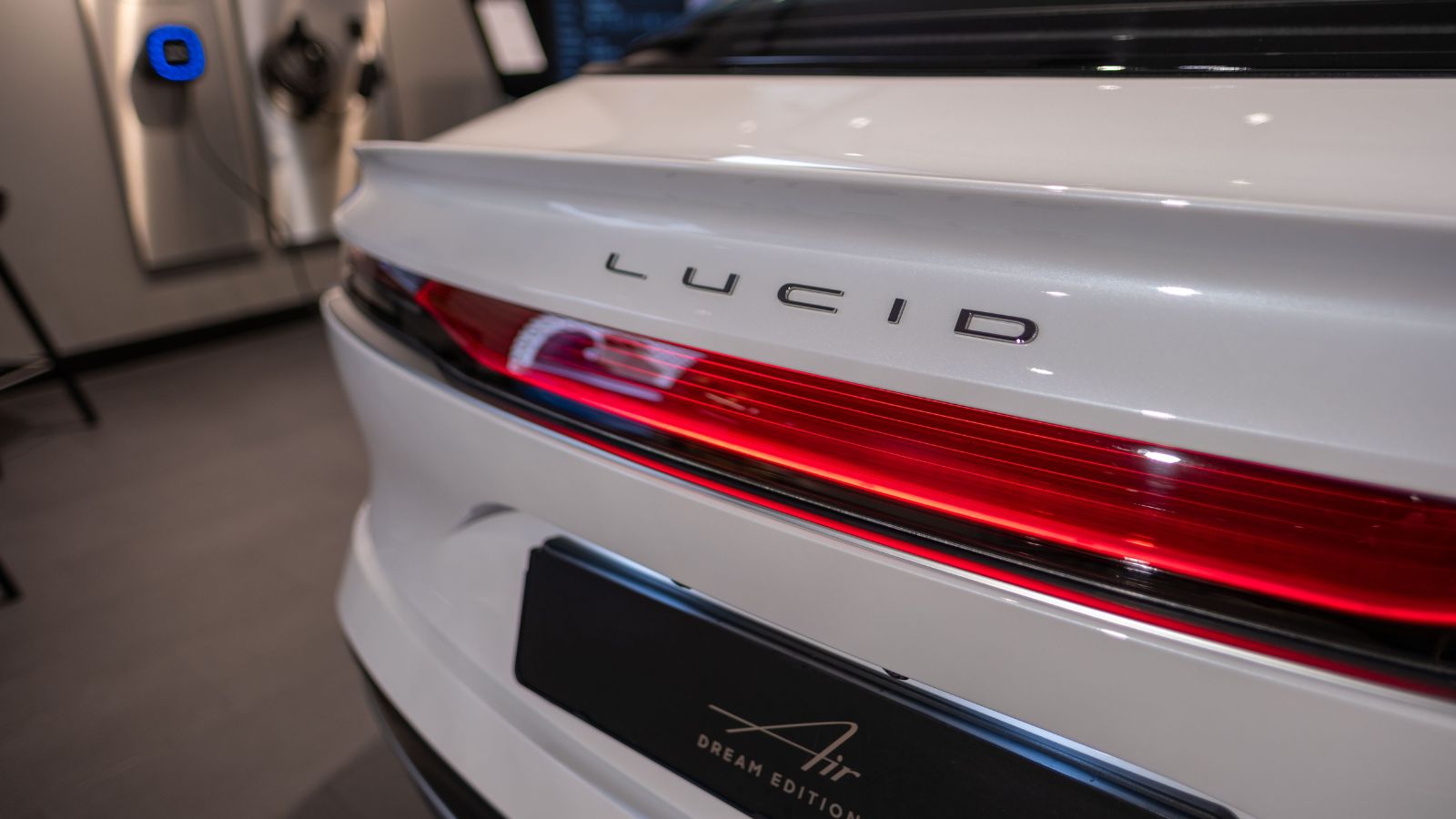
The horsepower race has reached a place that would have sounded absurd only a few years ago: the family three-row SUV. Lucid has unveiled the 2027 Gravity GT-S with 1,070 horsepower, seating for as many as seven adults and a claimed 0-to-60-mph time of 3.1 seconds. It arrives as the new performance flagship of the Gravity lineup and gives Lucid a numerical edge over the 1,025-hp Rivian R1S Quad.
Yet the GT-S is not simply an exercise in producing a spectacular specification. Lucid is pairing the extra power with rear-wheel steering, sophisticated air suspension, fast charging and the everyday packaging that made the original Gravity unusual. Starting at $125,900 before destination and other fees, it also reveals how fiercely luxury EV makers are redefining what a family vehicle can be.
Lucid Takes the Three-Row Horsepower Crown
Lucid is calling the Gravity GT-S America’s most powerful three-row SUV, and the raw number explains the confidence. Its dual-motor electric powertrain produces as much as 1,070 horsepower, eclipsing the 1,025 horsepower offered by Rivian’s current R1S Quad. Tesla’s Model X Plaid previously helped normalize the idea of a roughly 1,000-hp family EV with 1,020 horsepower, although Tesla’s U.S. website now says Model X is no longer in production.
That leaves Lucid and Rivian occupying particularly remarkable territory. A decade ago, four-figure horsepower was associated with hypercars built in tiny numbers. Now it can be ordered in vehicles capable of carrying children in a third row. Lucid’s advantage is small in percentage terms—the Gravity GT-S has only 45 more horsepower than the R1S Quad—but crossing the 1,000-hp threshold is important symbolically. The three-row EV segment is no longer competing primarily on efficiency, charging and cabin technology. Extreme performance has become another battleground.
The 3.1-Second Sprint Is More Than a Marketing Number
Lucid says the Gravity GT-S will accelerate from zero to 60 mph in 3.1 seconds and reach a top speed of 155 mph. Those figures become more believable because the GT-S is closely related to the discontinued Gravity Dream Edition, which used the same 1,070-hp output. Car and Driver independently recorded a 3.1-second 0-to-60 time from the Dream Edition, exactly matching Lucid’s claim for the new model.
The older Gravity Dream Edition also completed Car and Driver’s quarter-mile test in 10.6 seconds. That is extraordinary territory for a large vehicle built around passenger space rather than racetrack lap times. Rivian still holds an advantage in the initial sprint on paper: the R1S Quad is rated at 2.6 seconds to 60 mph with the appropriate wheels and Launch mode. The contrast illustrates why horsepower alone does not determine acceleration. Vehicle mass, traction, motor calibration, tires and power delivery all matter. Lucid’s new crown is therefore a horsepower title, not necessarily an acceleration title.
GT-S Replaces the Dream Edition With a Clearer Mission
The 1,070-hp figure is not entirely new to the Gravity. Lucid previously offered the limited Gravity Dream Edition with the same headline output. What changes with the 2027 GT-S is the positioning. Instead of treating maximum performance as part of a launch edition, Lucid is giving the idea a permanent-looking identity that sits above the 560-hp Touring and 828-hp Grand Touring in the regular Gravity range.
There is also a deliberate connection to Lucid’s most extreme sedan. The company says the GT-S takes inspiration from the Air Sapphire, Lucid’s 1,234-hp performance flagship. That makes the naming and styling strategy easier to understand: buyers looking at a Gravity can now move through a clear hierarchy from Touring to Grand Touring and finally GT-S. The approach mirrors traditional luxury automakers that build high-performance versions of practical vehicles rather than asking buyers to choose between utility and excitement. For Lucid, that creates another reason to keep affluent enthusiasts inside the brand.
The Handling Hardware May Matter More Than Another 242 Horsepower
Moving from the 828-hp Gravity Grand Touring to the 1,070-hp GT-S adds 242 horsepower, but Lucid is also emphasizing what happens when the road starts turning. The GT-S receives the company’s Dynamic Handling Package as standard equipment. That system combines independent rear-wheel steering with an adaptive three-chamber air suspension, which can lower the SUV at higher speeds while managing body control and ride comfort.
There is evidence that the underlying Gravity chassis can make unusually good use of that hardware. Car and Driver’s testing of the 1,070-hp Dream Edition produced 0.90 g of cornering grip on the publication’s skidpad, an impressive result for a large three-row electric vehicle. Rear-wheel steering also addresses a basic problem shared by big SUVs: maneuverability. The broader Gravity has a quoted curb-to-curb turning diameter of 38.4 feet when properly equipped. That means some of the most meaningful GT-S engineering may show up in a parking structure or tight corner rather than during a full-power acceleration run.
It Still Has to Carry a Family After the Launch-Control Run
Extreme performance would be far less interesting if Lucid had transformed the Gravity into a cramped specialty model. Instead, the company says the GT-S retains space for as many as seven adults. That distinction is central to the vehicle’s identity. A parent could theoretically use the same machine for a school run, a long-distance family trip and an acceleration run capable of embarrassing many dedicated sports cars.
The wider Gravity platform was designed around that kind of flexibility. Depending on configuration, it can offer fold-flat second- and third-row seating, while the five-seat version can provide as much as 120 cubic feet of cargo space. Lucid also lists a body length of 198.2 inches and a 119.5-inch wheelbase, relatively manageable dimensions considering the available passenger room. The GT-S therefore reflects a broader change in high-performance vehicles. Electrification allows manufacturers to deliver enormous power without sacrificing an entire cabin to a giant combustion engine, exhaust system and conventional transmission.
Lucid Is Trying to Keep Range Relevant Despite 1,070 HP
Huge horsepower numbers can easily overshadow the part of EV ownership that matters every day: how far the vehicle travels between charges. Lucid currently projects 373 miles of range for the Gravity GT-S, although that number has not yet received a final EPA rating. For comparison within Lucid’s own lineup, the less powerful Gravity Grand Touring can reach an EPA-estimated 450 miles in its most efficient five-seat configuration.
The difference illustrates the traditional performance trade-off. More aggressive tires, higher output and performance-focused equipment can reduce efficiency even when the underlying electric architecture is highly optimized. Still, a manufacturer-projected 373 miles would leave the GT-S with considerable road-trip capability if the final result lands close to that figure. Lucid is wisely labeling the number as projected rather than presenting it as certified. Real-world range will also depend on wheel choice, temperature, speed, climate-control use and driving behaviour—particularly relevant in a vehicle whose accelerator can command more than one thousand horsepower.
Fast Charging Keeps the GT-S From Becoming a One-Trick SUV
Lucid says the Gravity GT-S can add 200 miles of range in approximately 14 minutes when connected to a compatible 400-kW DC fast charger under appropriate conditions. The vehicle also uses a native North American Charging Standard port, giving it direct compatibility with eligible Tesla Supercharger locations while adapters broaden access to other charging equipment. That network flexibility has become increasingly important as luxury EVs take on long-distance family duties.
Charging performance is especially important because the GT-S gives up some projected range compared with the Grand Touring. A family travelling several hundred miles is unlikely to care that the SUV has 1,070 horsepower if every charging stop becomes lengthy. Lucid has therefore kept the Gravity’s high-voltage, fast-charging philosophy near the centre of the GT-S package. Actual speeds will vary with battery temperature, state of charge and charger capability, and few stations can sustain their headline maximum under every condition. Even so, rapid replenishment helps make the extreme-performance model usable beyond short recreational drives.
Rivian Makes This a Genuine Three-Row EV Performance Battle
The closest comparison is Rivian’s R1S Quad. Rivian lists 1,025 horsepower, 1,198 pound-feet of torque and a 2.6-second 0-to-60-mph time for its Quad-Motor R1S. It also offers an EPA-estimated 374 miles with the Max battery in the appropriate configuration—strikingly close to Lucid’s projected 373 miles for the Gravity GT-S. The similarities end quickly once their personalities are considered.
Rivian has built the R1S around substantial off-road and towing capability, including a listed towing maximum of 7,700 pounds. Lucid’s Gravity places greater emphasis on aerodynamic efficiency, road manners, cabin packaging and luxury. Pricing is similarly close at the top: Rivian currently lists the R1S Quad from $121,990, while Lucid puts the GT-S at $125,900 before destination. That gives buyers two very different interpretations of the thousand-horsepower three-row EV. Rivian offers an adventure-oriented machine with astonishing acceleration; Lucid is pitching something closer to a luxury grand tourer stretched into a family-SUV format.
The $125,900 Price Makes the Performance Surprisingly Quantifiable
Lucid prices the 2027 Gravity GT-S from $125,900 before taxes, options, documentation and the $1,850 destination charge. That puts the effective starting figure at $127,750 before taxes and most options. The current Gravity Grand Touring begins at $98,900 before destination, meaning the jump to GT-S costs roughly $27,000 before fees in exchange for substantially more power, standard performance hardware and distinctive styling.
There is another useful comparison inside Lucid’s own history. Car and Driver’s tested Gravity Dream Edition started at $141,550 including destination. The GT-S therefore brings the same 1,070-hp headline output back at nearly $14,000 less by that measure. Calling a $127,750 SUV inexpensive would be difficult, but the pricing shows how quickly extreme EV performance has become commoditized at the luxury end of the market. The buyer is not paying supercar money to access four-digit horsepower. Instead, the power is being packaged into a vehicle intended to perform ordinary household duties as well.
Blue Details Give the Performance Model Its Own Identity
Some high-performance SUVs advertise their capability with towering wings, oversized vents and aggressive bodywork. Lucid has chosen a more restrained route. The Gravity GT-S receives blue exterior detailing, blue-painted brake calipers, special badging and Lucid’s bear emblem on elements including the wheel caps and front headrests. The visual connection to the Air Sapphire is intentional and creates a recognizable theme for Lucid’s fastest models.
Inside, the blue theme becomes more obvious. Lucid specifies blue seatbelts, stitching and piping through the first and second rows, along with blue accents on the steering wheel and armrests. The standard Mojave PurLuxe Premium cabin uses wood trim, while buyers can choose a Tahoe leather interior for an additional $1,300. Those changes may sound minor beside 1,070 horsepower, but they solve an important product problem. The previous Dream Edition’s performance was extraordinary without having a particularly distinct visual identity. GT-S gives owners visible reminders that they chose the flagship even when all that power remains unused.
The GT-S Arrives While Lucid Is Under Pressure to Grow
The launch comes at an important moment for Lucid as a company. In the second quarter of 2026, Lucid produced 4,774 vehicles and delivered 3,953, representing year-over-year increases of 24% and 19%, respectively. Revenue reached $405 million, up 56% from the same quarter a year earlier. At the same time, Lucid ended June with $3 billion in total liquidity and announced an operational reset focused on cash, costs, customers and execution.
Management has identified approximately $1.4 billion in potential 2026 cash-flow improvements across inventory, capital expenditures and operating expenses. That context makes the GT-S both exciting and strategically limited. A six-figure performance SUV can strengthen Lucid’s image and showcase its technology, but it is not the volume product likely to transform the company’s economics by itself. Lucid is simultaneously developing a more accessible midsize platform. The GT-S therefore serves as a halo: proof of what the engineering can accomplish while the company works on reaching a much larger customer base.
Some of the Most Important Numbers Are Still Unfinished
Despite the detailed launch, several GT-S specifications should still be treated cautiously. Lucid’s 373-mile range figure is a manufacturer projection rather than an EPA-certified result. The company has announced late-2026 availability and opened U.S. orders, but the launch release says the GT-S is initially exclusive to the United States. Canadian availability has not been announced as part of this debut.
Lucid also has not used the launch to publish every technical specification enthusiasts might expect, including a GT-S-specific battery-capacity figure or official EPA efficiency rating. That makes comparisons based solely on early specification sheets premature. What is already clear is the direction of the market. The Gravity GT-S, Rivian R1S Quad and now-discontinued Model X Plaid show how far performance expectations have moved. Three-row EV makers are no longer debating whether a family SUV can reach four-digit horsepower. They are competing over which one can combine that power with the most convincing range, charging, handling, space and everyday usability.