
























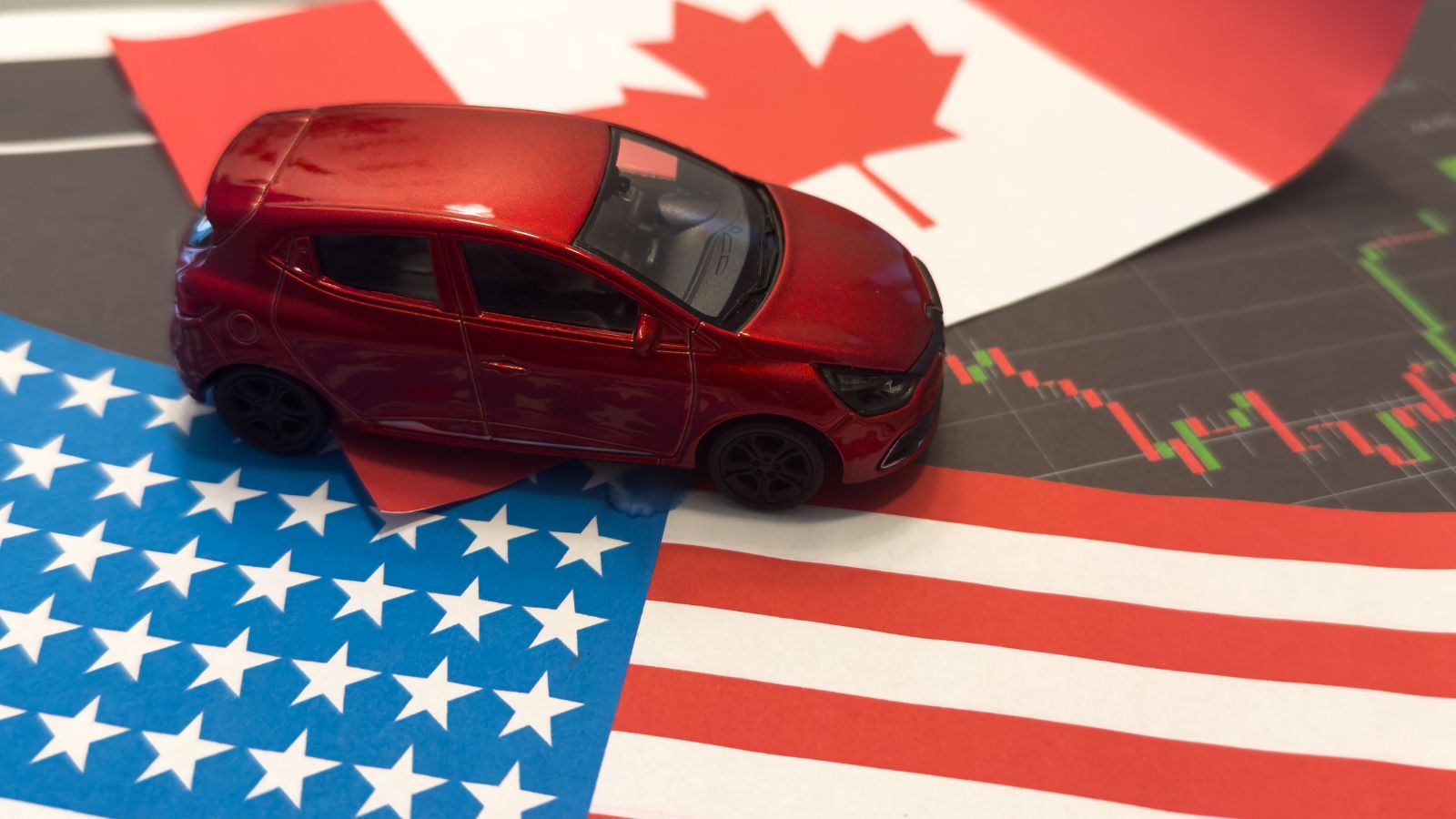
A widening divide over Chinese vehicles is emerging inside North America just as the global auto industry faces one of its most disruptive competitive shifts in decades. Major automakers, suppliers and dealers in the United States are pressing President Donald Trump to keep Chinese manufacturers out of the American market, even as Canada begins allowing a controlled number of Chinese electric vehicles to enter at dramatically lower tariffs than before.
The disagreement is about much more than imported cars. It touches manufacturing jobs, vehicle affordability, data security, battery technology and the future of deeply integrated Canadian-U.S. auto supply chains. With Chinese companies expanding rapidly across Europe and other international markets, decisions being made in Washington and Ottawa could help determine whether North America remains largely closed to Chinese automakers—or gradually becomes another major battleground for them.
America’s Auto Industry Is Delivering an Unusually Unified Warning
Six major automotive organizations representing automakers, suppliers and dealers urged Trump on September 18 to maintain policies preventing Chinese manufacturers from selling, importing or producing vehicles inside the United States. The coalition includes the Alliance for Automotive Innovation, American Automotive Policy Council, Autos Drive America, MEMA, the National Automobile Dealers Association and the Zero Emission Transportation Association. Together, their memberships encompass companies including General Motors, Ford, Toyota, Volkswagen, Hyundai, Stellantis and Tesla.
That breadth matters because these groups do not always agree on issues such as electric-vehicle mandates, emissions regulations or trade rules. On China, however, their concerns have increasingly converged. Their letter argued that Chinese automakers currently have essentially no U.S. market share and that allowing them to establish American manufacturing operations could provide a foothold from which they could challenge companies that have invested heavily in existing U.S. factories. The White House responded that it was working with automakers to strengthen American automotive manufacturing while protecting national and economic security.
Trump Has Left the Door Open to Chinese-Owned American Factories
The industry’s push followed comments from Trump indicating that his position is more complicated than a blanket rejection of Chinese investment. In a Fox News interview aired in September, Trump said he would be comfortable with Chinese manufacturers opening plants inside the United States if those operations employed American workers. He compared the possibility with the long-established manufacturing presence of Japanese automakers, which produce millions of vehicles in North America and employ large American workforces.
Trump drew a sharper line around production in Mexico, saying he did not want Chinese companies manufacturing vehicles there and shipping them into the United States. That distinction has unsettled established automakers because today’s restrictions go much further than simply imposing tariffs at the border. A Biden-era connected-vehicle regulation effectively prevents Chinese-linked manufacturers from selling many passenger vehicles in the United States beginning with the 2027 model year. Chinese electric vehicles also face tariffs of roughly 100% or more, creating another formidable barrier to direct imports.
Canada Has Already Moved in a Different Direction
Canada changed course earlier in 2026 by replacing its previous 100% surtax on Chinese electric vehicles with a tightly controlled import-quota system. The initial annual quota permits 49,000 eligible Chinese EVs to enter Canada at the normal most-favoured-nation tariff of 6.1%. The quota began March 1, with 24,500 vehicles available during the first six months. From September 1 through February 28, another 24,500 vehicles are available, plus any unused capacity remaining from the first period.
That means Canada has opened part of its market, but not without limits. Shipment-specific permits remain mandatory, and vehicles outside the quota cannot simply enter under the reduced tariff. The government says the initial 49,000-vehicle allowance represents less than 3% of Canada’s annual new-vehicle market. The quota is scheduled to grow 6.5% annually, while the share reserved for vehicles priced at C$35,000 or less is designed to increase over time, reaching 50% in the fifth year.
The Competitive Threat Is No Longer Theoretical
The anxiety surrounding Chinese automakers reflects their rapid expansion outside China. The International Energy Agency estimates that China produced nearly three-quarters of the world’s electric cars in 2025. Chinese electric-car exports doubled to more than 2.5 million vehicles that year as intense domestic competition and excess production encouraged manufacturers to pursue overseas customers. China also accounted for more than 80% of global battery-cell production, giving its automotive industry an unusually deep domestic supply chain.
Executives at established manufacturers have watched that expansion closely. Hyundai CEO José Muñoz said in September that Chinese vehicles were selling for roughly 30% to 40% less than competing models in some European markets. Chinese brands exceeded 9% of European Union car sales during the first half of 2026 and had reached a substantially larger share in Britain, where Chinese EVs face fewer trade barriers. That experience is frequently cited by manufacturers arguing that Chinese competition can reshape a mature vehicle market surprisingly quickly.
Washington Sees Connected Cars as a Security Issue, Not Just a Trade Issue
Price competition explains only part of Washington’s resistance. Modern vehicles continuously communicate with outside networks through cellular connections, Bluetooth, Wi-Fi, satellite systems, telematics equipment and increasingly sophisticated driver-assistance technology. In January 2025, the U.S. Commerce Department finalized rules covering connected vehicles and technology linked to China and Russia after concluding that certain systems could create unacceptable national-security risks involving sensitive information and potential remote access.
The restrictions are being introduced in stages. Beginning with model year 2027, manufacturers sufficiently linked to China or Russia cannot sell covered connected vehicles in the United States, even when those vehicles are assembled domestically. Restrictions involving specified connectivity and automated-driving software also begin with model year 2027. Covered connectivity hardware is scheduled for restrictions beginning with model year 2030, or January 2029 for products without a model year. That regulatory structure helps explain why simply building a Chinese-branded vehicle at an American factory would not automatically resolve Washington’s objections.
Ottawa Is Betting That Controlled Competition Can Produce Benefits
Canada has publicly framed its policy differently. Rather than treating Chinese vehicle participation as inherently incompatible with domestic manufacturing, Ottawa says carefully managed access could expand affordable EV options while encouraging Chinese companies to invest in Canadian production through joint ventures with trusted partners. The federal government has also said Chinese vehicles will still need to satisfy Canadian motor-vehicle safety requirements before being sold domestically.
The affordability argument is significant because the Canadian policy was deliberately structured to increase access for lower-priced models. Ottawa expects the percentage of quota vehicles priced at C$35,000 or less to rise substantially by 2030. Yet the government is simultaneously trying to protect Canada’s manufacturing base by limiting initial volumes. That balancing act is becoming more difficult as auto employment faces pressure. Statistics Canada reported that transportation-equipment manufacturing payroll employment fell by approximately 9,300 positions during 2025, while motor-vehicle parts manufacturing employment declined substantially. Policymakers therefore face competing priorities: cheaper vehicles for consumers, new investment and preservation of existing industrial jobs.
Canada Cannot Separate the China Question From Its U.S. Auto Relationship
Canada’s automotive sector remains deeply tied to American demand. Statistics Canada estimates that U.S. demand supported roughly 76.4% of Canadian automobile and light-duty vehicle manufacturing output and payroll jobs in 2024, representing about 27,000 jobs. More than 93% of Canadian motor-vehicle exports were still destined for the United States in 2025. Components also cross the border repeatedly during production, creating a supply network in which policies introduced on one side can quickly affect factories on the other.
That integration makes Canada’s Chinese EV policy more consequential than the relatively small initial quota might suggest. The United States has already objected to the decision. When Canada announced the arrangement in January, U.S. Transportation Secretary Sean Duffy said Canada would regret allowing Chinese EVs into its market and emphasized that those vehicles would not be allowed into the United States. The disagreement therefore raises longer-term questions about vehicle certification, investment rules and supply-chain security as Canada and the United States navigate an increasingly difficult trade relationship.
The Trump-Xi Meeting Could Turn Auto Policy Into a Bigger Trade Fight
The industry’s warning arrived immediately before a major diplomatic moment. Trump and Chinese President Xi Jinping are scheduled to meet in Washington on September 24, with trade, technology, critical minerals and other economic issues expected to dominate the discussions. Reuters reported that Chinese companies under consideration for Xi’s accompanying business delegation include major EV producer BYD and battery giants CATL and Gotion, adding to speculation that automotive investment could surface during the broader negotiations.
American automakers are not relying solely on the White House. Earlier in September, the Alliance for Automotive Innovation urged congressional leaders to enact a permanent statutory prohibition on the sale, import and manufacture of Chinese connected vehicles and associated hardware and software before the current Congress ends. For Canada, meanwhile, the Chinese EV quota is already operating. The result is an increasingly visible policy split: Ottawa is testing controlled Chinese market access while Washington’s automotive establishment wants barriers strengthened. How long those approaches can coexist within an integrated North American industry remains an increasingly important trade question.